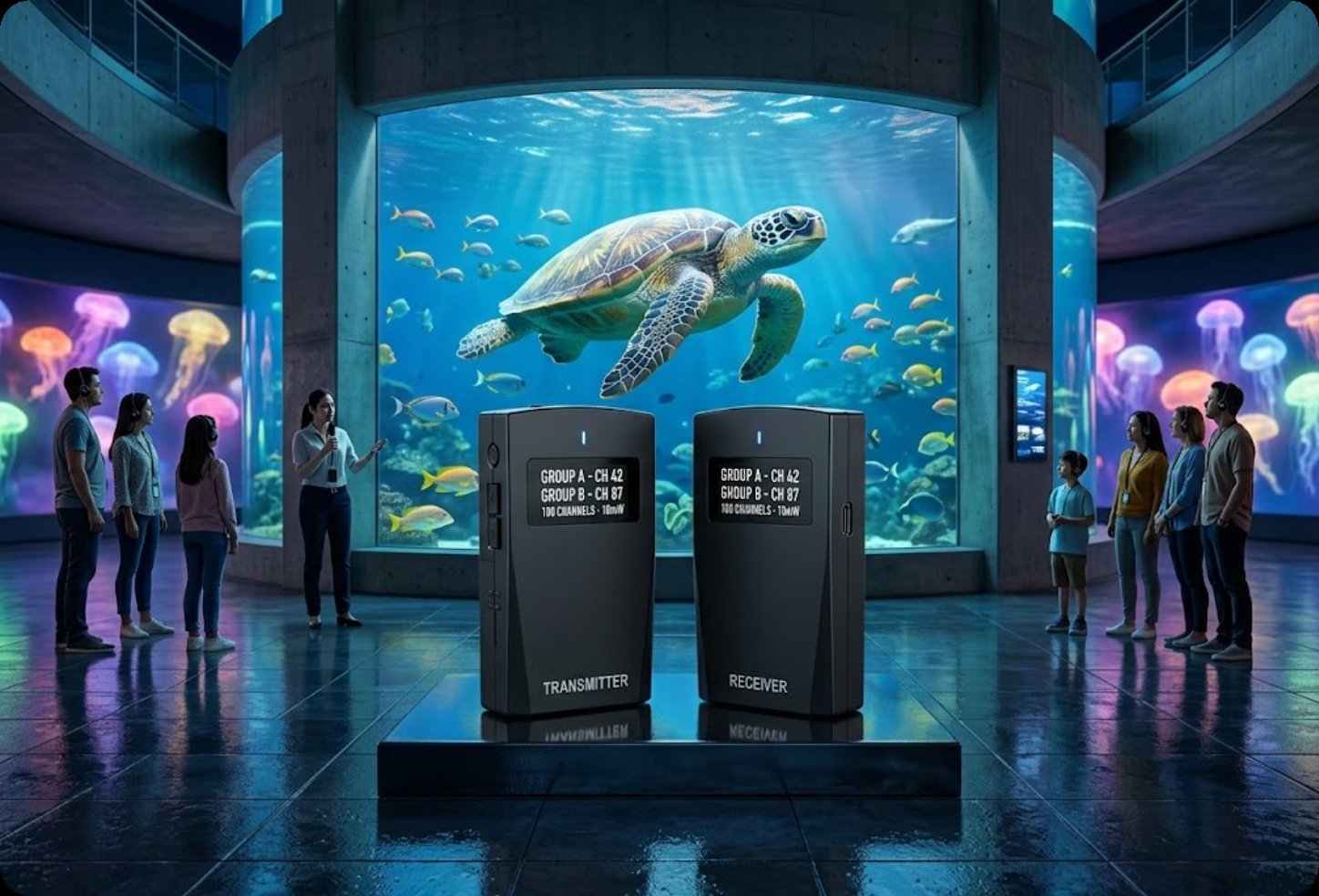
Aquarium Guide Systems: Wearing a Receiver in the Dark
An aquarium tunnel is the one place where a visitor takes a device on, keeps it on for forty minutes, and cannot see it. The lighting is deliberately low — a lit tank destroys the effect of the exhibit behind it — and the glass is curved, so what little light there is lands on the floor and the ceiling rather than on the person standing in the middle of it. Everything about a guide system that depends on the guest being able to find a button, read a display, or check a channel indicator falls apart in that light. What survives is a unit that can be put on, adjusted once, and then left alone for the length of a queue.
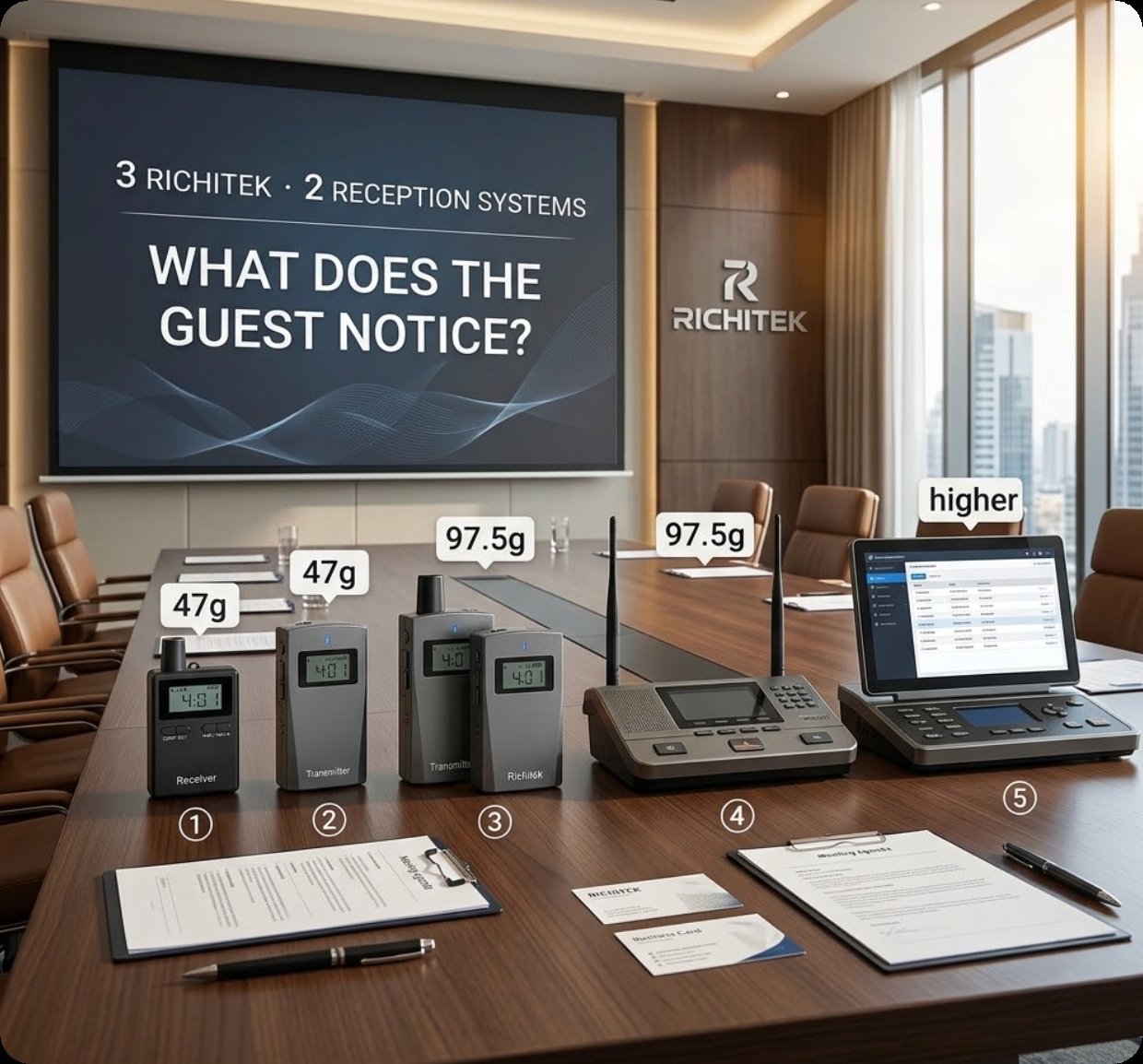
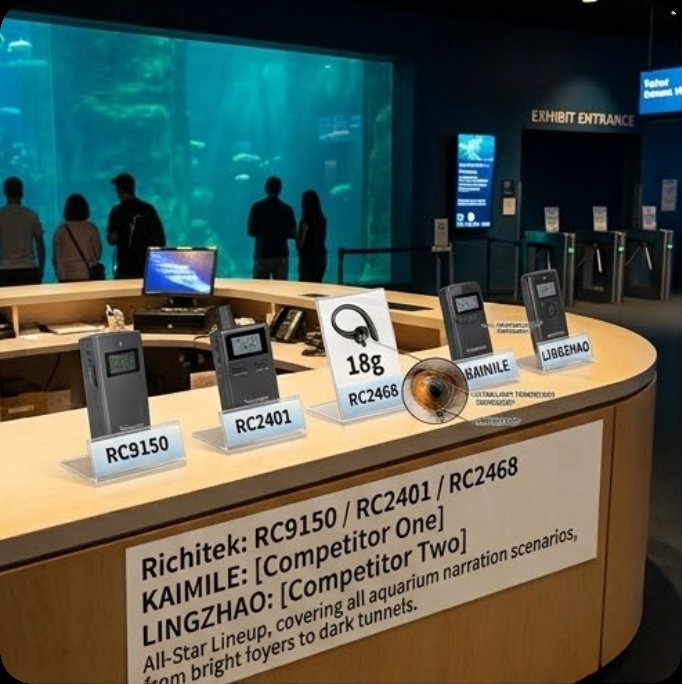
Three Richitek units are compared here against two systems that approach the problem from the opposite direction. The RC9150 is the hundred-channel unit at 97.5 grams on both halves, with a receiver standby quoted above thirty-five hours and Type-C charging. The RC2401 is the fifty-channel baseline at 59 and 50 grams, with twenty hours of receiver standby and multi-colour availability at volume. The RC2468 is the eighteen-gram ear-hook, and it is the only one of the three designed around the fact that a guest in a dark tunnel should not have to think about what they are wearing. Facing them are the Kaimile noise-cancelling headset system, which documents medical, government-reception and education deployments and sells a charging-and-disinfection cabinet as an integrated box, and Lingzhao, whose miniature ear-hook sets are positioned for small groups, study tours and temporary reception at the economy end of the market.
What follows is organised around the tunnel rather than a specification table. The three constraints that decide an aquarium purchase are the light level, the moisture, and a guest moving through a one-way space with a guide who cannot stop. None is a radio problem; the radio figures matter mainly because they tell you how long a battery must last and how many groups can run at once.
🏨 Level One: The Guest Cannot Find Anything
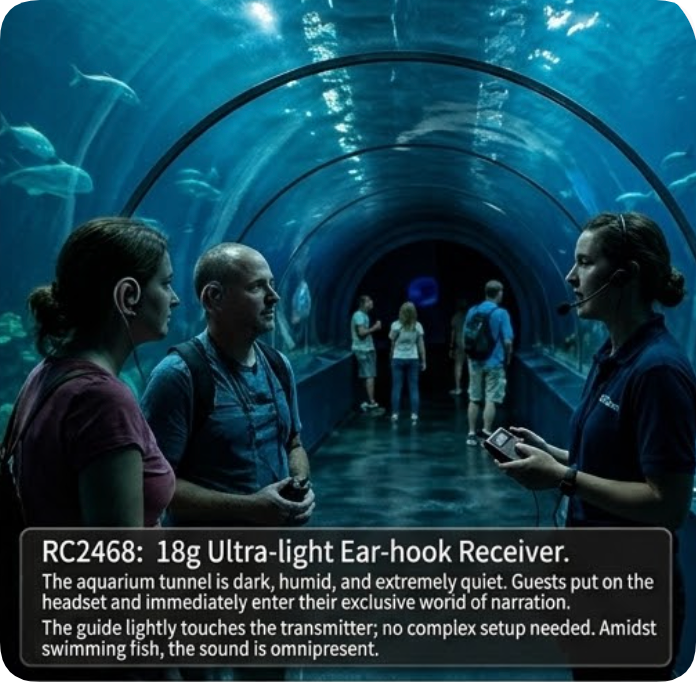
Every manual control on a guide receiver assumes a lit surface and a free hand. A guest in an aquarium tunnel has neither. The lighting is low enough that a small display is unreadable, the queue is moving, and the guest's hands are on a railing, a child's hand or a bag. Any interaction requiring finding a button — adjusting volume, confirming a channel, checking the battery — will not happen, and if it does it happens at the wrong moment, in front of other visitors, while a guide is talking.
This is why the ear-hook form factor is not a comfort preference in this environment; it is the difference between a device that works unattended and one that needs attention. The RC2468 is the unit in this comparison built for that: an eighteen-gram ear-hook receiver, a multi-colour transmitter, and a black receiver that disappears against clothing. Nothing about it needs to be looked at. The adjustment happens once, before the queue enters, and the guest then has one hand free for the rest of the walk.
The important caveat is what the lightness costs. The RC2468 carries a 3.7V 300mAh receiver cell and its receiver standby is quoted at about eight hours, against twenty hours on the RC2401 and thirty-five-plus on the RC9150. A tunnel queue that takes forty minutes does not exhaust that, but an aquarium that also hands out receivers for a gift shop, a café or an outdoor lagoon has to size the charging pool around that eight-hour figure rather than around the weight. The trade is explicit: eighteen grams are paid for in hours, and the tunnel is where those hours are least likely to matter.
A second consequence of the dark is less obvious. A guest who cannot see the device cannot report that it has stopped working, and a guest who cannot report a fault walks out believing the commentary was poor. A unit that dies halfway through a forty-minute walk is a more expensive failure than the same failure in a lit gallery, because there is no second chance to hand the guest another one. That belongs in the battery decision, and it is why the RC9150's thirty-five-hour figure is worth its weight where staff cannot reissue hardware mid-queue.
The dark also removes colour coding as a service tool. Handing a guest a blue receiver to match a blue zone is a system at a lit counter; in a dark tunnel the colour is invisible from the front, so it only lets staff sort the tray. The RC2401 and the RC2468 both offer multi-colour at volume, which buys a tidier issue desk rather than a better visitor experience — and it should be bought for the first reason rather than sold on the second.
Level Two: The Tunnel Is Wet and the Air Is Warm
An aquarium interior is close to a hundred percent relative humidity for a good part of the day, with the added exposure of condensation running down the inside of curved glass, and the air is warm rather than cold. Neither of those conditions is what ruggedness ratings are usually about, and neither is addressed by a figure on a guide system specification sheet, because a lavalier microphone receiver is not expected to be an outdoor device.
What this means in practice is that the failure mode is not a splash and it is not a drop. It is a receiver that has been worn for forty minutes in a warm humid tunnel, and then has been put back into a storage case that is cool, and then has been taken out again the following morning. Repeated condensation cycles on a printed circuit board are a slow problem, and slow problems are the ones that appear in year three rather than in the acceptance test.
There is a hygiene dimension as well, and it is the one the competing systems make explicit. The Kaimile documentation lists a charging-and-disinfection storage cabinet as a distinct integrated product, alongside a noise-cancelling headset system and a coverage figure of zero to one hundred and fifty metres, with the listed application set spanning government reception, medical training, scenic guiding and corporate meetings. Selling the cabinet as part of the system rather than as an accessory is a direct answer to a specific problem: in a site where a single pair of earhooks circulates between a hundred visitors a day, the charging box is where hygiene has to be solved, and a vendor who has designed one is telling you they have thought about it.
On the Richitek side, the published data does not include any disinfection or hygiene accessory, and this comparison should not pretend otherwise. That is a real gap against a competitor that has a documented answer, and the honest position is that an operator who needs a disinfection cycle as a specified requirement — a medical training site, a food-production visitor route, an aquarium that runs a school programme through the same hardware — is buying a cabinet from someone, and the Kaimile documentation already describes what that looks like.
What the Richitek units do hold is a configuration record that makes a hygiene routine possible: multi-colour transmitters on the RC2468 and the RC2401, and customisable grey and black on the RC9150. A site rotating three hundred receivers through a week can assign a colour to a cleaning cycle. That is a workflow answer rather than an engineering answer, and the difference is worth being clear about.
Noise is the third factor and a modest one. A tunnel is loud — pumps, filters, bubble columns, a hundred people talking — but the sound is broadband and steady, which a lavalier microphone close to the mouth handles better than a room microphone would. The Kaimile noise-cancelling headset answers a harder version of that problem, which matters where the guide must carry to the far end of a thirty-metre tube; it is also a more conspicuous product in a setting where the visitor is looking at fish.
Level Three: The Queue Does Not Stop
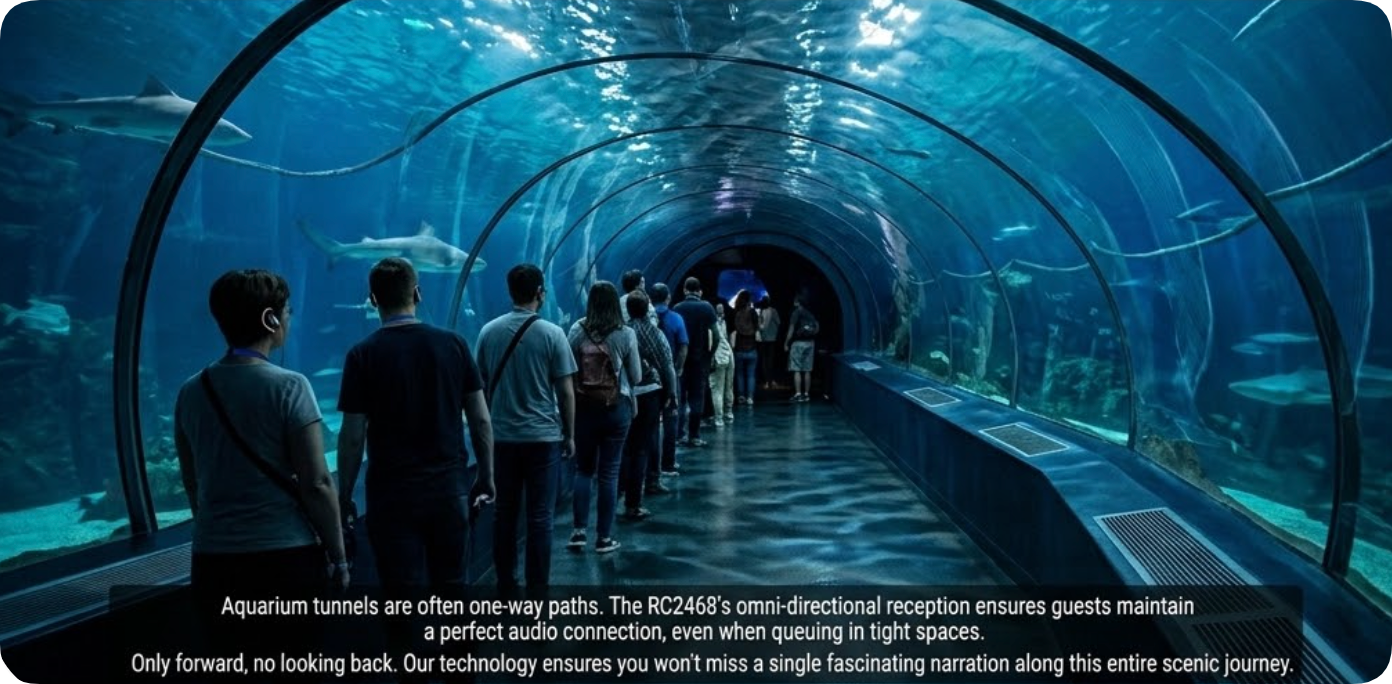
The third constraint is structural and it is the one that decides how many channels an aquarium actually needs. An aquarium tunnel is a one-way space: visitors enter at one end, move through it, and leave at the other, and they move at the speed of the slowest person in front of them. There is no way to send a second group the other way, no way to hold a group back while another passes, and no way to run two commentary lines through the same 30-metre glass tube without them being heard by everyone in it.
That is what makes channel count a strange metric here. The RC9150 carries a hundred channels and is documented for large venues — genuinely useful on a multi-site aquarium with two tunnels, an outdoor lagoon and a gift shop. In a single tunnel, ninety-eight of those channels describe a configuration that cannot exist. The specification is real; the situation it addresses is not the one in the tunnel.
Which makes the RC9150's other advantage the more interesting one. Its receiver standby of thirty-five-plus hours and its 3.7V 1800mAh cells on both halves mean a unit issued at the entrance is still working at the exit of a full day of visitors, and the Type-C port means one cable type across a large fleet. Its 20Hz to 8kHz audio bandwidth is the narrowest of the three, which is entirely adequate for a voice briefing in a noisy tunnel and is the wrong specification for a channel that has to carry a recorded soundscape as well as commentary — and an aquarium that plays ambient underwater audio over the commentary channel would need to think about that.
By contrast the RC2401 is the middle unit and the one most likely to fit a single-tunnel site. Fifty channels on 2403 to 2483MHz at 10mW over a quoted one to two hundred metres, with transmit audio at 50Hz to 200kHz and receive at 50Hz to 12kHz, ten hours on the transmitter and twenty on the receiver, 59 and 50 grams, PLL control, multi-colour at volume, charging over a DC port. The documented description calls it a basic 2.4GHz standard version, easy to use and high in value — for a site that runs one commentary line and hands out two hundred receivers a day, that is an accurate description of the requirement.
Twenty hours of receiver standby is the number doing the work. With a midday changeover, where the afternoon batch collects the morning batch from storage, the night charge has to cover the whole day and the cabinet has to hold a full batch. Twenty hours covers that with margin; eight hours does not, which is why the ear-hook unit is the one to buy for the tunnel and not for the gift shop.
Kaimile: The System That Includes the Cabinet
The Kaimile documentation is worth setting out on its own terms, because it describes a different purchase. Alongside the noise-cancelling headset system and the one-to-three-hundred-metre coverage figure, the record lists a wireless smart guide system, an integrated system, a charging-and-disinfection storage cabinet, and a noise-cancelling headset system, all positioned for government, education, medical, public-security and enterprise reception as well as scenic guiding, with system integration, hardware and software development and a cloud platform. It was founded as an audio equipment brand and is listed at the mid-to-high tier with pricing by quotation.
The commercial shape implied by that list is a project. A cabinet, a platform, a coverage design and an implementation are quoted together, which suits an operator who wants one supplier accountable for the whole thing and does not suit an operator who wants thirty receivers and a case. It also means the comparison on any hardware figure is difficult, because the published material is a system description rather than a device specification, and this article will not manufacture figures that are not there.
What can be said is that on the two points this aquarium cares about most, the Kaimile record is stronger. A documented charging-and-disinfection cabinet is a hygiene solution stated at the level of a product, and it is exactly the accessory an aquarium with a high daily device turnover would need. A noise-cancelling headset addresses the acoustic problem of a tube full of pumps and bubble columns, which is where a plain lavalier transmitter has to work harder. Neither advantage is available on the Richitek side of this comparison, and both are real.
Where the Richitek units answer differently is scale of commitment. Three devices can be bought and deployed by a two-person team on a weekend. A project with a platform and an implementation has a different lead time, and for a seasonal aquarium opening in twelve weeks that is often the deciding factor.
🔍 Lingzhao: The Economy End of the Same Problem
The Lingzhao record is a set of small products aimed at the other end of the market: a mini ear-hook guide set on 2.4GHz with one transmitter serving thirty listeners, a portable guide kit, a small-exhibition commentary device for a small team, a simple charging and storage case, and a description built around light weight and low power consumption. The listed applications are small and medium travel agencies, campus study tours, small exhibition halls and short-term events, with the economy tier and no price stated.
Being precise about what this covers: a one-to-thirty system on 2.4GHz is more than sufficient for a single tunnel, and a mini ear-hook is the right form factor for the same reason the RC2468 is. A simple charging and storage case answers the daily issue-and-collect cycle, without a disinfection claim attached. And a small team running a short-term event is a real customer with a real budget — a full specification comparison is not going to talk that customer out of a compact set.
Where the limits are honest ones. One-to-thirty is a hard ceiling on a single channel, and it is a ceiling rather than a description of intent — which is the opposite of the "multi-channel" language used by some vendors in this market, and it is a point in this product's favour. The record does not publish a channel count, a transmission distance, a battery figure or a weight for the ear-hook, and the price is not stated, so a buyer comparing it against the RC2401 on paper has less to work with than they would like.
The realistic reading is that the two ends of this market are answered by different products and the middle is where the Richitek units sit. A two-person team that needs thirty receivers for a school visit has a compact answer. An aquarium that runs several sites, wants documented hygiene hardware, and expects a platform has a system answer. A single-tunnel site with two hundred visitors a day and a storage cabinet at the end of the tunnel is where the RC2401 with its twenty-hour standby and multi-colour issue is doing the work.
Choosing by Where the Device Is Worn
The table below maps each unit to the position it fits rather than to a specification tier, because an aquarium has three distinct places where a device is worn and they do not want the same hardware. The counter where a guest receives it, the tunnel where a guest wears it for forty minutes, and the store room where it spends twelve hours do not have the same requirements, and one model chosen for all three is usually wrong in at least one.
One practical note belongs with any of these units. In a tunnel the guest's first thirty seconds decide whether the device is worn comfortably for the rest of the walk or quietly pocketed. Whatever the specification says about sensitivity or power, the setting a visitor actually uses decides whether the commentary is heard — and in a humid tunnel that setting is often lower than in a dry gallery, because ambient noise is higher.
🎯 Specification Summary and Selection Matrix
| Richitek RC9150 | 2403-2483MHz, 100 channels, 10mW, 1-200m | 3.7V 1800mAh both halves; 15h transmitter, 35+h receiver | 97.5g transmitter, 97.5g receiver | 20Hz-8kHz | Type-C; grey transmitter, black receiver, customisable at volume | Documented for high power, long standby, a hundred channels and large venues; PLL frequency synthesis |
| Richitek RC2401 | 2403-2483MHz, 50 channels, 10mW, 1-200m | 3.7V 1500mAh transmitter 10h; 3.7V 1000mAh receiver 20h | 59g transmitter, 50g receiver | Transmit 50Hz-200kHz, receive 50Hz-12kHz | DC port; multi-colour at volume | Documented as a basic 2.4GHz standard version, easy to use and high in value; PLL |
| Richitek RC2468 | 2403-2483MHz, 50 channels, 10mW, 1-200m | 3.7V 1500mAh transmitter 10h; 3.7V 300mAh receiver, about 8h standby | 59g transmitter, 18g ear-hook receiver | Transmit 50Hz-200kHz, receive 50Hz-12kHz | USB, Micro USB 5V/1A on the receiver; multi-colour transmitter, black receiver | Documented as an ultra-light ear-hook, small and convenient |
| Kaimile system | Coverage quoted zero to 150m and zero to 300m across the system range | Not published for the device in the comparison source | Not published | Noise-cancelling headset system; bandwidth not published | Charging-and-disinfection storage cabinet sold as an integrated product | Mid-to-high tier, priced by quotation; government, education, medical and scenic guiding; system integration and cloud platform |
| Lingzhao set | 2.4GHz, one transmitter serving up to 30 listeners | Low power consumption noted; no capacity published | Described as light weight; no figure published | Not published | Simple charging and storage case | Economy tier, price not stated; travel agencies, campus study tours, small exhibition halls, short-term events |
| A single tunnel where the guest cannot see the device and the guide cannot stop | RC2468 | Eighteen-gram ear-hook, nothing to look at or adjust, and the guest keeps one hand free for the railing |
| Two hundred visitors a day on one commentary line, with a midday battery changeover | RC2401 | Twenty hours of receiver standby covers the shift, multi-colour supports the issue desk, and fifty channels is more than a single tunnel uses |
| Multi-site operator where a device issued in the morning is still working at close | RC9150 | Thirty-five-plus hours of receiver standby on 1800mAh cells, Type-C across a large fleet, and a hundred channels for the tunnels, the lagoon and the shop |
| Site that must specify a documented disinfection cycle and a noise-cancelling headset | Kaimile | Charging-and-disinfection cabinet and noise-cancelling headsets are documented products rather than accessories |
| School visit or short-term event needing a small, simple, cheap set | Lingzhao | One transmitter to thirty listeners on 2.4GHz with a simple charging and storage case |
An aquarium buying its first guide system is likely to end up with a mixed fleet rather than a single model, because the tunnel and the store room want different things, and the honest recommendation is to size the tunnel on the RC2468 or the RC2401 and keep the RC9150 for the multi-site case. The two competing systems answer the parts of this comparison that the Richitek range does not cover: one has a documented hygiene cabinet and noise-cancelling headsets, the other has a compact and cheap set for a small team. Neither of those is a reason to replace a working fleet, and both are reasons to look at what a specific site actually needs before a fleet is bought.
Aquariums running a heritage or educational programme that also operates a multi-site visitor route can review the museum audio guide equipment overview for indoor chassis options, and industrial sites with the same multi-guide constraints across several halls are covered in the industrial tour headset page. To weigh capacity classes across the whole range before specifying, begin with the tour guide system comparison index, and the RC9150 channel and standby detail is set out separately in the RC9150 deployment walkthrough.