.webp)
Two classes share the studio on Tuesday and Thursday evenings. The nine o'clock group works on breathing and holds the floor mats in rows. The seven o'clock group works on strength and pushes the mats to the walls to clear a lane for the racks. Both groups play music. Neither group can hear the other. That is the whole arrangement, and it only works because the transmitter is sending on two channels at once and every headphone shows its channel as a colour.
Both rooms here run a Silent Disco Wireless Headphone System, which is the RC-409 headset paired with an RC-50RF transmitter. What follows is what the studio's photographs actually show, and where the specification sheet and the room disagree.
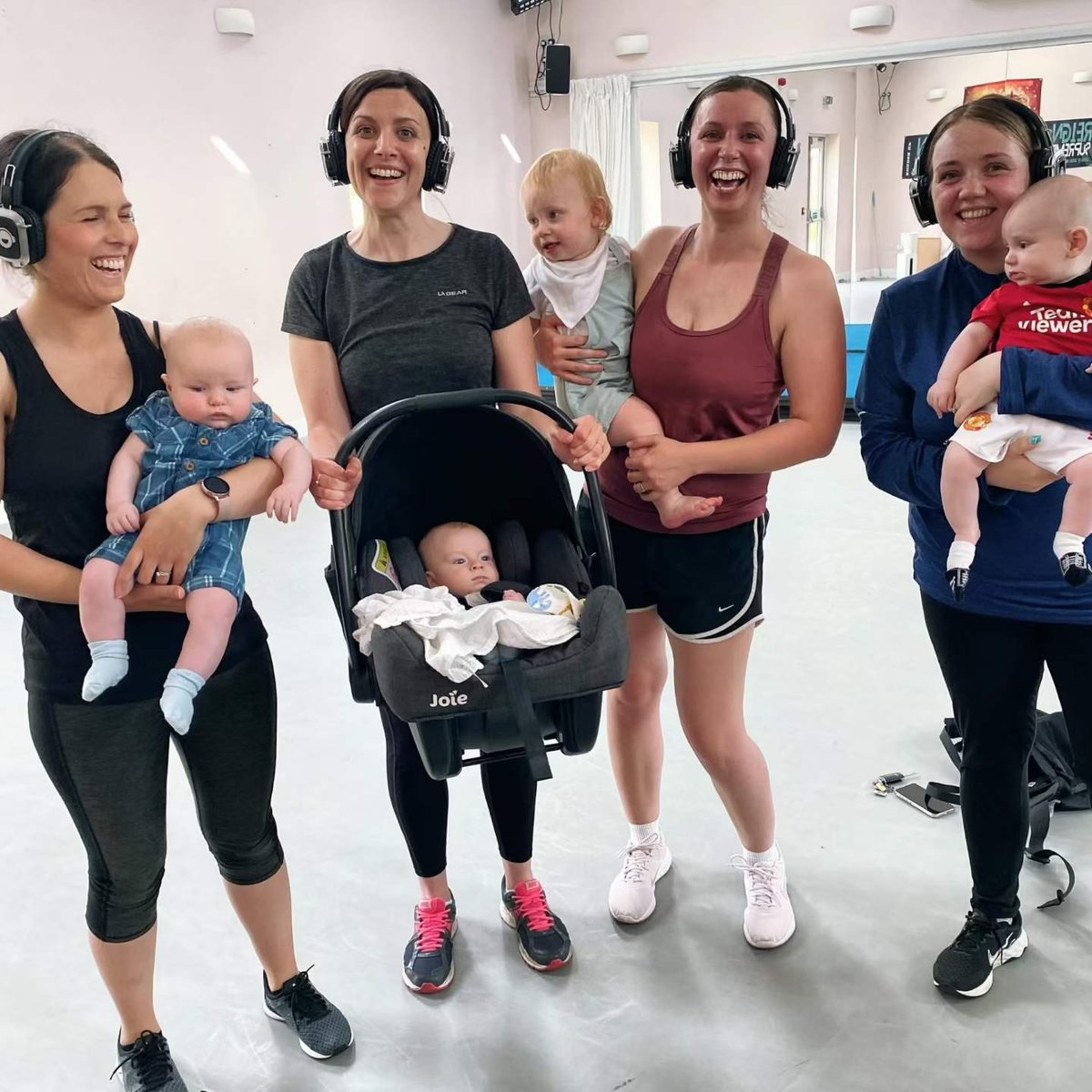
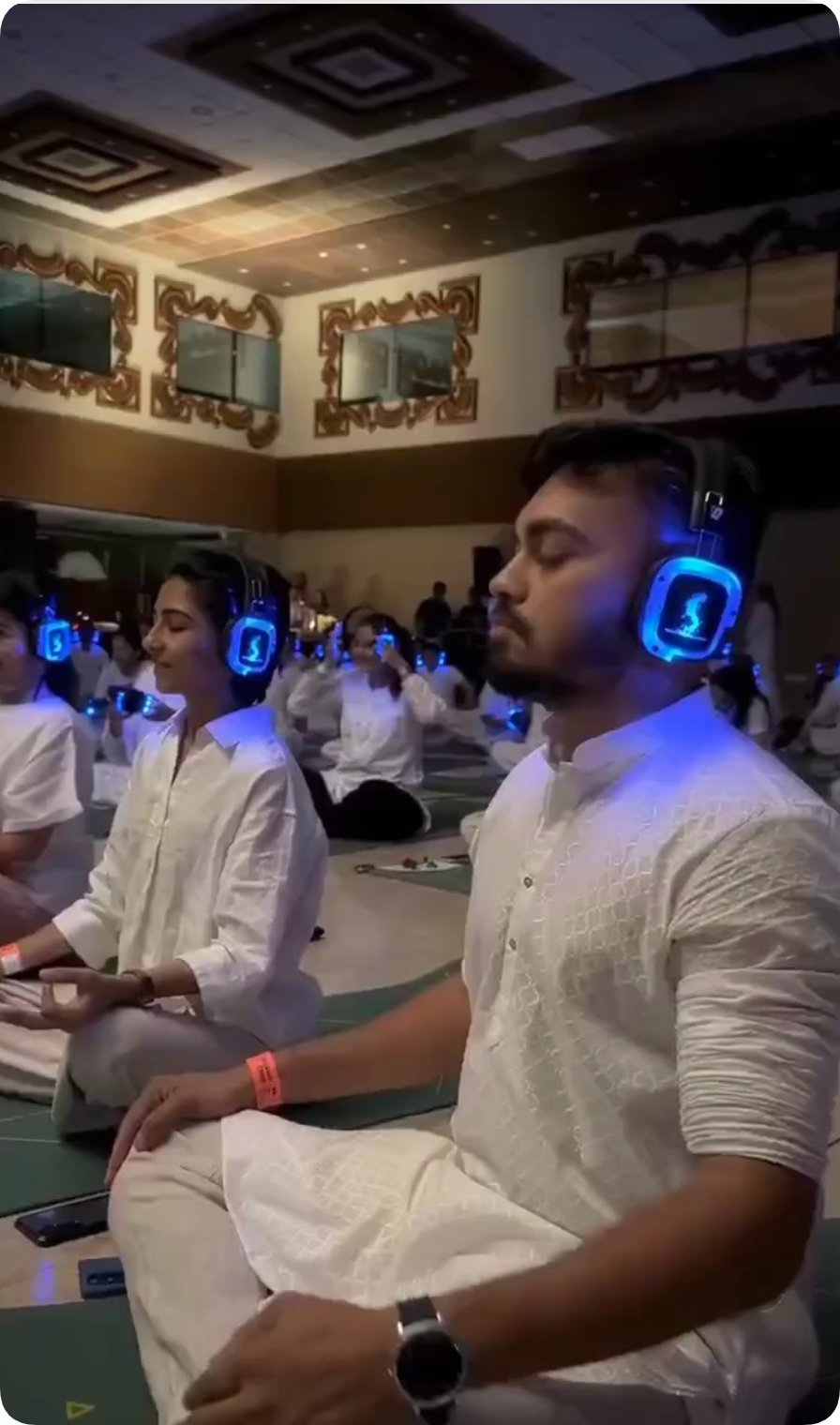
The photographs below came back from the studio manager rather than from us. That matters for how this reads: they are not staged product shots, they are what the room looked like on a normal evening with a normal class on the floor. The colour visible on the ear cup in the second frame is the part of the system that does the actual work in this room, and it is worth looking at before any specification is discussed, because the specification sheet does not mention it at all.
What the Manager Sent Back From the Thursday Evening
The first frame is the Thursday strength class. Five people on the floor, each holding a child or standing beside a carrier, each wearing a pair of headphones that are on their head and not over their ears. The instructor speaks from the front of the room and nobody has to be quiet. That is the ordinary benefit of the system and it is the reason a studio buys one, but it is not what makes this particular installation unusual.
What is unusual is the hour before. The nine o'clock breathing group had been in the room for fifty minutes, and when they finished, the same set of headphones went straight onto the headrests by the door for whoever arrived next. The room did not have to be reset, the speakers were never switched off, and the only thing that had to happen between the two groups was the channel on the transmitter.
So the manager's question, when we asked what he wanted from the follow-up order, was not about sound quality or range. It was: how do we stop a late arrival from standing on the wrong side of the room and following the wrong class? The answer is printed on the outside of the headset, in light, at a glance, from across the floor. It is the least technical part of the system and it is the part that decided this second order.
The Room Where Nobody Can Hear Anyone Else
The second frame is the quiet room in the same building, a hotel meditation space rented by the hour. The participants are seated on the floor in a loose circle, and the only bright objects in the photograph are the ear cups. Each one is lit, and each lit ear cup is a different channel. In this room nobody is listening to the same thing. One person is following the instructor, one is on a different track because the instruction was in a language they did not choose, and one has simply moved to the channel with less talking on it.
The transmitter on the front table is a metal-cased unit with a small LCD, and it is doing the one thing the room design depends on: it is putting several audio streams into the same air at the same time, and letting each headset pick exactly one of them. Without that, a meditation class where participants choose their own audio is a room with a loudspeaker and a request queue. With it, the room is quiet and the choice is invisible to everyone who is not wearing a headset.
The Part of the System That Is Not on the Specification Sheet
The hardware is straightforward. Ten channels, FM stereo modulation, a folding headset that packs into a case the size of a laptop sleeve, and a battery that runs a class-length session on one charge. None of that is unusual for this category of product, and none of it is what the studio photographs are about.
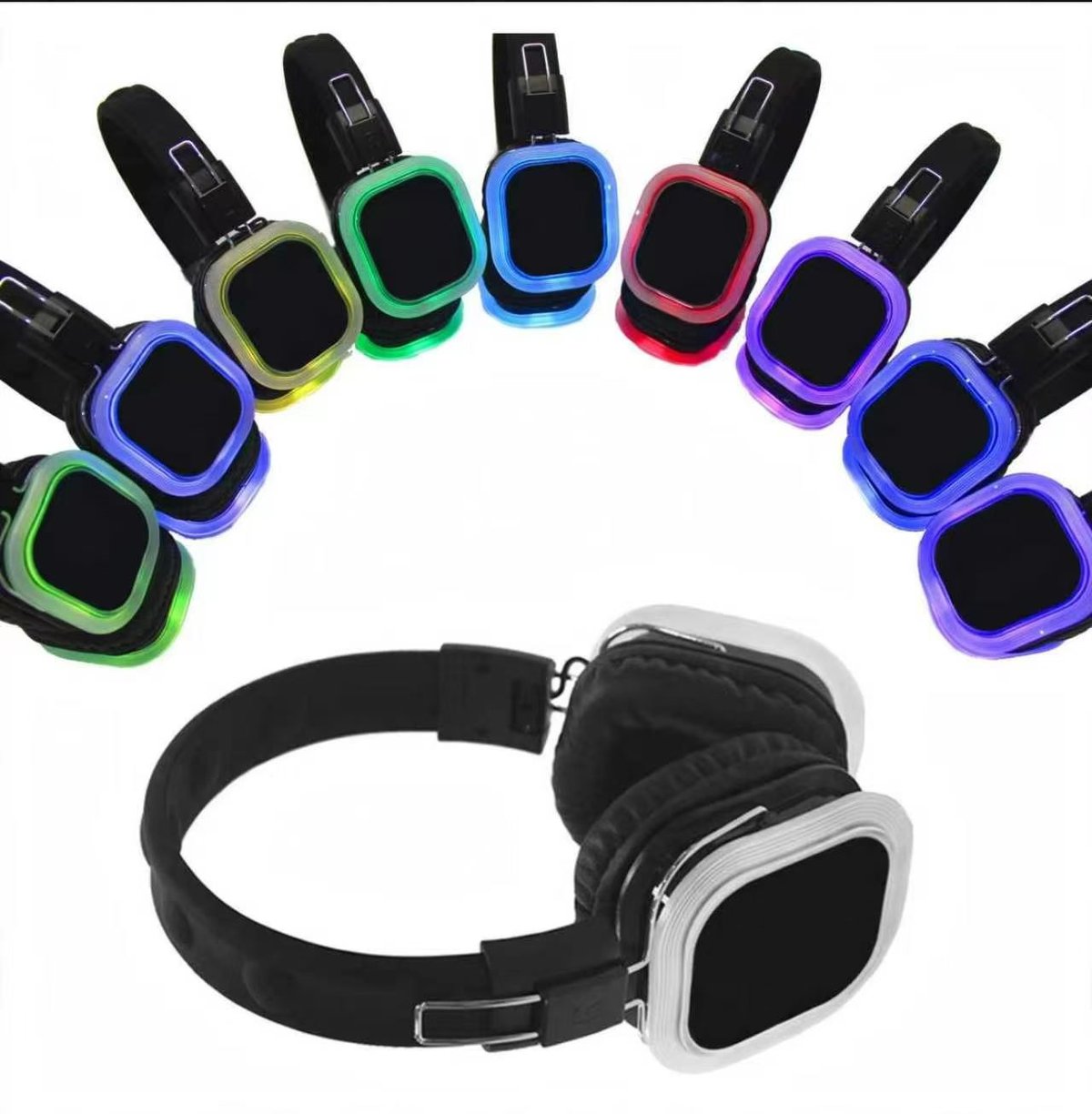
The part that matters is five colour states on the outside of each ear cup: red, green, blue, purple, yellow. The channel a headset is sitting on is not displayed as a number the wearer has to read. It is displayed as a light other people can read. From the doorway, from the far wall, from a person holding a child who is looking the other way, the light is the only piece of information available, and it is legible in a lit room at twenty metres in a way that printed numbers on the same surface are not.
This changes what the studio staff do. They do not announce a channel number before class. They walk to the door and check the colour of the headsets that are already on, and if the light is the wrong one they change it with one button. The check takes under a minute and it is the same action at the start of every class, whatever the class is about.
The Two Rooms That Made the Same Purchase for Different Reasons
It is worth separating the two installations, because they bought the same system and they did not get the same benefit from it. The studio bought channels as a scheduling tool: one room, two bookings, no reset between them. The quiet room bought channels as a content tool: one room, several different audio choices, no loudspeaker at all.
The studio's constraint is time. It has a window from seven to ten and a fixed floor plan, and the only thing it can change between bookings is which channel the transmitter is putting out. The quiet room's constraint is politeness. It is rented by the hour by groups of different sizes and compositions, and no two of them want the same thing playing. In both cases the answer is that a headset makes a private choice visible to nobody, which is why a colour on the outside of the earcup is worth more than a number on the inside.
A venue running several streams in one hall usually reaches for this by way of a simultaneous interpretation system, because the multi-channel part of that category is what it was built for. The difference in a room like these two is who chooses the channel: an interpreter assigns it, a studio lets the person in the doorway pick it.
| What the room needs | Studio, two bookings | Quiet room, mixed group |
|---|---|---|
| Number of channels actually used | Two, one per class | Three or four, one per language or track |
| Deciding factor between sessions | Channel on the transmitter | Channel on each headset, set at the door |
| How a late arrival is redirected | Staff check the colour from the doorway | Participant switches before sitting down |
| What the photographs show | Headsets on, not over the ears, no silencing | Lit ear cups on seated participants |
| Where the system is not used | Lockers and toilets, outside the transmitter's reach | Corridors, for the same reason |
The transmitter runs on the 863/925 MHz band with a selectable power setting. The high-power setting reaches past five hundred metres in open air, which matters for an outdoor festival but is irrelevant to either room in this case. The low-power setting is the one a studio actually uses, because a studio is a walled room of a known size and running the transmitter wide open in a building that shares a corridor with apartments is not something anyone wants to do. The specification's headline number is the one number neither of these two rooms needed.
💡 Why a Silent System Needs the Light More Than It Needs the Range
A silent system is easy to buy and easy to misunderstand. The common mistake is to treat the transmitter range as the product. It is not. Range determines whether a signal arrives; it says nothing about who in the room is listening to which of the streams that arrived. In a single-room installation where every headset is on the same channel, the channel system is decorative. In a room where streams differ, it is the entire product.
That is why the light is the piece worth checking at delivery. A headset can pair, hold a channel, fold up and run for a session and still be useless in a shared room, because nobody in the room can tell which stream a stranger is on. The studio manager's second order was for more headsets, not more power, and the reason he gave was that the light on the earcup was the only thing that had kept a seven o'clock group from standing up in the middle of a nine o'clock class.
There is a smaller point in the same place. Each headset has its own volume control, so a person can turn their stream down without affecting anyone else, and a participant who finds the instruction too loud can solve it without leaving the circle. In a room where people are asked to sit still for an hour, a control that can be adjusted without standing up is worth more than it sounds like it is.
Where the Same Three Checks Apply Elsewhere
The same reasoning transfers to any venue that runs more than one audio stream in one room, and there are more of them than people expect. A museum that lets visitors choose between a guided commentary and three language tracks needs a way to show which one a visitor is on, for exactly the reason above: staff cannot walk the hall continuously and cannot see a screen on a headset from the far end of a gallery. A factory tour running two narration tracks in a production hall has the same problem in a worse acoustic environment. A conference with simultaneous interpretation channels has the same problem with an extra constraint, because the language channels are not chosen freely by the listener but assigned, and an incorrect assignment is a problem that only becomes visible when someone answers in the wrong language.
In all of those rooms the light does the same small job. It converts a private decision into a public fact, at zero cost, in a form that a person who is not wearing the equipment can read from several metres away. It is not in the specification because it is not a specification item; it is a housing feature. But in any installation where more than one stream is live, it is the feature that decides whether the streams are usable. A hall that runs one commentary for everybody, in the way a museum audio solution normally does, never needs it, which is exactly why the feature tends to be overlooked when the same hardware is specified for a multi-stream room.
A studio booking a first system should ask three questions before choosing a supplier, and none of them are about range. How many channels does the transmitter hold at once, and are they selectable from a panel or from a handset. What does the headset show on the outside that a person at the door can read. And how long a session the battery actually covers, because a class is an hour and a battery that is borderline at an hour is borderline in the wrong direction.
Running a Similar Two-Booking Evening
A studio planning this kind of arrangement needs a room that can be handed over without a reset, which means a transmitter that can be left running and a channel that can be changed by one person in a few seconds. It needs enough headsets that nobody waits at the door, and a charging plan that puts every headset back on charge the moment the last class ends, because the two-hour gap in the afternoon is exactly the window in which a half-charged headset becomes a headset somebody cannot issue. It needs a check at the door, done the same way every time, and it needs someone on staff who owns that check rather than a rota that shares it.
What it does not need is a discussion about whether the music is loud enough for the whole room, because the music is never for the whole room. It is for the people wearing the headsets, and the person standing at the front of a strength class who appears to be speaking loudly is speaking at a volume that has to carry across the floor, which is a different exercise from filling a room with sound and takes practice.
A studio comparing this against a conventional guided-tour kit built for a single channel should read the two as different instruments rather than competing ones; the wider comparison of one-channel and multi-channel systems is set out in the solutions range overview, which lists where each format is normally deployed.
The manager's photographs are the best evidence we have that the arrangement worked as designed. Two bookings, one room, no reset between them, and a class that nobody had to whisper through. If a room like that is what you are running, the decision to make first is not the transmitter. It is whether everyone in the room can tell which group they are in.