
.webp)
A riding school that has run for years out of one indoor arena rarely changes its audio setup on purpose. It changes when the timetable does. In this case the school added an outdoor arena on the far side of the yard, then opened a cross-country loop that leaves the fence line altogether, and inside one season the same afternoon could hold two classes and, on two days a week, three. The instructor's voice stopped being the only thing moving across that ground. The question was no longer which system sounds best on a bench, but which assignment keeps three classes apart while a rider is turning a horse.
Three units ended up on the wall, and none of them was chosen on price. The RC2406, the RC8860 and the RC9150 each earned a place for a separate reason: how many independent conversations the site can hold at once, which unit can leave the crowded band when a class rides out of sight, what a rider will keep on under a helmet for a full session, and how long the gap between charges actually is. Read as a catalogue of wireless tour guide systems, the three look interchangeable. Read against the school's roster, they separate quickly, and that separation is what this case is about.
A Roster That Repeats Rather Than Peaks
This school's term is not built around one big day. It repeats the same blocks every week: beginner groups in the indoor arena through the morning, private lessons in the outdoor arena after lunch, and a cross-country session twice a week for riders past the walk and trot stage. That repetition matters, because a repeating roster exposes a weakness every week instead of once a year. A unit that fails on a graduation weekend is a bad memory. A unit that bleeds audio every Tuesday afternoon is a reason to replace it. Written out, the week had a shape nobody had described aloud: the load was heaviest in the middle of the day, when both arenas were in use, and lightest at the edges. That list came first, and the question behind it came second: what would the hardware have to survive in order to fit it? The wireless horse instruction system was specified against that list rather than against a showroom.
Two Classes, One Earshot
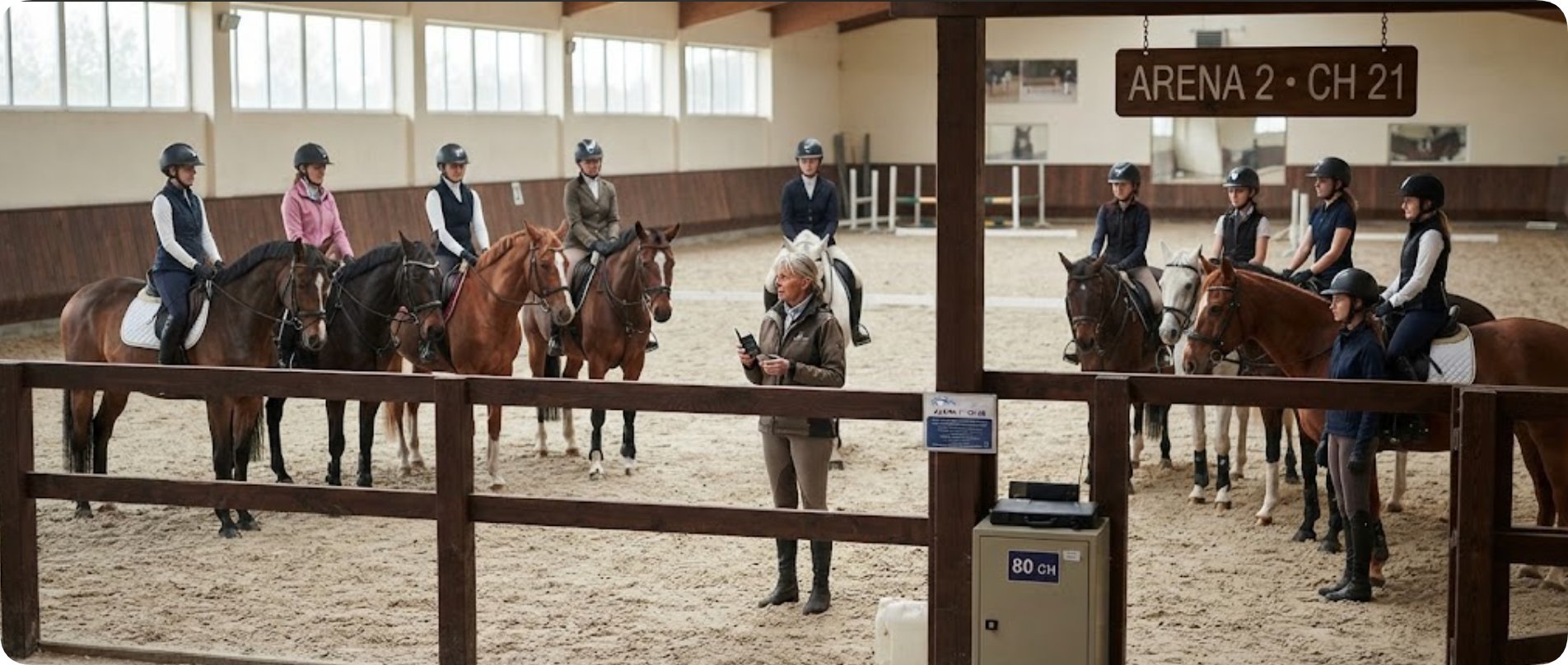
The two arenas share a fence, not a wall, and radio does not respect a fence. When a beginner group worked on one side and a private lesson on the other, the same audio crossed the rail. The fix is not distance, it is counting. Every class needs its own conversation, and the number a site can hold at once is what the channel figure describes. Here the school wanted headroom rather than a bare minimum, because two classes is a normal afternoon and three happens twice a week. The RC2406 carries 80 channels on the licence-free 2.4GHz band and pairs in a single press, which is what let a second and a third class sit on the same site without sharing one frequency.
Separating Classes Across One Fence
Separation on a site this size is an administrative habit before it is a technical one. What the school settled on was a rule that one arena owns one assignment, written down, with the transmitter for that arena matched to it and kept in the same box between sessions. Riders are handed the receivers that belong to that box, so a beginner who walks from the indoor school to the outdoor one does not carry a unit paired to the wrong class. The rule sounds obvious, and it is exactly the rule that quietly breaks when a unit is borrowed and not returned. The match is made once, at setup, with a single press, so the twenty-minute changeover is a matter of carrying boxes between arenas rather than reconfiguring anything. The symptom of a broken rule is never silence. It is a second class hearing the first.
💡 Why the Farthest Class Left the Common Band
The cross-country loop runs past the fence line and out over open ground, which is a different kind of problem. The 2.4GHz band is shared with wi-fi, phones and every Bluetooth device in the yard, and the crowding is worst wherever people gather. The school's answer was not more power, it was another band. The RC8860 transmits on UHF, between 860 and 870MHz, where the traffic is thinner and the signal bends around obstacles instead of stopping at them. It carries 20 channels, far fewer than the other two, and it was still the right unit for the loop, because its job was to hold one class on a band nothing else on the site was using.

What a Rider Cannot Take Off
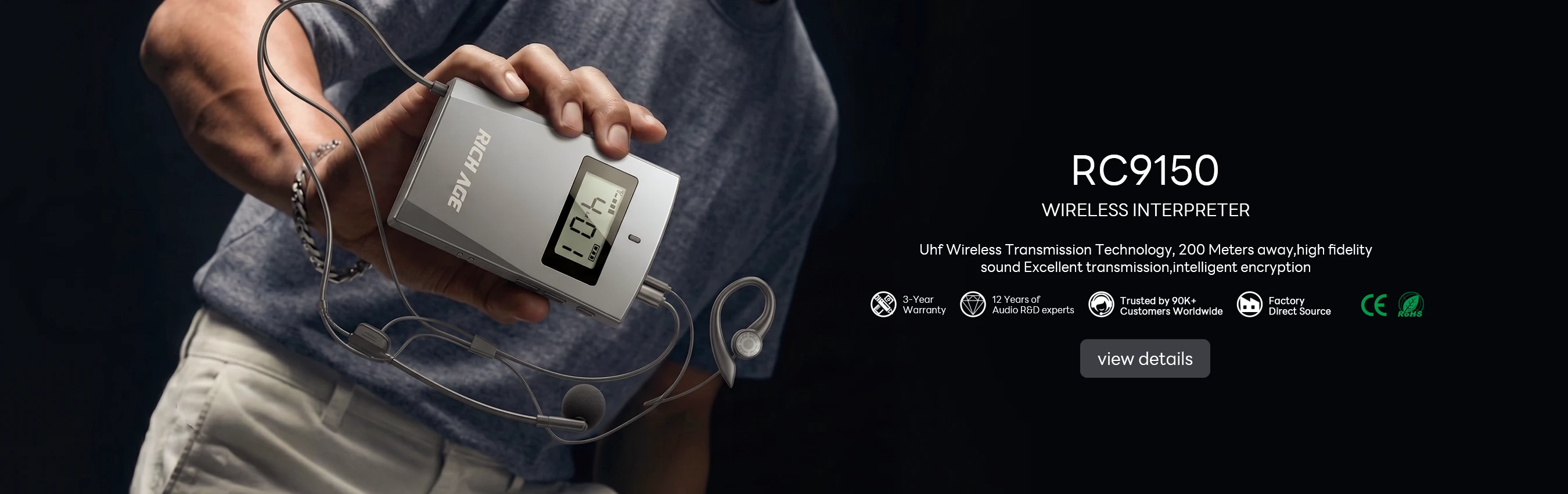
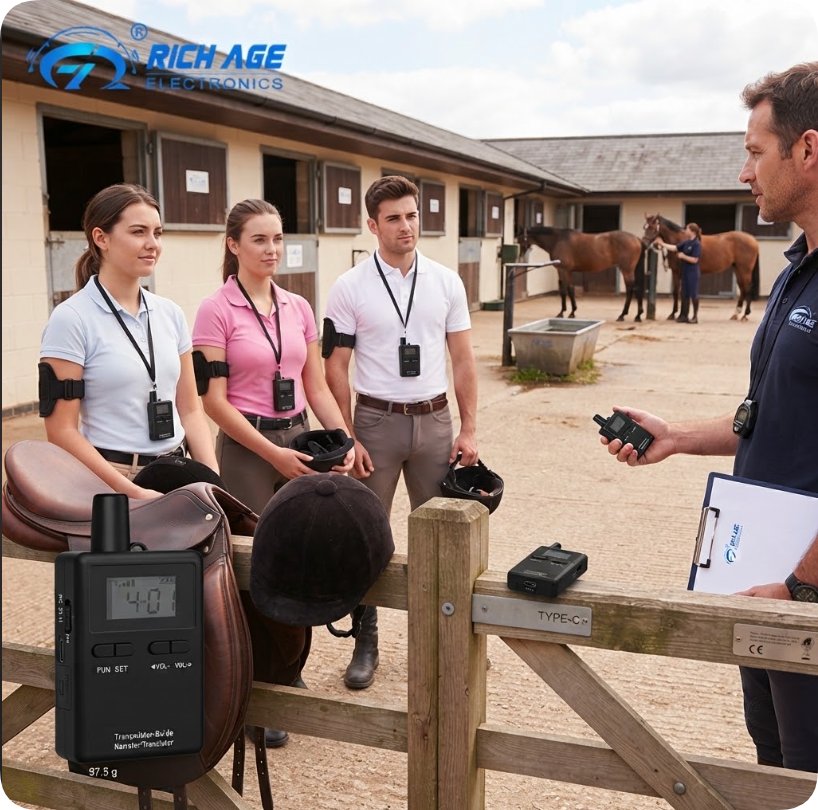
A riding helmet is a certified object. It cannot be drilled, and nobody is going to clamp a bracket to the shell, so a receiver has to live on a lanyard, in an armband or in a pocket. That turns weight into something the rider feels for the whole session rather than reads on a sheet. Here the receivers split cleanly. The RC2406 and the RC8860 both ship a receiver at 50g, and the RC9150 runs 97.5g on both halves of the kit. The school's rule follows from that number. The lighter units go to riders who are moving and changing direction, and the heavier set goes where a receiver can rest on a rail or in a coat pocket instead of hanging on a child.
From the First Bell to the Last
Between one beginner block and the next private lesson there is a changeover of about twenty minutes, and twenty minutes is not a charging window. Talk time is what the transmitters give: the RC2406 and the RC8860 are quoted at 10 hours, the RC9150 at 15. Listening time runs longer on every unit, and much longer on one, where the receivers go past 35 hours. That single figure changed the school's routine more than any other number in the case. The long-running receivers now go out for two short sessions a day and come back to the charging table twice a week, not every evening, which removed the end-of-day scramble that used to close the yard. A set that leaves the charging table in the morning now comes back without a top-up, and that is the whole reason the long-running units stayed with the school.
Where the Three Belong on the Schedule
Set against the roster, the three units stop looking like competitors. What matters is the band each one holds, how many classes it can carry at once, how long it runs between charges, and what it weighs on the person wearing it.
| Rig | Frequency | Channels | Talk / listen time | Transmitter / receiver weight | Charging |
|---|---|---|---|---|---|
| RC2406 | 2.4GHz ISM, 2403-2483MHz | 80 | 10h / 20h | 59g / 50g | DC Port |
| RC8860 | UHF 860-870MHz | 20 | 10h / 20h | 59g / 50g | DC Port |
| RC9150 | 2.4GHz ISM, 2403-2483MHz | 100 | 15h / 35+h | 97.5g / 97.5g | Type-C |
Two figures are deliberately missing from that table. All three units are quoted at the same 10mW output, and all three are listed with a 1-200m working range, so those rows would say nothing about which to choose. The published protections differ as well, and they belong in the text rather than in a cell. The RC2406 and the RC8860 carry an IPX4 splash rating, while the RC9150 lists encryption instead.
🎓 What a Smaller School Borrows
A school with one arena and one class at a time has none of this problem. A single assignment covers the site, the smallest channel count is enough, and the only real question is how long a unit runs before it needs a socket. That is worth saying plainly, because most of this case only starts to matter once a timetable overlaps. What travels to a smaller yard is the habit rather than the hardware. Count the changeover instead of the battery rating printed on the box, keep one arena tied to one assignment and every unit back in its own box, and when a class leaves the fence line for open ground, move that class to a band nothing else is using. The horse riding training case shows the same logic at the scale where it first had to be solved.