.webp)
Three photographs came back from a group that walked an old stone cloister with the RC2408. They are the same group in the same arcade, shot from three positions, and on first reading they look like three pictures of a queue. They are not. They are three different answers to a question the client never asked out loud, which is whether the guide could see who was still with her while the building was doing what a stone building does to a radio path.
That question is not answered in the specification table, and it is not answered by the range figure either. A 200-metre range says how far a signal can travel. It does not say whether the person wearing the receiver can be seen by the person transmitting. In a cloister, those are separate questions, and the second one decides whether the visit works.
The kit was one RC2408 transmitter and a set of receivers on the 2.4GHz band, 80 channels, with the guide carrying the transmitter on a neckband and the group carrying receivers the same way. Below is what the three photographs actually settle, and what they leave open.
Three Frames, One Arcade, One Afternoon
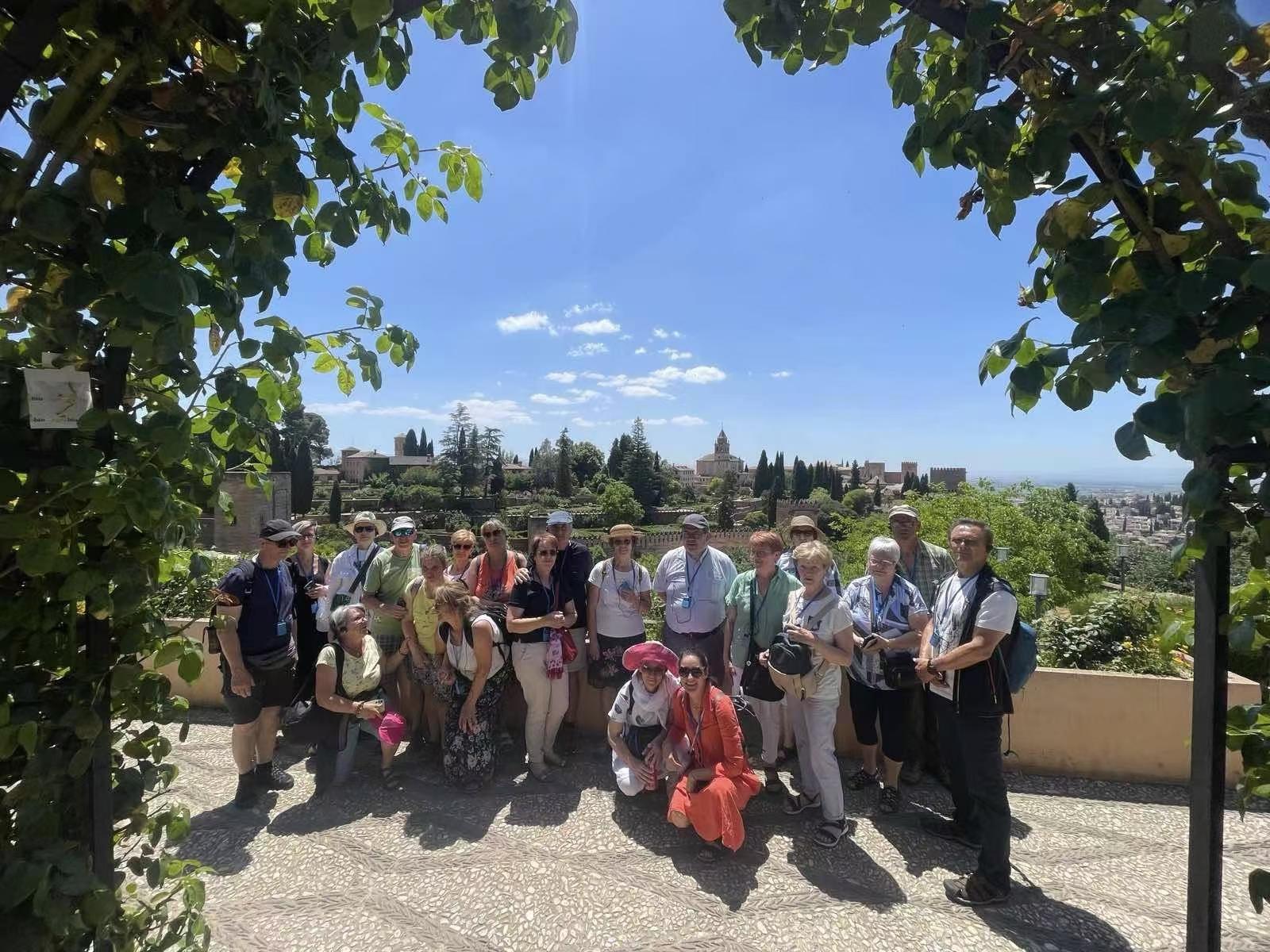
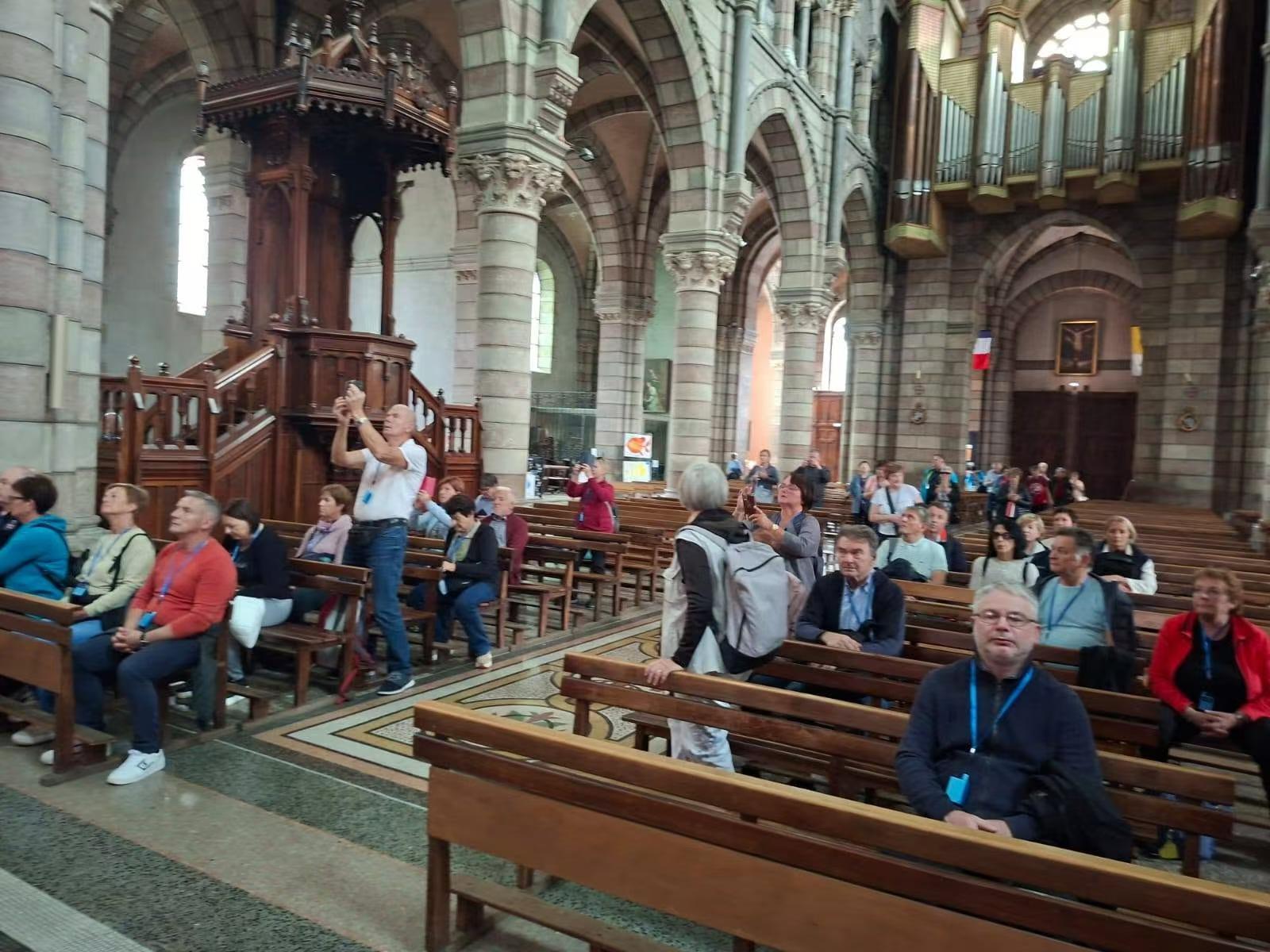
The first frame shows the group stopped along an arcade of round arches, all of them looking up and slightly left, the receiver lanyards visible against a mix of dark coats and pale shirts. The second frame is the same arcade from further along, with the group mid-stride and the neckbands swinging at slightly different angles. The third frame is tighter, taken from the side, with a stone pier cutting the frame in half and half the group already under the next arch.
Three positions, one room, one afternoon. What they establish is the shape of the group in motion: about a dozen people, spread across the width of the arcade rather than funnelled into a line, moving at walking pace, stopping together. None of that is in the datasheet. All of it is in the pictures.
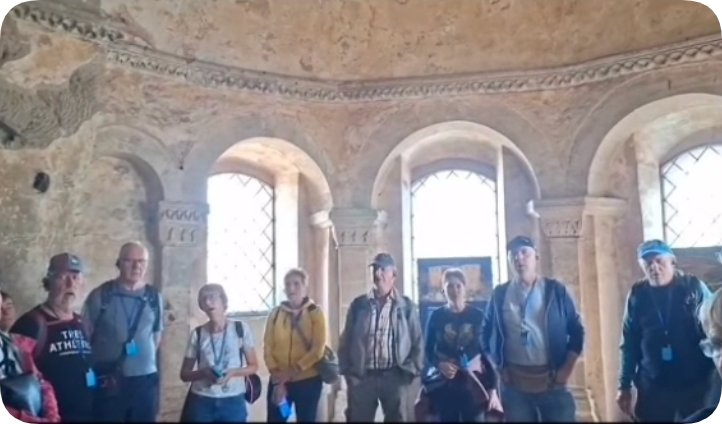
What the pictures do not show is equally useful. There is no tour flag, no numbered headset, no visible microphone on the guide, and no sign of a second transmitter. Whatever interpretation arrangement this was, it was a single transmitter driving a single group, which is the arrangement the RC2408 is built for rather than the one it is usually sold for.
🗺️ Three Positions, Three Different Sight Lines
| What the frame shows | Where the guide is relative to the group | What that does to the audio path |
|---|---|---|
| Group stopped, all faces turned upward along the arcade | At the near end, facing the same direction as the group | Single path, no competing body in the way; the easiest frame of the three |
| Group mid-stride, lanyards at different angles | Moving at the flank, roughly level with the middle of the group | Receiver bodies swing and turn; the path is short but nobody is stationary |
| Group split by a stone pier, half already under the next arch | Behind the group, with load-bearing stone between guide and rearmost receivers | The only frame where the wall, not the distance, is the limiting factor |
Read as a set, the three frames describe a guide who changes position rather than a guide who holds one. The third frame is the interesting one, because a stone pier between the transmitter and the rearmost receivers is a different problem from a long walk, and it is not solved by more range. The RC2408 Wireless Tour Guide System page gives the range as up to 200 metres and the band as 2403-2483MHz; neither number changes the fact that a pier is a pier.
💡 Why the Neckband Was Chosen Over a Handheld
Every receiver in these photographs is on a neckband rather than in a pocket or held in a hand. That is usually discussed as a comfort or hygiene choice. In a cloister it is closer to a visibility decision, and it is the reason the group can be counted at a glance.
A receiver in a hand is invisible from four steps away, which means the guide either walks at the back where she can see hands or stops to count. A receiver in a pocket is worse. A receiver on a neckband is a small bright object on a moving chest, and a dozen of them are countable in a single sweep. The group in the second frame, mid-stride with lanyards at different angles, is a group whose headcount can be read without stopping.
The transmitter wears the same kind of band. That matters in a narrower way: the guide's own hands stay free, which in a building with uneven floor levels and a walking pace of about a kilometre an hour is the difference between a smooth visit and a hand full of equipment. The RC2408 weights are published as 59g for the transmitter and 50g for the receiver, which is the number that makes a full-day neck-worn set plausible rather than merely possible.
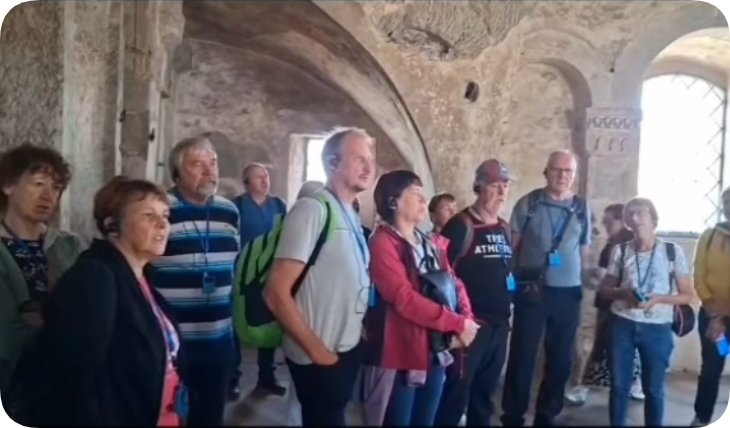
What the pictures cannot settle is comfort over a full day. Nobody in these frames is near the point where a neckband becomes a complaint, because the visit is short and the pace is slow. A ten-hour rotation is a different claim, and it would need to be tested rather than inferred from a photograph taken in the first hour.
Where a Stone Archway Eats a 2.4GHz Path
Third frame: a stone pier down the middle, the guide behind it, receivers beyond. This is the part of the deployment that the range figure does not cover, and it is worth being precise about it because the industry's habit is to answer every stone-building question with a lower frequency or a higher power figure.
The RC2408 sits in the 2.4GHz ISM band. Its published advantages over UHF systems are a licence-free worldwide operation and one-key synchronisation, both of which are administrative or operational wins rather than propagation wins. The published advantage that does matter in a cloister is the 80-channel count, because a channel that another group is using is a channel this group cannot use cleanly, and a stone arcade is a place where several groups can and do end up within earshot of each other.
The two-way capability is the other structural point in these frames. With two-way communication, a question from the back of the group does not have to be shouted forward or passed along the row; the guide can answer the individual. In a space where raising a voice is inappropriate, that feature does the work that a second guide would otherwise have to do. The 20-hour receiver runtime is what allows the guide to answer that question at the eighteenth hour of a long day rather than at the second.
Systems comparison pages for this category tend to frame the choice as band versus band. The RC2402 vs RC2408 comparison is the closest in-house reference, and for a site already standardised on the RC2408 the relevant question is not which band wins but how many groups this site runs at once. Eighty channels answers that, provided the site actually allocates them.
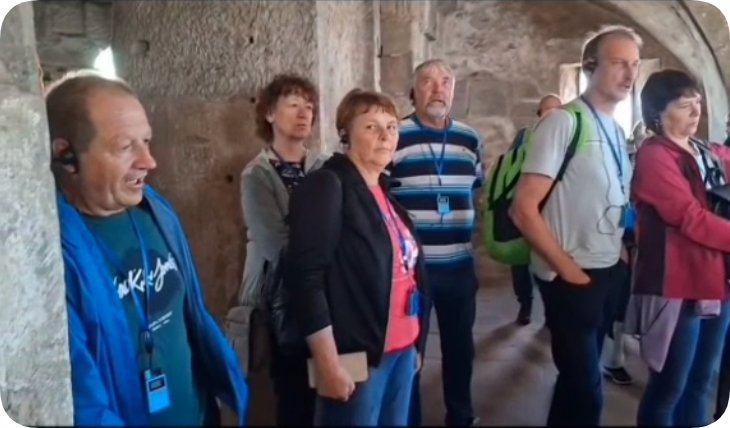
One caveat belongs here rather than in a footnote. All three frames were taken in the same arcade within a short span, so the photographs document a group that stayed together in one stone environment. They do not document a different group, a different building, or a different month. A case built on three images should be read as three images.
Three Questions the Returned Images Leave Open
Three things are missing and each of them is a real procurement question rather than a gap in the photography.
The first is count discipline. Nobody in the frames is holding a numbered handout, and there is no visible check at the end of the route. With 12 to 14 receivers out of a case that can carry more, a group of that size is large enough to lose someone at a pier and small enough that nobody notices for two arches. The mechanism that closes this gap is a roll call at the second arch, not a louder transmitter.
The second is what the site did with the kit afterwards. The batteries are DC-charged and the warranty runs three years with the mainboard covered, excluding headset, microphone and battery. Those exclusions are published and they are exactly the parts that a neck-worn, daily-use set touches most. A case that does not report the charging location or the headset replacement interval is leaving the largest recurring cost unrecorded.
The third is the second group. Eighty channels makes multi-group operation possible, but nothing in these frames indicates whether this site ran one group or several. The church and religious site wireless audio solutions page describes the multi-group pattern for sites of this type, and it is the reference to check against before assuming a single group describes the whole operation.
Running a Similar Visit in an Old Stone Building
Three concrete steps, in the order they matter. First, put the guide at the flank rather than the back, and keep the transmitter on a neckband so her hands stay free and her own head is visible to the group. Second, count the group at the second structural pier rather than at the entrance, because that is where a stone building actually takes people out of sight. Third, decide the channel allocation in advance and write it down, because the 80 channels are a resource and an unrecorded allocation is a resource that gets double-booked on a busy day.
Add a fourth if the site is running more than one group in the same building: city tour wireless audio solutions sets out the same kit in an open-air environment, and the contrast is instructive. Outdoors the limiting factor is distance and the group spreads; under an arcade the limiting factor is stone and the group funnels. The equipment is the same. The headcount discipline is not.
For a site evaluating this rather than running it already, the church and religious translation system case is the closest published reference, and the full system is listed under wireless tour guide systems for comparison against UHF and DECT alternatives.
Finally, one honest limitation. These are three client photographs of one afternoon in one arcade. They are evidence that a neck-worn RC2408 set held a group together in a stone cloister, and they are the best evidence available for that specific claim. They are not a coverage survey, and no photograph of this kind can be.