





A cathedral visit produces a particular kind of paperwork. Nobody sends a spreadsheet with signal readings or a maintenance log. What arrives instead is a short message from the person who booked the coach, written a day or two after the group has gone home, and it tends to mention the things that nearly went wrong rather than the things that simply worked. In this case the message was unusually specific. It named a quantity of receivers, a smaller quantity of transmitters, and a batch that had been checked only halfway before the first talk began. It also said the whole system had worked perfectly, which is a useful sentence but not a very informative one. The numbers around it are what make the letter worth reading closely, because they describe a decision about when the equipment was made ready rather than a decision about audio.
The group was a pilgrimage party spending a morning inside one large church, with a seated address, a period of quiet, and a walk back out to the coach afterwards. That shape matters more than the architecture does. Three people needed to speak at different moments, dozens of people needed to listen without raising their voices, and the whole programme stayed inside a single stone building from arrival to departure. Organisers who plan this kind of morning usually ask about Church Wireless Audio Solutions before they ask about any individual device, and that is the right order. Once the route and the pauses are settled, the remaining question is whether every unit is ready when the doors open, and whether anybody has to find a socket inside the building to make that happen.
Sixty Sets and Three Voices on the Same Line
The letter puts two figures next to each other without much ceremony: sixty receivers, and three more transmitters. Sixty is a coach-sized number. It is large enough that a missing unit will not be noticed until the group is already seated, and small enough that one person can still count the whole batch on a table before anybody arrives. Three transmitters is the interesting half of the pair. It says the organiser expected more than one voice to lead the morning: a welcome at the entrance, the address itself, and a closing word before everybody stood up. Nobody asked for sixty transmitters. The ratio was chosen deliberately, and the person who wrote the letter had already thought about who would hold the three of them.
The RC2402 Wireless Tour Guide System was the model named on that order, and the published description fits the arithmetic. It works in the 2.4 GHz band at 2403-2483 MHz, offers 50 selectable channels with one-click synchronisation, and quotes a working range of up to 200 m in open area. Its transmitter is rated for 10 hours on a 1500 mAh cell and its receiver for 20 hours on a 1000 mAh cell, both recharged through a DC port. Those lines, together with the published HD Voice figures, are the whole of the specification we will quote here. Anything the page does not state, we will not invent for the sake of a tidier story. The letter is evidence of what a customer ordered and what he reported afterwards; the product page is evidence of what the manufacturer publishes. Keeping the two sources separate is what makes the rest of this account useful to the next organiser reading it.
Before the first address, the clergy took their place at the lectern while the group was still settling. The room was full, the speaking position was fixed, and the listeners were spread across wooden rows rather than standing in a cluster. That arrangement is why the ratio in the letter matters: three speaking roles, one seated audience, and no requirement for anybody at the back to move closer in order to hear. The photograph below records the moment without naming any equipment in it, and that is deliberate. What the picture shows is a room being used for a talk, not a product demonstration.

🔋 What the Product Page Publishes About Power
A rechargeable fleet moves the preparation to the evening before. Published endurance is 20 hours for each receiver and 10 hours for each transmitter, and a seated address followed by a short walk out to the coach consumes a fraction of either figure. Charging therefore belongs to the place where the group sleeps, not to the building where the group listens. The cathedral team arrived with sixty receivers already at full charge, three transmitters likewise, and no cable to account for during the morning. That is a different routine from one built around swapping cells, and the distinction is worth stating plainly because the two are often confused in enquiries.
A later message from the same customer asked whether receivers and transmitters could be charged inside a travelling case holding sixty units. That question is recorded here because it was asked, not because it can be answered from the catalogue. The product page publishes DC port charging and nothing about a case with a stated number of slots. We therefore quote no slot count, name no accessory, and draw no conclusion about how such a case would be wired. A field the manufacturer has not published stays out of the article, even when a customer has raised it in correspondence. The organiser's own question and the published specification are two different kinds of evidence, and only one of them belongs in a specification table.
This is also where a pilgrimage itinerary differs from a museum or a factory tour. Groups built around a religious site often travel for several days and sleep in different towns; the people leading them are volunteers or clergy rather than technical staff. A Hajj & Umrah Audio Guide Kits enquiry usually starts from the same concern, which is why we mention it here: the question is not how many hours a cell lasts in a laboratory, but whether a person with no toolkit can put the system right during a short pause. For a rechargeable system the answer lies in the preparation done the previous evening, when there is time to check every unit in daylight and set aside any that did not reach full charge. A unit that is ready at the door needs no intervention at all.
The letter says the customer had already checked half of the receivers and put them to work for a colleague. Read literally, that is a progress report on a batch of sixty. Read as an operational detail, it is more revealing: the check was done in stages, the units were usable as soon as they were set up, and nobody waited for the whole consignment to be validated before starting. A rechargeable fleet supports that sequence when each unit arrives charged, because readiness belongs to the individual device and not to a shared cabinet. Half a batch being ready is a meaningful state, and the customer treated it as one.
A Seat Plan Drawn Before the First Hymn
The group did not arrive as a single block and then sort itself out. People who travel together by coach tend to sit in the same clusters they used on the journey, and the front rows fill last because nobody wants to be the first to walk past everybody else. The organiser had a seat plan in mind before the first hymn, and it divided the nave into rough zones rather than named places. That distinction is worth keeping. A plan with zones survives a few late arrivals, a walker who needs an aisle seat, and a family that wants to stay together; a plan with names does not. It also gives the person holding a transmitter a clear answer to the question of where to stand, because the listening area has an edge.
Range figures are easier to use when the room has edges. A published working range up to 200 m describes an open-area capability, not a promise about any particular interior, and a stone building with thick walls is exactly the sort of place where an organiser should verify rather than assume. Here the entire audience stayed within one connected space for the address, with the speaking position fixed at the lectern and no courtyard stop in between. The practical check was simple: walk to the farthest occupied row, listen, and then walk back. Nobody measured anything in metres, and we will not publish a reading that was never taken. The letter's word for the result was that the system worked perfectly, and the group completed the morning without changing the plan.
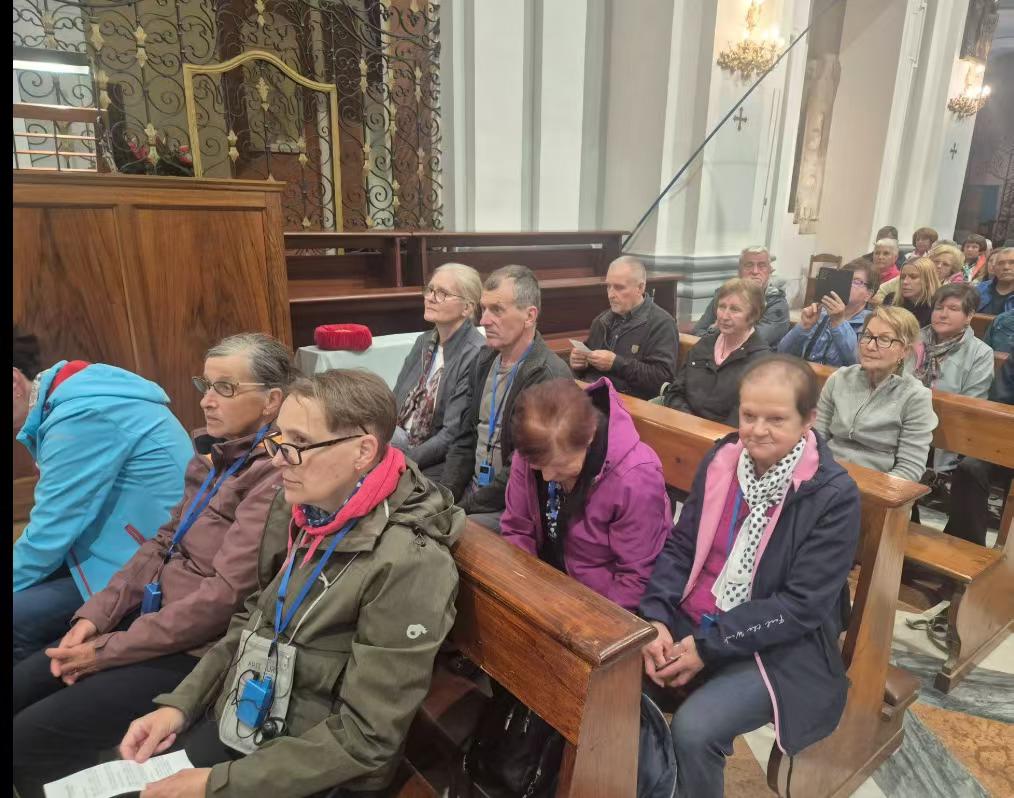
The listeners in the front rows were settled well before the address started, with coats still on and the quiet that comes before a service rather than after an announcement. Several had paper in their hands, which is a useful reminder that a guided visit inside a church is rarely a passive listening exercise. People follow a printed order, look up at a particular moment, and then return to the sheet. Whatever the audio arrangement, it has to leave room for that rhythm instead of filling every pause with speech.
The Rows That Filled From the Back
By the time the room was close to full, the pattern had inverted: the rear rows were occupied first and the spaces near the front were still open. This is common enough that an organiser can plan for it, and it affects where the spare units should sit. If the latecomers end up at the front, a spare receiver kept near the entrance will be behind them; keeping the reserve near the speaking position puts it where the last arrivals actually are. It is a small piece of positioning, but it is the kind of thing a customer mentions in a follow-up message because somebody had to walk the length of the nave to fix it. Nothing in the published specification covers it, and no amount of channel planning will substitute for it.
The same letter that gave us the two figures also said the customer would place another order. Read alongside the progress report about half the receivers, that sentence describes confidence in a process rather than enthusiasm about a feature. He had split a batch, set part of it up, handed it to a colleague, and watched the morning complete without a return to the storage room. That sequence is repeatable. An organiser who has done it once can do it again with a larger group, on a different day, in a different building, without asking a technician to travel. The wider view of the pews below shows the filled room at that stage of the morning, with the aisle still clear and the group settled into the rows they had chosen on the way in.

Numbers Printed on the Product Page
When a customer letter and a product page are read together, it helps to keep the two columns visibly apart. The table below puts each line from the letter's concerns next to the corresponding published statement and the demand the cathedral morning placed on it. The table contains no measurements taken on site, because none were recorded, and it leaves out any field the page does not publish. Readers who want a fuller catalogue of the range can find it through the Wireless Tour Guide Systems listing; the point of this table is narrower, which is to show which published line actually carried weight on the day.
| Line in the customer letter | What the product page publishes | What the cathedral visit asked of it |
|---|---|---|
| Receiver readiness | 20 h on a 1000 mAh cell; DC port charging | Sixty units usable from the first row to the last, with no socket in the nave |
| Transmitter readiness | 10 h on a 1500 mAh cell; DC port charging | Three speaking roles sharing one seated morning |
| Radio band | 2403-2483 MHz, 2.4 GHz ISM, licence-free worldwide | One stone building with thick walls and a full nave |
| Working range | Up to 200 m in open area | A group that stays inside one room for the whole address |
| Channel choice | 50 selectable channels; one-click synchronisation | Three separate voices kept on one synced setting |
| Voice quality | HD Voice; TX 50 Hz-200 kHz / RX 50 Hz-12 kHz | A low speaking volume inside a stone interior |
Two rows deserve a note. The range line is a capability statement, and the visit used only a fraction of it because the group never left the building; quoting the whole number as though it had been consumed would be misleading. The channel line is the opposite: 50 selectable channels sounds generous, yet the morning asked for three voices and nothing more. Organisers sometimes select equipment by comparing the largest number on each page, and then discover that the binding constraint was a door that closes at a fixed time or a coach that will not wait. The letter is quiet on those details, but the two figures at its centre point straight at them.
There is a third point about the endurance rows. Both figures are ratings published by the manufacturer, not readings from this visit, and we have kept them in that column for exactly that reason. The cathedral team did not time the equipment, did not log a start voltage, and did not report how much charge remained when the coach left. What the letter does establish is that the morning finished without anybody returning to a charging point. That is an outcome, and it is the only outcome the correspondence supports.
The Charging Step That Stayed Off Site
The least visible part of a guided visit is the evening before it. Sixty receivers and three transmitters have to be connected, checked, and packed while the building where they will be used is closed and empty. In this case that work happened away from the cathedral altogether. The venue supplied no power point for the audio kit, nobody carried a cable into the nave, and nobody stayed behind after the coach left to collect chargers. A published receiver rating of 20 hours is what makes that arrangement credible for a single morning, because it leaves a wide margin between the charged state and the point at which the programme ends.
Institutions that run daily tours face the same arithmetic at a larger scale, which is why the comparison comes up in enquiries about a Museum Wireless Audio Guides order as well. A museum has a closing time, a security round, and a staff rota; a pilgrimage group has a coach and a volunteer. Both can move charging outside opening hours and outside the building, and both then find that the end of the working day is simply the end of the working day. The difference is that a venue with a fixed cabinet and a night shift has a place for the task, while a travelling party has to arrange one wherever it sleeps. The letter describes a group that arranged it before arriving.
There is a second consequence that is easy to miss. Because each unit carries its own charge, one unit that failed to reach full capacity affects one listener rather than the whole batch. The organiser who checked half of the receivers and handed them to a colleague was already working in that granularity. He was not validating a fleet; he was validating individual units, one after another, and stopping when he had enough for the morning. That is also the reason a spare kept near the speaking position is worth the short walk to place it. A reserve unit that is already charged can be handed over without a cable, a waiting period, or an explanation.
Adding Transmitters to an Already Charged Fleet
The sentence about another order invites a guess about what would be in it, and the guess worth examining is the one about extra speaking roles. Adding a transmitter to a rechargeable fleet is an addition of one unit, one DC port connection, and one line on the checklist used the previous evening. It does not require a new kind of preparation, and it does not change what happens inside the building during the address. For a group that grows from three speaking roles to four between one season and the next, the expansion is visible and countable before anybody travels.
We wrote up a separate note that also uses this model, where the question was whether to count runners or counting points across a long course. That RC2402 and RC2406: Counting Runners or Counting Points account isolates the variable this cathedral visit did not have: a route that keeps moving and a population that changes by the minute. Put the two side by side and the preparation reads the same in both, while the counting question changes completely. One party stayed in a single room; the other spread across open ground. A specification sheet cannot tell an organiser which of those two mornings he is planning, which is why the customer's own numbers are the better starting point for a second order.
Neither letter includes a reading, a log, or a time stamped to the minute, and we have not added any. What they offer is a count, a ratio, a progress report on half a batch, and a sentence about a future order. Those four things are enough to reconstruct how the equipment was prepared, how it was handed over, and why the person who booked the coach was willing to book again. A follow-up enquiry that begins with sixty receivers and three transmitters is already a long way past the stage of asking whether wireless audio is suitable for a group at all.
Frequently Asked Questions
1. How many receivers did the organiser order?
The order consisted of sixty receivers and three additional transmitters, both figures written directly into the reservation prior to arrival. We maintained this ratio on the packing manifest and categorized the three speaking assignments independently.2. Does the RC2402 system require mid-event charging during the cathedral visit?
No. The published receiver runtime reaches up to 20 hours on its 1000 mAh battery, while the transmitter operates for up to 10 hours on a 1500 mAh battery. Charging completed the previous evening comfortably covers full-day operational needs without requiring wall outlets inside the building.3. Which frequency band does the product specification support?
The RC2402 system utilizes the 2403-2483 MHz range within the 2.4 GHz ISM band. This spectrum provides legal, license-free operation globally with 50 selectable channels and one-click channel synchronization.4. What was the post-event feedback from the tour coordinator?
The coordinator confirmed that the entire 60-receiver setup performed reliably without signal dropouts or power failure, confirming intent to reorder additional units for future pilgrimage schedules.The useful part of a customer letter is rarely the verdict at the end. It is the count at the beginning, the ratio beside it, and the small operational detail about a batch checked only halfway. Those are the lines that tell the next organiser what to prepare before the coach arrives, and they are the reason a short message from a cathedral visit is worth more than a page of general claims. Readers planning a route with several stops and a fixed closing time can explore our Wireless Audio Guide Application Solutions to compare how other venues handle the same sequence, then decide where to place the charging step for their own group.