





Field Observation: Photographs captured during live tour group outings offer far more operational insight than static manufacturer specification sheets. One frame reveals visitors gathered around a macaque at an open-air cave attraction, several wearing compact receivers on lanyards. Another depicts guests standing before a ruined historic colonnade, each utilizing the same lightweight audio units. A third showcases the pocketable transmitter issued to the guide before departure, complete with a illuminated channel display. Examining these scenes alongside matching hardware clarifies how open-air heritage sites demand robust audio distribution.
Traditional loudspeakers struggle immensely in environments defined by stone underfoot, open sky, and wandering crowds. For broader venue planning strategies, review City Sightseeing Tour Audio Solutions. The analysis below explores the exact equipment configuration deployed by the guide that day: one pocketable transmitter paired with two distinctly styled receiver options.
1. Decoding What Real-World Tour Photos Reveal
The initial photograph captured near a busy cave entrance demonstrates how crowds naturally disperse around points of interest. Visitors form an organic semicircle around wildlife without lining up in rigid rows, meaning audio must reach individuals looking sideways rather than facing a fixed speaker. The second image, featuring guests in front of weathered stone columns, illustrates compact units worn securely at chest height on short lanyards, eliminating uncomfortable swinging during movement.
 Open-air engagement: visitors wearing compact lanyard receivers while exploring an outdoor heritage site.
This visual evidence confirms that modern tour participants prefer carrying audio feeds rather than remaining anchored under fixed P.A. coverage. Guests retain full freedom of movement while maintaining uninterrupted acoustic connection to the guide.
2. The Pocketable Transmitter Designed for Roving Guides
Product photography of the RC2406 80 Channel Tour Guide Transmitter Receiver highlights its ergonomic design: a clear front LCD screen displaying active channel status, tactile confirmation and volume keys, and a durable rear housing featuring conformity marks. Featuring a stub antenna and integrated strap loop, the lightweight chassis slips easily into a jacket pocket, allowing guides to access settings only when transitioning between tour stops.
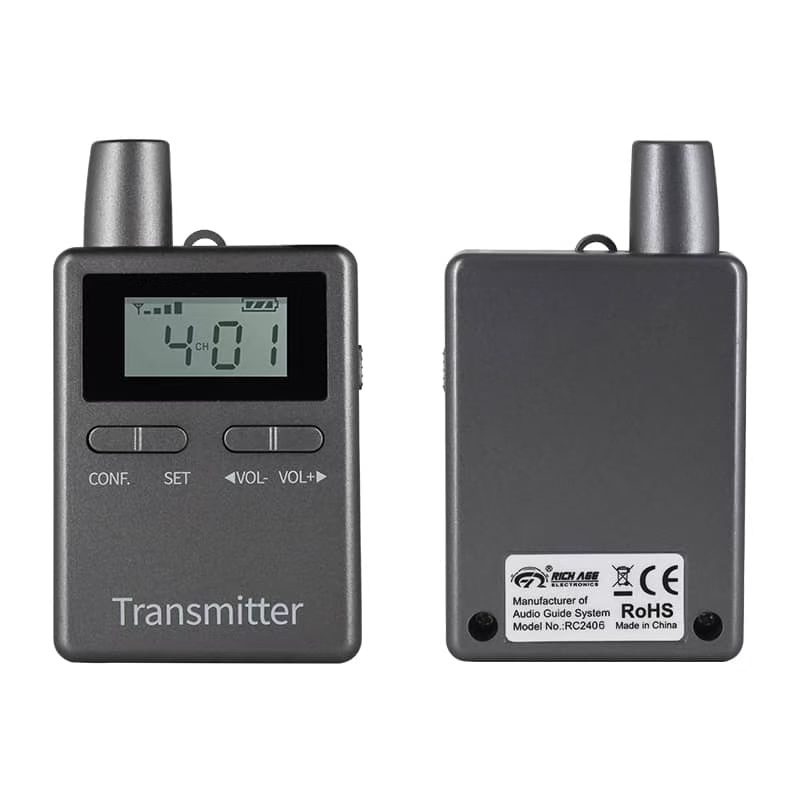 Guide hardware: the pocketable RC2406 transmitter with LCD channel readouts and tactile control buttons.
Operating on 80 selectable channels, this transmitter enables operators to manage multiple concurrent groups on the same grounds without frequency cross-talk, providing vital flexibility during peak tourist seasons.
3. Dual Receiver Styles Accommodating Diverse Visitor Preferences
A tour group inherently consists of individuals with varying ergonomic preferences. To satisfy diverse visitor habits, operators utilize a mixed receiver inventory. The RICH AGE RC2401 Wireless Audio System Factory receiver offers a conventional screen-equipped body with tactile control keys, while the RC2468 Lightweight Tour Guide Headsets Bulk unit provides an ultra-lightweight, 18-gram ear-hook design that leaves hands entirely free for cameras and walking sticks.
 Ergonomic deployment: guests wearing compact receivers on short lanyards during courtyard exploration.
Issuing lightweight ear-hook units to visitors requesting minimal hardware while reserving lanyard models for standard participants ensures maximum comfort across multi-hour walking itineraries.
Overcoming Acoustic Obstacles at Unpredictable Tour Stops
Every heritage route features challenging stops where traditional group cohesion breaks down—such as wildlife viewings or architectural bottlenecks where visitors disperse. Amplified loudspeakers struggle against scattered crowds and stone echo effects, leaving rear participants straining to hear. Wireless receivers eliminate directional dependency entirely; the guide's voice reaches each visitor's ear with equal clarity whether they are observing wildlife, examining signage, or shielding their eyes from direct sunlight.
This capability fundamentally transforms tour pacing. Guides no longer need to wait for a rigid semicircle to form before speaking. Commentary can commence as early arrivals gather and continue smoothly as stragglers approach, ensuring a seamless, professional visitor experience on public footpaths.
Technical Specifications and Battery Endurance Matrix
The hardware comparison table below outlines published manufacturer specifications for the transmitter and receiver models deployed on heritage routes:
| Specification Parameter | RC2406 Transmitter | RC2401 Lanyard Receiver | RC2468 Ear-Hook Receiver |
|---|---|---|---|
| Operating Frequency Band | 2403–2483 MHz | 2403–2483 MHz | 2403–2483 MHz |
| Selectable Channels | 80 Channels | 50 Channels | 50 Channels |
| Working Range | 1–200 meters | 1–200 meters | 1–200 meters |
| RF Output Power | 10 mW | 10 mW | 10 mW |
| Battery Endurance | 10 hours (Transmitter) | 20 hours (Receiver) | ~8 hours (Ear-hook) |
| Unit Weight | 59 grams | 50 grams | 18 grams |
| Charging Interface | DC Port | DC Port | USB |
Analyzing battery endurance and weight metrics highlights the practical benefits of mixed-fleet deployment: lanyard receivers offer extended multi-shift operation, whereas featherlight ear-hook units prioritize maximum physical comfort during shorter tours.
Operational Best Practices: Spares and Pre-Tour Checks
Successful tour execution relies heavily on proactive preparation. Packing a compact spares kit containing a small surplus of ear-hook and lanyard receivers ensures seamless handling of late arrivals, misplaced units, or battery depletion during extended outings. Because all components operate within compatible 2.4 GHz parameters, deploying the guide's backup transmitter on an alternate channel provides instant failover security.
Prior to departure, operators should perform a rapid acoustic sweep by tuning a test receiver to the target channel and walking to the maximum expected perimeter boundary. This simple routine verifies correct volume calibration and prevents legacy channel conflicts from disrupting the itinerary. To explore comprehensive professional hardware series, visit the Wireless Tour Guide System Manufacturer Direct hub, examine application notes across Wireless Audio Guide Application Solutions, or read related field insights in Colour-Coded Headphones on a Heritage Walking Tour.
Frequently Asked Questions
1. Do tour group participants need to remain closely clustered together to hear the guide clearly?
No. With a verified working range of 1 to 200 meters, visitors can safely disperse across expansive outdoor viewing areas and architectural exhibits while receiving crystal-clear audio commentary.
2. Can two different models or series of receivers pair simultaneously with a single transmitter?
No. Different models or non-matching series operate on incompatible transmission protocols or firmware encodings and cannot cross-pair. Tour organizers must ensure all receivers belong to the exact matching model family as the transmitter.
3. Will a full day of active walking drain the battery life of lightweight ear-hook receivers?
Not during standard operating hours. The RC2468 ear-hook receiver provides approximately 8 hours of continuous operation, perfectly supporting standard morning-to-afternoon heritage itineraries.
4. Is an 80-channel transmitter beneficial when operating only a single tour group?
Yes. High channel density allows operators to instantly bypass local radio frequency interference on site and enables secondary groups to execute parallel walks without channel contention.