A leading China factory specializing in Wireless Tour Guide Systems, Church Audio Guides, and Translation Headphones with premium OEM/ODM solutions.

Tel:+86 18922879583

Email:tiger.wang@richitek.com

Factory Tour Guide System Case Study: Optimizing Acoustic Clarity for Multi-National Supply Chain Audits

In international manufacturing and electronics supply chains, an on-site facility evaluation is rarely a simple visitor tour. Purchasing teams, quality engineers, third-party inspectors, and corporate decision-makers may need to move through receiving areas, production workshops, quality-control stations, cleanrooms, testing areas, and other operational zones while receiving a continuous explanation of manufacturing processes, quality procedures, safety requirements, and engineering capabilities.

The communication challenge becomes particularly serious inside an active factory. Automated equipment, CNC machinery, assembly stations, material handling systems, ventilation equipment, and other industrial infrastructure can create a constant background noise level that makes normal conversation unreliable. Metal structures and enclosed production areas can also make conventional loudspeakers or handheld megaphones uncomfortable and difficult to use.

This case study examines how a professional Factory Tour Guide System can be incorporated into a high-density manufacturing environment. Instead of requiring a tour leader to raise their voice, the wireless audio system creates a direct communication path between the presenter and multiple visitors. This allows purchasing delegates, auditors, investors, and technical visitors to remain focused on the production process while receiving the same explanation at the same time.

Why Factory Audits Require More Than a Conventional Tour Audio Setup

A factory audit is information-intensive. Visitors may need to listen while observing production equipment, checking material labels, reviewing process controls, asking technical questions, and following strict pedestrian or cleanroom procedures. A suitable wireless tour guide system therefore needs to support clear speech, group mobility, practical battery management, simple operation, and reliable communication across different areas of the facility.

Factory Tour Guide System for industrial factory audits

International Case Profile: Tier-1 Automotive and SMT Cleanroom Compliance Audit

Execution Date: September 12-15, 2025

Location & Facility: High-Precision Industrial Park, Stuttgart, Germany

Context & Challenge: The facility was undergoing a multi-day VDA 6.3 compliance audit involving a European purchasing delegation. The tour route included high-noise IQC bays and sensitive SMT production areas where ESD and 5S procedures had to be maintained. Ambient floor noise was reported to reach approximately 85dB around automated production equipment, making conventional face-to-face communication difficult.

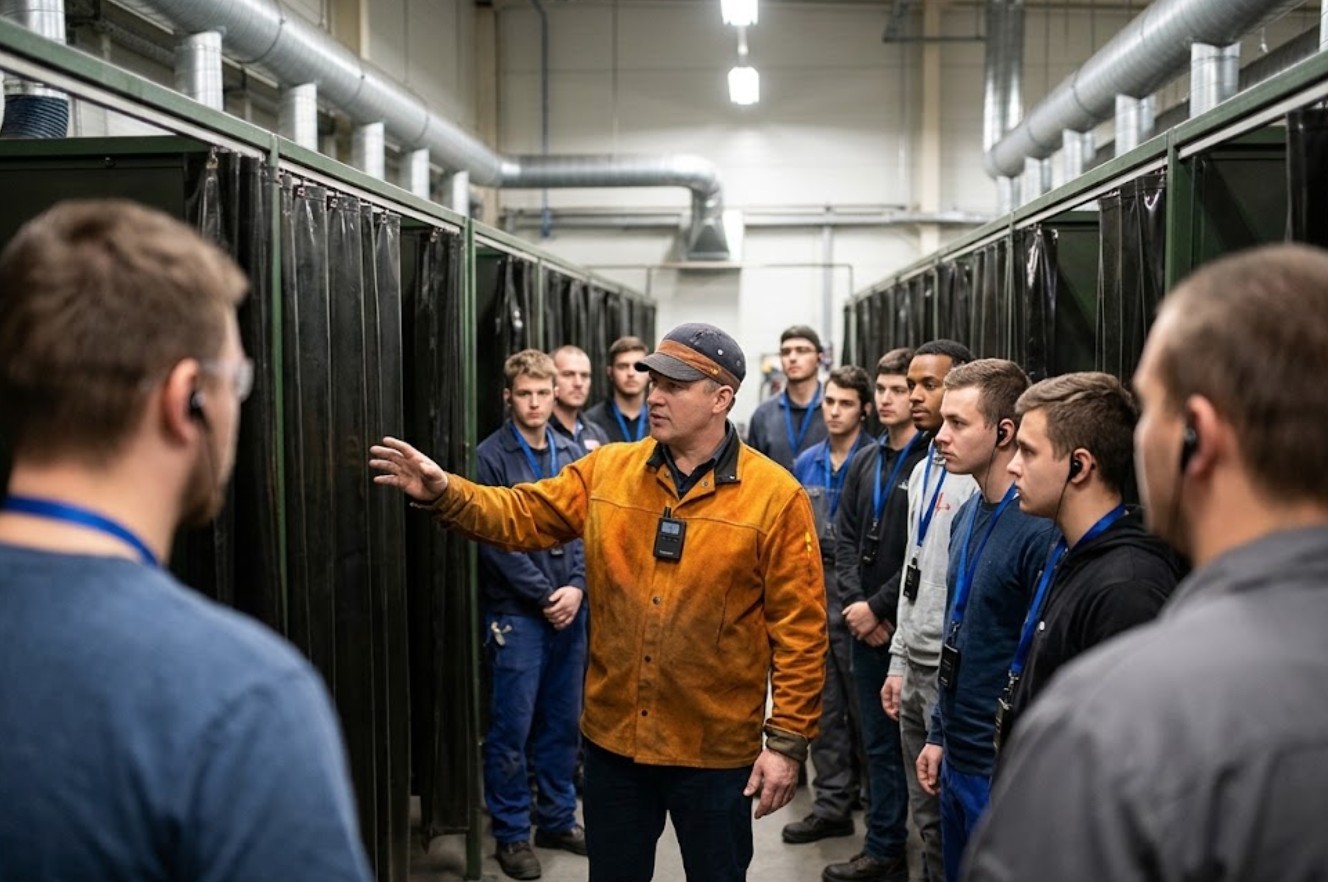
On-Site Deployment: Richitek deployed an industrial-grade UHF wireless fleet. The lead audit engineer used a transmitter and microphone while 18 auditing delegates were equipped with lightweight earhook receivers designed to work alongside normal PPE requirements.

The deployment was designed around the actual movement pattern of the audit rather than around a fixed conference-room environment. Visitors could remain within the designated tour route while the presenter continued explaining production details. This is particularly useful when an audit requires visitors to observe machinery or process controls at the exact location where work is taking place.

In this type of environment, the main value of a wireless factory tour guide system is not simply making the presenter louder. It separates the presenter’s speech from the surrounding mechanical noise and distributes that speech directly to individual receivers. Each visitor can therefore listen at a practical volume without requiring the tour leader to shout across the production floor.

Case Scenario I: IQC Receiving Bays and Material Traceability

Incoming Quality Control is one of the first points at which visitors can see how a manufacturer controls material quality. Receiving docks and IQC areas can also be among the noisiest parts of an industrial facility because of material handling equipment, automated guided vehicles, unpacking operations, pneumatic systems, and frequent movement of components.

During an international supply chain audit, the facility needed to demonstrate its material traceability process and explain AQL sampling procedures to European quality controllers. The challenge was that the visitors needed to remain close to the actual receiving and inspection activities rather than moving into a separate conference room.

A wireless tour guide system allows the lead quality engineer to explain the inspection sequence while the delegation remains together. Visitors can listen to the explanation through their individual receivers while simultaneously checking component information, material records, labels, sampling procedures, or other quality-control details.

Receiving Area

Visitors remain close to the material flow while receiving procedures are explained.

IQC Inspection

Quality engineers can describe sampling and inspection steps without shouting.

Traceability

The delegation can connect the spoken explanation with actual production records.

Case Scenario II: High-Noise Workshop Audits and 8D Corrective Action Tracking

A factory audit does not always follow a predefined showroom route. When a quality issue, process deviation, or engineering question is identified, auditors may need to inspect the relevant workstation immediately. This can place the discussion directly beside CNC machining centers, reflow ovens, assembly equipment, robotic systems, or other production machinery.

In these situations, moving every participant to a conference room creates an additional interruption. The engineering team has to leave the production area, explain the problem away from the equipment, and then return to the workstation. Important details can be lost between the actual process and the discussion.

Richitek's Factory Tour Wireless Audio Solutions are intended for this type of mobile communication. The presenter can continue explaining process information while the visiting team stays within the designated production route. For an 8D investigation, this can make it easier for quality directors, engineers, suppliers, and customer representatives to discuss the same production condition while standing beside the relevant equipment.

The practical advantage is continuity. Instead of separating the technical explanation from the physical production process, the wireless communication system allows the conversation to remain connected to the workstation, process parameter, inspection point, or corrective action being discussed.
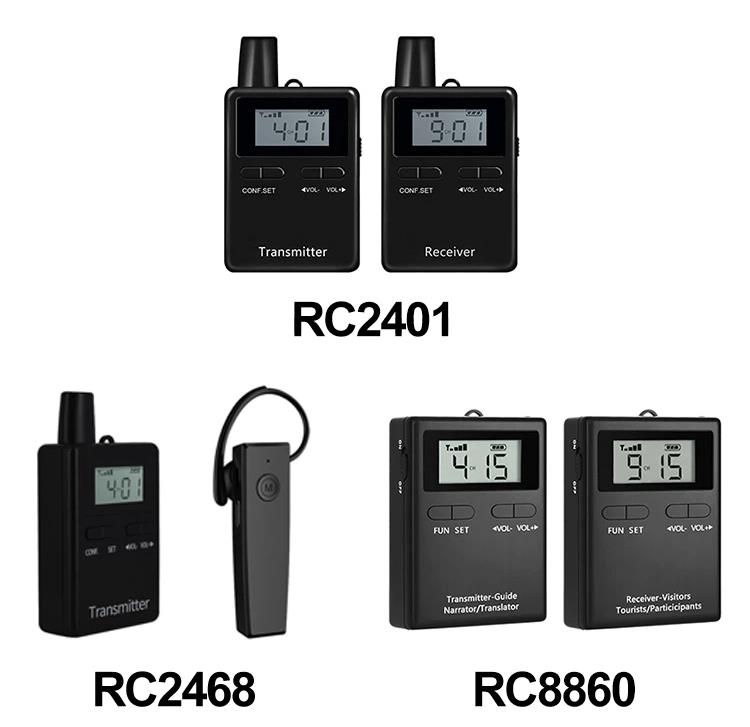
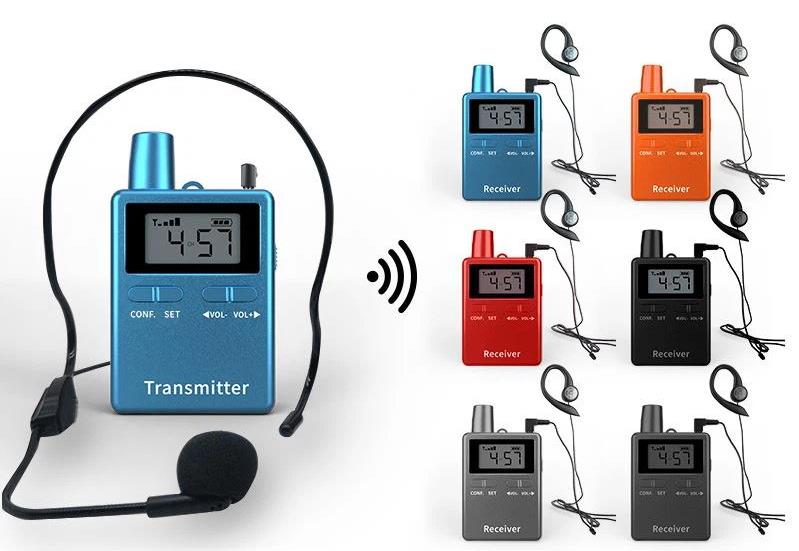
Factory Tour Guide System multi-model wireless fleet

Factory Tour Guide System transmitter and receiver charging kit

Technical Performance Matrix: Communication Challenges in Industrial Environments

Industrial production floors create several communication challenges at the same time. Noise is only one factor. Large machinery, metal structures, changing room layouts, multiple groups, long walking routes, and the need for clean and organized visitor management can all influence the effectiveness of a tour communication setup.

For this reason, a professional wireless tour guide solution should be evaluated according to the complete operating environment. Range, receiver battery operation, hygiene, channel management, transmitter operation, charging procedures, and compatibility with the facility's tour workflow can all influence the overall user experience.

Facilities managing several tour groups should also consider channel organization. If multiple groups operate in adjacent production areas, channel separation becomes important because each presenter should be able to communicate with the intended audience without creating unnecessary audio overlap.

For facilities evaluating different Richitek configurations, the centralized Model Head-to-Head Comparison Guide provides a useful starting point. A more specific comparison such as RC2401 vs RC2406 can also help when a facility needs to evaluate channel capacity and operating requirements between specific models.

Industrial Evaluation VectorLegacy Megaphones / Analog HardwareProfessional Digital Wireless FleetOperational Consideration
Speech ClarityPresenter must compete directly with ambient machinery noise.Speech is distributed directly to individual receivers.Visitors can focus on the explanation without relying on shouted speech.
Group MobilityCommunication becomes difficult as the group spreads out.Wireless receivers allow visitors to move with the tour leader.Useful for long factory routes and multi-area audits.
Battery ManagementDisposable or individually managed batteries can increase operational work.Rechargeable receiver fleets can be organized around centralized charging.Charging routines become part of fleet management.
Visitor HygieneConsumer-style equipment may be harder to integrate into industrial hygiene procedures.Smooth receiver designs can simplify cleaning and shared use.Important for factories operating 5S or controlled-area procedures.
Multi-Group ManagementSeparate groups are difficult to coordinate acoustically.Channel-based operation can support organized group communication.Useful when several tours share adjacent production areas.

How a Factory Tour Guide System Fits Into the Audit Workflow

The most effective deployment is not simply a matter of handing out receivers before a tour. The audio fleet should become part of the facility's visitor-management process. Before the group enters the production area, the coordinator can distribute charged receivers, verify the transmitter and microphone, assign channels where required, and explain basic operating procedures.

01

Pre-Tour Preparation

Charge and organize the receiver fleet, confirm the transmitter, and prepare the required channel configuration.

02

Safety Briefing

Visitors receive the initial safety instructions before entering the active production environment.

03

Production Walkthrough

The presenter explains manufacturing, quality, engineering, and process information while the group moves through the plant.

04

Post-Tour Collection

Receivers are collected, checked, cleaned where required, and returned to the charging workflow.

This workflow is particularly relevant to manufacturers that host recurring customer visits, supplier audits, compliance inspections, training groups, or investor tours. Once the fleet and operating procedure are standardized, the same communication infrastructure can support different visitor groups without rebuilding the entire tour process for every event.

Global Plant Deployment Experience

“We implemented the Richitek UHF system during our intensive annual ISO compliance and electronics assembly audit. The active shop floor generates intense high-frequency interference, but the digital headsets allowed our plant managers to communicate intricate tracking metrics to the auditing committee effortlessly.”

— Senior Plant Operations Director, Electronics Manufacturing Group

“Ensuring visitor safety and maintaining strict 5S protocol across a sprawling 120,000 square foot automotive components plant was a constant logistical headache. With these rugged industrial ear-hooks, our touring groups can hear safety warnings clearly while remaining within the designated pedestrian routes.”

— Head of Corporate Quality & Public Relations

Industrial Procurement FAQ: System Lifecycle and Operations Assessment

Q1: How does the system handle multi-language translation profiles for international audit delegations?

Our industrial transmitters support multi-channel isolation within the same physical building footprint. If an auditing group consists of mixed nationalities, such as Japanese inspectors, German supply chain leads, and local staff, separate interpreters can be assigned to distinct wireless channels. Visitors can select their designated language channel on their personalized receivers and listen to the corresponding translation stream without requiring the entire delegation to remain beside the interpreter.

Q2: What is the projected lifecycle degradation curve for the Richitek factory fleet's battery cells?

Unlike lower-cost retail-grade tour hardware that may rely on continuous alkaline-cell replacement, the professional industrial fleet described in this case is designed around rechargeable high-density lithium polymer cells and integrated Battery Management Systems (BMS). The source case information specifies that these power units are designed to retain more than 80% of their peak energy storage capacity after 500+ full rapid-charge cycles, supporting a dependable long-term operating lifecycle when the charging and maintenance procedure is properly managed.

Q3: Can the master transmitter interface with pre-recorded safety audio loops or central factory PA systems?

Yes. The master transmitters described in the source material include auxiliary (AUX) input capability alongside the standard vocal microphone line. This allows plant coordinators to connect compatible digital media players, smartphones, or central public address sources to the wireless broadcast feed. Pre-recorded safety briefings, corporate introductions, facility information, or other approved audio content can therefore be distributed to visitors through the same receiver fleet used for live explanations.

Selecting the Right Wireless Audio Architecture for Your Factory

Different factories have different communication requirements. A small production workshop may only need a compact transmitter and a limited number of receivers, while a large automotive, electronics, machinery, or industrial-components facility may need a higher-density fleet with organized charging and channel management.

Procurement teams should therefore evaluate the complete visitor workflow instead of selecting equipment based only on nominal wireless range. The number of visitors, expected tour duration, number of simultaneous groups, noise conditions, production-area restrictions, charging requirements, hygiene procedures, language requirements, and integration with existing audio equipment can all affect the final configuration.

For recurring B2B factory tours, the wireless system should also be treated as an operational asset. A clearly defined charging routine, receiver inventory process, cleaning procedure, pre-tour inspection checklist, and post-tour storage process can reduce avoidable problems and help keep the equipment ready for the next delegation.

A Factory Tour Is Also Part of Your Customer Experience

When international buyers and auditors visit a production facility, communication quality influences how easily they can understand the processes they are evaluating. A professional wireless tour guide system helps the host team keep the discussion connected to the production floor while maintaining a more organized visitor experience.

Elevate Your Facility Hospitality and Direct Audit Compliance Success

A high-density factory tour places unusual demands on communication equipment. Visitors need to hear safety instructions and technical explanations while moving through active production areas, and the host team needs a system that can be prepared, operated, charged, cleaned, and reused as part of a repeatable B2B visitor workflow.

Richitek provides professional wireless audio solutions for factory tours, manufacturing facilities, industrial plants, corporate visits, technical demonstrations, compliance audits, and international customer delegations. The company also provides B2B global order fulfillment, tiered factory-direct wholesale pricing, international shipping, and Wireless Audio Device ODM Services for projects requiring customized hardware or branding.

Discuss Your Factory Tour Communication Requirements

Contact the Richitek engineering team for a project assessment, bulk quotation, product configuration discussion, or on-site hardware demonstration.

                   Contact Our Factory Engineering Team                

We specialize in high-noise plant audio architectures and offer complete industrial-grade Wireless Audio Device ODM Services for global corporate facilities.
2025年12月26日 14:21
ꄘ click: 922

Get the spec sheet, MOQ and a factory-direct quote

Tell us the venue, the group size and how many languages you need. An engineer at our Shenzhen factory replies within one business day with the matching model, a written quote, lead time and the CE / RoHS / ISO 9001 documents.

Talk to an engineer WhatsApp +86 189 2287 9583

Prefer email? tiger.wang@richitek.com  |  OEM / ODM, custom tooling and neutral packaging available  |  send the enquiry through our contact page

Shenzhen Rich Age Electronics Co., Ltd. (Richitek) - manufacturing wireless tour guide systems, church translation headsets and museum audio guide equipment since 2007.

Factory Tour Guide System Case Study: Optimizing Acoustic Clarity for Multi-National Supply Chain Audits

time: 2025年12月26日 click:922

In international manufacturing and electronics supply chains, an on-site facility evaluation is rarely a simple visitor tour. Purchasing teams, quality engineers, third-party inspectors, and corporate decision-makers may need to move through receiving areas, production workshops, quality-control stations, cleanrooms, testing areas, and other operational zones while receiving a continuous explanation of manufacturing processes, quality procedures, safety requirements, and engineering capabilities.

The communication challenge becomes particularly serious inside an active factory. Automated equipment, CNC machinery, assembly stations, material handling systems, ventilation equipment, and other industrial infrastructure can create a constant background noise level that makes normal conversation unreliable. Metal structures and enclosed production areas can also make conventional loudspeakers or handheld megaphones uncomfortable and difficult to use.

This case study examines how a professional Factory Tour Guide System can be incorporated into a high-density manufacturing environment. Instead of requiring a tour leader to raise their voice, the wireless audio system creates a direct communication path between the presenter and multiple visitors. This allows purchasing delegates, auditors, investors, and technical visitors to remain focused on the production process while receiving the same explanation at the same time.

Why Factory Audits Require More Than a Conventional Tour Audio Setup

A factory audit is information-intensive. Visitors may need to listen while observing production equipment, checking material labels, reviewing process controls, asking technical questions, and following strict pedestrian or cleanroom procedures. A suitable wireless tour guide system therefore needs to support clear speech, group mobility, practical battery management, simple operation, and reliable communication across different areas of the facility.

Factory Tour Guide System for industrial factory audits

International Case Profile: Tier-1 Automotive and SMT Cleanroom Compliance Audit

Execution Date: September 12-15, 2025

Location & Facility: High-Precision Industrial Park, Stuttgart, Germany

Context & Challenge: The facility was undergoing a multi-day VDA 6.3 compliance audit involving a European purchasing delegation. The tour route included high-noise IQC bays and sensitive SMT production areas where ESD and 5S procedures had to be maintained. Ambient floor noise was reported to reach approximately 85dB around automated production equipment, making conventional face-to-face communication difficult.

On-Site Deployment: Richitek deployed an industrial-grade UHF wireless fleet. The lead audit engineer used a transmitter and microphone while 18 auditing delegates were equipped with lightweight earhook receivers designed to work alongside normal PPE requirements.

The deployment was designed around the actual movement pattern of the audit rather than around a fixed conference-room environment. Visitors could remain within the designated tour route while the presenter continued explaining production details. This is particularly useful when an audit requires visitors to observe machinery or process controls at the exact location where work is taking place.

In this type of environment, the main value of a wireless factory tour guide system is not simply making the presenter louder. It separates the presenter’s speech from the surrounding mechanical noise and distributes that speech directly to individual receivers. Each visitor can therefore listen at a practical volume without requiring the tour leader to shout across the production floor.

Case Scenario I: IQC Receiving Bays and Material Traceability

Incoming Quality Control is one of the first points at which visitors can see how a manufacturer controls material quality. Receiving docks and IQC areas can also be among the noisiest parts of an industrial facility because of material handling equipment, automated guided vehicles, unpacking operations, pneumatic systems, and frequent movement of components.

During an international supply chain audit, the facility needed to demonstrate its material traceability process and explain AQL sampling procedures to European quality controllers. The challenge was that the visitors needed to remain close to the actual receiving and inspection activities rather than moving into a separate conference room.

A wireless tour guide system allows the lead quality engineer to explain the inspection sequence while the delegation remains together. Visitors can listen to the explanation through their individual receivers while simultaneously checking component information, material records, labels, sampling procedures, or other quality-control details.

Receiving Area

Visitors remain close to the material flow while receiving procedures are explained.

IQC Inspection

Quality engineers can describe sampling and inspection steps without shouting.

Traceability

The delegation can connect the spoken explanation with actual production records.

Case Scenario II: High-Noise Workshop Audits and 8D Corrective Action Tracking

A factory audit does not always follow a predefined showroom route. When a quality issue, process deviation, or engineering question is identified, auditors may need to inspect the relevant workstation immediately. This can place the discussion directly beside CNC machining centers, reflow ovens, assembly equipment, robotic systems, or other production machinery.

In these situations, moving every participant to a conference room creates an additional interruption. The engineering team has to leave the production area, explain the problem away from the equipment, and then return to the workstation. Important details can be lost between the actual process and the discussion.

Richitek's Factory Tour Wireless Audio Solutions are intended for this type of mobile communication. The presenter can continue explaining process information while the visiting team stays within the designated production route. For an 8D investigation, this can make it easier for quality directors, engineers, suppliers, and customer representatives to discuss the same production condition while standing beside the relevant equipment.

The practical advantage is continuity. Instead of separating the technical explanation from the physical production process, the wireless communication system allows the conversation to remain connected to the workstation, process parameter, inspection point, or corrective action being discussed.

Factory Tour Guide System multi-model wireless fleet

Factory Tour Guide System transmitter and receiver charging kit

Technical Performance Matrix: Communication Challenges in Industrial Environments

Industrial production floors create several communication challenges at the same time. Noise is only one factor. Large machinery, metal structures, changing room layouts, multiple groups, long walking routes, and the need for clean and organized visitor management can all influence the effectiveness of a tour communication setup.

For this reason, a professional wireless tour guide solution should be evaluated according to the complete operating environment. Range, receiver battery operation, hygiene, channel management, transmitter operation, charging procedures, and compatibility with the facility's tour workflow can all influence the overall user experience.

Facilities managing several tour groups should also consider channel organization. If multiple groups operate in adjacent production areas, channel separation becomes important because each presenter should be able to communicate with the intended audience without creating unnecessary audio overlap.

For facilities evaluating different Richitek configurations, the centralized Model Head-to-Head Comparison Guide provides a useful starting point. A more specific comparison such as RC2401 vs RC2406 can also help when a facility needs to evaluate channel capacity and operating requirements between specific models.

Industrial Evaluation VectorLegacy Megaphones / Analog HardwareProfessional Digital Wireless FleetOperational Consideration
Speech ClarityPresenter must compete directly with ambient machinery noise.Speech is distributed directly to individual receivers.Visitors can focus on the explanation without relying on shouted speech.
Group MobilityCommunication becomes difficult as the group spreads out.Wireless receivers allow visitors to move with the tour leader.Useful for long factory routes and multi-area audits.
Battery ManagementDisposable or individually managed batteries can increase operational work.Rechargeable receiver fleets can be organized around centralized charging.Charging routines become part of fleet management.
Visitor HygieneConsumer-style equipment may be harder to integrate into industrial hygiene procedures.Smooth receiver designs can simplify cleaning and shared use.Important for factories operating 5S or controlled-area procedures.
Multi-Group ManagementSeparate groups are difficult to coordinate acoustically.Channel-based operation can support organized group communication.Useful when several tours share adjacent production areas.

How a Factory Tour Guide System Fits Into the Audit Workflow

The most effective deployment is not simply a matter of handing out receivers before a tour. The audio fleet should become part of the facility's visitor-management process. Before the group enters the production area, the coordinator can distribute charged receivers, verify the transmitter and microphone, assign channels where required, and explain basic operating procedures.

01

Pre-Tour Preparation

Charge and organize the receiver fleet, confirm the transmitter, and prepare the required channel configuration.

02

Safety Briefing

Visitors receive the initial safety instructions before entering the active production environment.

03

Production Walkthrough

The presenter explains manufacturing, quality, engineering, and process information while the group moves through the plant.

04

Post-Tour Collection

Receivers are collected, checked, cleaned where required, and returned to the charging workflow.

This workflow is particularly relevant to manufacturers that host recurring customer visits, supplier audits, compliance inspections, training groups, or investor tours. Once the fleet and operating procedure are standardized, the same communication infrastructure can support different visitor groups without rebuilding the entire tour process for every event.

Global Plant Deployment Experience

“We implemented the Richitek UHF system during our intensive annual ISO compliance and electronics assembly audit. The active shop floor generates intense high-frequency interference, but the digital headsets allowed our plant managers to communicate intricate tracking metrics to the auditing committee effortlessly.”

— Senior Plant Operations Director, Electronics Manufacturing Group

“Ensuring visitor safety and maintaining strict 5S protocol across a sprawling 120,000 square foot automotive components plant was a constant logistical headache. With these rugged industrial ear-hooks, our touring groups can hear safety warnings clearly while remaining within the designated pedestrian routes.”

— Head of Corporate Quality & Public Relations

Industrial Procurement FAQ: System Lifecycle and Operations Assessment

Q1: How does the system handle multi-language translation profiles for international audit delegations?

Our industrial transmitters support multi-channel isolation within the same physical building footprint. If an auditing group consists of mixed nationalities, such as Japanese inspectors, German supply chain leads, and local staff, separate interpreters can be assigned to distinct wireless channels. Visitors can select their designated language channel on their personalized receivers and listen to the corresponding translation stream without requiring the entire delegation to remain beside the interpreter.

Q2: What is the projected lifecycle degradation curve for the Richitek factory fleet's battery cells?

Unlike lower-cost retail-grade tour hardware that may rely on continuous alkaline-cell replacement, the professional industrial fleet described in this case is designed around rechargeable high-density lithium polymer cells and integrated Battery Management Systems (BMS). The source case information specifies that these power units are designed to retain more than 80% of their peak energy storage capacity after 500+ full rapid-charge cycles, supporting a dependable long-term operating lifecycle when the charging and maintenance procedure is properly managed.

Q3: Can the master transmitter interface with pre-recorded safety audio loops or central factory PA systems?

Yes. The master transmitters described in the source material include auxiliary (AUX) input capability alongside the standard vocal microphone line. This allows plant coordinators to connect compatible digital media players, smartphones, or central public address sources to the wireless broadcast feed. Pre-recorded safety briefings, corporate introductions, facility information, or other approved audio content can therefore be distributed to visitors through the same receiver fleet used for live explanations.

Selecting the Right Wireless Audio Architecture for Your Factory

Different factories have different communication requirements. A small production workshop may only need a compact transmitter and a limited number of receivers, while a large automotive, electronics, machinery, or industrial-components facility may need a higher-density fleet with organized charging and channel management.

Procurement teams should therefore evaluate the complete visitor workflow instead of selecting equipment based only on nominal wireless range. The number of visitors, expected tour duration, number of simultaneous groups, noise conditions, production-area restrictions, charging requirements, hygiene procedures, language requirements, and integration with existing audio equipment can all affect the final configuration.

For recurring B2B factory tours, the wireless system should also be treated as an operational asset. A clearly defined charging routine, receiver inventory process, cleaning procedure, pre-tour inspection checklist, and post-tour storage process can reduce avoidable problems and help keep the equipment ready for the next delegation.

A Factory Tour Is Also Part of Your Customer Experience

When international buyers and auditors visit a production facility, communication quality influences how easily they can understand the processes they are evaluating. A professional wireless tour guide system helps the host team keep the discussion connected to the production floor while maintaining a more organized visitor experience.

Elevate Your Facility Hospitality and Direct Audit Compliance Success

A high-density factory tour places unusual demands on communication equipment. Visitors need to hear safety instructions and technical explanations while moving through active production areas, and the host team needs a system that can be prepared, operated, charged, cleaned, and reused as part of a repeatable B2B visitor workflow.

Richitek provides professional wireless audio solutions for factory tours, manufacturing facilities, industrial plants, corporate visits, technical demonstrations, compliance audits, and international customer delegations. The company also provides B2B global order fulfillment, tiered factory-direct wholesale pricing, international shipping, and Wireless Audio Device ODM Services for projects requiring customized hardware or branding.

Discuss Your Factory Tour Communication Requirements

Contact the Richitek engineering team for a project assessment, bulk quotation, product configuration discussion, or on-site hardware demonstration.

                   Contact Our Factory Engineering Team                

We specialize in high-noise plant audio architectures and offer complete industrial-grade Wireless Audio Device ODM Services for global corporate facilities.

Get the spec sheet, MOQ and a factory-direct quote

Tell us the venue, the group size and how many languages you need. An engineer at our Shenzhen factory replies within one business day with the matching model, a written quote, lead time and the CE / RoHS / ISO 9001 documents.

Talk to an engineer WhatsApp +86 189 2287 9583

Prefer email? tiger.wang@richitek.com  |  OEM / ODM, custom tooling and neutral packaging available  |  send the enquiry through our contact page

Shenzhen Rich Age Electronics Co., Ltd. (Richitek) - manufacturing wireless tour guide systems, church translation headsets and museum audio guide equipment since 2007.

×

Contact us

email:
name:
subject:
content: