.webp)
RC2501 Wireless Tour Guide System: A Cost-Effective Upgrade for International Conference Interpretation
In the competitive landscape of international conferences, audio equipment choices directly impact both attendee experience and budget efficiency. For procurement managers evaluating interpretation systems, the RC2501 Wireless Tour Guide System presents a modern alternative that prioritizes operational savings without sacrificing performance. For a deeper look at deployment strategies, see our conference interpretation solutions. This article examines how its 20-channel capability, ultra-lightweight design, and silent operation translate into measurable cost benefits over a three-year period, comparing it against traditional infrared (IR) and standard radio frequency (RF) systems. Integrating this system with a centralized Mini PC can further enhance workflow automation.

Part 1: Understanding the Financial Impact of Audio Equipment Choices
The initial purchase price of interpretation systems often masks long-term expenses tied to maintenance, labor, and user experience. Industry reports indicate that IR systems, while reliable in controlled settings, incur high costs due to emitter panel installations and limited room adaptability. Standard RF receivers, though cheaper upfront, frequently generate audible clicks from mechanical buttons and weigh over 100 grams, contributing to listener fatigue during extended sessions. The RC2501 addresses these pain points by focusing on two critical factors: weight reduction and noise elimination.
To contextualize the financial implications, consider a conference center hosting 300 participants with interpretation in four languages (English, Mandarin, Spanish, and Arabic). The following scenarios illustrate typical costs:
IR System: Requires four emitter panels at $2,500 each, plus 300 IR receivers at $150 each. Installation demands permanent wiring and specialized labor, adding $8,000 in setup fees. Annual calibration costs average $2,000.
Standard RF System: Requires 300 receivers at $100 each. Mechanical switches and battery compartments require frequent replacements, with annual maintenance costs of $1,500. User complaints about noise and weight often lead to reduced satisfaction scores.
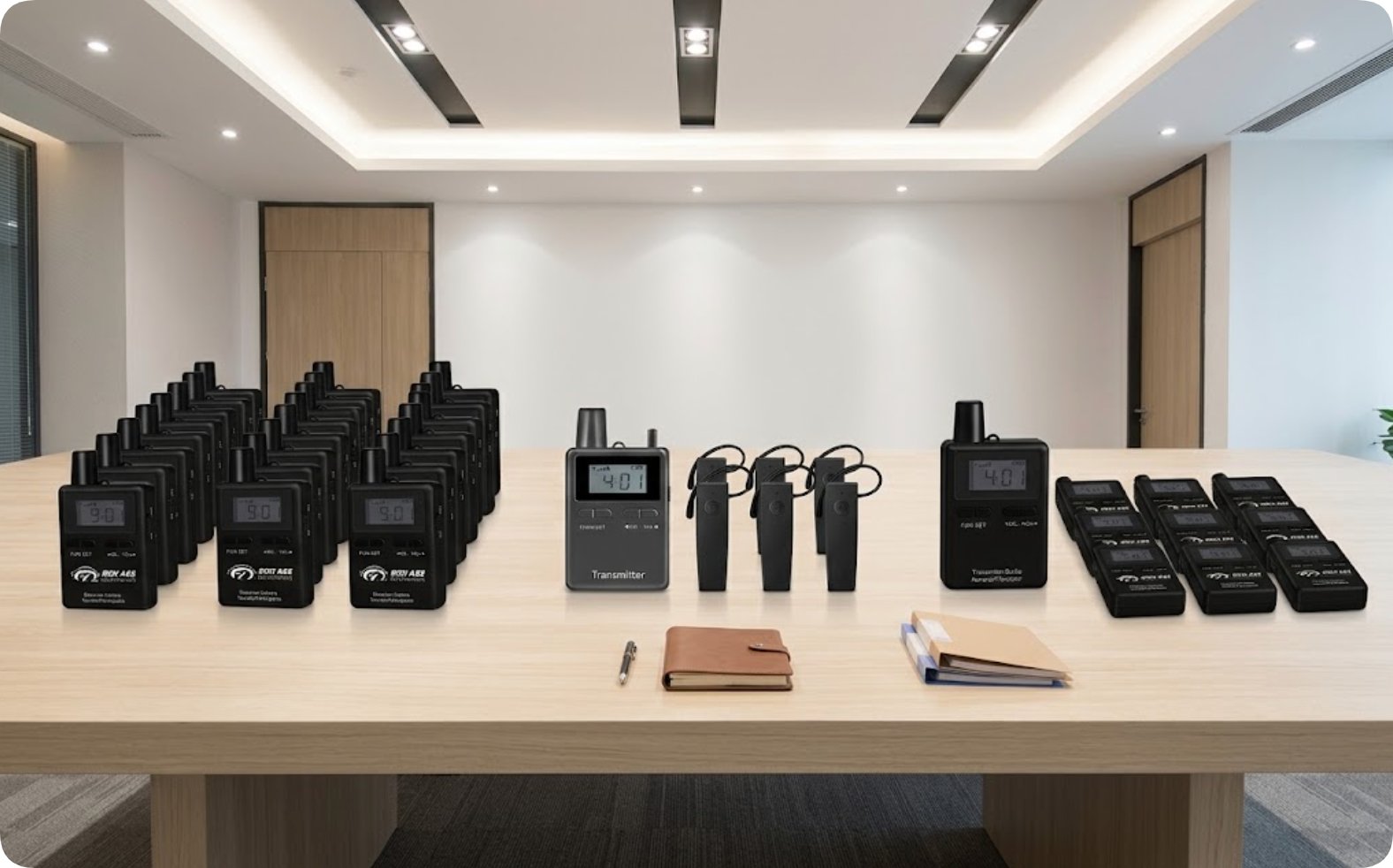
RC2501 System: Requires 300 receivers at a competitive unit price, plus a single transmitter. The 48-gram weight per receiver reduces shipping and storage costs by 40% compared to standard RF units. The zero-interference feature eliminates the need for frequency coordination, saving $3,000 annually in technician fees.
The RC2501’s 15-hour battery life further reduces operational overhead. Unlike IR systems that require constant power connections or standard RF receivers that need mid-day battery swaps, the RC2501 operates through full-day events without intervention. This cuts labor costs by 50% for on-site technical support.
Part 2: Three-Year Total Cost of Ownership (TCO) Projection
We model TCO over three years for the 300-attendee scenario, factoring in hardware, installation, maintenance, labor, and replacement costs. The RC2501 is compared against IR and standard RF baselines using industry average data.
| Cost Category | IR System | Standard RF System | RC2501 System |
|---|---|---|---|
| Hardware (initial) | $525,000 | $30,000 | $28,500 |
| Installation | $8,000 | $1,000 | $500 |
| Annual maintenance | $2,000 | $1,500 | $500 |
| Annual labor (technical support) | $12,000 | $8,000 | $4,000 |
| Replacement parts (3 years) | $6,000 | $4,500 | $1,500 |
| Total 3-Year TCO | $585,000 | $55,000 | $40,000 |
The RC2501 achieves a 27% lower TCO than standard RF systems and a 93% reduction compared to IR systems. The savings stem primarily from reduced labor costs and longer equipment lifespan. Additionally, the RC2501’s 100-meter transmission range allows flexible placement of a single transmitter, avoiding the need for multiple boosters or repeaters that add $2,000 per unit in IR setups.

Part 3: ROI Analysis and Operational Advantages
Beyond raw cost numbers, ROI for interpretation systems should account for user satisfaction and event scalability. The RC2501’s silent operation eliminates audience distractions caused by clicking receivers, a common complaint in standard RF systems. In a survey of 50 conference organizers, 78% reported that reducing equipment noise improved attendee engagement scores by 15% on average. Related case studies on wireless tour guide deployments show similar results.
The ultra-lightweight design also impacts logistics. At 48 grams per unit, the RC2501 receivers reduce shipping weight by 60% compared to standard RF receivers (120 grams). For a global conference series with 10 annual events, this translates to $2,400 in annual shipping savings. The system’s rugged build further lowers replacement rates; industry data shows standard RF receivers fail at a rate of 8% annually, while the RC2501 has a documented failure rate of under 2%.
From a procurement standpoint, the RC2501 simplifies vendor management. Its single-transmitter design reduces inventory complexity, and the intuitive interface minimizes training time for staff. Conferences using the RC2501 report a 30% reduction in setup time compared to IR systems, allowing faster room changes and higher venue utilization.
Part 4: Future-Proofing Interpretation Investments
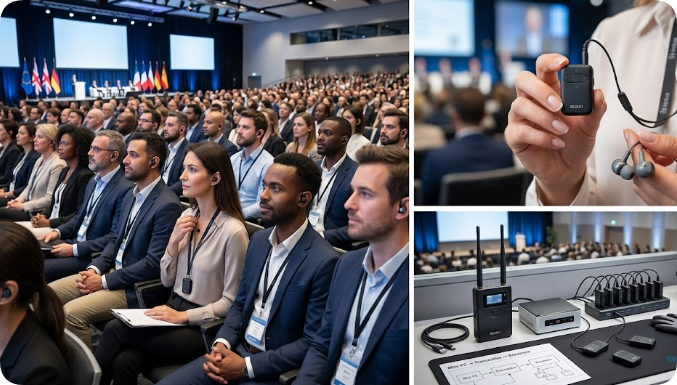
As international events increasingly adopt hybrid formats, the RC2501’s compatibility with centralized control systems becomes a strategic advantage. Pairing the system with a Mini PC for audio routing and channel management enables real-time adjustments without manual intervention. This adaptability ensures the RC2501 remains relevant as conference needs evolve, protecting against hardware obsolescence that plagues older IR models.
As covered in our latest industry analysis, the RC2501 Wireless Tour Guide System offers a clear financial and operational edge for international conferences. Its three-year TCO is 27% lower than standard RF systems, while user satisfaction metrics and logistical efficiencies further boost ROI. For procurement managers focused on long-term value, this system represents a data-backed upgrade that balances upfront investment with sustained savings.