.webp)
A public consultation in a civic hall is one of the few events where an audio system is asked to do a job it cannot do well. The room is hard-surfaced by construction: a polished floor, a stage, a lectern microphone already bolted to the floor, and eighty to two hundred people who all need to hear one resident at the back without raising their voice. What the chair needs is a verbatim record, because a planning objection that was misheard at the microphone becomes a dispute six months later about what was actually said.
That requirement changes the equipment question. A guide system is built for a group that moves together and stays quiet. A hearing is a room where the audience is supposed to talk back, one person at a time, from a fixed point or not at all. Below is how three very different units are judged against that room, using only figures each manufacturer publishes, and where the honest answer is that one of them does not belong at all.
The Comment Must Reach the Back Row Before It Is Typed
Start with the ordinary failure. A resident speaks for ninety seconds, and somewhere between the front row and the back the commentary is gone. The chair repeats the question, the resident answers to the room rather than to the panel, and the two halves of the exchange stop being the same exchange. Nothing is broken and nothing is recorded wrong; the recording is simply incomplete.
In a hard room this is harder than it sounds, because the surfaces that make the space pleasant to speak in are the same surfaces that scatter and reflect speech. A room designed for a lecture is not the same as a room designed for a hearing, and the difference is not covered by any figure on a product page. It is covered by standing in the room, which is why the walk-through below is the operative test rather than the specification table.
There is a second failure that matters more and gets less attention. The system is expected to produce a verbatim record, not just an intelligible one. That means every comment has to reach a recording point as it is spoken, including the ones spoken quietly by residents who have not used a microphone before and do not intend to use one again.
A Roving Handset With No Fixed Position to Return To
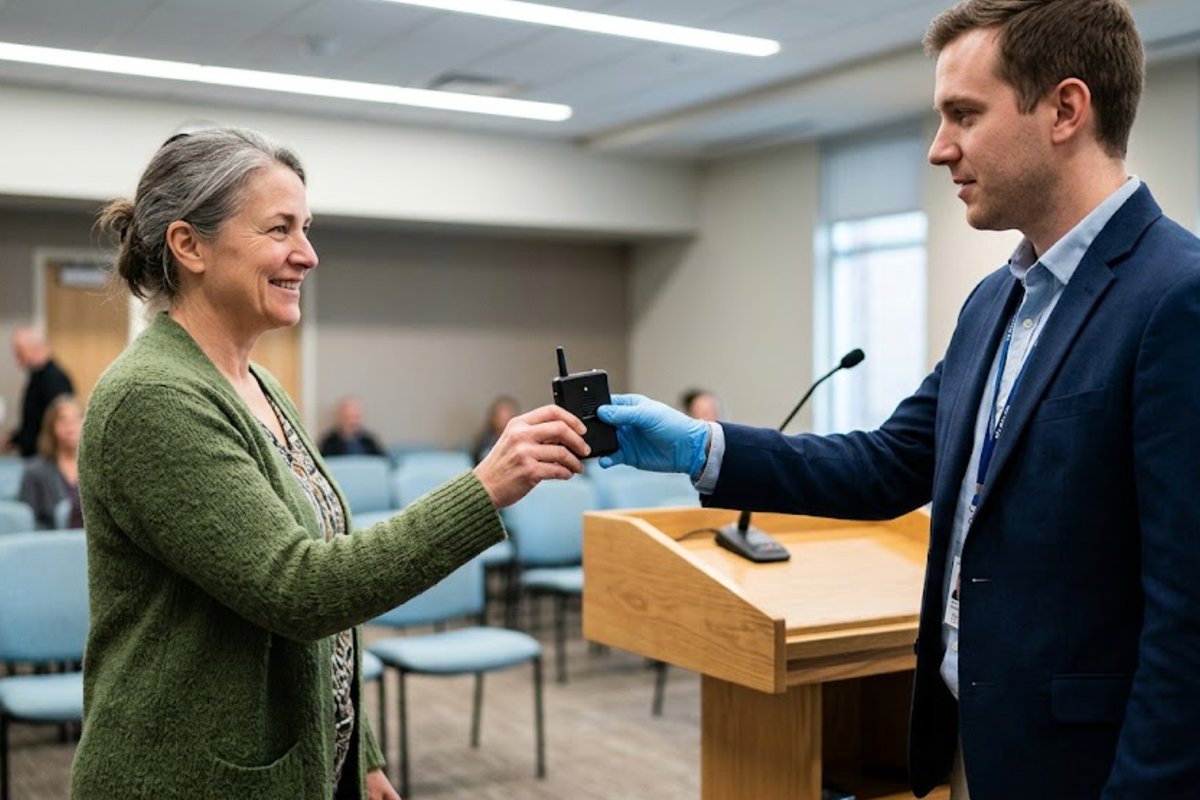
The instinctive response to a room like this is to hand a microphone to whoever is speaking. It is what happens at most public meetings, and it fails in a specific way: the person holding it has to be handed back before the next person can be heard, and the gap between those two moments is where the chair says something into a room that cannot hear it.
A wireless handset solves the return problem. There is no cable, so the unit can pass from the front row to the back row within the time it takes somebody to stand up, and the chair never has to wait for a microphone to be recovered. In a room where three or four speakers are expected in the first hour, that difference is worth more than any audio specification in this article.
What a handset does not solve is the return of the audio to a recording device. A handset carries audio from the speaker to the audience. A verbatim record requires the same audio to arrive at a recorder, which is a separate path and, in most published configurations, a separate piece of equipment that has to be specified explicitly rather than assumed to be included.
A Keypad System Breaks Down When a Resident Will Not Press
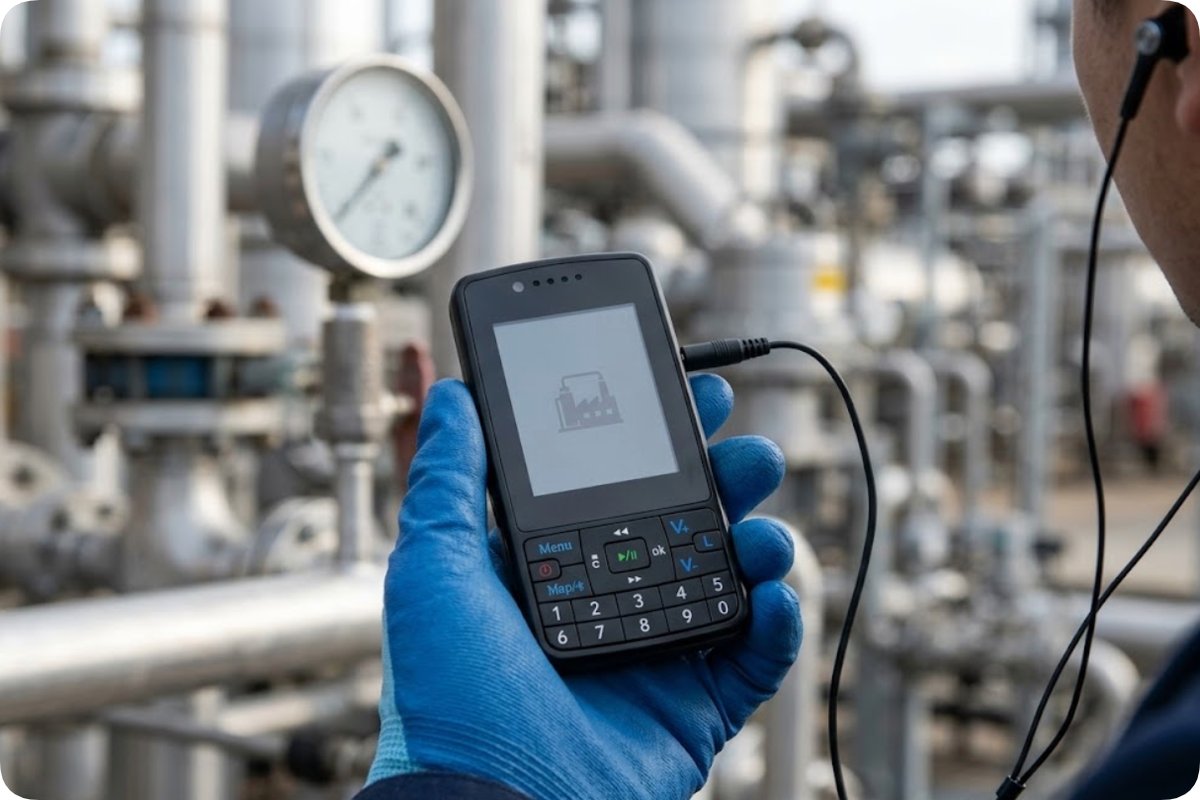
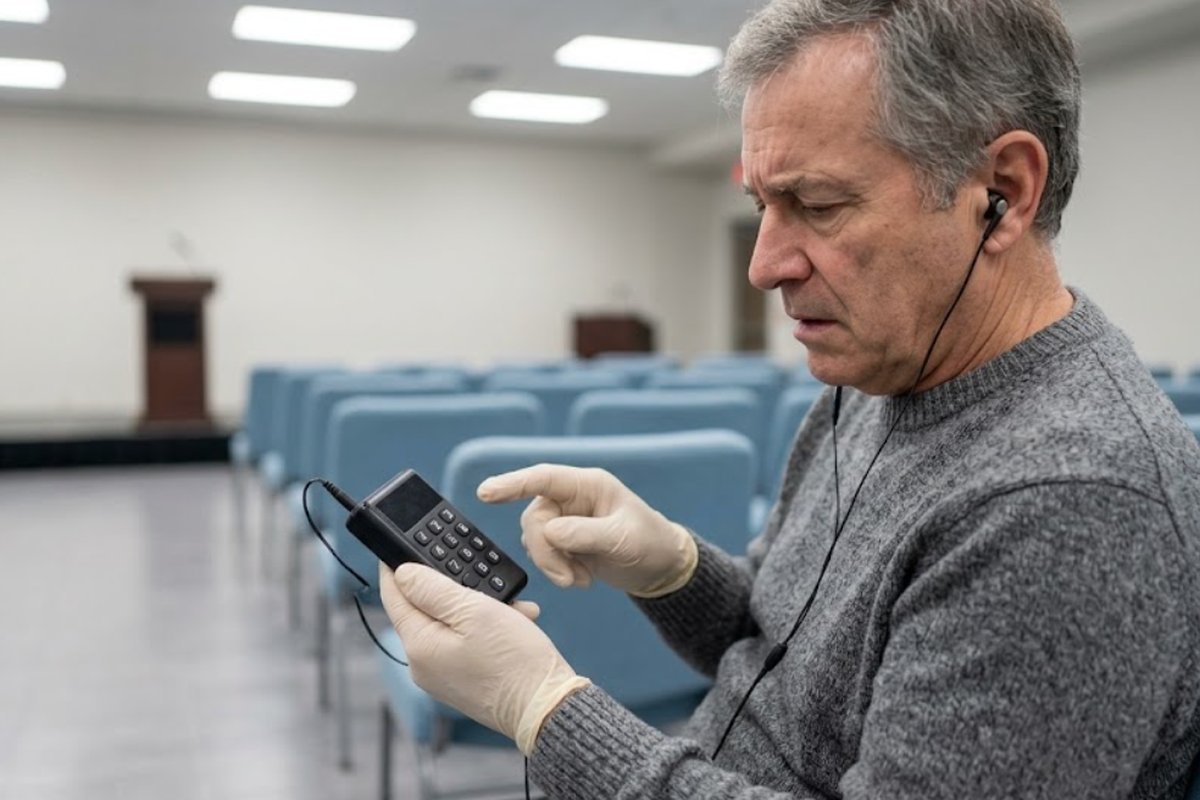
The 2.8-Inch Semi-Auto Digital Audio Guide is a good fit for a different event entirely, and it is worth being clear about why it is not a fit for this one. Its published configuration is a 0-9 numeric keypad that triggers playback from internal memory, 2GB of storage, capacity for up to 9999 audio files, up to 16 languages, up to 18 hours of operation on a full charge through a Micro USB interface, and earphones supplied in the box.
Every one of those figures describes a self-paced visitor experience. The user presses a number, something plays, and nothing is transmitted because there is no transmitter. In a gallery that is exactly right. In a civic hall it fails at a single point: the resident who has never pressed anything like it.
A resident who does not understand the keypad does not ask a question on the microphone; they stop, and they are recorded as not having spoken at all. A consultation that quietly loses its elderly, its first-time speakers and anyone who does not want to touch a borrowed device is not a record of the meeting, it is a record of the people who were comfortable with the equipment. That is the specific reason a keypad system belongs in the exhibition hall next door and not in this room.
Fifty Channels Are a Routing Decision, Not a Distance One
Both wireless units here operate on the same 2.4GHz band from 2403 to 2483 MHz, and both publish 50 channels and a transmission distance of 1-200 metres. That channel figure is usually read as a capacity number for large venues, and in a civic hall it is almost irrelevant. Two hundred residents in one room is one group on one channel; the channel count is insurance against interference, not a measure of how many people can listen.
What actually decides the channel assignment is what else is transmitting in the building. A hall that is also used for bookable meetings may have a second system in the cupboard. A neighbouring room with a karaoke system on the same band will appear in the same air as your consultation, and 50 channels give room to step around it, while 20 does not. The planning question is therefore not how many channels we have, it is who else is in the building.
🔍 With Only Twenty Channels, Capacity Is Not the Problem
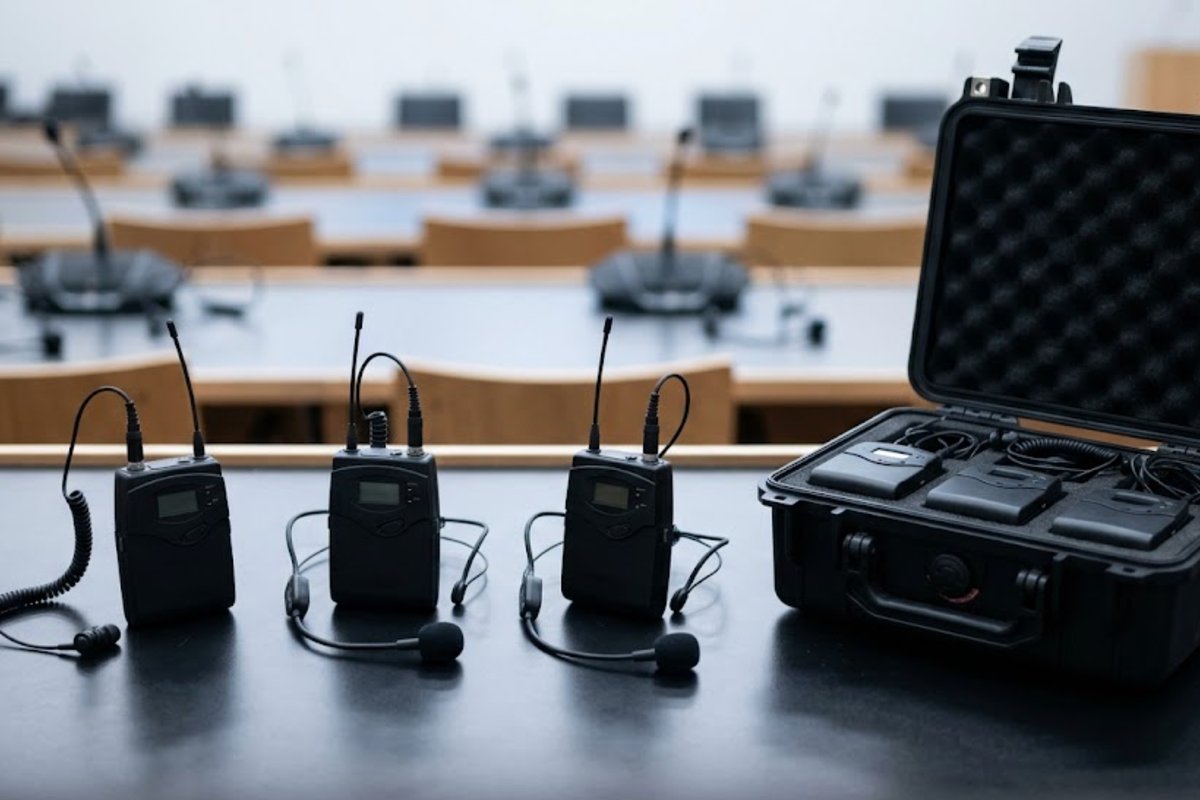
It is worth saying what a low channel count is and is not. Twenty channels is not a weakness in a small hall. It is a weakness in a hall that shares a band with an industrial site, a large exhibition hall with a dozen simultaneous tours, or any building where unlicensed devices accumulate. Where the whole channel allocation of the building fits inside twenty, the additional thirty buy nothing that can be demonstrated.
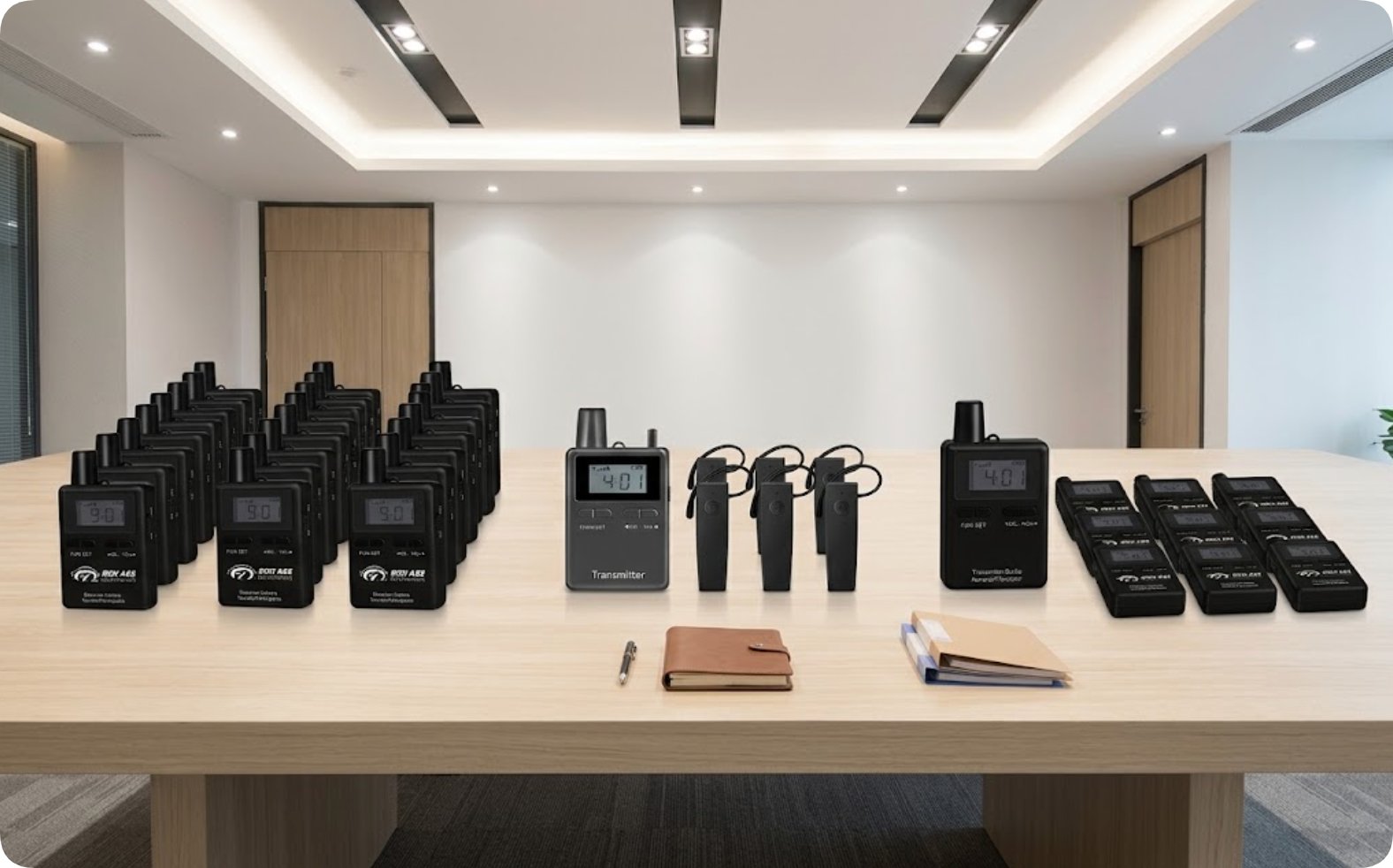
The published figures that do separate the two units are battery life and output power rather than channels. The RC2501 Wireless Tour Guide System publishes 13mW output against 10mW for the RICH AGE RC2401 Wireless Audio Guide System, and its receiver battery figure is 35 hours or more against 20 hours. A consultation is rarely more than three hours, so the battery difference is not decisive either, and the honest conclusion is that the two units are separated by specification rather than by capability for this room.
The difference that does matter operationally is the microphone. The RC2501 publishes an optional headset or lapel microphone arrangement; the RC2401 is published as a basic 2.4GHz standard version with no professional microphone listed. A chair who speaks into a lapel microphone for three hours needs the lapel, and this is the row to check before comparing anything else.
The Figures Behind the Three Choices
The keypad player is not a wireless system and has no channels, no output power and no transmission range, so the table below lays out the comparison by role rather than by a channel-for-channel match. Where a figure is not published, the row says so instead of estimating it.
| What the hearing has to decide | RC2501 | RC2401 | 2.8-Inch Semi-Auto Player |
|---|---|---|---|
| Live comment to the back of the room | Supported, 2.4GHz system | Supported, 2.4GHz system | Not applicable, no transmitter |
| Audio reaches a recording point | Requires a separately specified recording path | Requires a separately specified recording path | Not applicable, playback only |
| Resident who will not touch equipment | Handed a handset or a microphone | Handed a handset or a microphone | Will not participate |
| Published band | 2403-2483 MHz | 2403-2483 MHz | Not applicable |
| Published channels | 50 | 50 | Not applicable |
| Published output power | 13mW | 10mW | Not applicable |
| Published transmission range | 1-200m | 1-200m | Not applicable |
| Transmitter battery | 15h, 3.7V 1500mAh | 10h, 3.7V 1500mAh | Not applicable, single device |
| Receiver battery | 35h or more, 3.7V 1000mAh | 20h, 3.7V 1000mAh | Not applicable, single device |
| Weights, transmitter and receiver | 47g and 47g | 59g and 50g | Not published |
| Frequency response | 20Hz-200kHz | Transmit 50Hz-200kHz, receive 50Hz-12kHz | Not published |
| Microphone arrangement | Optional headset or lapel microphone | Not listed, basic standard version | Earphones supplied in the box |
| Listed receiver sensitivity | Approx. -38dBm | Not separately published | Not published |
| Charging interface | Type-C | DC port | Micro USB |
| Content capacity | 50 numbered channels | 50 numbered channels | 9999 files, 16 languages, 2GB |
| Declared operating time | 15h transmit, 35h+ receive | 10h transmit, 20h receive | Up to 18h continuous |
Three rows deserve a note rather than a reading. The RC2501's published receiver sensitivity is approximately -38dBm, which is a different figure in kind from the sub-100dBm sensitivities quoted by some other models in this range; no comparison should be drawn between them without asking what was measured. Neither wireless unit publishes a storage figure for recorded audio, because neither is where the recording is held. And the keypad player's weight, response range and any ingress rating are absent from its product page, so they are absent from this table rather than filled in.
Read down the columns and the decision is mostly about the third column. If this is a walk-through, a self-paced exhibition or a multi-language visitor route, the keypad player is the cheapest and the simplest answer. If this is a meeting where people are expected to speak, it should not be in the quotation at all.
What Has to Be Settled Before the Doors Open
How many people are expected, and does that number change between the scheduled session and the largest meeting of the year? A council that books a hall for a consultation and gets three hundred people at a second hearing has a different problem from the one it planned for, and the receiver count is the row that quietly determines the budget.
Where does the audio go in order to be recorded, and is that device part of this purchase or a separate one? This is the single most commonly missed item in guide system quotations for hearings. A system that distributes audio beautifully and records nothing has not solved the problem that brought the council to the meeting.
Who is chairing, and will they speak into a lavalier or a handheld microphone? A lavalier changes the requirement to a professional microphone arrangement, and only one of the two wireless units here publishes one as an option. A handheld changes nothing except the recovery problem.
Is the building shared with any other bookable room that transmits on the same band? That determines whether fifty channels is comfortable or whether someone else in the building already owns the lower half of the allocation.
Questions Worth Asking the Audio Supplier
Can the same audio be routed to a recorder as well as to the receivers, and is that routing in the quoted configuration or an option? Ask for it in writing during quotation, not after the room has been booked.
What is the measured sensitivity of the receiver, and what was measured? A published sensitivity figure with no test condition attached is a number for a marketing page rather than a number for a tender document, and the two wireless sets in this comparison are not directly comparable on it.
How is a channel plan written for a building, and can it be printed and handed to whoever opens the hall on the day? The person at the lectern at seven in the evening is not the person who configured the system, and a plan that exists only in a supplier's laptop is a plan that will not be followed.
And what happens when a resident refuses the equipment? If the answer is that the chair hands them a microphone, the room is covered. If the answer is that the audio goes through the system or it does not go anywhere, the meeting will record a smaller cross-section of the room than attended it, which is the outcome nobody in the room intends.
Every figure in this comparison is published rather than measured, which is the right place to start a specification and the wrong place to end one. Standing in the room, with the microphones that will actually be used, is worth more than another page of a quotation.
For the surrounding systems used in meeting rooms and conference settings, the conference wireless audio solutions page covers the wider options, and the complete transmitter and receiver range is listed under wireless tour guide systems.