A leading China factory specializing in Wireless Tour Guide Systems, Church Audio Guides, and Translation Headphones with premium OEM/ODM solutions.

Tel:+86 18922879583

Email:tiger.wang@richitek.com

RC085, RC2402 and a 2.8-Inch Semi-Auto Guide: What a Refinery Turnaround Decides About Kit

A refinery turnaround is the one tour slot that cannot be moved. A delegation from a licensing authority, an insurer's surveyor or a partner plant arrives in the week when the crude unit is drained, the catalyst is off-loaded and every scaffold is down. That week is also the only week a visitor can walk the process area at all. For six days the plant is quiet enough to hear somebody talk, and for six days the escort team has to make that conversation audible to eight people wearing mandatory hearing protection.

That deadline changes which equipment gets loaded onto the crate, and it does so in ways that have little to do with audio quality. A guide set chosen for a permanent gallery has to survive a compressed schedule, a rising dust load, a concrete floor and a permit boundary that may move twice. Below is how three very different units are actually judged against that week, using only figures each manufacturer publishes.

A Refinery Stops for Six Days and That Is the Whole Budget

Every other venue buys audio equipment against a calendar year. A turnaround site buys it against a fortnight that is negotiated between two production departments and then confirmed by a permit. Miss the window and the delegation does not reschedule; it goes home and the file is closed. That asymmetry changes the arithmetic before any specification is opened.

The practical consequences are unglamorous but decisive. Charging has to finish at the gate office, because the visitor reception room sits outside the hazardous area boundary and the charging trolley does not go past it. Sets are counted out and counted back within the same shift. A unit that fails at hour five of six has no second chance, because the plant has restarted and the walkway that made it reachable is gone.

Noise is the second constraint, and it is the one most often misjudged. Inside a furnace gallery the ambient level is high enough that a guide group is already wearing defenders. A lanyard receiver pushing into the outer ear competes with an attenuator that is already doing its job. A headset set leaves the ear canal alone, which is why it survives the gallery and why the operator wearing it cannot hear a guide who is not transmitting.

💡 Why the Old Kit Survived Every Refit Except This One

The kit already in the control room usually consists of wired headsets from the original construction package. It has survived every refit because wired headsets have nothing to fail in the ways wireless kit fails. There is no channel to plan, no battery to flatten, no pairing step at the gate and no firmware decision to make at midnight before a permit.

What changed is not the hardware. It is who owns the tour. A permanent plant tour is usually run by the same safety or community team every quarter, so the handover instructions stay in one drawer. During a turnaround the escort can be a contractor from a different region who has never entered a process area, carrying a visitor who has never seen one. The kit now has to survive being handed to a stranger within ninety seconds, in a car park, with rain on the crate.

The failure mode that follows is rarely a bad recording. It is a receiver that was charged on a different shelf, a headset whose band was left on a neighbouring tour, or a crate that came back with six sets instead of eight because two were still in the lockers. Each of those is an administrative failure, and each one is decided by how the equipment is written up rather than by what the equipment can do.

A Number-Keyed Player Needs No Spectrum Licence

The 2.8-Inch Semi-Auto Digital Audio Guide solves the turnaround problem by not being a tour guide system at all. It is a standalone player with a numeric keypad. A visitor presses the number printed beside an exhibit and the commentary plays back from internal memory. There is no transmitter, no channel assignment and no coordination between eight people holding a device, because nothing is being transmitted.

Published figures for this unit are modest and honest: 2GB of internal memory, capacity for up to 9999 audio files, up to 16 languages, and up to 18 hours of continuous operation on a full charge through a Micro USB interface. Earphones are included in the box. The page states a one-year warranty on the unit and a defective rate below one percent, with units tested individually before shipment.

For a delegation walking a numbered walkthrough, that is enough. The walkthrough does not need a live operator because the process description does not change during the week. It also removes the two administrative failure modes that bite hardest on a compressed schedule: there is no charging trolley to book and no pairing to fail, so a visitor can be handed a device and be working inside a minute of clearing the gate.


A visitor holding a 2.8-inch keypad audio guide player in a refinery walkthrough corridor

Fifty Channels Work Until the Furnace Line Starts

Live commentary does need transmission, and here the entry point is the RC2402 Wireless Tour Guide System. Its published figures sit in the middle of the range: 2.4GHz operation from 2403 to 2483 MHz, 50 channels, 10mW output, a 1500mAh transmitter battery giving 10 hours, and a 1000mAh receiver battery giving 20 hours. Transmitter and receiver weigh 59g and 50g. Charging is by DC port.

Those numbers describe a general-purpose indoor system, and inside a control building or a quiet gallery they hold comfortably. The furnace gallery is a different environment. A 2.4GHz band sitting close to the ISM allocation is shared territory, and a process area is exactly where unlicensed devices accumulate: contractor laptops, wireless instruments, crane radios, temporary cameras. Fifty channels give you room to separate your own group, but they do not give you immunity from the aggregate noise floor of a live plant.

The practical test worth running before a permit is issued is not a channel count. It is a walk of the actual route with the actual escort crew, wearing the defenders they will wear, at the time of day the walk happens. If the group loses the guide commentary at the furnace door, the channel count is not the variable that failed.


A visitor in a refinery gallery wearing an over-ear noise-cancelling headset during an industrial walkthrough

The UHF Set Pays for Itself on the Refit Crate

The RC085 Digital Tour Guide System takes the opposite approach to the same problem. Its published band is 470 to 510 MHz rather than the 2.4GHz range, output power is quoted as 8 to 10mW, and the channel count is 100 rather than 50. The receiver figures are 1200mAh for the transmitter with 12 hours of use, 1000mAh for the receiver with 20 hours, and weights of 65g and 60g. Sensitivity is listed at approximately -102dBm, and the charging port is USB.

That sensitivity figure is the one to argue about in a process area. A lower sensitivity number means a quieter radio floor will not swamp the signal, which is precisely the situation a furnace gallery creates. The 470 to 510MHz band also sits well away from the Wi-Fi and Bluetooth traffic that accumulates inside an industrial building, so the fifty channels of a 2.4GHz system and the hundred channels of a UHF system are not competing for the same air.

Where this unit earns its cost on a turnaround is not sound quality. It is that a hundred channels let a site run several delegations across the same week without renegotiating anything, and the -102dBm figure is the number to put in front of the person who signs the purchase when they ask why one set costs more than another. If the delegation list is short and single-language, that premium buys nothing useful, and the numbered player is the cheaper answer.
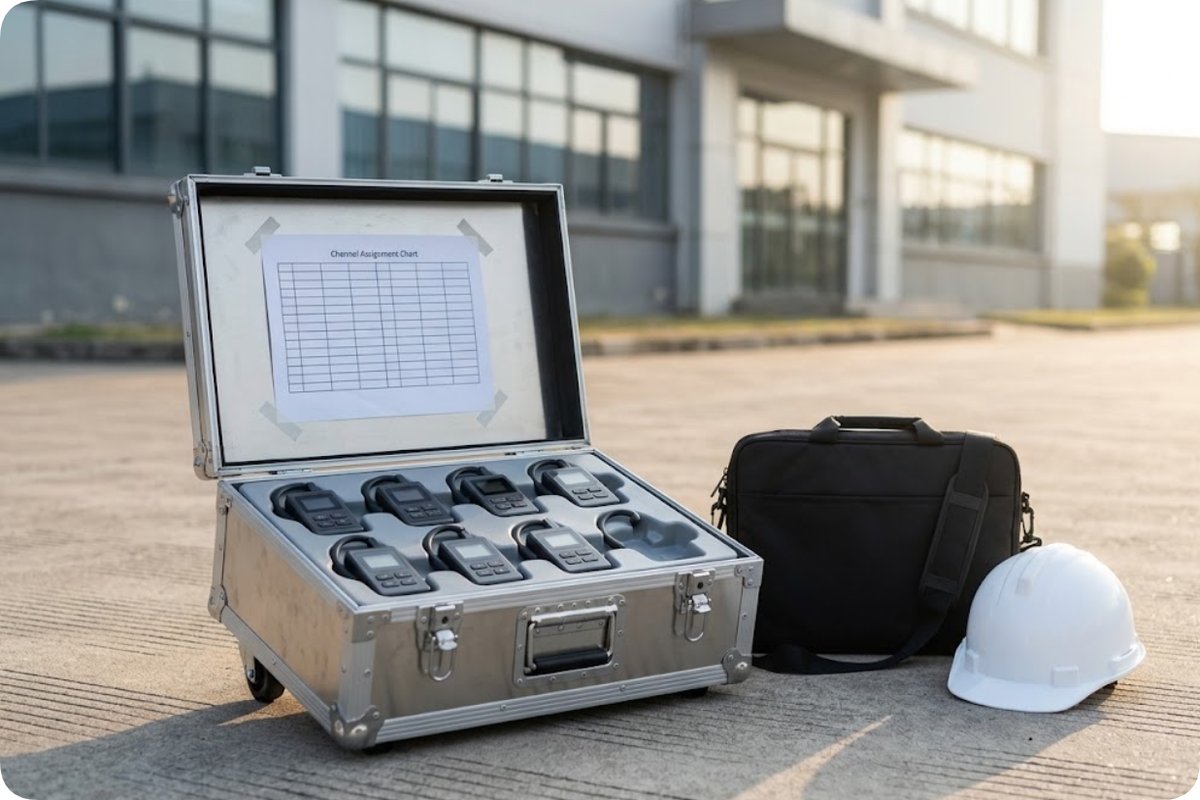

An open wheeled equipment case holding a row of UHF receivers with a handwritten channel plan taped to the lid

🎯 The Three Figures That Decide Which One You Load

The two wireless sets share a great deal, which is why they share a table. The numbered player shares almost nothing with either of them, because it transmits nothing, so comparing it channel-for-channel would be comparing a filing cabinet to a telephone line. The table below separates what can be compared from what cannot.

What the site has to decide2.8-Inch Semi-Auto PlayerRC2402RC085
Live operator commentaryNot supported, playback onlySupportedSupported
Published bandNot applicable, no transmitter2403-2483 MHz470-510 MHz
Published channelsNot applicable50100
Published output powerNot applicable10mW8-10mW
Declared battery life18 hours, 2GB internal10h transmitter, 20h receiver12h transmitter, 20h receiver
Charging interfaceMicro USBDC portUSB
Headset or earphone arrangementEarphones included in the boxEar-hook receiver published at 50gEar-hook or lapel microphone options
Operating range as publishedNot applicable1-200m1-200m
Listed receiver sensitivityNot publishedNot separately publishedApprox. -102dBm

Two things are deliberately absent from that table. Operating temperature, ingress protection and certification class are not published for the numbered player, so they cannot be placed in a column that also holds two radio systems. The same applies to the weight of the numbered player, which is not stated on its product page and would have had to be guessed to appear here. Neither figure should be inferred from the fact that the device is smaller.

Read down the columns rather than across the rows and a decision forms quickly. If the walkthrough is pre-recorded, numbered and the same for everyone, the player removes the entire coordination layer. If the walkthrough needs a person answering questions beside an operating unit, the choice comes down to fifty channels in a shared band against a hundred channels in a quieter one, and the honest answer is that only a walk of the real route will settle it.

A Loading Plan That Survives a Stoppage Moving Twice

Whichever unit is chosen, the turnaround week is won or lost in the crate. Count out against a list, not against a memory of what came back last time. Keep the spare units in the same crate as the deployed ones rather than in an office drawer, because the office is on the other side of the gate and the second-hand count always happens under time pressure.

Book the charging trolley for the evening before, and charge everything to the same state rather than top-up only the sets people used on the previous walk. Pair nothing on the morning of a permit. If the kit is wireless, write the channel plan on paper and put it in the crate, because the person at the gate is not the person who configured the system and will not know why a delegation is silent.

Plan for the stoppage moving once and then moving again. Dates shift when a vessel fails an inspection, and a week that moves to the right can still shorten on the left. Any plan that assumes a single fixed window has already lost, because the only part of it that was certain was the part that could not be relied upon.

Questions Worth Asking Before the Permit Is Issued

Will the walk include a live operator who must answer questions as we go, or is the commentary fixed in advance and identical for every visitor? That single question eliminates one of the three options and usually eliminates it early, when it is cheapest.

How many delegations run in the same week? One delegation makes a hundred channels an indulgence. Four delegations on overlapping days makes fifty channels a queue. And will the route pass the furnace gallery at all, because if it does not, most of the argument for the UHF set disappears along with the noise.

Finally: does anyone carrying the equipment hold a current permit for the hazardous area, and does the device itself carry any published classification for entry? The second question is worth asking precisely because the answer is often that no classification is published for a given unit. That is not a defect, but it does need to reach the person who signs the entry paperwork rather than being discovered at the gate.

Most of the comparison above rests on published figures rather than measured ones, which is deliberate. A turnaround site that has not yet walked its route with the kit is better served by knowing exactly which numbers are on the sheet and which ones nobody has printed yet.

For a broader look at how these three types of equipment are deployed across industrial sites, the factory tour solutions page covers the surrounding infrastructure, and the full range of transmitter and receiver sets is listed under wireless tour guide systems.

Frequently Asked Questions

1. Can the numbered player be used for a live-guided walk instead of a fixed one?

No. It has no transmitter, so nothing a guide says reaches a visitor's device. What a site does instead is record the answers to the questions it expects, number them, and print those numbers on the walkthrough sheet. In our last turnaround plan the walk had fourteen expected questions and we recorded eleven of them; the remaining three were written on the escort's card to be answered face to face outside the gallery.

2. We run four delegations in the same turnaround. Does a hundred channels really remove the conflict?

It removes the conflict you were expecting and not the one you get. Four groups at a hundred channels have room between them, but every one of those channels still shares the same physical band, and in a furnace gallery the band is crowded by equipment the site does not control. We reserve and label channels per delegation on paper before the week starts, and we hand each group a different starting channel rather than the same one.

3. What battery figure should we plan the schedule around?

The one printed on the box rather than the one in the specification table, because a six-day site will run the gear every day and the printed figure is what your operators will hold you to. Our own planning figure for the 18-hour player is a full shift with margin, and for a 20-hour receiver we still charge overnight. A ten-hour transmitter figure is a morning figure, not a day.

4. Is it acceptable to bring equipment into a process area without a published hazardous-area classification?

That is a question for your own safety function and your permit issuer, not for a supplier, and it should be raised before the visit rather than at the gate. We supply the classification documentation for any unit we sell where one exists, and we say so plainly where none is published. The numbered player page states a one-year warranty and a defective rate below one percent, but it does not publish an area classification, and no assumptions should be made on the site's behalf.

5. How early should charging finish before the delegation arrives?

The previous evening, fully rather than topped up, and with the spare units in the same crate as the deployed ones. A unit charged for an hour and left overnight is not the same unit as one charged overnight, and the difference shows up as a set that dies during the walk rather than one that comes back. We also count out against a printed list, because counting against memory is what puts two sets back in the locker.


2026年10月15日 10:00
ꄘ click: 12

RC085, RC2402 and a 2.8-Inch Semi-Auto Guide: What a Refinery Turnaround Decides About Kit

time: 2026年10月15日 click:12

A refinery turnaround is the one tour slot that cannot be moved. A delegation from a licensing authority, an insurer's surveyor or a partner plant arrives in the week when the crude unit is drained, the catalyst is off-loaded and every scaffold is down. That week is also the only week a visitor can walk the process area at all. For six days the plant is quiet enough to hear somebody talk, and for six days the escort team has to make that conversation audible to eight people wearing mandatory hearing protection.

That deadline changes which equipment gets loaded onto the crate, and it does so in ways that have little to do with audio quality. A guide set chosen for a permanent gallery has to survive a compressed schedule, a rising dust load, a concrete floor and a permit boundary that may move twice. Below is how three very different units are actually judged against that week, using only figures each manufacturer publishes.

A Refinery Stops for Six Days and That Is the Whole Budget

Every other venue buys audio equipment against a calendar year. A turnaround site buys it against a fortnight that is negotiated between two production departments and then confirmed by a permit. Miss the window and the delegation does not reschedule; it goes home and the file is closed. That asymmetry changes the arithmetic before any specification is opened.

The practical consequences are unglamorous but decisive. Charging has to finish at the gate office, because the visitor reception room sits outside the hazardous area boundary and the charging trolley does not go past it. Sets are counted out and counted back within the same shift. A unit that fails at hour five of six has no second chance, because the plant has restarted and the walkway that made it reachable is gone.

Noise is the second constraint, and it is the one most often misjudged. Inside a furnace gallery the ambient level is high enough that a guide group is already wearing defenders. A lanyard receiver pushing into the outer ear competes with an attenuator that is already doing its job. A headset set leaves the ear canal alone, which is why it survives the gallery and why the operator wearing it cannot hear a guide who is not transmitting.

💡 Why the Old Kit Survived Every Refit Except This One

The kit already in the control room usually consists of wired headsets from the original construction package. It has survived every refit because wired headsets have nothing to fail in the ways wireless kit fails. There is no channel to plan, no battery to flatten, no pairing step at the gate and no firmware decision to make at midnight before a permit.

What changed is not the hardware. It is who owns the tour. A permanent plant tour is usually run by the same safety or community team every quarter, so the handover instructions stay in one drawer. During a turnaround the escort can be a contractor from a different region who has never entered a process area, carrying a visitor who has never seen one. The kit now has to survive being handed to a stranger within ninety seconds, in a car park, with rain on the crate.

The failure mode that follows is rarely a bad recording. It is a receiver that was charged on a different shelf, a headset whose band was left on a neighbouring tour, or a crate that came back with six sets instead of eight because two were still in the lockers. Each of those is an administrative failure, and each one is decided by how the equipment is written up rather than by what the equipment can do.

A Number-Keyed Player Needs No Spectrum Licence

The 2.8-Inch Semi-Auto Digital Audio Guide solves the turnaround problem by not being a tour guide system at all. It is a standalone player with a numeric keypad. A visitor presses the number printed beside an exhibit and the commentary plays back from internal memory. There is no transmitter, no channel assignment and no coordination between eight people holding a device, because nothing is being transmitted.

Published figures for this unit are modest and honest: 2GB of internal memory, capacity for up to 9999 audio files, up to 16 languages, and up to 18 hours of continuous operation on a full charge through a Micro USB interface. Earphones are included in the box. The page states a one-year warranty on the unit and a defective rate below one percent, with units tested individually before shipment.

For a delegation walking a numbered walkthrough, that is enough. The walkthrough does not need a live operator because the process description does not change during the week. It also removes the two administrative failure modes that bite hardest on a compressed schedule: there is no charging trolley to book and no pairing to fail, so a visitor can be handed a device and be working inside a minute of clearing the gate.


A visitor holding a 2.8-inch keypad audio guide player in a refinery walkthrough corridor

Fifty Channels Work Until the Furnace Line Starts

Live commentary does need transmission, and here the entry point is the RC2402 Wireless Tour Guide System. Its published figures sit in the middle of the range: 2.4GHz operation from 2403 to 2483 MHz, 50 channels, 10mW output, a 1500mAh transmitter battery giving 10 hours, and a 1000mAh receiver battery giving 20 hours. Transmitter and receiver weigh 59g and 50g. Charging is by DC port.

Those numbers describe a general-purpose indoor system, and inside a control building or a quiet gallery they hold comfortably. The furnace gallery is a different environment. A 2.4GHz band sitting close to the ISM allocation is shared territory, and a process area is exactly where unlicensed devices accumulate: contractor laptops, wireless instruments, crane radios, temporary cameras. Fifty channels give you room to separate your own group, but they do not give you immunity from the aggregate noise floor of a live plant.

The practical test worth running before a permit is issued is not a channel count. It is a walk of the actual route with the actual escort crew, wearing the defenders they will wear, at the time of day the walk happens. If the group loses the guide commentary at the furnace door, the channel count is not the variable that failed.


A visitor in a refinery gallery wearing an over-ear noise-cancelling headset during an industrial walkthrough

The UHF Set Pays for Itself on the Refit Crate

The RC085 Digital Tour Guide System takes the opposite approach to the same problem. Its published band is 470 to 510 MHz rather than the 2.4GHz range, output power is quoted as 8 to 10mW, and the channel count is 100 rather than 50. The receiver figures are 1200mAh for the transmitter with 12 hours of use, 1000mAh for the receiver with 20 hours, and weights of 65g and 60g. Sensitivity is listed at approximately -102dBm, and the charging port is USB.

That sensitivity figure is the one to argue about in a process area. A lower sensitivity number means a quieter radio floor will not swamp the signal, which is precisely the situation a furnace gallery creates. The 470 to 510MHz band also sits well away from the Wi-Fi and Bluetooth traffic that accumulates inside an industrial building, so the fifty channels of a 2.4GHz system and the hundred channels of a UHF system are not competing for the same air.

Where this unit earns its cost on a turnaround is not sound quality. It is that a hundred channels let a site run several delegations across the same week without renegotiating anything, and the -102dBm figure is the number to put in front of the person who signs the purchase when they ask why one set costs more than another. If the delegation list is short and single-language, that premium buys nothing useful, and the numbered player is the cheaper answer.


An open wheeled equipment case holding a row of UHF receivers with a handwritten channel plan taped to the lid

🎯 The Three Figures That Decide Which One You Load

The two wireless sets share a great deal, which is why they share a table. The numbered player shares almost nothing with either of them, because it transmits nothing, so comparing it channel-for-channel would be comparing a filing cabinet to a telephone line. The table below separates what can be compared from what cannot.

What the site has to decide2.8-Inch Semi-Auto PlayerRC2402RC085
Live operator commentaryNot supported, playback onlySupportedSupported
Published bandNot applicable, no transmitter2403-2483 MHz470-510 MHz
Published channelsNot applicable50100
Published output powerNot applicable10mW8-10mW
Declared battery life18 hours, 2GB internal10h transmitter, 20h receiver12h transmitter, 20h receiver
Charging interfaceMicro USBDC portUSB
Headset or earphone arrangementEarphones included in the boxEar-hook receiver published at 50gEar-hook or lapel microphone options
Operating range as publishedNot applicable1-200m1-200m
Listed receiver sensitivityNot publishedNot separately publishedApprox. -102dBm

Two things are deliberately absent from that table. Operating temperature, ingress protection and certification class are not published for the numbered player, so they cannot be placed in a column that also holds two radio systems. The same applies to the weight of the numbered player, which is not stated on its product page and would have had to be guessed to appear here. Neither figure should be inferred from the fact that the device is smaller.

Read down the columns rather than across the rows and a decision forms quickly. If the walkthrough is pre-recorded, numbered and the same for everyone, the player removes the entire coordination layer. If the walkthrough needs a person answering questions beside an operating unit, the choice comes down to fifty channels in a shared band against a hundred channels in a quieter one, and the honest answer is that only a walk of the real route will settle it.

A Loading Plan That Survives a Stoppage Moving Twice

Whichever unit is chosen, the turnaround week is won or lost in the crate. Count out against a list, not against a memory of what came back last time. Keep the spare units in the same crate as the deployed ones rather than in an office drawer, because the office is on the other side of the gate and the second-hand count always happens under time pressure.

Book the charging trolley for the evening before, and charge everything to the same state rather than top-up only the sets people used on the previous walk. Pair nothing on the morning of a permit. If the kit is wireless, write the channel plan on paper and put it in the crate, because the person at the gate is not the person who configured the system and will not know why a delegation is silent.

Plan for the stoppage moving once and then moving again. Dates shift when a vessel fails an inspection, and a week that moves to the right can still shorten on the left. Any plan that assumes a single fixed window has already lost, because the only part of it that was certain was the part that could not be relied upon.

Questions Worth Asking Before the Permit Is Issued

Will the walk include a live operator who must answer questions as we go, or is the commentary fixed in advance and identical for every visitor? That single question eliminates one of the three options and usually eliminates it early, when it is cheapest.

How many delegations run in the same week? One delegation makes a hundred channels an indulgence. Four delegations on overlapping days makes fifty channels a queue. And will the route pass the furnace gallery at all, because if it does not, most of the argument for the UHF set disappears along with the noise.

Finally: does anyone carrying the equipment hold a current permit for the hazardous area, and does the device itself carry any published classification for entry? The second question is worth asking precisely because the answer is often that no classification is published for a given unit. That is not a defect, but it does need to reach the person who signs the entry paperwork rather than being discovered at the gate.

Most of the comparison above rests on published figures rather than measured ones, which is deliberate. A turnaround site that has not yet walked its route with the kit is better served by knowing exactly which numbers are on the sheet and which ones nobody has printed yet.

For a broader look at how these three types of equipment are deployed across industrial sites, the factory tour solutions page covers the surrounding infrastructure, and the full range of transmitter and receiver sets is listed under wireless tour guide systems.
Frequently Asked Questions

1. Can the numbered player be used for a live-guided walk instead of a fixed one?

No. It has no transmitter, so nothing a guide says reaches a visitor's device. What a site does instead is record the answers to the questions it expects, number them, and print those numbers on the walkthrough sheet. In our last turnaround plan the walk had fourteen expected questions and we recorded eleven of them; the remaining three were written on the escort's card to be answered face to face outside the gallery.

2. We run four delegations in the same turnaround. Does a hundred channels really remove the conflict?

It removes the conflict you were expecting and not the one you get. Four groups at a hundred channels have room between them, but every one of those channels still shares the same physical band, and in a furnace gallery the band is crowded by equipment the site does not control. We reserve and label channels per delegation on paper before the week starts, and we hand each group a different starting channel rather than the same one.

3. What battery figure should we plan the schedule around?

The one printed on the box rather than the one in the specification table, because a six-day site will run the gear every day and the printed figure is what your operators will hold you to. Our own planning figure for the 18-hour player is a full shift with margin, and for a 20-hour receiver we still charge overnight. A ten-hour transmitter figure is a morning figure, not a day.

4. Is it acceptable to bring equipment into a process area without a published hazardous-area classification?

That is a question for your own safety function and your permit issuer, not for a supplier, and it should be raised before the visit rather than at the gate. We supply the classification documentation for any unit we sell where one exists, and we say so plainly where none is published. The numbered player page states a one-year warranty and a defective rate below one percent, but it does not publish an area classification, and no assumptions should be made on the site's behalf.

5. How early should charging finish before the delegation arrives?

The previous evening, fully rather than topped up, and with the spare units in the same crate as the deployed ones. A unit charged for an hour and left overnight is not the same unit as one charged overnight, and the difference shows up as a set that dies during the walk rather than one that comes back. We also count out against a printed list, because counting against memory is what puts two sets back in the locker.


×

Contact us

email:
name:
subject:
content: