.webp)
Three wireless tour guide systems arrive at the same data centre procurement desk in the same week, and the person writing the comparison has one line that the three quotations do not agree on. Two of the pages list five marks: CE, EMC, LVD, RED and RoHS. The third lists one: RoHS. On a purchase order that line looks like a formality, because it sits below the frequency band, below the channel count and below the range figure, all of which are easier to argue about.
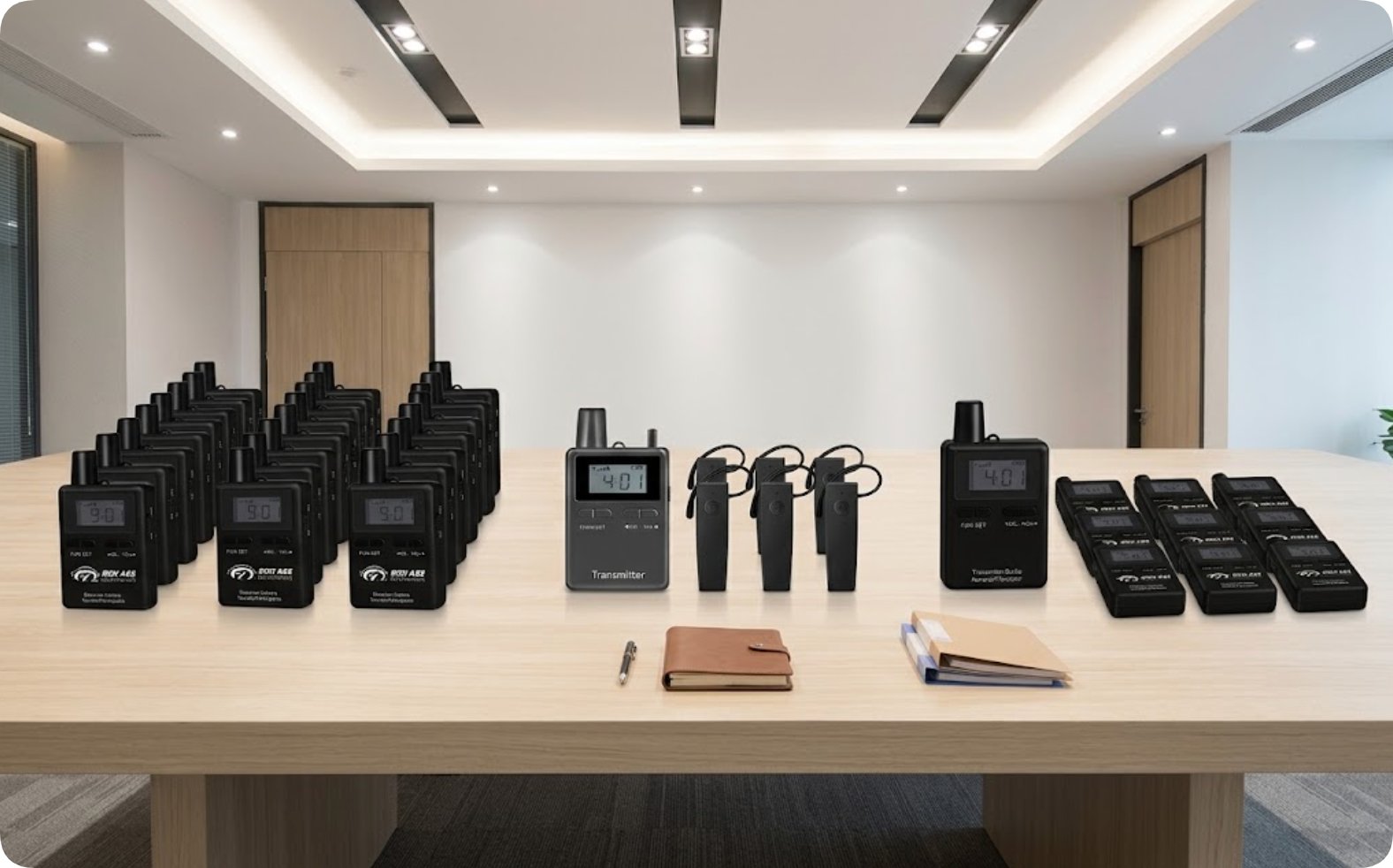
The reason to argue about it anyway is that a data centre is not an ordinary venue. Visitors pass a security desk, a badge reader and often an air shower before they see anything at all, and every one of those steps is a point where a visitor's own equipment is either accepted or refused. A visitor wearing a receiver that will not survive the walk from the entrance to the meeting room does not get a tour. Facilities running escorted visits usually plan these walks against a documented visitor procedure rather than an ad-hoc one, and the public safety and security hardware range is where most operators first look when they are thinking about what a visitor is allowed to carry. The RC2402 wireless tour guide system, the RC2468 ultra-light 2.4G system and the RC2406 80-channel system are three of the units most often quoted for escorted visits, and they present that line three different ways.
💡 A Line That Looks Administrative Until the Entrance
Most shortlists treat certification as a box to be ticked. The supplier writes "certified" or "CE" in that cell, the evaluator moves on to the row above, and the box gets closed. That habit works fine for a museum. It fails in a facility where a visitor's equipment has to be admitted through a controlled entrance, because what the marks on a product page describe is the product as placed on the market, not the specific model number, the specific batch, or the specific end use the facility has in mind.
The practical consequence is that the equipment list and the compliance file end up describing two different things. The equipment list says the visitors will wear receivers. The compliance file, if it is built only from what the pages state, says the system carries a set of conformity marks without naming which standards they cover or which model variant they were assessed on. When the security team asks whether the receiver a visitor will be holding at the badge reader is the same product that was assessed, there is no answer on the quotation.
🚪 Nothing about that is a reason not to buy any of these units. It is a reason to move the certification line up the evaluation instead of down, and to ask a question the standard shortlist never asks: which of these marks covers the part of the kit that a visitor physically carries through a controlled door.
📋 What Each Page Lists
Read the three specification tables against each other and the certifications row is the one place where the three differ in kind rather than in degree. The rest of the tables differ by figures. This row differs by how much of the product each page is describing.
| Item | RC2402 | RC2468 | RC2406 |
|---|---|---|---|
| Certification as published | CE, EMC, LVD, RED, RoHS | CE, EMC, LVD, RED, RoHS | RoHS compliant |
| Frequency | 2403-2483 MHz, 2.4 GHz global ISM, licence-free | 2403-2483 MHz, 2.4 GHz ISM | 2403-2483 MHz, 2.4 GHz ISM, licence-free |
| Channels | Not stated as a figure; one-click frequency synchronisation | 50, PLL synthesis | 80, PLL anti-interference |
| Range as published | Up to 200 m open area | 1-200 m open area; usable through walls and obstacles | Up to 200 m open area |
| Transmitter battery | 1500 mAh implied by 10 h working figure | 1500 mAh, 12 h continuous talk | 1500 mAh lithium |
| Receiver battery / life | 20 h working | 300 mAh, 10 h continuous use | Full-day continuous use stated |
| Weight | Lightweight design stated; no figure given | Transmitter 59 g / receiver 18 g | 50 g stated |
| Water resistance | Not published | Not published | IPX4 splash resistant |
| Audio frequency response | Not published | 50 Hz - 200 kHz Hi-Fi | Not published |
| Output power | Not published | 10 mW receiver output | Not published |
| Charging interface | Not published | Micro USB, 5 V / 1 A | Not published |
| Colour options | Not published | Transmitter: black, iron grey, silver grey, red, orange, blue; receiver black | Not published |
| Warranty | 3 years, mainboard covered; headset, microphone, battery excluded | 3 years, mainboard covered; headset, microphone, battery excluded | 3 years, mainboard covered; headset, microphone, battery excluded |
| Customisation | OEM/ODM: logo, packaging, functional adjustment, appearance design | OEM/ODM: logo, function tuning, packaging design, colour | Not published on the page |
Read down that table and a second pattern appears almost as clearly as the first. The RC2468 publishes the details that a facility's own engineers would want to check, down to output power in milliwatts and the frequency response in hertz. The RC2402 publishes less of that detail but publishes a wider conformity statement. The RC2406 publishes neither the engineering detail nor the wide conformity statement, but it is the only one of the three that publishes a water resistance figure at all.
🔍 What Each Mark Covers, and What It Does Not
The five marks listed on the RC2402 and RC2468 pages are not five versions of the same reassurance. They cover different things, and the difference matters when someone is trying to decide whether a receiver can be admitted through a controlled entrance.
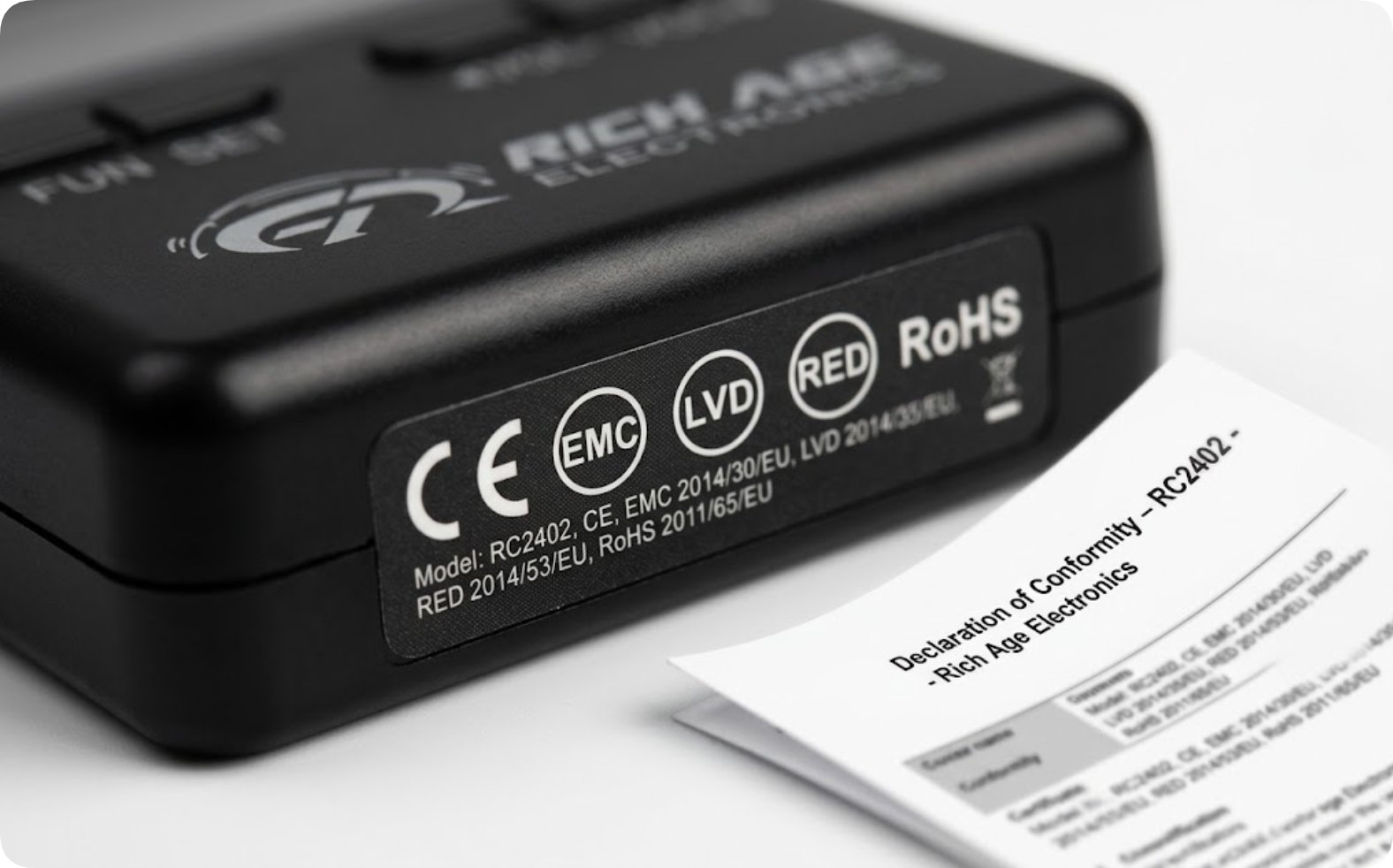
🛡️ CE is the manufacturer's own declaration that the product meets the applicable European requirements, which is a wider statement than any single test. EMC is the part of that covering electromagnetic behaviour: what the unit emits, and what it does when something else is emitting near it. In a data centre that second half is the practical part, because the environment is full of servers, cooling equipment and power distribution that are not switched off for a tour.
⚡ LVD covers electrical safety at low voltage, which is a statement about the charging side of the product rather than the listening side. For a visitor kit that gets charged overnight on a trolley and then carried through a building the next morning, this is the mark that speaks to the part of the kit nobody is listening to during the tour but everybody touches when they plug it in.
📡 RED is the radio-specific directive, and for a 2.4 GHz tour guide system it is the single most relevant mark on the list, because it is the one that covers the radio behaviour rather than the mains behaviour. Two of these three pages list it. The third does not list it at all.
♻️ RoHS is the restriction of hazardous substances mark, and it is the only mark on all three pages. It says nothing about radio behaviour, nothing about electrical safety and nothing about electromagnetic compatibility. It is a materials mark, and it is the item that survives on a line where the other four have been dropped.
So the honest reading of that row is not that one product is uncertified. It is that two pages describe conformity across electrical safety, radio behaviour and materials, while one page describes a materials restriction. Both statements can be true at once, and a comparison that places them in the same cell without explaining the difference invites the evaluator to draw a conclusion neither page actually supports.
💡 🚪 Why This Matters at the Entrance Rather Than in the Meeting Room
The operational consequence of the certification row shows up in the ten minutes before the tour starts, not during it.
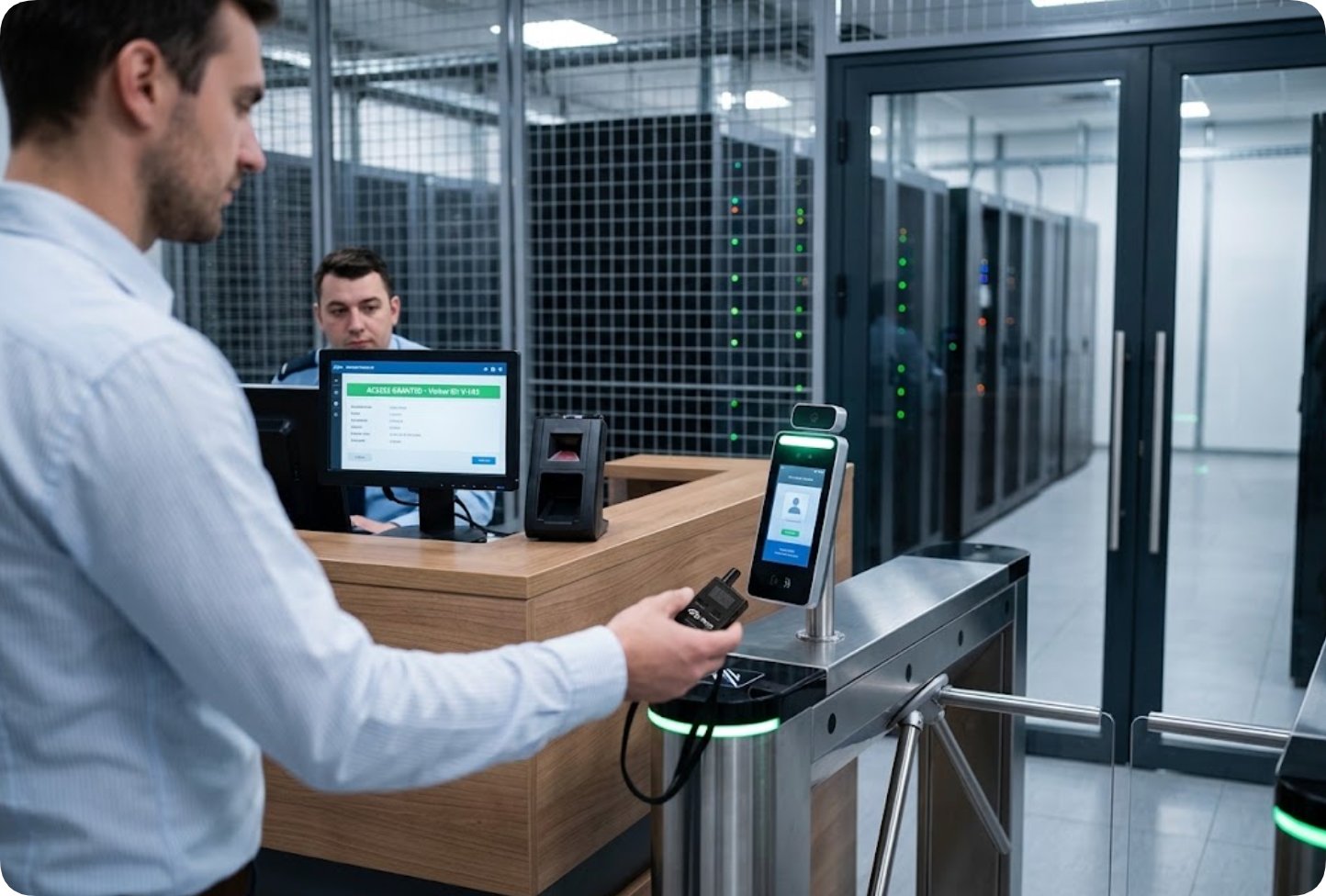
Data centre escorted visits usually involve a security desk, a badge or identity check, and in many facilities an air shower or a controlled corridor between the public area and the machine hall. At each of those points a visitor is carrying or wearing the equipment. The receiving gate does not read a conformity mark. It reads a badge, and it applies whatever rule the facility has written about what a visitor may bring past that point.
That rule is written without reference to which mark a manufacturer printed on a website. It is written in terms of what the device is: is it powered, does it have a radio transmitting, does it have a screen, does it get stuck in a pocket. This is where the details in the table above become useful rather than decorative. The RC2468's 18 g receiver is the kind of figure that can go into a pocket. The RC2406's IPX4 rating is the kind of figure that answers a question about a splash-prone route. The RC2402's wider conformity statement is the kind of figure that answers a question about the whole kit.
🔴 The three questions are different questions, and the common mistake is asking only one of them. A facility that only checks the weight will approve a heavy but well-certified unit into a zone it should not enter. A facility that only checks the certification marks will approve a set that no visitor can comfortably carry for three hours. A facility that only checks the water rating will approve a set that is not permitted past the badge reader. The quotation answers none of these by itself, which is why the certification row is worth reading closely rather than quickly.
❓ Questions Worth Asking Each Supplier
These are the questions that turn the certification row from a checkbox into something a compliance file can actually be built on. They are not unusual questions, and a supplier that answers them in writing is usually the supplier whose file survives an internal review.
For the RC2402, ask for the documents behind each of the five marks, not just the marks themselves. In particular, ask whether the assessment covers the exact model number and the current hardware revision, and whether the transmitter and the receiver are covered by the same documents or by separate ones. Ask which standards each mark refers to, because CE and EMC in particular are a declaration and a test family rather than two independent certificates.
For the RC2468, ask the same question about its five marks and add a practical one. The page publishes colour options and a 10 mW receiver output, which are the kind of details that come from an engineering document rather than a marketing page. Ask whether test documentation exists for those specific variants, or whether the published figures describe a single reference configuration.
For the RC2406, the questions are different because the row is different. Ask specifically whether a radio conformity assessment exists and simply is not published on the page, since the page does describe the product as a 2.4 GHz system operating on a licence-free ISM band. A product operating in that band normally has a compliance story behind it, and its absence from the page is more likely an editorial choice than a product fact. Ask for the water resistance test reference behind the IPX4 figure as well, since it is the only one of the three that publishes one and it deserves a document.
Across all three, the useful request is identical and it is not a long one: ask each supplier for a compliance file that names the model number, the hardware revision, the applicable standards, and the testing laboratory, and that distinguishes the parts a visitor carries from the parts that stay with the guide. Kits sold into escorted visits are frequently split between a transmitter the guide wears and receivers the visitors hold, and the documentation is often easier to obtain for one than for the other.
💡 For operators comparing these units against the broader industrial and factory tour guide range or planning a programme across several sites, the pattern is worth carrying forward: a shorter published certification list does not automatically mean a less compliant product, but it does mean the file has to be requested rather than assumed. Settling it once at programme level through a documented supplier arrangement is considerably less work than settling it again in each facility's own procurement, and the answer travels with the fleet rather than being rediscovered at every site. That distinction is the difference between a supplier file that can be audited and one that has to be rebuilt from scratch when someone asks.
💡 📈 Why This Line Is Getting Harder to Skip
Two trends are pushing a line that used to be administrative into the part of the evaluation that gets discussed.
The first is that escorted facility visits are growing. More corporations are running supplier visits, audit days and investor tours inside buildings they do not own, and each of those sits behind somebody else's security desk with somebody else's rules about visitor equipment. A product list that assumed an open lobby no longer describes the situation. When the visitor has to be admitted somewhere, the documentation behind the kit becomes an operational question rather than a paperwork one.
The second is that the radio element of the equipment is no longer the only radio in the room. A facility where a visitor stands next to a rack of running servers is surrounded by radio activity of all kinds, and a system that is going to be admitted into that environment needs to be assessed against it rather than against a showroom. This is precisely what the EMC and RED marks speak to, and precisely what a one-item certification row leaves unsaid. Operators comparing several solution areas at once, from guided visit solutions to dedicated factory routes, tend to find the same pattern: the hardware specification is settled early and the documentation behind it is settled late, usually because somebody has to ask for it.
Neither trend changes how any of these three systems perform. A visitor will hear the same audio regardless of how the marks are printed. What changes is the number of questions a buyer has to answer in writing before that visitor is allowed through the door, and a comparison that surfaces those differences early is worth more than one that hides them behind a single word.
🚦 The Question the Marks Cannot Answer
None of these three systems is a poor choice on the strength of its certification line, and two of them publish a wider statement than the third. The useful thing about that difference is not a verdict; it is a set of three questions that would otherwise not have been asked at all.
Once those questions are in the file, the choice between the three becomes an ordinary one about operating environment and guest comfort. How many channels does a multi-group visit day need. How long does a receiver have to last between charges. Does the route cross anywhere the equipment might get wet. Whether the facility requires a documented conformity assessment for anything a visitor carries past a controlled door, and which supplier will supply it. Those are ordinary engineering and procurement questions with ordinary answers, and they are easier to settle when the certification row has been read properly rather than ticked.
Buyers reading these three pages side by side should treat the certification line as the row that describes how much of the product each supplier is willing to account for, rather than as a score. Two pages account for the radio, the electrical side and the materials. One page accounts for the materials. Both are useful starting points, and only one of them is a starting point that can be filed without a phone call.