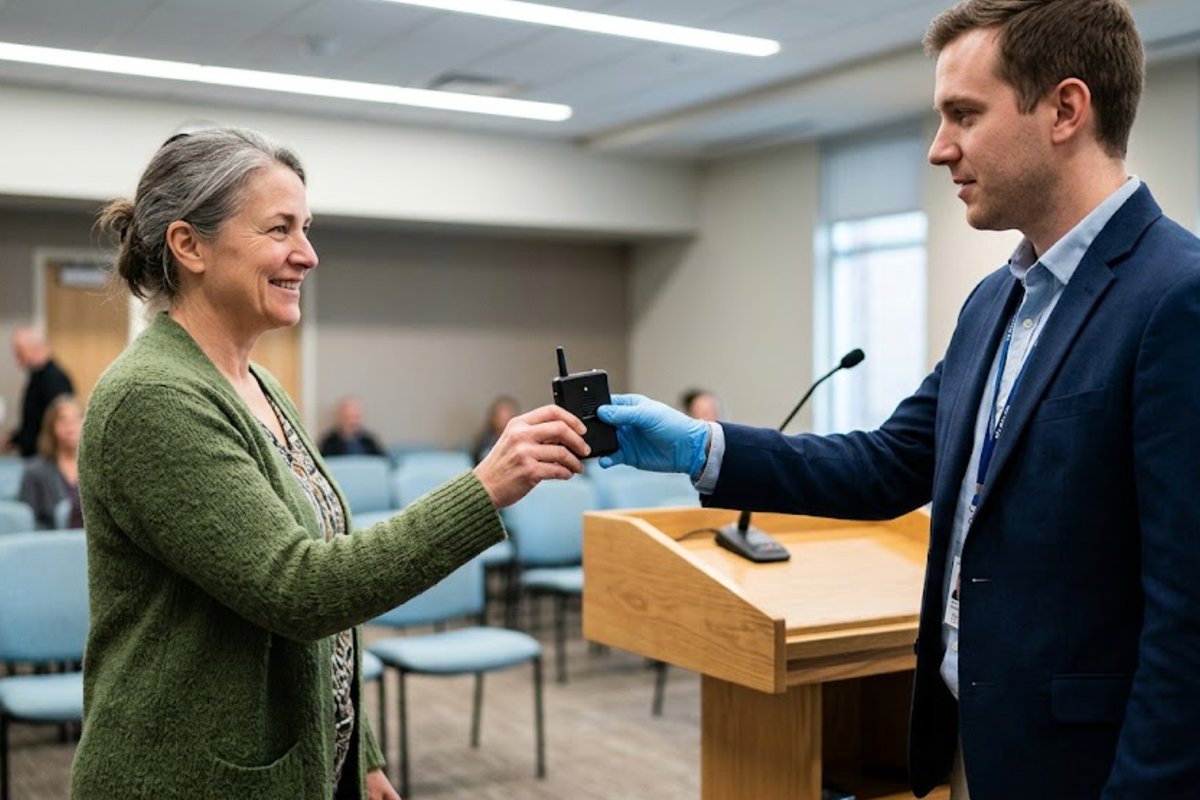
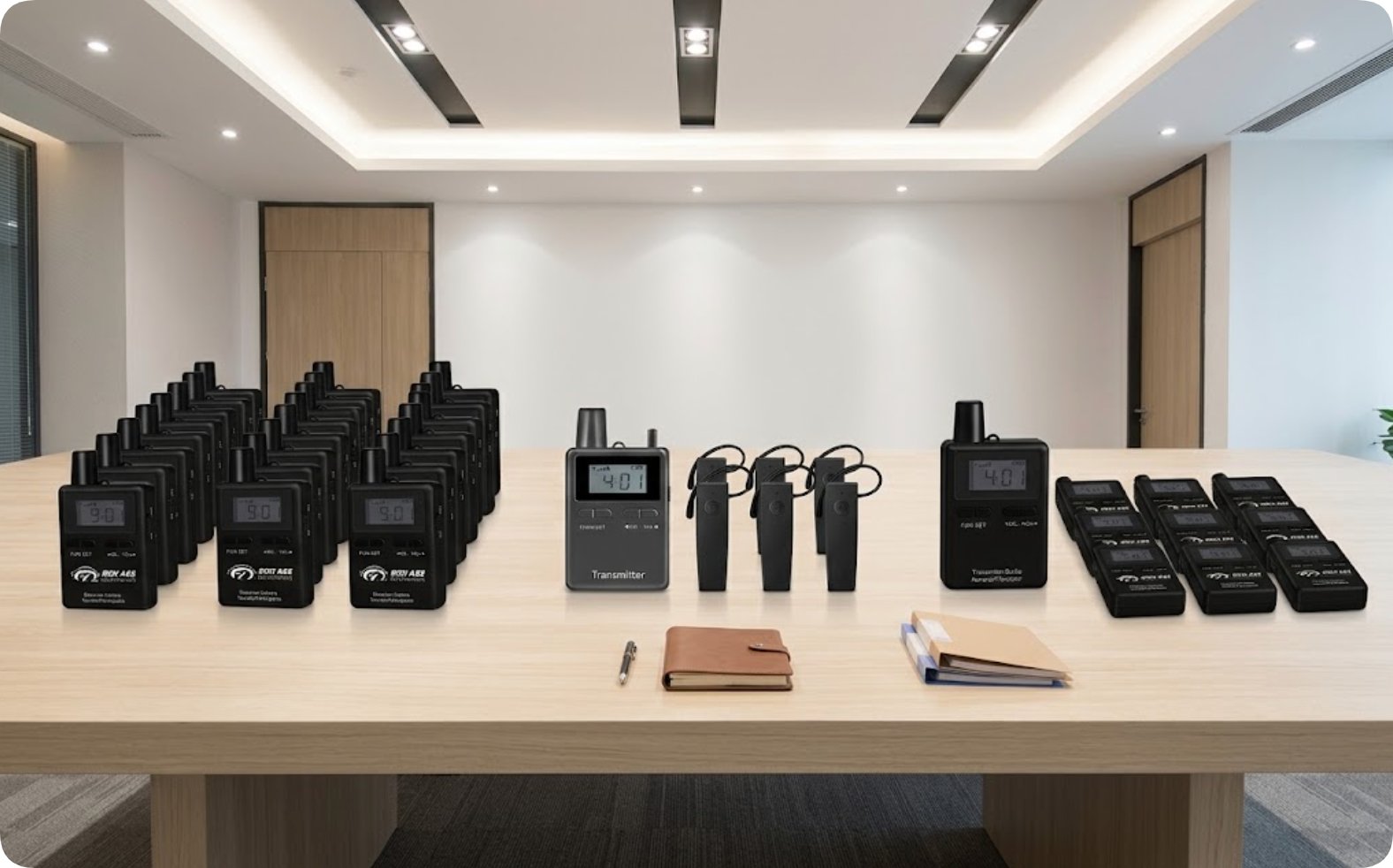
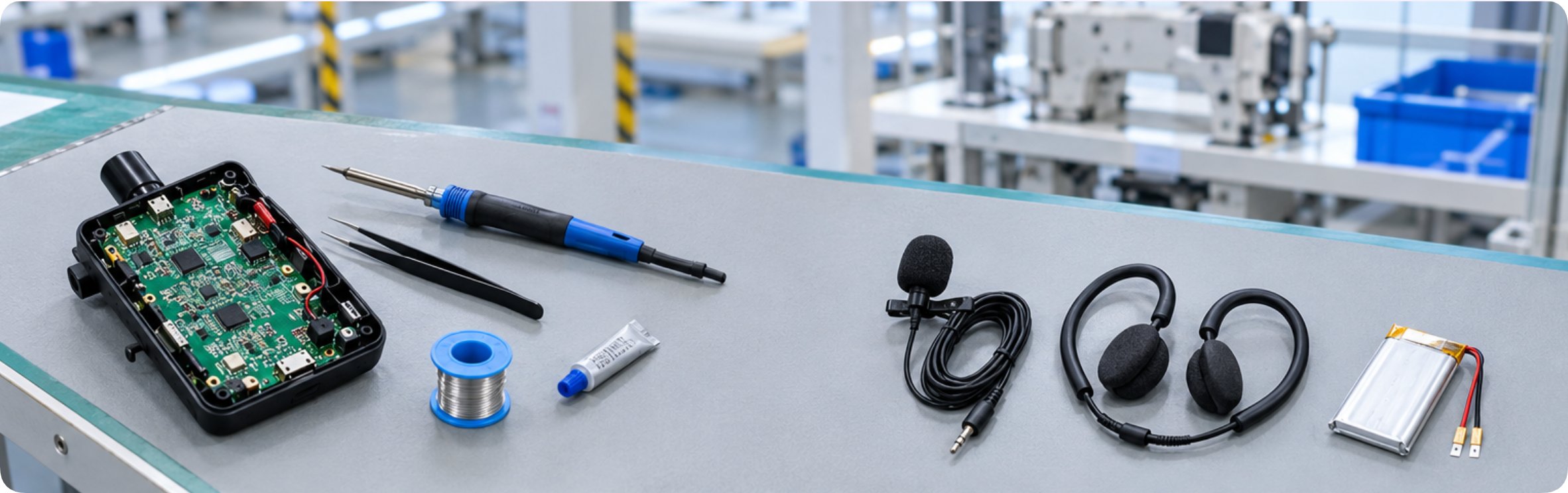
.webp)
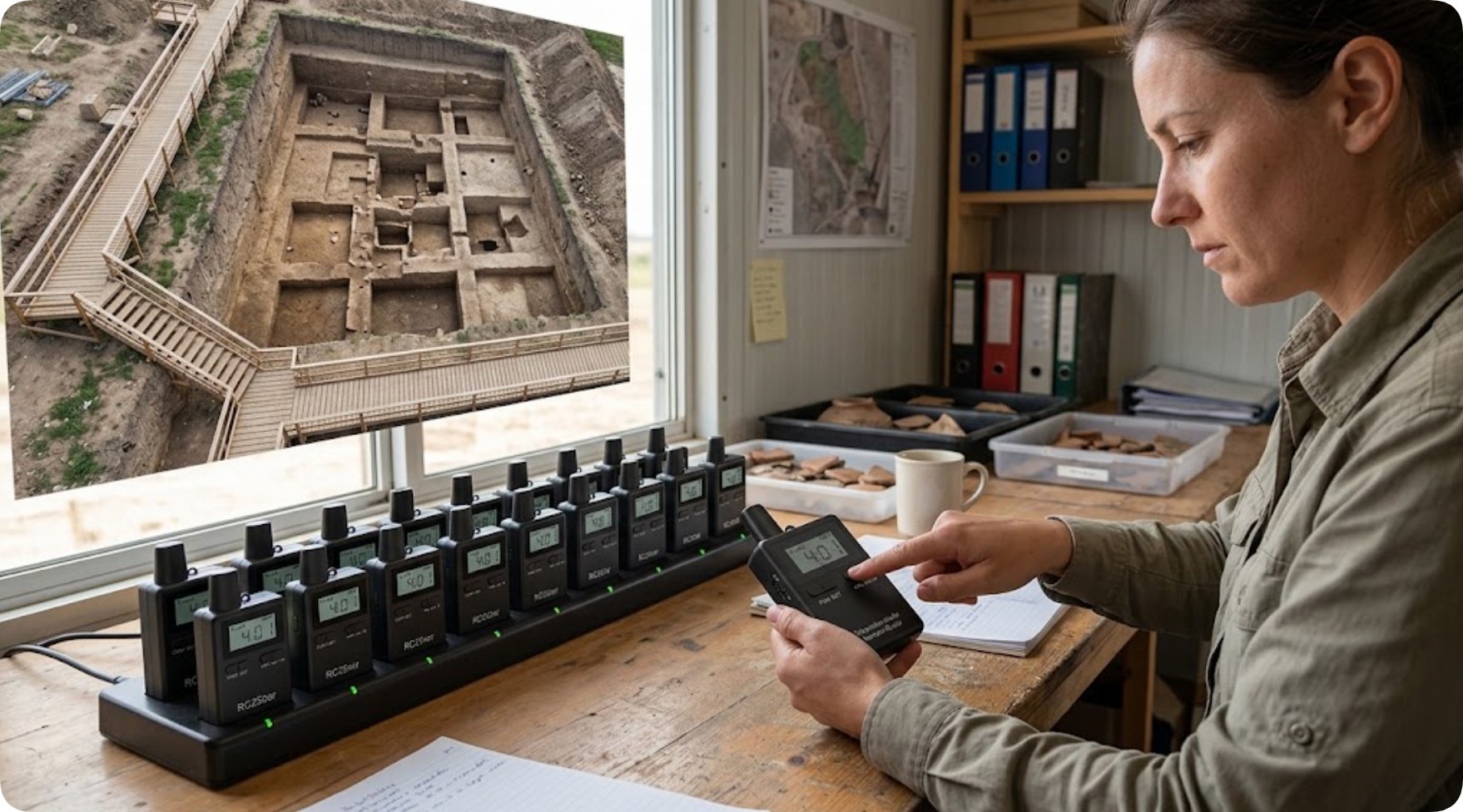
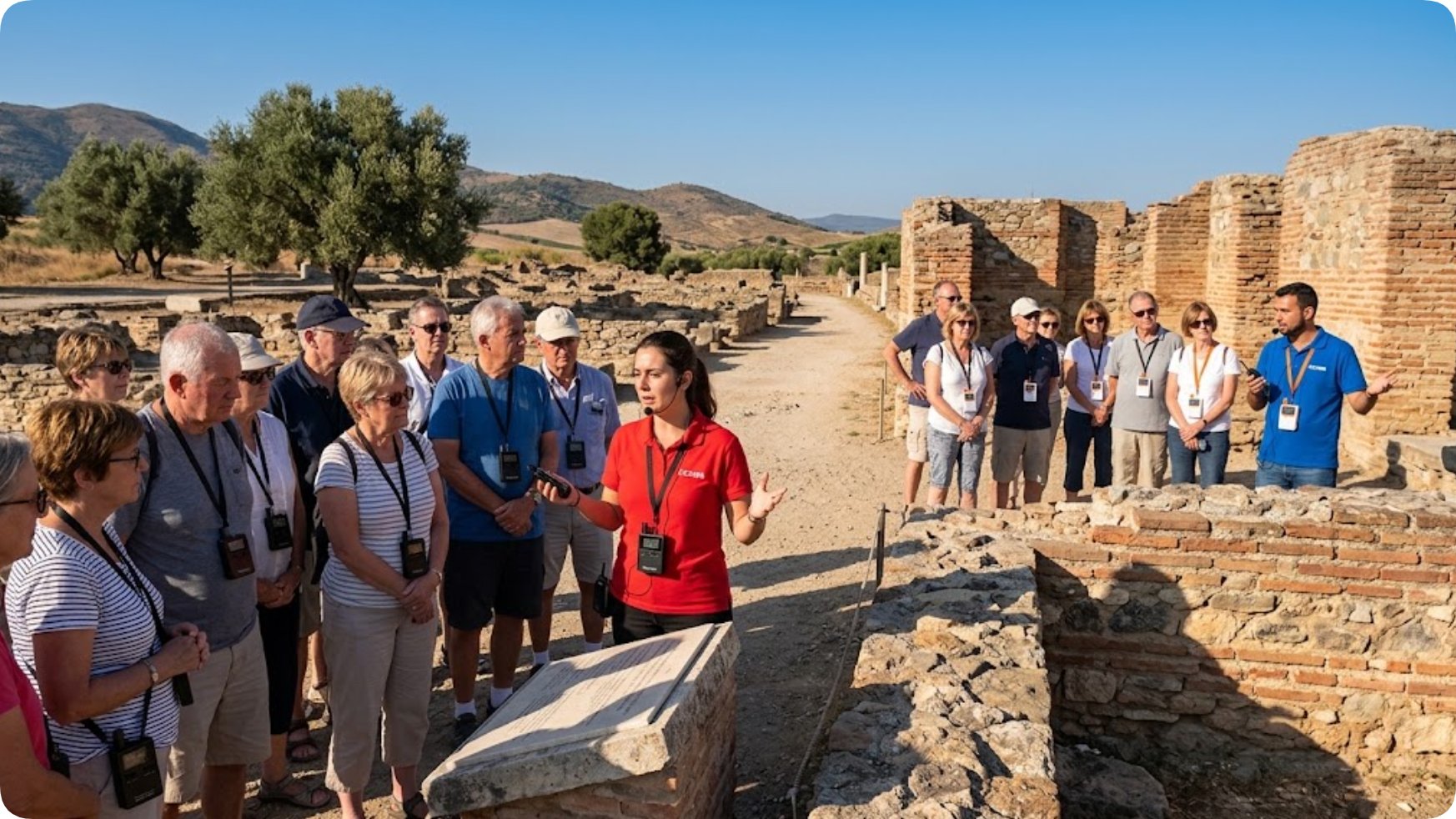
An archaeological site that receives visitors is not a museum with better weather. The commentary happens standing in the open, in a group that keeps reshaping itself around fencing, and the tour moves — trench one, the bathhouse, the viewing platform, back along the field path — with the wind and the distance deciding how much of the guide's voice survives each leg. Procurement for such a site therefore reads differently from a museum order. The museum asks how many languages and how many headsets. The site asks how far the walk is, how many groups share the same air, how long a day runs without mains power, and what the equipment does when a guide needs both hands at the excavation edge. This article writes that order around three Richitek units — the RC2500, the RC2406 and the RC2501 — because each one answers a different question the trench loop asks.
The Walk Decides the Order Before Any Spec Sheet
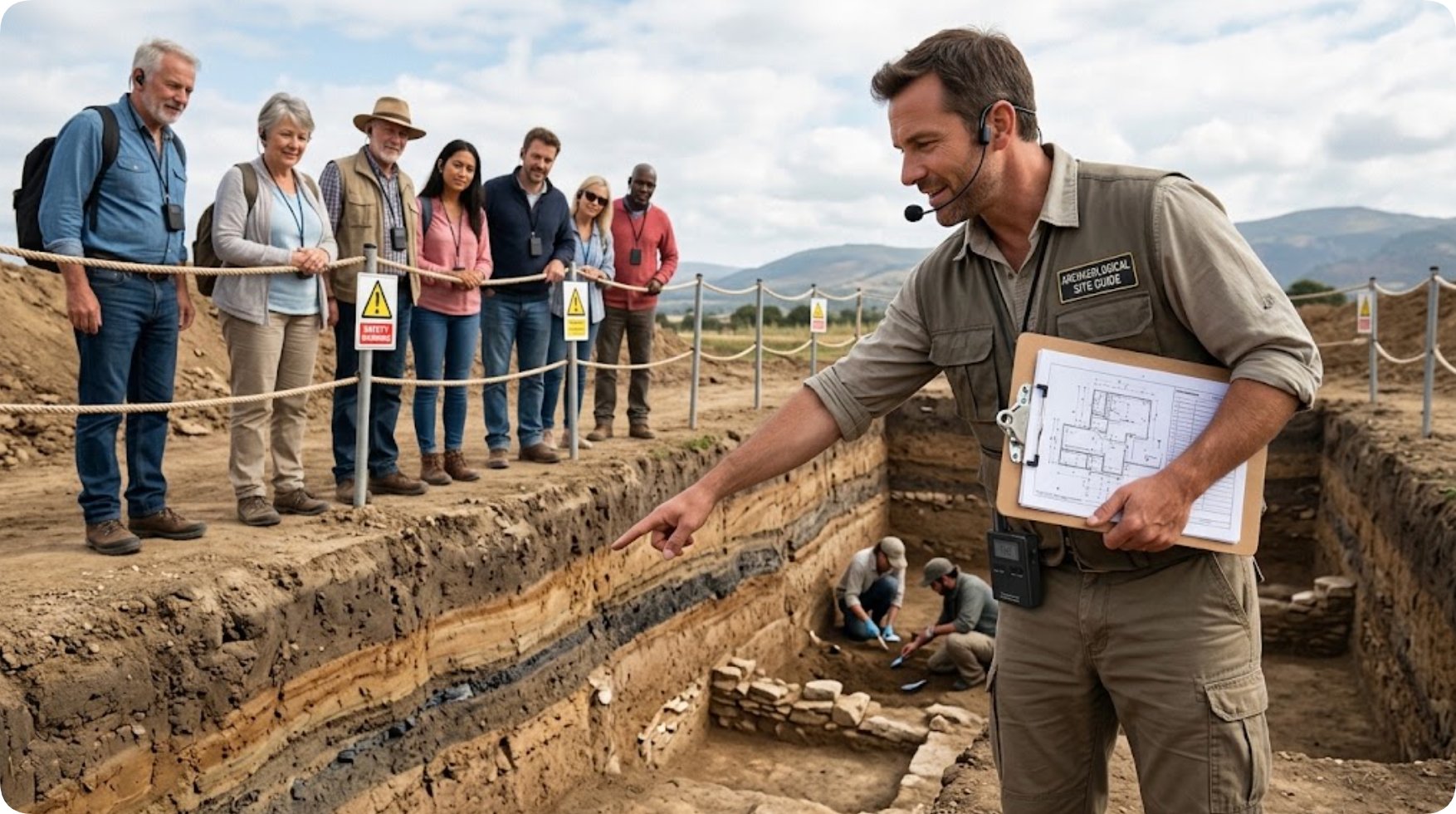
Start from the loop itself. A typical open-air site runs a tour of forty-five minutes to two hours, stopping at between four and nine points, and the stops are not acoustically separated: one group can often hear the next group's guide across an open trench. Two or three site guides usually run at the same time in high season, which means the radio environment is shared, and each guide needs a channel that stays theirs from the first stop to the last. The walk between stops crosses ground with no shade and, in many regions, real dust — the equipment rides in a pocket, a belt pouch or a day pack between legs of the tour. And the day is long: volunteers, school groups and cruise excursions arrive back to back, and the charging infrastructure at a rural site is whatever the site office can plug into overnight. None of those facts appear on a specification sheet, but every one of them eliminates a line item from an order.
What the Trench Loop Asks of the Equipment
Broken into checklist language, the loop makes four demands. First, channel separation: enough channels that concurrent guides never share a frequency, and channel discipline that survives a busy day when groups cross paths at the same stop. Second, stamina: a transmitter and receiver fleet that covers the longest tour twice over without a mid-route battery decision, because there is nowhere on the loop to swap anything. Third, hands-free options: a guide who points at stratigraphy, holds a plan or steadies a visitor on uneven ground cannot spare a hand for anything awkward. Fourth, fleet logistics: charging that survives a dusty site office, and enough receiver endurance that a morning fleet does not come back half-dead at fourteen hundred. The three units below each carry one of those demands as its specialty, and the table at the end shows where they overlap.
It is worth stating what the loop does to ordinary speech, because it explains why the commentary layer is not optional. At the first stop the whole group fits within a few meters of the guide and every unaided voice works. By the third stop the group has learned to spread: the visitors who read every interpretation panel trail behind, the school party clusters at the railing nearest the finds, and the people who cannot hear drift forward and block the view. Open-air noise — wind across an exposed site, a tractor on the far side of the field, the next group's guide twenty meters away — sits exactly in the frequency band where a human voice already struggles. The wireless layer does not amplify the guide so much as it freezes the group back into a shape where the guide controls the pace again, and that is why the procurement decision is about the whole walk rather than about loudness at one stop.
RC2500: The Fleet Anchor With the Longest Day in It
The RC2500 is the unit the charging routine gets built around. Its transmitter runs 15 hours on a 3.7V 1800mAh cell and its receiver holds 35 hours and more on the same capacity, so a fleet charged on Monday evening survives a full Tuesday of back-to-back tours without anyone opening a battery cover — and the standby figure of 35 hours and more means a unit left on overnight by mistake is not a casualty. Transmission is 2.4GHz across 50 channels at 10mW with the standard 1-200 meter working range, PLL-synthesized, and the frequency response of 50Hz-8kHz keeps speech intelligible in wind rather than flattering music. The one-key synchronization is the quiet logistics win at a site: when the fleet comes back to the site office, syncing, shutting down and muting are single-button operations that a seasonal volunteer can be taught in one minute. Both transmitter and receiver weigh 104 grams and ship in black only, Type-C charging, and the austere color actually suits a dig site where a bright loaner unit would walk off in a visitor's pocket.
📡 RC2406: The Channel Answer for a Shared Radio Day
The RC2406 exists for the interference problem, and an archaeological site on a summer Saturday has one: two site guides, a private group that brought its own equipment, and whatever 2.4GHz traffic the nearby visitor center generates, all in the same air. Its 80 channels — the widest channel count in this trio — give the site office room to allocate each guide a channel at the morning briefing and keep those assignments stable for a whole season, and its specification explicitly leans on that count for anti-interference performance. Otherwise it runs the same 2.4GHz band, 1-200 meter range and 10mW output, with 10 hours on the transmitter and 20 on the receiver from 1000mAh cells, both units at 50 grams, DC-port charging, and a multi-color option that matters more than it sounds: color-coding receivers per guide or per group ends the end-of-day sorting argument before it starts. At 20 hours of receiver endurance, a morning fleet comfortably covers a two-tour day and still has margin for the afternoon school slot. The allocation habit that makes the channel count real is written down, not remembered: the morning briefing board lists guide, channel and color, and the same board is what the end-of-day count reconciles against, so a receiver that comes back on the wrong channel is caught by the count rather than by the next morning's first complaint.
RC2501: The Hands-Free Specialist at the Excavation Edge
The RC2501 is the guide's unit, and the case for it is made at the exact moment a guide needs both hands. It accepts an optional headset or lavalier microphone, so the commentary sits on the voice instead of on a handheld bar, and at 13mW it carries the highest output power of the trio — useful on the legs of the loop where the group straggles along thirty meters of field path. The transmitter runs 15 hours on a 1500mAh cell and the receiver 35 hours and more on 1000mAh; transmitter and receiver both weigh 47 grams, the lightest pairing here, which is what makes a headset-based rig tolerable across a two-hour open-air tour. Frequency response of 20Hz-200kHz, PLL control, Type-C charging, gray-only finish. On a site where the guide also handles plans, finds trays and the occasional steadying hand at the trench edge, the microphone option stops being a comfort feature and becomes a safety one.
The Order Table: One Row Per Loop Demand
| Loop demand | RC2500 | RC2406 | RC2501 |
|---|---|---|---|
| Band / channels / power | 2.4G / 50 ch / 10mW | 2.4G / 80 ch / 10mW | 2.4G / 50 ch / 13mW |
| Transmitter endurance | 15h (1800mAh) | 10h (1000mAh) | 15h (1500mAh) |
| Receiver endurance | 35h+ (1800mAh) | 20h (1000mAh) | 35h+ (1000mAh) |
| Weight (TX / RX) | 104g / 104g | 50g / 50g | 47g / 47g |
| Charging port | Type-C | DC Port | Type-C |
| Specialty on the loop | One-key sync, shutdown, mute; fleet anchor | Widest channel count; anti-interference | Optional headset / lavalier mic; 13mW |
| Color for fleet sorting | Black only | Multi-color | Gray only |
Read honestly, the table shows three 2.4G systems on the same 1-200 meter range with PLL control, and the differences are operational rather than radio-theoretical. The endurance figures split the day: RC2500 and RC2501 cover the longest touring schedule without a swap, while RC2406 trades some endurance for eighty channels of separation. The charging ports split the site office: Type-C on the RC2500 and RC2501 means one cable standard for the anchor fleet, while the RC2406's DC port needs its own brick in the charging drawer. And the color column, trivial as it looks, is what the end-of-day count actually relies on when three guides return their fleets at the same time.
The Charging Drawer and the End-of-Day Count
The least glamorous part of the order is the part that fails first in the field. A site office drawer with mixed cables, unlabeled spares and no fixed channel assignments produces the two classic failures by mid-season: a fleet that comes back unsynced because somebody paired a receiver to the wrong transmitter, and a morning start delayed while staff work out which units are charged. The routine that prevents both costs nothing extra. Receivers return to the drawer in the same slots every evening, ideally in a color order that mirrors the RC2406 allocations. Transmitters go on charge last and come off first, because the morning briefing is the one moment every guide needs a live unit. The RC2500's one-key sync and one-key shutdown get used at exactly this moment: a volunteer can sync a returned receiver to the right transmitter, power the fleet down, and sign the drawer closed in the time it takes to fill in a visitor log. And the endurance figures decide how forgiving the drawer has to be — a fleet anchored on the 35-hour receiver of the RC2500 or RC2501 tolerates one forgotten charging night in a way that a 20-hour fleet on the RC2406 does not, which is why the anchor fleet and the high-channel fleet should not be assigned to the same charging logic.
Three Lines That Belong in the Quotation Before the Season
An order written around the trench loop should settle three things with the factory before the visitor season opens. First, the channel plan: how many concurrent guides the site actually runs at peak, and which channels each keeps for the season, so the 80-channel headroom of the RC2406 is allocated rather than improvised. Second, the microphone configuration: whether the RC2501 order includes headset or lavalier options per guide, and whether spares cover the units that will be dropped on stone. Third, fleet arithmetic: receivers per guide slot, one spare receiver per ten in service, and how the charging drawer is arranged overnight — which port standard dominates decides whether the site buys one charging arrangement or two. A fourth line costs nothing to add and saves a season of guesswork: sample units on the actual loop, in the wind the site actually gets, before the fleet order is signed, because a ten-minute walk with a demo kit tells the guides more than any specification row about whether the commentary survives the straggling legs. Sites that send these lines with the first inquiry get a configuration back that survives contact with a real Saturday; sites that do not spend the season negotiating it one tour at a time. The museum and heritage audio solutions page collects the site-type configurations, and the full hardware range sits on the Richitek tour guide system line.