.webp)
Light manufacturing plants rarely get asked about their guide systems once. The customer audit, the buyer visit and the open day all land in the same building, and the questionnaire that comes with each of them asks the same short question in the same place: how long is the cover, and what sits outside it. On three product pages that question has three different answers, and the differences are not cosmetic. One of them covers a mainboard for three years. The other two cover the product for one year and both name accessories as excluded.
This is a compliance question rather than a specification question, which is why it tends to be the last one answered. Channel counts, ranges and battery hours get compared on a spreadsheet because they are single numbers with the same units. Cover length is also a single number, and it is the one field where the three products below genuinely cannot be placed in the same column without the column misleading whoever fills it in.
What follows goes through the three pages line by line, then works out what a plant actually has to do to answer the question honestly rather than optimistically.
The One Line an Auditor Reads Twice
On a factory questionnaire the cover line sits near the bottom, after the technical rows and before the signature. It is the field an auditor reads twice: once when confirming the supplier's claim, and again when working out who absorbs the cost when a unit handed to a visitor fails in month seven. Read carelessly, three years and one year look like a ranking. Read properly, they describe three different products with three different failure-prone parts.
That distinction matters more in light manufacturing than in a museum. A textile mill, a furniture workshop and a light assembly line all hand equipment to people who were not trained on it, often for a single session, and then take it back at the end of the visit. The parts most likely to fail are the parts the visitor handled, not the electronics inside.
Three Years on the Mainboard, and What That Excludes
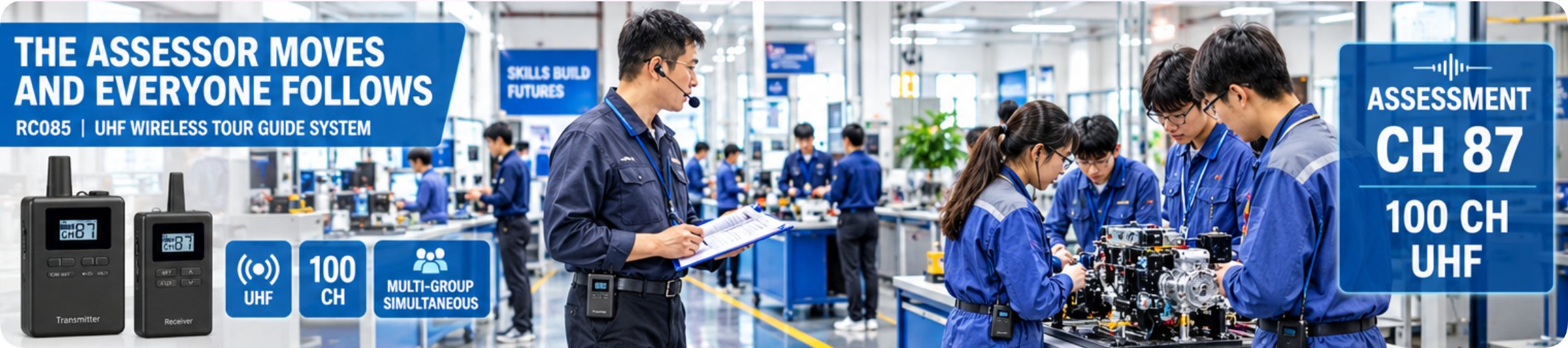
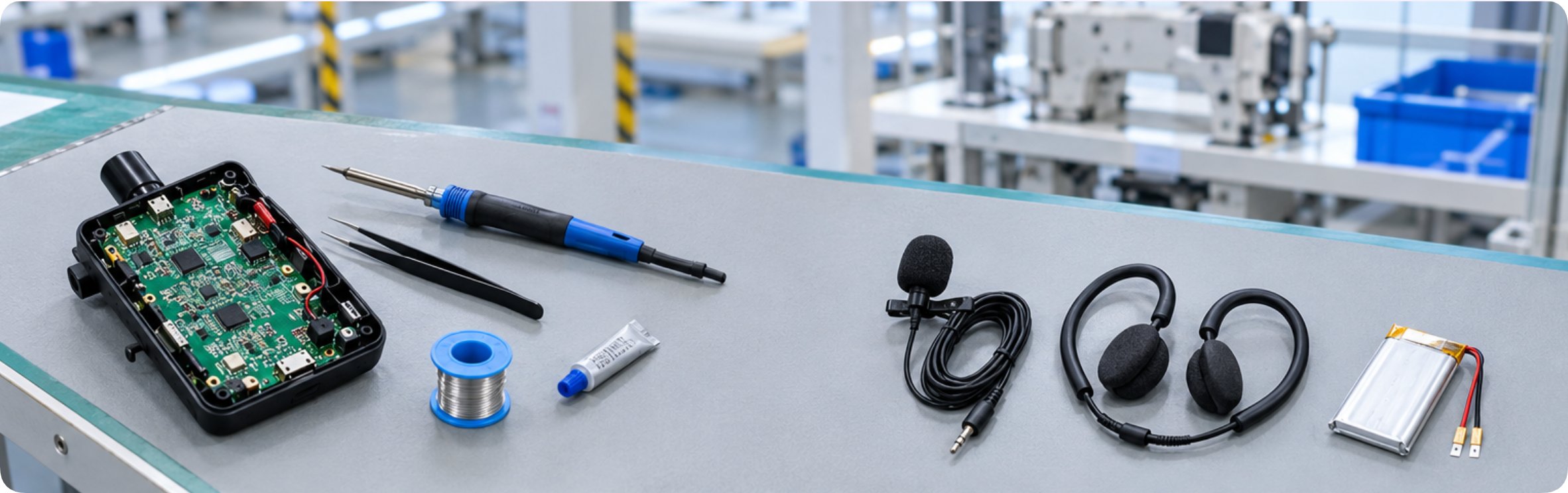
The RC2408 is the only one of the three that quotes a figure above one year, and it is worth reading the whole line rather than the first two words. The page states a three-year warranty, with the mainboard covered and vulnerable parts excluded, naming the headset, the microphone and the battery as the excluded items. The certification line on the same page reads CE and RoHS, and the unit runs on the 2.4GHz band from 2403 to 2483MHz across 80 channels with a range up to 200 meters.
That is a narrower promise than the headline figure suggests, and it is a more useful one for a plant, because it names the boundary. A transmitter that fails on the board is a workshop fault. A microphone that fails after a week of being clipped to a lapel in a dusty room is consumable, and treating it as a warranty event means an argument with the supplier on every single one. Separating the board from the wearable parts is what makes the three-year figure credible rather than promotional.
One Year, Accessories Outside the Cover
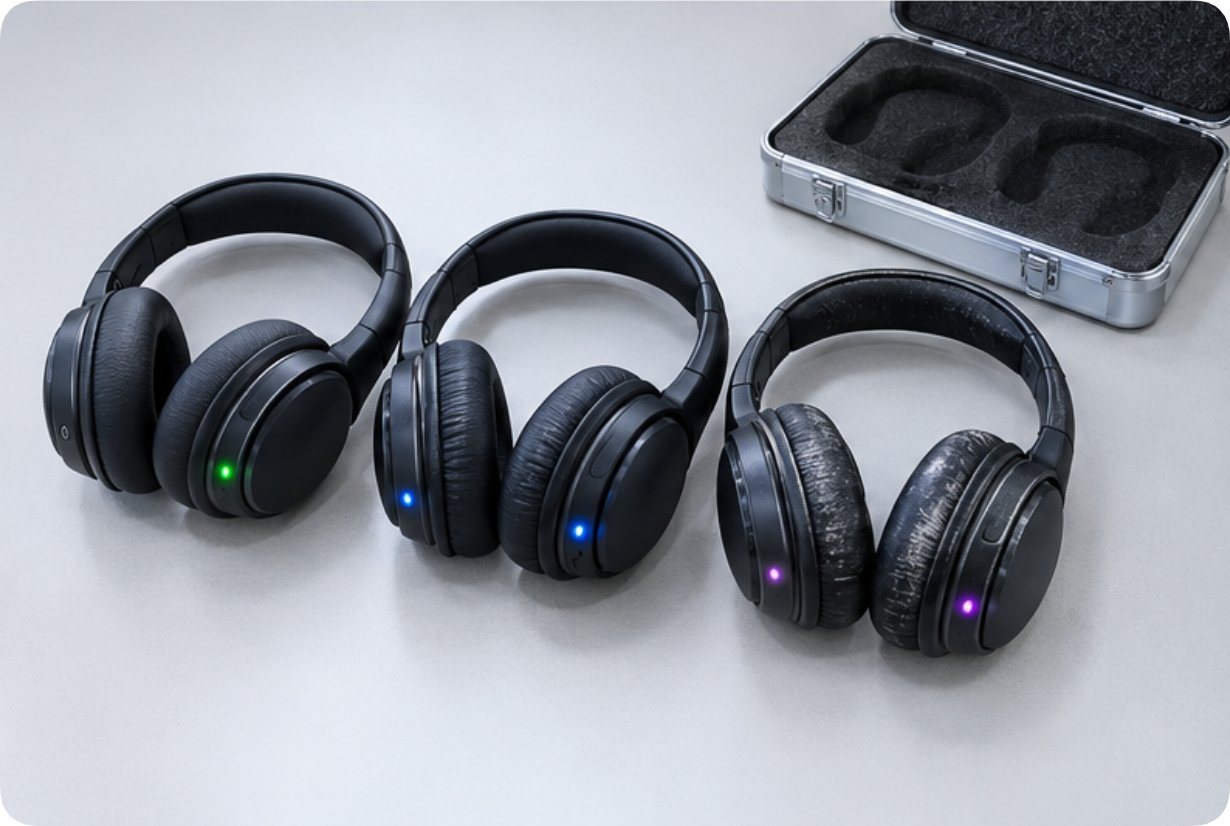
The Silent Disco Wireless Headphone System quotes a one-year warranty with accessories not included, and separately states a defective rate below one percent based on individual testing before shipping. The pair on that page is the RC-409 headphones with the RC-50RF transmitter: ten channels with FM stereo modulation, five colour LED indicators across red, green, blue, purple and yellow, 40mm Mylar drivers with a signal-to-noise ratio above 75dB and total harmonic distortion below one percent.
The accessory exclusion is doing more work on this product than on a headset system, because here the accessory is the product. These are headphones, and the five-colour channel indicator is built into both ear cups, so a set handed to visitors wears out at the ear pads and the cushions long before the electronics inside the housing fail. Powering them is a 500mAh lithium-ion cell giving ten hours of operation and three hours of charge over Micro USB, with the RC-50RF transmitter quoted at up to 200 meters in low-power mode and over 500 meters in high-power mode.
The Player That Carries Its Own Content
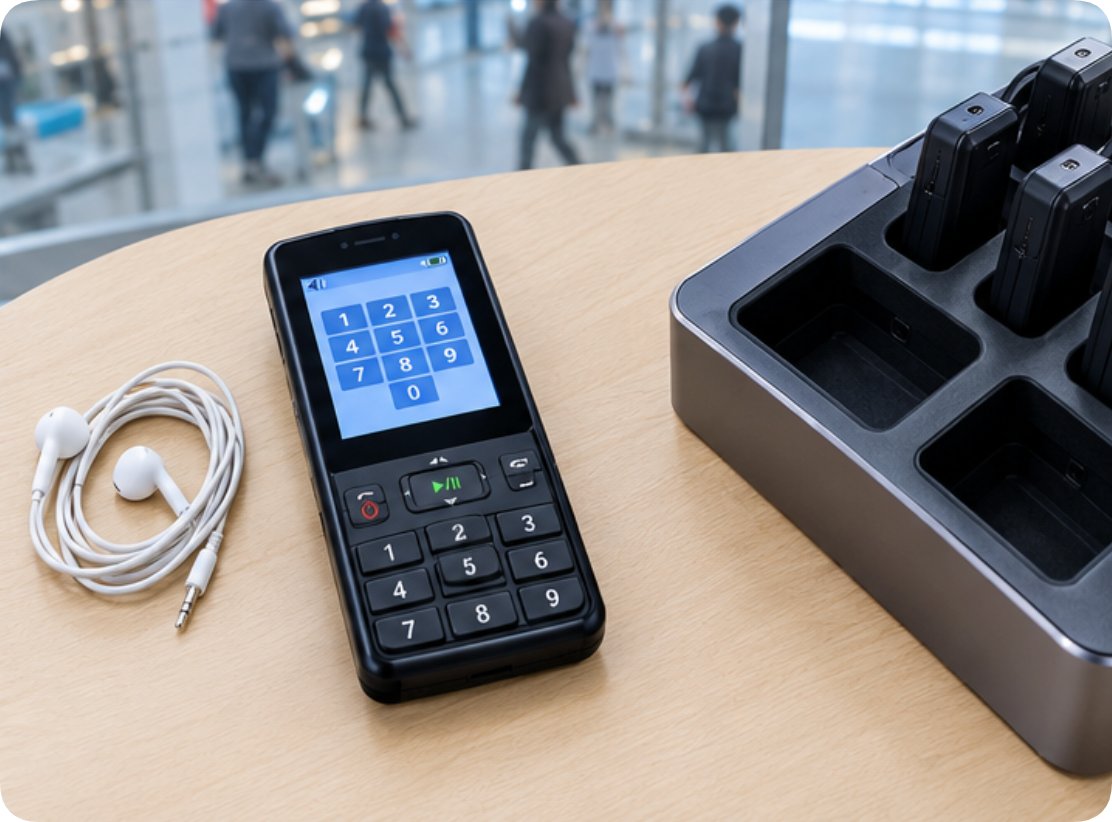
The 2.8-inch semi-auto digital audio guide also quotes one year with accessories excluded, and it is a different kind of product in the same questionnaire. It holds up to 16 languages and up to 9999 audio files on 2GB of built-in memory, takes a number from the 0-9 keypad to trigger playback, runs up to 18 hours on a charge over a Micro USB interface, and ships with earphones included. There is no radio link to a transmitter and no channel to clear, which is the reason it appears in this comparison at all.
What it changes on the questionnaire is the nature of the failure. A self-contained player does not fail as a system, because there is no system around it to fail: it plays its own files, and the question becomes whether the built-in memory still holds every language the plant promised to a visitor group. That is a content-management check rather than a hardware one, and no warranty period covers it either way.
The Fields That Do Line Up
Warranty is the field that cannot be tabled, but it is not the only one in the questionnaire that needs care. The table below carries only the rows where all three pages published comparable values. Fields where one product simply has nothing published are left out rather than filled in, because a blank cell in an audit file is an honest answer and an inferred one is not.
| Field | RC2408 | Silent Disco RC-409 | 2.8-inch semi-auto player |
|---|---|---|---|
| Product type | Wireless tour guide system, 2.4GHz | UHF/RF wireless stereo headphone set | Self-contained digital audio guide |
| Channels or capacity | 80 channels | 10 channels | 9999 audio files, 16 languages |
| Battery life | TX 10h / RX 20h | 10h, 3h charge | Up to 18h |
| Charging interface | DC | Micro USB | Micro USB |
| Warranty | 3 years, mainboard covered | 1 year, accessories excluded | 1 year, accessories excluded |
| Defect rate statement | Not published | Below 1% | Below 1% |
Range and weight are both absent from that table on purpose. The RC2408 quotes 200 meters and 59g for the transmitter with 50g for the receiver; the headphone set quotes the same 200 meters but adds over 500 meters in high-power mode and carries no weight figure; the self-contained player publishes neither number at all, because neither applies to a unit that never transmits. A column with one filled cell and two blanks is not a comparison.
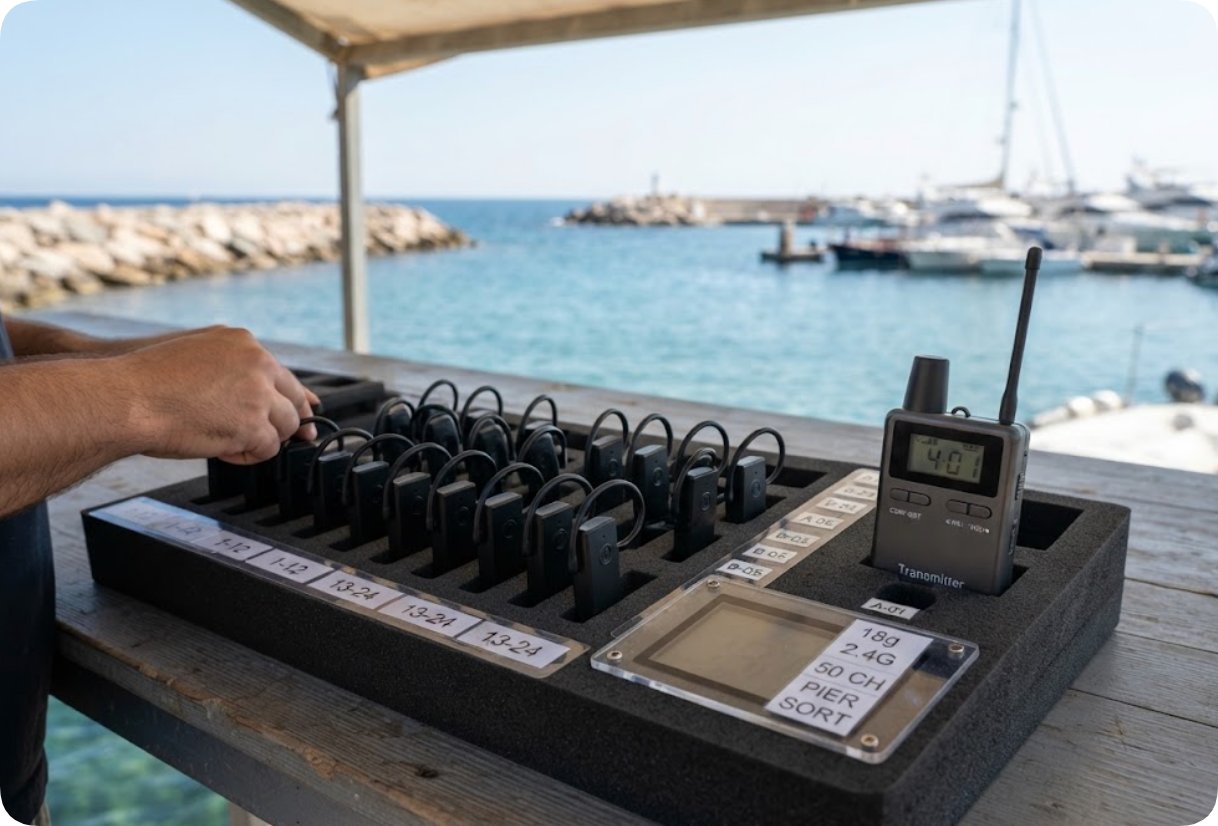
Placing an order against this kind of table is also where a plant's own obligations show up. Programmes built around factory tours carry expectations about channel counts and group sizes that belong to the wider factory tour audio range rather than to any one model, and the visit format decides which of those rows the audit will actually ask for.
Two rows in that table look trivially alignable and are not. The charging interface reads DC on one page and Micro USB on the other two, which sounds like a detail until a plant tries to keep one spare charging cabinet for a mixed fleet: a DC jack needs its own cable type, and the semi-auto player's own page notes compatibility with multi-slot charging boxes, so the two Micro USB products can share a ten-slot dock while the tour guide set cannot. The frequency row divides the same way. The RC2408 sits on the 2.4GHz band from 2403 to 2483MHz, the headphone set runs UHF/RF with FM stereo modulation, and the semi-auto player has no radio at all, so a plant carrying two of these on one visit cannot treat channel planning as a single exercise.
Asking the Question So the Answer Holds Up
The practical conclusion is not that one of these three is the compliant choice and the others are not. It is that the cover line has to be quoted with its exclusions attached, every time it appears, in the questionnaire and in the plant's own file. Three years covering a mainboard is a strong answer; three years without the exclusions printed underneath it is a commitment nobody can keep, and the first month it fails is the first month the audit turns into a dispute.
For the two one-year products the same discipline applies from the other direction. A plant running headphone sets across a year of visitor sessions needs a spare-parts line in its budget, because ear pads, cushions and microphones sit outside the cover on both pages. Writing that cost into the file before the first visit costs nothing. Discovering it after the first season means going back to the supplier for a part the contract never covered.
The same reasoning applies to anything else in the questionnaire that comes with a boundary attached: the certification line reads CE and RoHS on the tour guide system's page, and the pages that state a defective rate state it as a testing figure rather than a warranty term. Where a plant writes those into a supplier file, the exclusions belong in the same paragraph as the claim, not in a footnote. Buyers comparing the wider wireless tour guide range for a multi-site audit programme should expect the same boundary on every page, and should ask for the boundary in writing before the first purchase order is raised.