.webp)
A government delegation itinerary arrives as a single PDF with three columns: time, venue, and the name of the person hosting. Language appears nowhere in it. Two months later, on the morning of the visit, forty visitors walk into the assembly hall in three language groups, the programme has not changed, and the person who hired the audio guide kit is standing in the corridor holding two systems that were bought for an entirely different assumption about who would be listening to whom.
The assumption that quietly shapes every kit purchase is that there is one guide and one audience in one language. A delegation breaks that assumption three times over. There is more than one language, there is a host who has to speak even when the interpreter is still setting up, and there is a building with concrete, steel and glass between the guide and the back row. None of that shows up in the specification sheet, and all of it shows up in the corridor on the day.
Our position after supplying these visits repeatedly: the language split is the easiest thing to solve and the most common thing to solve last. A bilingual plan is a channel-allocation problem, not a translation problem. Decide which language travels on which band, how many devices each side carries, and who is allowed to speak, and the day becomes manageable. Leave it until the group is standing at the door and it becomes a negotiation.
The Official Programme Never Mentions the Second Language
The programme you receive is written for people who already share a language, because the people writing it usually do. It will list the 09:00 welcome remarks, the 09:40 factory walk, the 11:15 signing, and the 12:00 lunch, and it will describe the visitors as a single group of thirty-eight. Nowhere does it record that eleven of those thirty-eight will need Mandarin, that a further nine need English, and that the remaining eighteen are attendees rather than listeners and will be on their phones regardless of what you do.
Three things follow from that gap. First, the interpreter count is set from the headcount rather than from the language split, so it is usually wrong in the direction that cannot be fixed on the day. Second, the receiver count is set to the full group, so you carry devices for people who will not wear them. Third, and most expensively, the guide is expected to speak both languages fluently, because nobody wrote down that she would not be.

The fix is a single column added to the programme before anyone books equipment. It costs nothing to add and everything to omit. Our wireless tour guide system range is specified around that column: how many devices per language, how many channels, and who carries the transmitter at each venue.
Two Systems, Two Bands, One Corridor
The temptation on a bilingual visit is to solve it with one system and one channel per group, switching languages by handing the microphone across. That works in a seminar room and fails in a corridor, for a reason that has nothing to do with the equipment: a channel carries one audio stream, and a channel carrying Mandarin cannot simultaneously carry English. Somebody has to be on the other channel, which means somebody has to be holding a second transmitter.
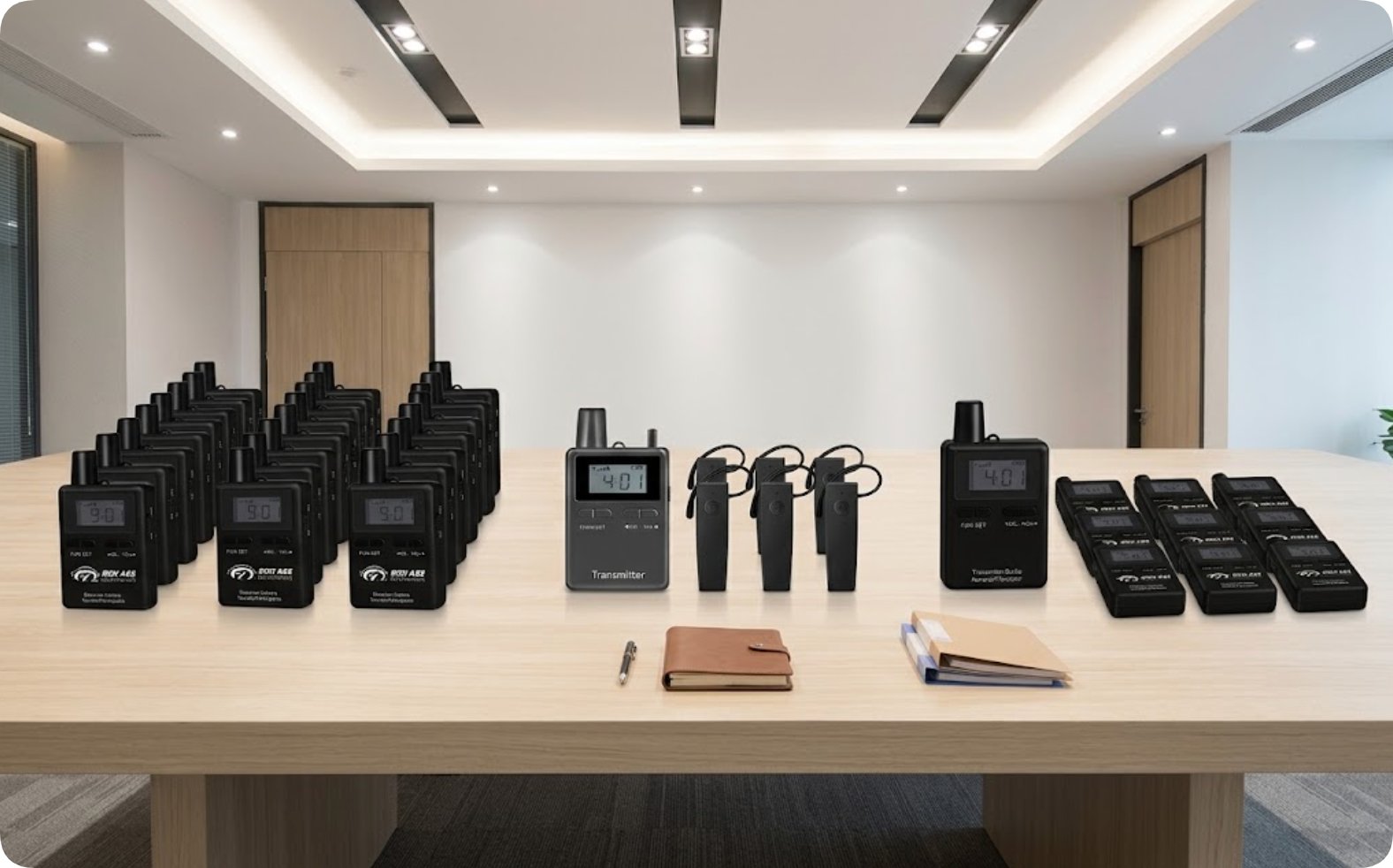
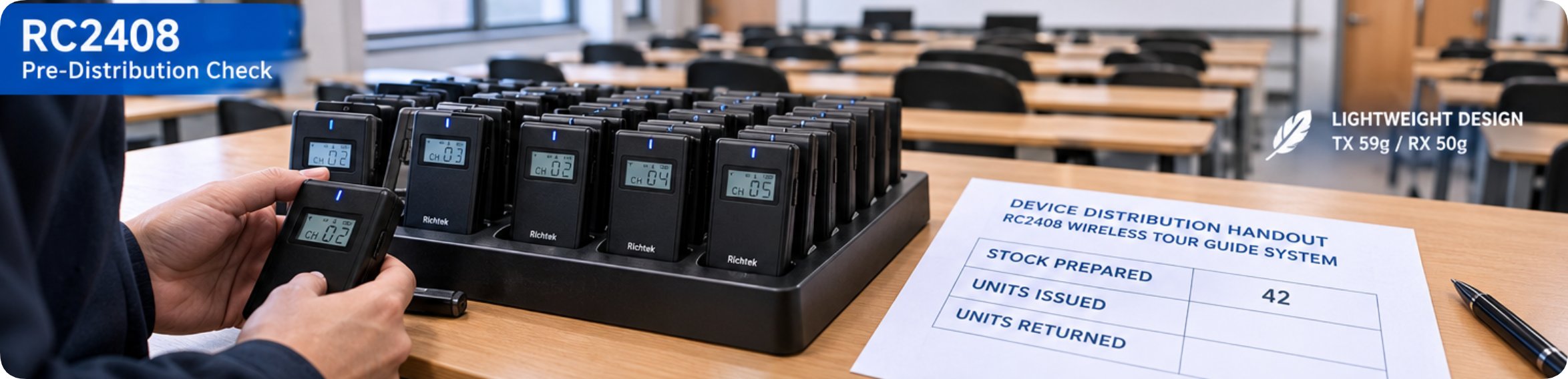
That is the whole design. Two bands, two transmitters, one audience split. The RC2408 wireless tour guide system runs on the global 2.4GHz ISM band from 2403 to 2483MHz with 80 independent channels and one-key channel synchronisation. Eighty channels sounds like overkill for a delegation of forty, and it is: the reason to hold that headroom is that the channel you need is never the one you predicted, and changing channel should take one key rather than a laptop.
Sixty to eighty channels is the working assumption for a visit where the language split might change between the morning and the afternoon session, and where a third group may be added at the lunch. The specification that matters is not the peak channel count but the time to change it.
💡 Why the Channel Count Is Not the Hard Question
Planners usually ask about channels first, and the answer is generous enough that they stop asking there. Channel count is a solved problem at these group sizes. The three questions that actually decide the day are narrower and easier to get wrong.
The first is the hand-off point. When the guide speaks Mandarin and the interpreter takes over mid-sentence, the second channel must be live and the interpreter's transmitter already paired. If the interpreter pairs on arrival, there is a window where one language has no audio at all, and in a delegation visit that window always contains the sentence that matters.
The third is what happens at the venue change. Buildings that host delegations are usually the worst case for wireless audio: a convention centre with hard walls and a metal roof, or an industrial site with racking between the guide and the group. That is a band decision, not a channel decision, and it is the next section.
The second question is who holds what. A transmitter passed between four people across a two-hour walk will end up in a coat pocket, and a coat pocket in a corridor is an RF shadow. The RC2501 wireless tour guide system is built for this: 86 by 50 by 19mm, so it clips to a lanyard or a jacket lapel and stays on the body rather than in a pocket, with a smart noise-cancelling microphone that keeps the guide's voice intelligible when the corridor is busy.

That distinction is why the same three figures are quoted at different weights depending on the venue. On a walk the weight and the mounting decide whether the device is still worn at hour three; in a meeting room the microphone decides whether the sentence arrives; in a factory aisle neither of those matters if the band is wrong.
Reading the Three Published Figures Side by Side
Three units get quoted when a bilingual visit is being specified. Read on their own they look interchangeable. Read together they answer three different questions, and picking the wrong one for a delegation costs a morning.
| Figure | What it actually answers | Where it is the wrong choice |
|---|---|---|
| RC2408: 2.4GHz, 80 channels, 200m | How many simultaneous language groups can run in one room | A site where the guide and the group are separated by steel racking or a concrete core |
| RC2501: 2.4GHz, noise-cancelling mic, 86×50×19mm | Who carries the device for four hours without dropping it | Any venue where the radio path is the problem rather than the room noise |
| RC8860: UHF 860–870MHz, 20 channels, 200m, IPX4 | Whether the signal survives the building between the guide and the back row | A venue with eight or more parallel groups needing separate channels at once |
The pattern is that the 2.4GHz units give you channel headroom and the UHF unit gives you wall penetration, and those are not interchangeable currencies. Eighty channels is more than a delegation needs. Twenty is fewer than a multi-track summit needs. The band question is decided by the building, and the channel question is decided by the programme.
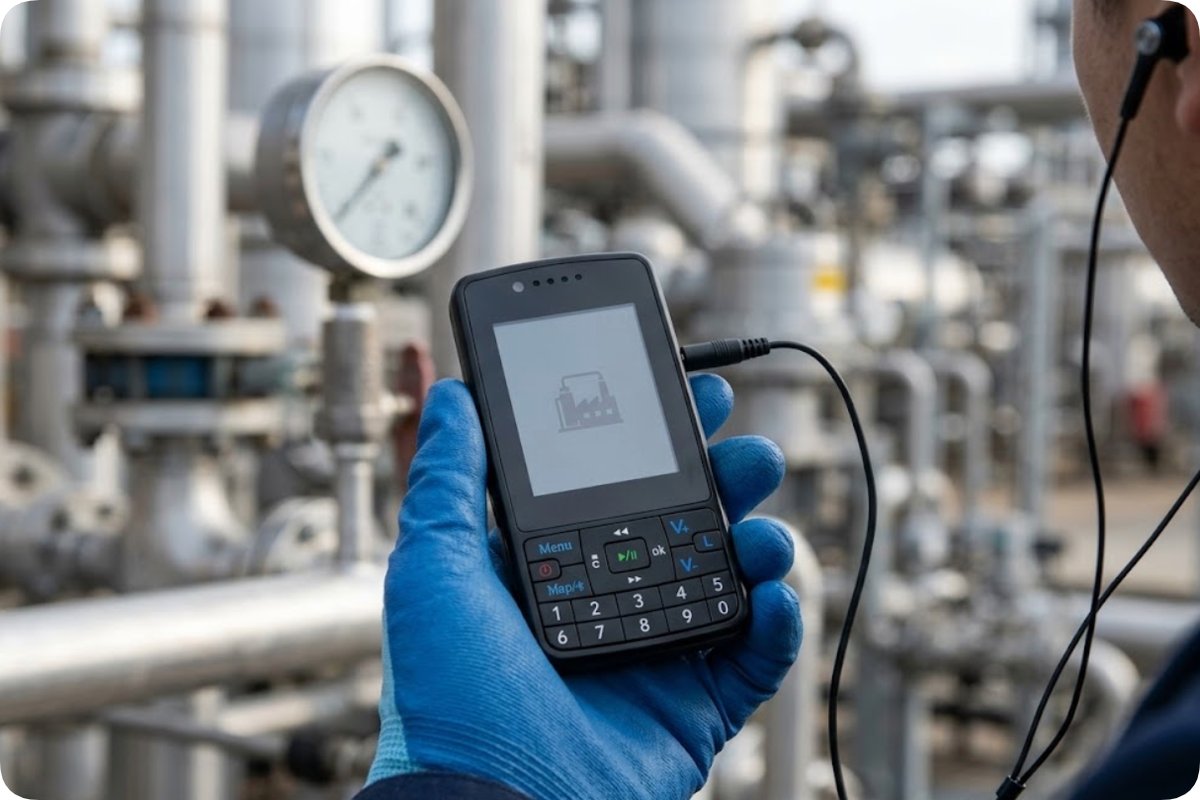
For most delegation visits the answer is one system for the language split and one for the building. The RC8860 UHF wireless tour guide system is the one to reach for when the visit includes a factory floor, a plant, or a building with a structural core: at 860–870MHz it bends around obstacles and penetrates concrete and metal shelving in a way a 2.4GHz system does not, and at 10mW receiver output with a 1000mAh cell it will run a full twenty hours, which covers two back-to-back working days on one charge.
🚀 The Noise-Cancelling Mic Fixes Voice, Not Bandwidth
It is worth being precise about what the smart noise-cancelling microphone on the RC2501 does, because it is regularly credited with more than it can deliver. It filters background interference out of the microphone pickup: machinery rumble, corridor echo, overlapping voices from the next booth. It improves the signal-to-noise ratio at the input.
It does not change the radio path. It does not add channels. It does not help if the receiver is fifty metres away through a concrete wall, because at that point the audio never reaches the microphone to be filtered. A delegation that buys a noise-cancelling mic to solve a penetration problem will hear the same dropouts, with a slightly cleaner sound in the parts of the room where the signal does arrive.
That said, it is genuinely load-bearing in the specific case it was designed for: a guide speaking to a room where the noise is produced by the room itself. A reception hall with a hundred people talking, a trade stand demonstration next to four competing booths, an open-plan office floor with overhead ventilation. In those rooms the microphone decides whether visitors hear the sentence or strain to reconstruct it, which matters far more for visitors whose first language is not the one being spoken.
The other two figures on that unit are worth noting for delegation use. The operating range is minus 10 to 45 degrees Celsius, so the same kit works for a February site visit and a July outdoor ceremony without a second inventory. And the OEM/ODM path means a host who wants the unit in institutional colours with their own logo on it can have that done at production rather than stickered on arrival.
Where a Walkie Arrangement Breaks at the Turnstile
The most common bilingual solution we are asked to replace is two ordinary radio sets, one per language, with a hotel staff member holding one of them. It works in the meeting room. It fails in three specific places, and all three of them appear on delegation itineraries.
At the entrance is the first failure. Radio sets need a channel plan and a volume discipline. Forty visitors arriving through one turnstile at slightly different speeds means the last person joins mid-sentence, and there is no equivalent of one-key channel synchronisation to recover it. This is the point where the pairing behaviour of a dedicated receiver earns its cost, because the visitor does not need a volume knob set correctly or a channel chosen by hand.
The second failure is the walk itself. A radio set on a lanyard is a 200g object that people will put down. A receiver designed to be worn all day at 50g is a different category of object, and that difference shows up in whether people are still listening at hour three.
The third failure is security. A radio set in a government building is a radio set in a government building. A dedicated receiver on a closed channel with no external controls is easier to clear through a venue's own screening process, and that is a question worth raising before the visit rather than on it.

For visits that run across several venues, our conference and delegation visit solutions page covers how the same kit is configured differently for a plenary hall, a break-out room and an outdoor walk without changing the device fleet.
Running the Whole Visit on One Sheet
Here is the plan we would give to a host organising a forty-person bilingual delegation across a factory and a conference centre. It is one page, and it fits in a phone photograph.
Venue 1, reception hall: two languages, noisy room, no wall problem
RC2501 carries the Mandarin channel and the English channel, two transmitters, one guide and one interpreter. The noise-cancelling microphone is doing real work here because the room produces its own noise. Receiver count set to attendees only, not the full headcount.
Venue 2, factory floor: two languages, steel racking, long walk
RC8860 moves in. The building, not the crowd, decides this one. Channel count of twenty is ample because a factory visit is one group in one language pair at a time. The IPX4 rating matters only if any part of the walk is outdoors, and it is worth having regardless.
Venue 3, conference hall: eight parallel sessions
Here the channel budget inverts. RC2408 with 80 channels and one-key synchronisation goes in, because the constraint is now the number of rooms rather than the wall structure. This is the only venue where the channel count is the first question and the band is the second.
Handover points, written down
Three named moments: end of welcome remarks, end of factory walk, start of afternoon session. At each one the outgoing transmitter is confirmed off, the incoming one confirmed paired, and the outgoing language is confirmed to have no channel still live. This is the only part of the plan that must be executed exactly, and it costs about ten seconds each time.
Battery and charging, one table
RC2408 transmitters run ten hours and receivers twenty. RC8860 matches that: 1500mAh in the transmitter for ten hours, 1000mAh in the receiver for twenty. A delegation day is typically six hours of actual listening, so a full charge at the start covers it with margin, and charging stays in the vehicle rather than in the venue's security queue.
Questions Worth Settling Before the Delegation Letter Arrives
Five questions that decide whether a bilingual delegation visit works, and that are all cheaper to answer during planning than on the day.
What is the actual language split, not the total headcount? The number that matters is how many people need a receiver in each language. Thirty-eight visitors split eleven, nine and eighteen is three different kit configurations. Thirty-eight visitors with one interpreter is a completely different problem.
Who speaks and who interprets? If the guide is not fluent in the second language, an interpreter has to be paired and live before the session starts, not during it. This is the single most common cause of a bad opening minute.
What is between the guide and the back row? Concrete core, steel racking, a glass partition between rooms. This decides the band. If nobody has walked the route, assume the worst structural case and choose UHF.
How many parallel sessions run at once? One language pair in one room is twenty channels of headroom. Eight sessions in eight rooms is a channel-budget problem, and the answer is the 80-channel unit rather than the 20-channel one.
Finally, who hands over and when? Three written handover points with named names attached. Nothing else on this list requires a person to remember something at a specific moment; this does.
Three Records Instead of One Purchase Order
None of this requires a large system or a long contract. It requires that the purchase order specify the language split rather than the headcount, that the venue list specifies the building rather than the capacity, and that the programme carries a language column. Most delegation visits go wrong because a kit was bought against a programme that never recorded any of those three things.
RC2408, RC2501 and RC8860 cover the combinations that come up most: channel headroom for parallel sessions, a wearable form factor for long walks, and a band that survives the building. Free consultation and quotation, custom assembly from prototype to mass production, ISO certified manufacturing, worldwide shipping, and a dedicated project manager are available when the visit list is still open. For a fuller picture of how the same kit is configured for exhibitions and multi-track events, our solution deployment guides set out the venue-by-venue patterns.