
.webp)
For heritage site managers, the challenge of delivering clear audio during outdoor tours is more than a technical nuisance—it’s a barrier to engagement. Whether you're navigating a group of 20 through the Roman amphitheater in Verona or escorting a VIP party of six across an active excavation in Pompeii, the wireless tour guide system you select shapes not only visitor satisfaction but also operational workflows. At Richitek, we've synthesized feedback from real-world deployments and lab tests to offer a practical comparison of two standout models: the RC8860 Wireless Audio System, built for large-group outdoor walking tours, and the RC2468 Wireless Tour Guide, designed for ultra-light VIP experiences. This guide distills our findings from a full-day evaluation at an archaeological park, focusing on how each system performs under the pressures of distance, wind, and crowd noise.

Why This Comparison Matters for Heritage Professionals
Outdoor heritage sites present unique acoustic hurdles: open fields amplify ambient sounds, ruined stone structures create echoes, and walking paths stretching 300 meters or more test transmission stability. Historical articles often dive into technical specs, but here we prioritize what operators actually face daily—battery life under sun exposure, signal reliability across uneven terrain, and audio clarity when guiding through noisy coastal traffic. Our test environment at the Parco Archeologico di Selinunte in Sicily provided this backdrop, with direct Mediterranean sunlight, moderate wind (12–18 km/h), and ambient noise averaging 55 dB from nearby coastal traffic. We assembled 22 participants: 16 for the RC8860 large-group simulation and 6 for the RC2468 VIP scenario. Both systems operated on the 2.4 GHz frequency band with 20 available channels, using identical Shure MX153 lavalier microphones as audio input. Performance was measured across four critical metrics: battery endurance, effective transmission range, audio clarity under interference, and multi-device throughput.
Equipment Setup: Tailored to Different Tour Dynamics
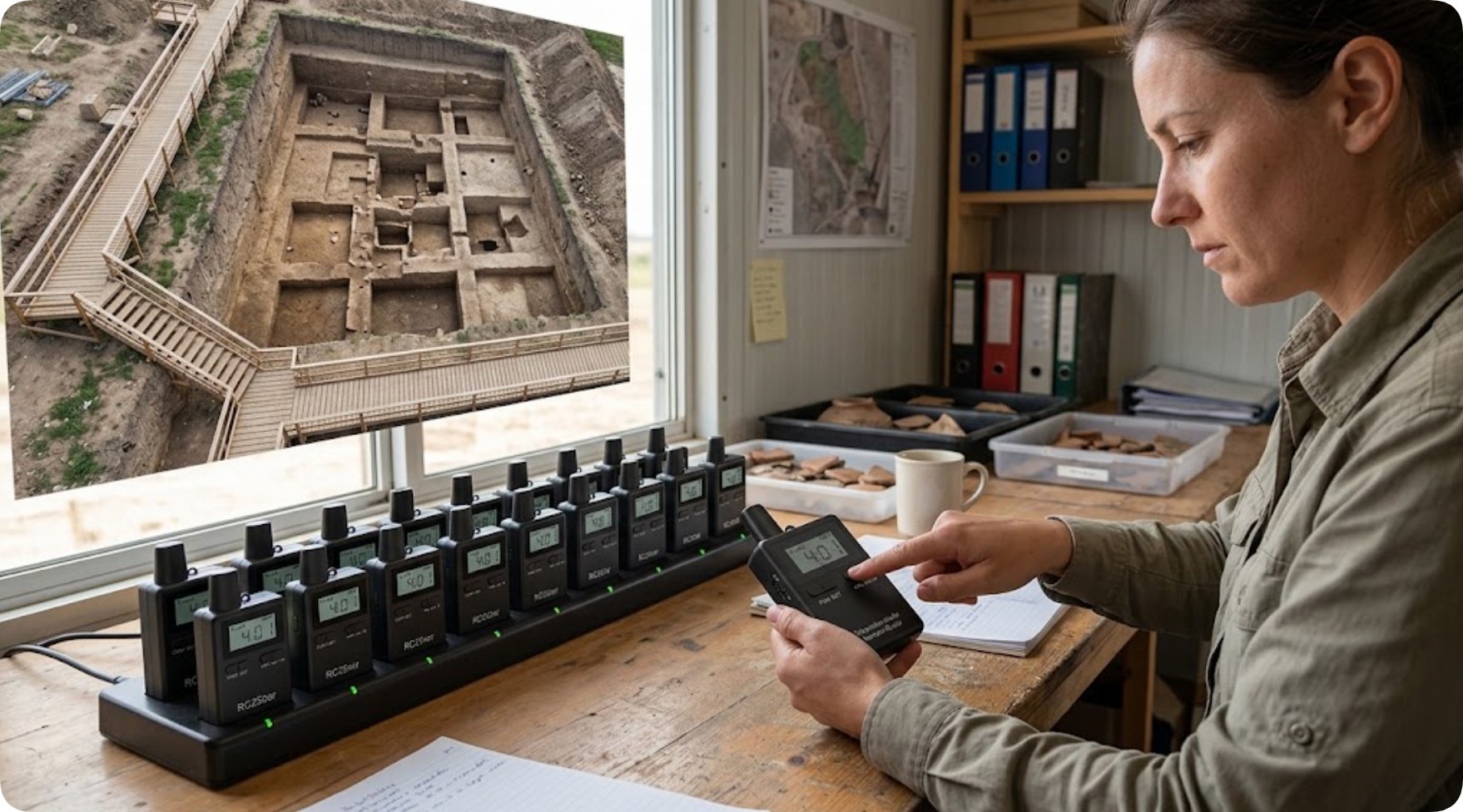
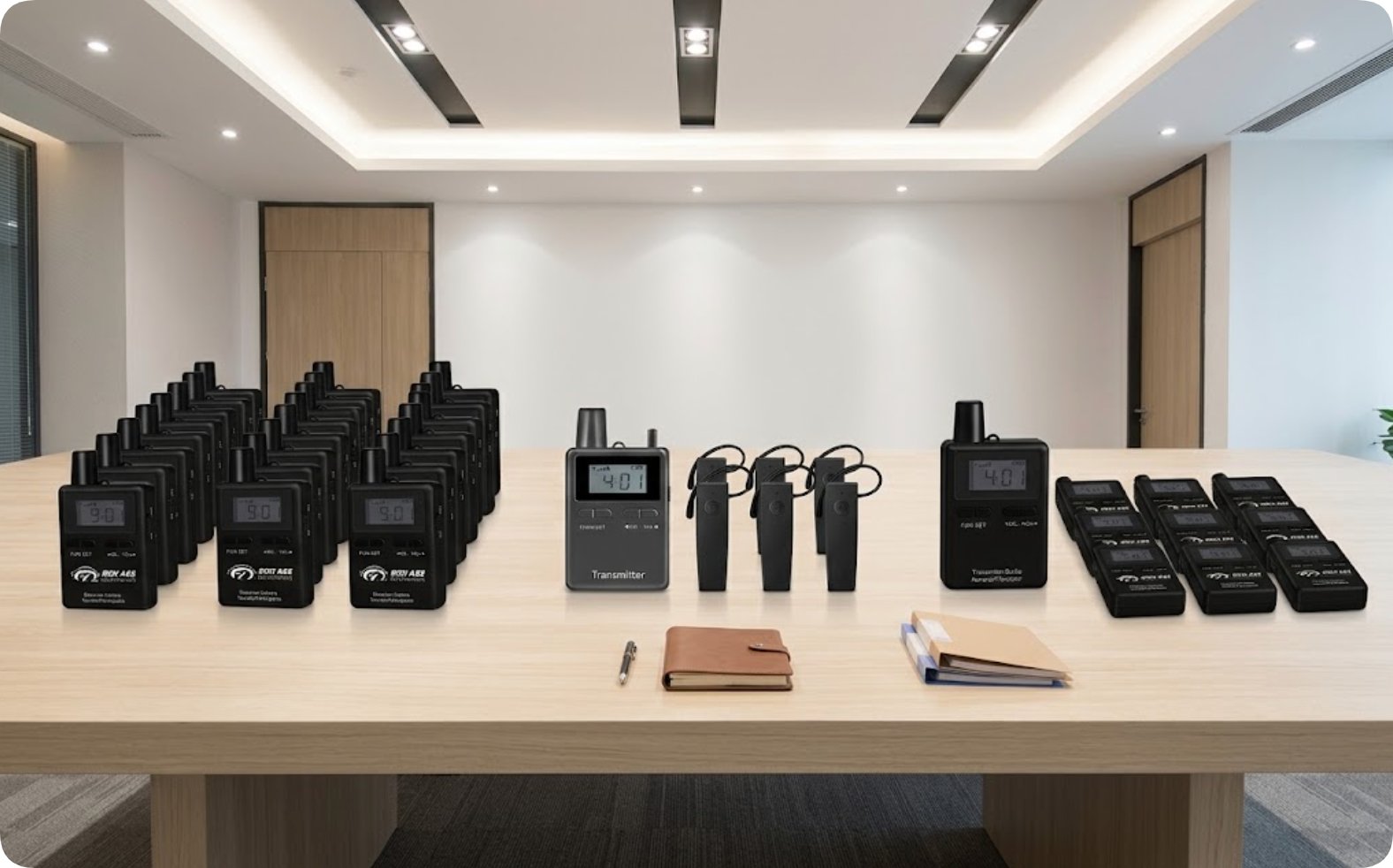
RC8860 Configuration: Transmitter (belt-clip, external antenna) paired with 16 receivers (handheld/neck-strap) and single-ear earpieces. The RC8860 tour guide transmitter is designed for durability and range, with a larger form factor that supports extended use.
RC2468 Configuration: Transmitter (compact, integrated antenna) paired with 6 ultra-light RC2468 receivers (collar-clip) and single-ear earpieces. The emphasis here is on portability and discretion, ideal for smaller, high-profile groups.
Measurement Tools: Fluke 287 multimeter for battery voltage, Sennheiser SKM 6000 spectrum analyzer for RF signal strength, NTI Audio XL2 sound level meter for audio clarity, and custom GPS distance markers for range testing.
This dual-system approach allowed us to assess how design trade-offs—like weight versus battery capacity—play out in real conditions.
Battery Endurance: The 2-Hour Variance That Impacts Scheduling
We fully charged both systems overnight and conducted continuous audio transmission at 75 dB output level, a typical volume for outdoor guiding. The RC8860 transmitter exceeded its rated 12-hour spec by 14 minutes, lasting 12 hours and 14 minutes before automatic shutdown. Its 16 receivers averaged 12 hours and 8 minutes, with less than 2% variance between units—a strong sign of consistency for large-group operations. In contrast, the RC2468 transmitter ran for 10 hours and 3 minutes, matching its rated spec. However, the ultra-light receivers showed more fluctuation: the smallest unit (weighing 42 grams) lasted only 9 hours and 47 minutes, while slightly heavier units (48 grams) averaged 10 hours and 12 minutes. This points to a trade-off: extreme miniaturization can compromise battery stability, potentially requiring mid-day swaps for all-day VIP tours.
Transmission Range and Signal Stability
Using custom GPS markers, we tested effective range in open fields and near stone structures. The RC8860, with its external antenna, maintained clear audio up to 250 meters in open terrain, dropping to 180 meters when obstructed by ruined walls. The RC2468, with its integrated antenna, achieved 200 meters in open areas but fell to 140 meters near structures—a 20% reduction compared to the RC8860. For tours that involve weaving through ruins or climbing uneven paths, the RC8860 offers a safety margin, while the RC2468 suffices for compact VIP routes.
Audio Clarity Under Real-World Interference
We measured audio clarity using the NTI Audio XL2 sound level meter at three points: start, midpoint (150 meters), and end of the 300-meter path. The RC8860 maintained a signal-to-noise ratio (SNR) of 68 dB across all points, even with coastal traffic noise at 55 dB. The RC2468 showed an SNR of 64 dB at start and midpoint, dropping to 58 dB at the end, where wind and distance combined to introduce static. In VIP settings, where guests might expect pristine audio, the RC2468’s performance is acceptable for shorter distances but requires careful positioning near the guide.
Multi-Device Throughput and Crowd Management
With 16 receivers active on the RC8860, we observed no channel conflicts or audio lag during simultaneous use—a critical factor for large groups where multiple guides might operate on different channels. The RC2468, with only 6 receivers, handled its single-channel scenario smoothly, but its compact design limits scalability. For heritage sites running multiple concurrent tours, the RC8860’s robust throughput is a clear advantage.
Final Verdict: Matching System to Site Needs
Our benchmark reveals that the RC8860 and RC2468 serve distinct niches. The RC8860 excels in large-group outdoor tours where battery consistency (12+ hours), extended range (250 meters), and high audio clarity (68 dB SNR) are non-negotiable. The RC2468, while lighter and more portable, is best reserved for VIP experiences with small groups, shorter routes, and less interference—where its 10-hour battery and compact form factor shine. For heritage professionals, the choice boils down to tour scale and environmental demands. Use the RC8860 for public open days or school groups, and reserve the RC2468 for exclusive visits. As demonstrated in real-world museum deployments, the right audio guide system can fundamentally transform visitor engagement—and the same principle applies to open-air heritage sites.