.webp)

RC2408, RC2500 and RC2406: What a Data Centre Tour Earns From Every Admitted Window
My view up front: the return on a data centre audio kit is not decided by the price list or by the headcount. It is decided months earlier, by how many visit windows the operations team is willing to release, and by how long a briefing survives inside a live hall. Buyers who model visitors and hours end up arguing about an invoice. Buyers who model windows pick three devices and move on.
Two things govern everything that follows. The first is the noise floor of a working hall, which fixes how far a voice carries before it stops being useful. The second is the number of times a year your host will be allowed to walk a group past live equipment. The kit has to serve both, and the three models below serve them in different ways.
Why the Noise Floor Sets How Long a Briefing Lasts
A working hall is a hostile room for a speaking voice. Rack fans run continuously and never pause for a question, aisles are long and lined with metal, and hard floors with perforated tiles reflect sound back instead of absorbing it. A host talking unaided is not describing a facility, they are projecting into a wall of broadband noise, and the further a party strings out along an aisle, the less of the explanation arrives. This is the same problem that makes industrial site tour solutions worth reading before a technical visit is planned, because the room dictates the equipment rather than the other way round.
What matters at the specification stage is not a single headline range figure. It is whether the audio path still works when the listener is fifteen metres behind the host, facing away, behind a row of cabinets. A receiver that only performs on a straight line of sight is a receiver that fails in the one place you are taking people.
The Access Slot Is the Real Constraint
Facilities do not release access generously. A visitor list has to be agreed, escorts have to be taken off other duties, and no group walks a live aisle during a maintenance window or a customer migration. That means capacity is measured in admitted slots rather than in staff hours, and a slot is a fixed-length asset that cannot be stored. If a forty-minute window is spent re-explaining a section to the back of the group, the slot has been partly wasted in a way no timesheet will ever show.
The practical consequence for a purchase decision is uncomfortable but simple. Anything that shortens a briefing inside the slot raises the value of a slot you already have permission to use. Anything that adds setup time at the door consumes the same slot from the other end.
The Cost of a Re-Brief Nobody Priced
Repeats are the omitted line in most visit budgets. When a host has to stop, walk back and restate a point for listeners who missed it, three costs land at once: the minutes come out of the remaining window, the escort's attention leaves the equipment, and the group's confidence in the visit drops at exactly the point you wanted it to rise. Indoors this rarely shows up as a complaint. It shows up as a shorter visit next time, or as a decision that gets taken without another site walkthrough at all.
Pricing this properly is a modelling exercise, not a measurement one. Take the admitted slots per year, the minutes a single repeat consumes, and the loaded hourly cost of the people standing in the aisle during it. The result is a defensible figure for what clear audio returns, and it does not depend on anyone manufacturing a field reading to support it.
Two-Way Audio for the Escort Walking Ahead
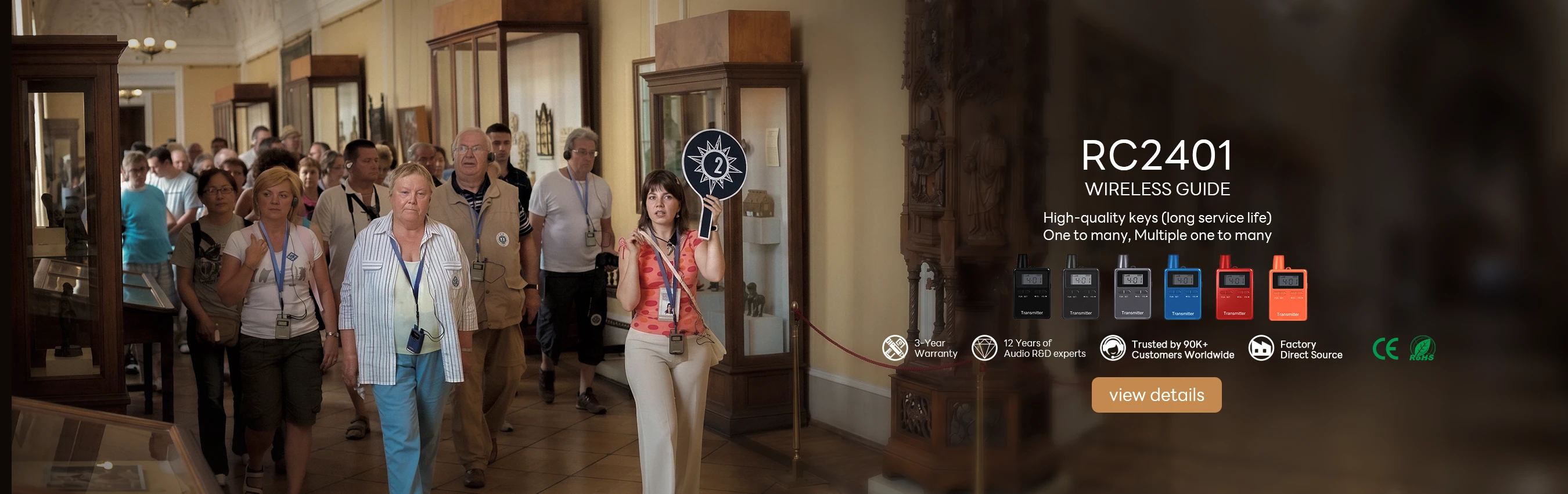
The first of the three devices fits the visit where two groups move through the same hall and an operations escort needs to say something without breaking the line. The RC2408 runs on the global 2.4GHz ISM band between 2403 and 2483MHz, carries 80 anti-interference channels, and pairs on a single key press. Two-way communication is the feature that earns its place here: the host can hear the escort's warning about a live panel without the group stopping, or a translator can answer while everyone else keeps listening.
Weights are 59 grams for the transmitter and 50 grams for the receiver, with ten hours of transmitter runtime against twenty hours at the receiver, which covers a full day of back-to-back visits on one charge. Four groups can run in the same building on separated channels without crosstalk, and quoted range reaches 200 metres, comfortably beyond the distance a party walking a rack aisle will ever span.

A Receiver That Outlasts a Back-to-Back Week
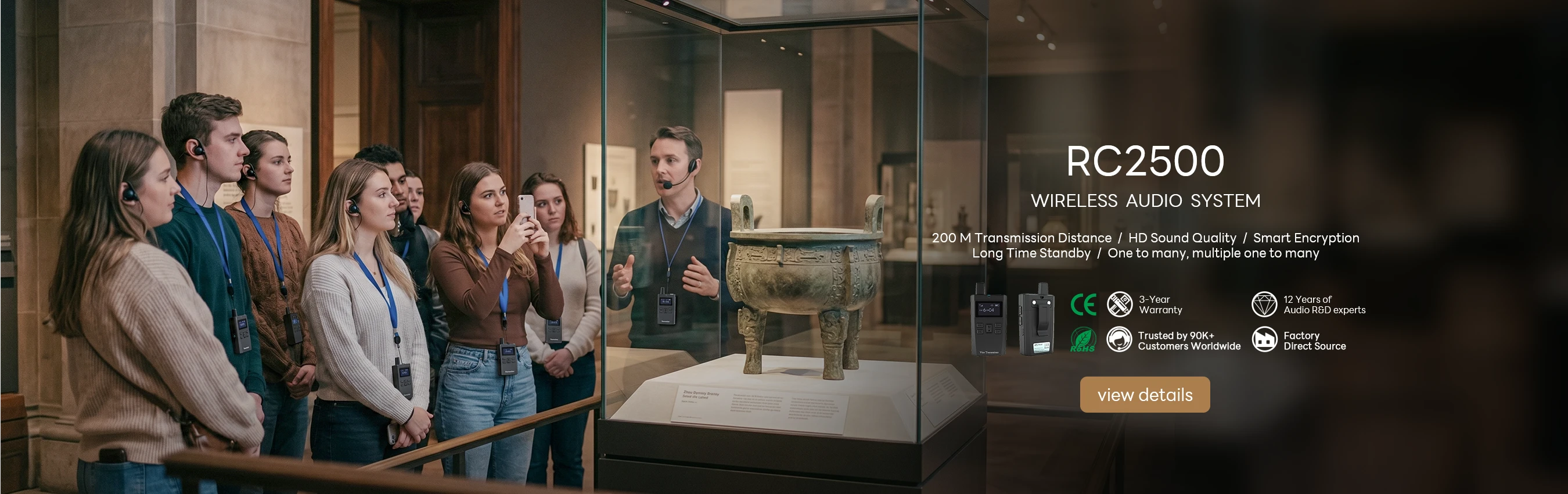
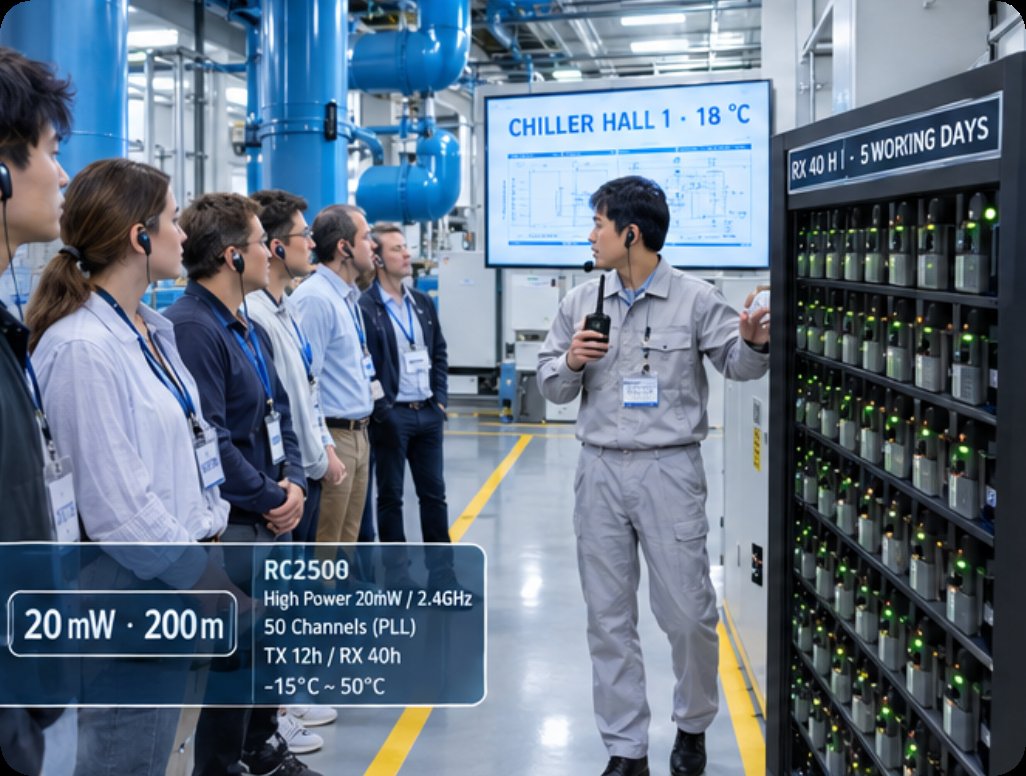
The second device answers a different question: what happens when visits run every day for a week and nobody wants a charging ritual at seven each morning. The RC2500 is specified as a high-power system built on a 20mW 2.4GHz transmission, with 50 independent channels using PLL frequency synthesis and a quoted 200 metre range. Receiver runtime is the headline figure at forty hours against twelve hours for the transmitter, and the manufacturer frames the receiver side as five working days between charges.
Its operating window runs from minus fifteen to fifty degrees Celsius, which matters more than it looks when a group moves from a chilled white space into a plant room where chillers and switchgear share the floor. High transmitter power is the reason this model suits that leg of the visit, and the receiver count is not capped: one transmitter can serve as many listeners as the aisle can safely hold.
Compact Enough for Narrow Rack Aisles
The third model is the one that goes where the group has to compress. The RC2406 carries 80 PLL anti-interference channels on the same licence-free 2.4GHz band, reaches 200 metres in open area, and weighs 50 grams at both the transmitter and the receiver, which is light enough that visitors forget they are wearing it. A 1500mAh cell is quoted for full-day continuous use.
Its body is rated IPX4 for splash resistance, a small detail that matters in rooms where cleaning crews work wet and where a dropped unit lands on a hard floor. For a party threading a single narrow aisle between two rows of cabinets, the combination of light weight, full-day working time and eighty separated channels is what lets a host keep the commentary continuous instead of pausing to re-group.

Side-by-Side Specification Check
| Model | Channels | Runtime, transmitter / receiver | Weight | Ingress protection | Best leg of the visit |
|---|---|---|---|---|---|
| RC2408 | 80, anti-interference | TX 10 h / RX 20 h | TX 59 g / RX 50 g | Not published | Parallel groups with a talking escort |
| RC2500 | 50, PLL synthesis | TX 12 h / RX 40 h | Not published | Not published | Daily visits and the plant room leg |
| RC2406 | 80, PLL anti-interference | 1500 mAh, full day | 50 g | IPX4 | Narrow aisles and mixed group sizes |
Two fields in that table read "not published", and they stay that way on purpose. Neither figure appears on the manufacturer's product page for the relevant model, and inventing a plausible number would turn a specification sheet into a liability the first time a visitor asks where it came from. Every other value above is quoted from the product pages themselves.
Turning Available Slots Into a Payback Figure
Once the slots are known, the arithmetic is mostly clerical, which is why it gets skipped. Four inputs decide whether the kit pays for itself inside the first year, and none of them require a pilot study:
| Model input | What belongs in that row |
|---|---|
| Admitted slots per year | Windows operations will release, not calendar days or visitor numbers |
| Parties per slot | Groups the aisle can hold at once before the visit becomes a crowd management exercise |
| Re-briefs avoided per visit | Minutes recovered when nobody has to walk back and restate a section |
| Coordinating hours returned | Escort time no longer spent relaying instructions along the line |
Reading the two tables together gives the shape of the decision. Where groups spread out and an escort needs to intervene, the two-way capability of the RC2408 earns the first slot in the budget. Where visits run daily and the week never resets, the receiver endurance of the RC2500 removes the charging chore and covers the plant room. Where the route narrows and the party shrinks or grows without warning, the light body and channel count of the RC2406 keep the commentary running. Most programmes end up buying two of the three and adding the third once the second visit season proves the point.
If the visit is part of a sales cycle rather than a public tour, the same reasoning applies and the audience simply changes. Programme managers weighing which configuration matches their calendar can browse our wireless tour guide system range for the full channel and runtime matrix, and can compare the formats used by technical facilities in the published deployments before committing budget to a first purchase. Teams that have not yet run a structured visit programme may prefer to explore our solutions first, since the planning questions come before the hardware questions.
Decide the slots first, then the devices. A data centre tour earns its return in the windows it is allowed to occupy, and the audio kit is what stops those windows being spent on repeating yourself.