
RC2401, RC2468 and RC2501: How Many Guides Does a Campus Open Day Really Need?
I have watched more campus open days go sideways than I care to count, and the audio hardware is almost never the reason. The reason is that somebody builds the roster first and counts the groups second. Twenty volunteers get assigned to a "welcome day", and then at 09:00 four separate parties set off in four directions at the same time, each one expecting a guide who can be heard. Whatever kit you bought, the day is now a staffing problem wearing a technology costume, which is why we treat campus tour solutions as a planning exercise before they are a purchase.
The useful way into it is to stop asking how many visitors are coming and start asking how many parties will be moving in parallel, how long each one stays out, and who hands out and collects the receivers. Those three answers fix the head count and the transmitter count at the same time.
Start With the Number of Parallel Groups
Parallel groups, not total visitors, is the number that drives everything. A department that receives four hundred guests with two groups moving at a time needs less crew than one that receives one hundred and twenty in six simultaneous parties. The transmitter count equals the number of parties in motion, plus one held in reserve at the desk.
Channel capacity is rarely the binding constraint. The units in this range run on the license-free 2.4 GHz band with fifty PLL channels, so six or eight concurrent groups separate cleanly. What the group count really consumes is people: every moving party needs a lead who can walk backwards and keep time.
Two Extra Units per Group, and Why
The spare ratio is where planning usually fails. Two spare receivers per group and one spare transmitter per site is the figure I would defend. Receivers fail for boring reasons: a battery that was not seated, an earpiece that goes missing somewhere between the car park and the quadrangle, a late arrival who joins at the halfway point. A lead who has to walk a guest back to the desk to swap a unit loses ten minutes of the tour, and everyone behind them loses it too.
The second spare exists for a less obvious reason. Visitors who use hearing aids, or who arrive with a companion who needs to hear the same commentary, tend to be discovered on the day rather than in the booking form. Having two spares in the lead's bag keeps that a one-minute adjustment instead of a decision about whether to keep going.
The Auditorium Segment: One Voice, Dozens of Listeners
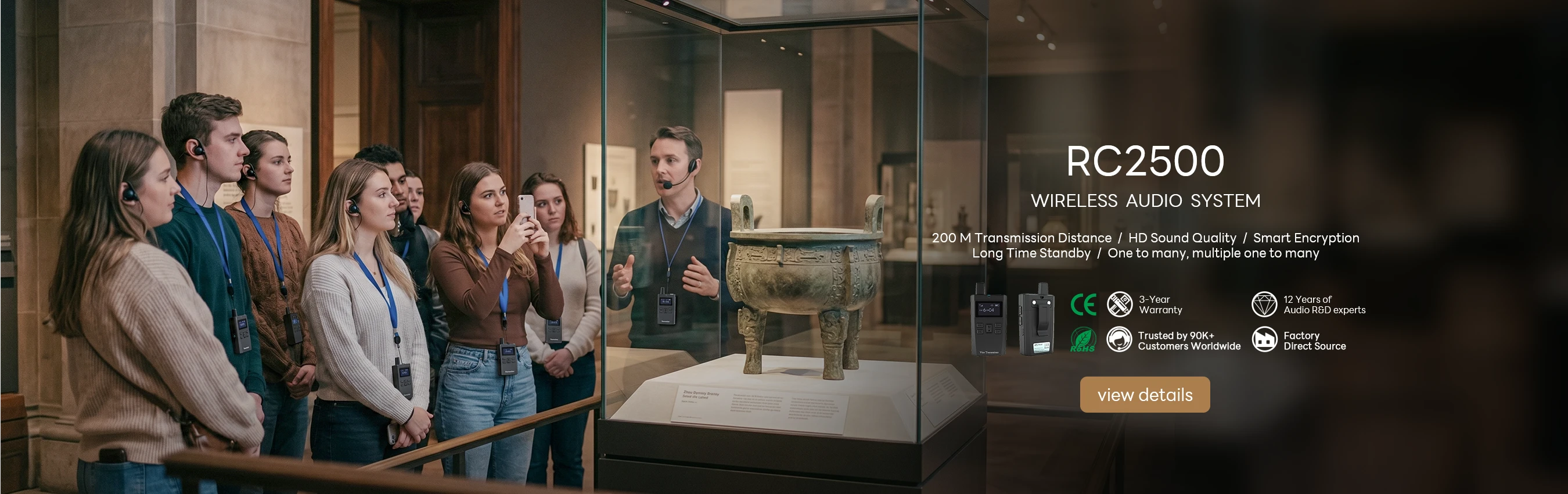
The welcome briefing is the only part of the day where the audience sits still, which makes it the easiest segment to over-staff. The RC2401 suits it: fifty PLL channels on the 2403 to 2483 MHz ISM band, a 200 metre open-area range, and receivers good for around twenty. One-button synchronisation means the desk can hand out receivers and pair them without a technician anywhere near the room.
Because the channels are independent, the briefings can be split by faculty rather than run as one long address, and latecomers can be added to whichever room is still talking. The crew for this segment is three people: one host who owns the front of the hall, one marshal who keeps the doorway clear and adds latecomers, and one desk hand who pairs receivers and records serial numbers against the group colour.

The Walking Segment: Rotating Leads Across Four Routes
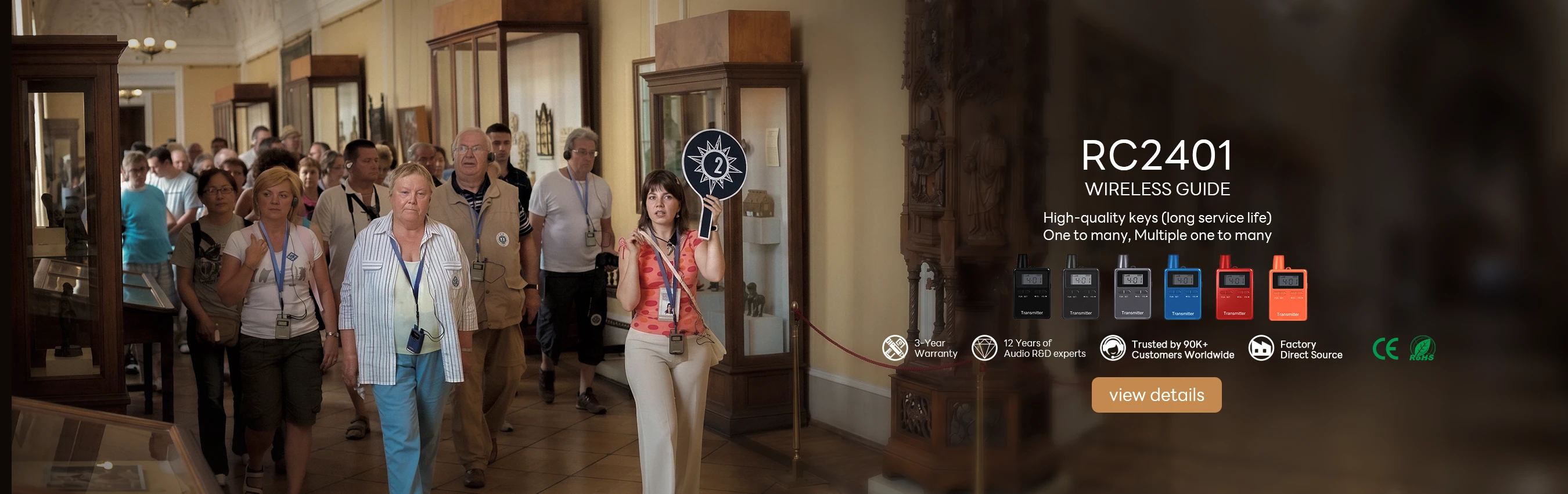
The walking leg is where staff fatigue shows up. The RC2468 was built for it: the receiver weighs eighteen grams and the transmitter fifty-nine, the transmitter runs twelve hours on a 1500 mAh cell and the receiver ten on a 300 mAh cell, and the pairing is one touch. Fifty channels keep four routes apart in the same quadrangle, and the transmitter shells come in several colours. Assign a colour to a route and the equipment audit at the end of the day becomes a glance rather than a spreadsheet.
Rotate leads rather than fixing them to a route. A guide who walks the same loop four times stops noticing what has changed. Swap leads at the midpoint handover so each one covers two routes at most, and put a sweep at the back of every party whose only job is to keep the last visitor within earshot. When the receiver is eighteen grams, the sweep is realistic rather than a nominal role.

The Quiet Reading-Room Segment: Whisper-Level Delivery
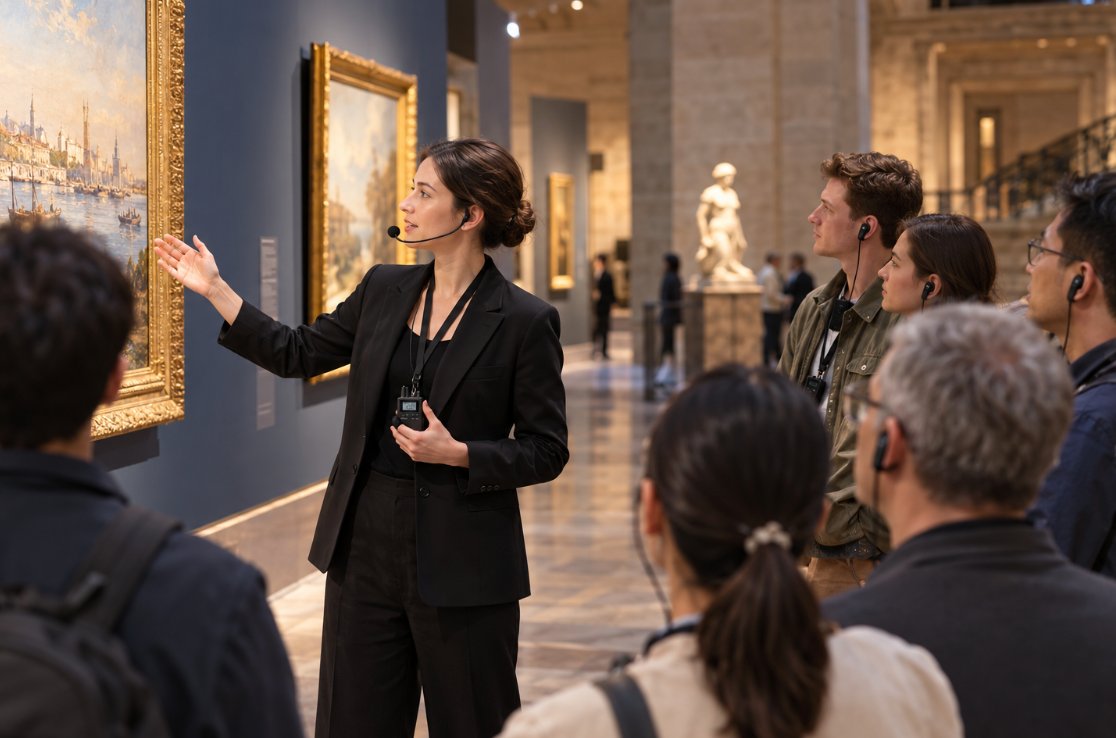
Libraries, archives, laboratories and conservation studios cannot absorb a normal tour voice. The RC2501 handles that constraint with a noise-cancelling microphone that picks out the guide against background chatter, an 86 by 50 by 19 millimetre body that disappears into a pocket or onto a lanyard, one-click pairing for staff who have never seen the equipment before, and an operating range from minus ten to forty-five degrees for the cold store and the glasshouse on the same route. Its audio path is optimised for English-only transmission, which suits international schools and visiting exchange groups.
The staffing rule here is different from the outdoor leg. One whisper guide per twenty visitors, no raised voice, and a room steward supplied by the library itself who owns the behaviour rules rather than the equipment. The guide's job in this segment is timing, not volume: knowing how long a group can stand in a reading room before the silence stops being respectful and starts being awkward.

Matching Wireless Tour Guide System Units to Segments
Three segments, three different sets of priorities, and the decision rule is to buy for wear time and room acoustics rather than for price tier.
| Model | Weight | Battery | Protection / Rating | Best Used For |
|---|---|---|---|---|
| RC2401 | 72 g transmitter | 10+ h transmitter, 20+ h receiver | IPX4 splash resistant, CE and RoHS | Auditorium briefings and parallel faculty sessions |
| RC2468 | 18 g receiver, 59 g transmitter | 12 h transmitter, 10 h receiver | CE, EMC, LVD, RED, RoHS | Long outdoor walking routes and rotating leads |
| RC2501 | 48 g, 86 x 50 x 19 mm | Not published | CE and RoHS, minus 10 to 45 degrees C | Libraries, archives and other quiet indoor spaces |
Where a manufacturer has not published a figure, we leave the cell empty rather than fill it with a number that sounds plausible. Ask for it in writing before you standardise on a single model across the campus, because the segment that matters is always the quietest one. If your estate spans all three segments, it is worth mapping the whole our wireless tour guide system range against the timetable before you place a single order.
Who Carries the Spares, and Where They Live
A staffing plan is only real once the spares have a home. The table below is the version I hand over on the morning, because each row names a person rather than a department.
| Role | Crew Count | Equipment Held | Escalates To |
|---|---|---|---|
| Briefing host | 1 per hall | Spare transmitter, printed channel list | Open day coordinator |
| Desk hand | 1 per 60 visitors | Spare receivers, charging trays, sign-out sheet | Briefing host |
| Route lead | 1 per moving party | Two spare receivers, route-colour transmitter | Roaming coordinator |
| Roaming coordinator | 1 per site | Spare batteries, earpieces, full spare kit | Open day coordinator |
| Room steward | 1 per quiet space | Quiet-zone rules, visitor count | Route lead |
If you are building this out for the first time and want the wider picture, explore our solutions for the segments that sit next to education, because the same crew pattern reappears in museums, factory visits and city walks with only the ratios changed.
What the First Rehearsal Should Prove
Run one rehearsal before the visitors arrive, and make it test four things rather than sound quality. First, that the desk can pair and hand out a full group's receivers inside ten minutes without the host helping. Second, that a lead can be swapped at the midpoint without the party noticing a gap in commentary. Third, that a spare receiver can be introduced to a moving group in under a minute. Fourth, that the colour-coded equipment all comes back to the right tray within fifteen minutes of the last party returning.
If all four hold, the day itself is mostly logistics, and logistics you can rehearse. Rich Age has been building wireless tour guide systems for education, museums and industrial visits for more than a decade, and the questions that decide an open day are usually about people rather than frequencies. Tell us how many parties you plan to run in parallel and we will help you size the crew and the kit around that number.