.webp)

RC2402, RC2401 and RC2408: Where a Wireless Tour Guide System Fails on Heritage Routes
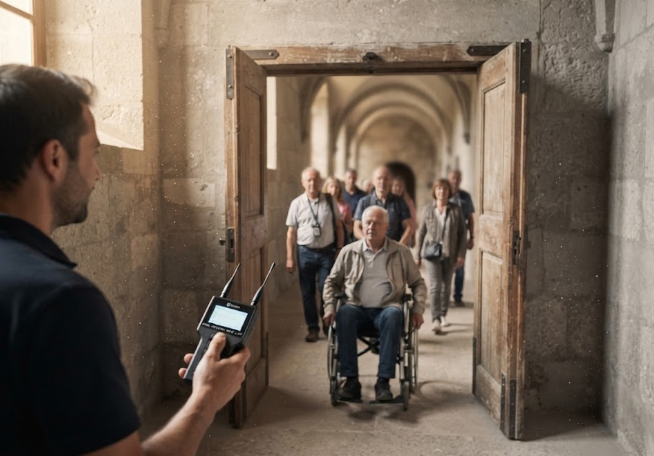
I have spent enough afternoons in cloisters and walled courtyards to know that audio trouble on a heritage route almost never announces itself as a broken device. It shows up as a visitor at the back turning their head, tapping a receiver, then quietly falling out of the walk. The old building is usually blamed first, and it usually deserves part of it: thick stone, low archways and below-grade chambers do unkind things to any radio signal. But blaming the architecture alone is how operators replace perfectly good hardware while the real fault sits elsewhere in the chain. This is a fault-finding guide, not a catalogue; the units below are three reference points for the fixes they make available.
Operators running a walking route through a historic quarter can see the wider programme of guided city visits here: city tour solutions.
Break the Chain Into Four Links
Every wireless commentary setup is a chain with four links: the person speaking, the path the radio takes, the box on the visitor's belt, and the ear at the end of it. A complaint from a visitor tells you almost nothing on its own, because the same words — "it cut out" — can come from a dead battery in link one or a blocked line of sight in link two. The discipline that saves a season is refusing to swap anything until you have decided which link is actually at fault. I work through them in order, because the cheapest link to test sits with the person holding the microphone.
Link One: The Speaker's End Before Anyone Else Hears a Word
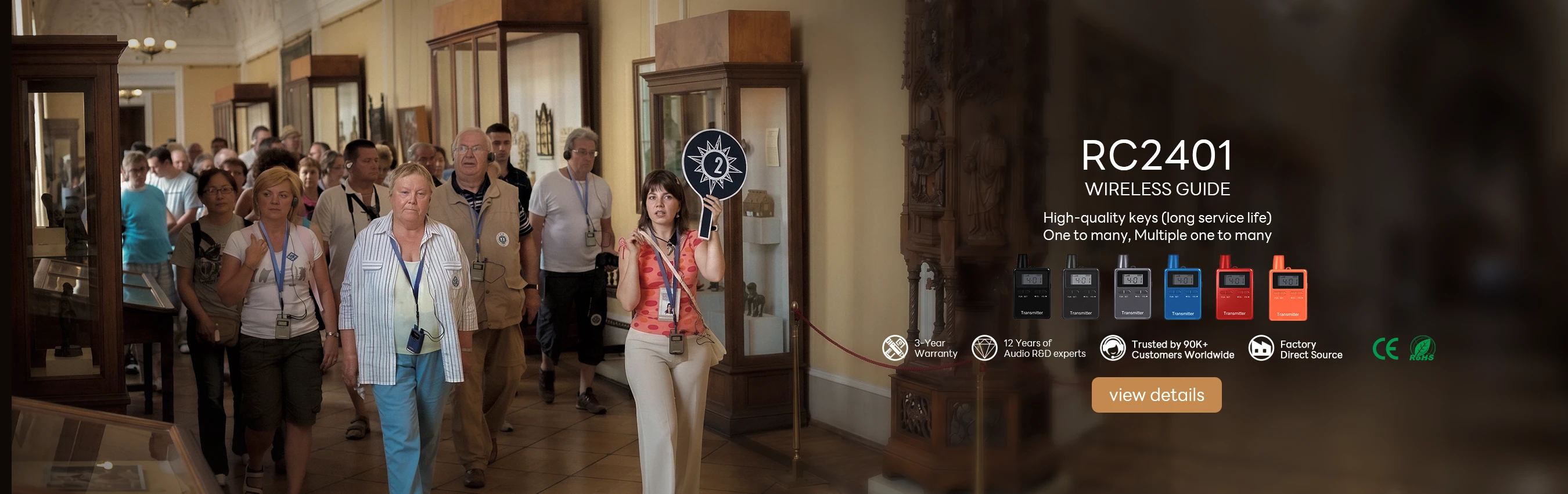
The first link fails more often than any other, and it fails silently. A presenter clips on a lapel microphone, checks the transmitter display, sees a green light, and starts walking. What that light does not tell you is whether the mute switch on the headset boom was brushed on, whether the group channel was set before the group formed, or whether the pack was charged on top of a half-empty cell. On a route where one guide hands over to a colleague at the halfway point, the handover is where most of these faults bloom. Multi-group sites also need channel separation that survives two groups crossing in a narrow lane, otherwise one party hears the other's commentary and both complain. The RC2401 is the reference point I use for this link: fifty PLL digital channels give each party its own lane, the housing carries an IPX4 splash rating for the drizzle that catches an outdoor route, and the transmitter runs 10+ hours against a 20+ hour receiver across a 200 m working range. Two habits prevent most first-link faults: set every channel before the group arrives, and confirm the mute switch by speaking, not by looking.

Link Two: What Old Stone Does to a Radio Path
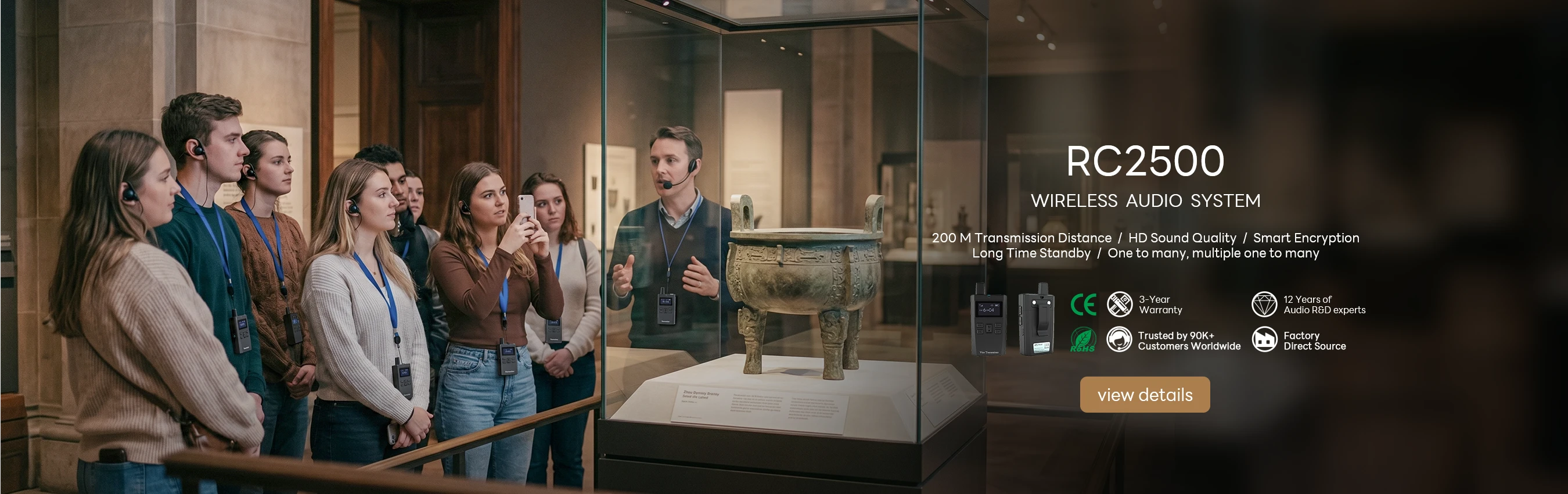
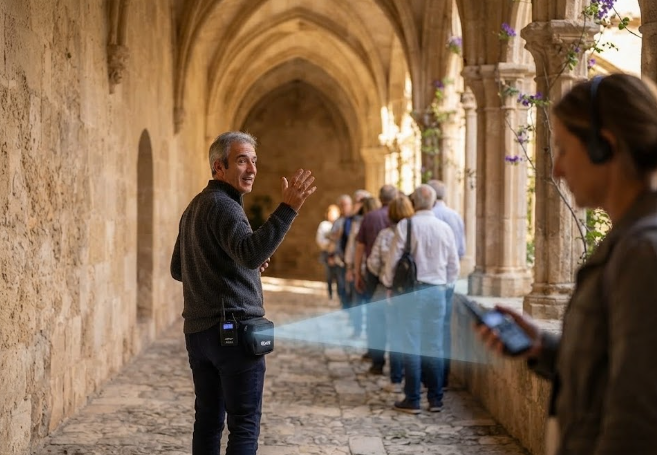
The second link is the one visitors never see and operators blame instantly. At 2.4 GHz, radio energy travels well through open air and poorly through masonry, and a heritage route is a sequence of deliberate obstructions. A guide steps through an archway ahead of the group and the stone pier between them takes the signal down; a stair turret turns a clean line-of-sight path into a scramble of reflections. A range figure printed on a box stops being useful here, because 200 m of open ground and 200 m of winding stone corridor are not the same claim. Test it positionally: walk the transmitter where the guide will actually walk, including the turn through the arch, and listen from the back of the queue. The RC2408 is built for this link, with eighty anti-interference channels, a 59 g transmitter and 50 g receiver for all-day carrying, ten transmitter hours against twenty on the receiver, and two-way talk-back so the sweeper at the back can reach the guide without shouting. One-key channel synchronisation also lets a replacement receiver join the right lane in seconds, which matters mid-route.
Link Three: The Unit Riding on a Visitor's Hip
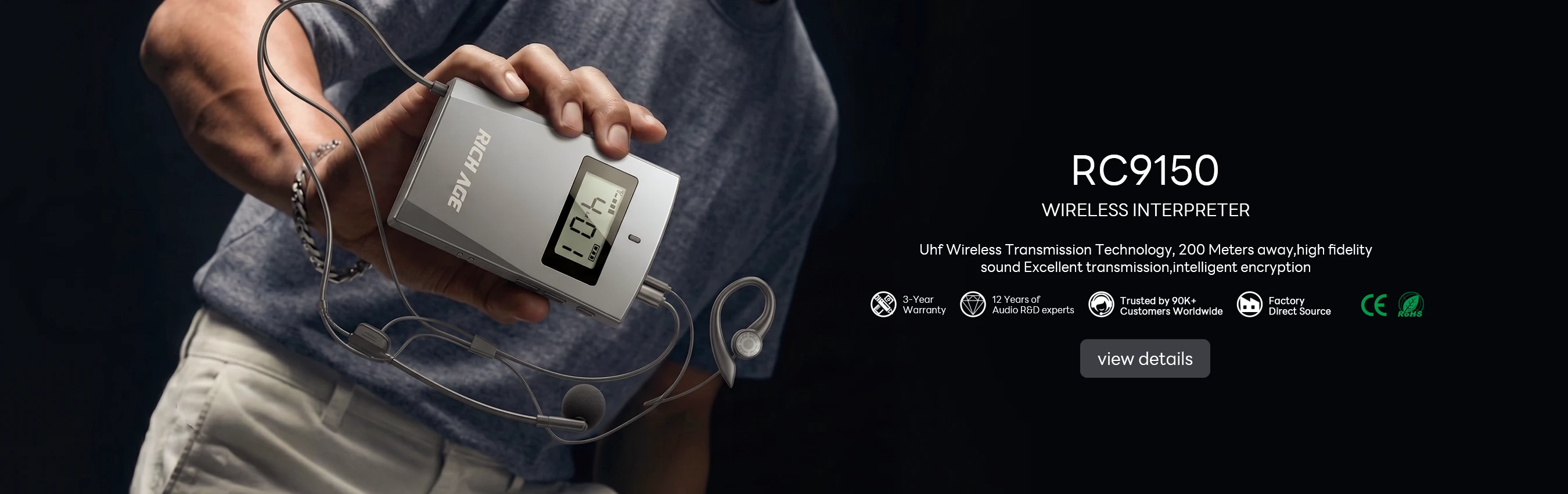
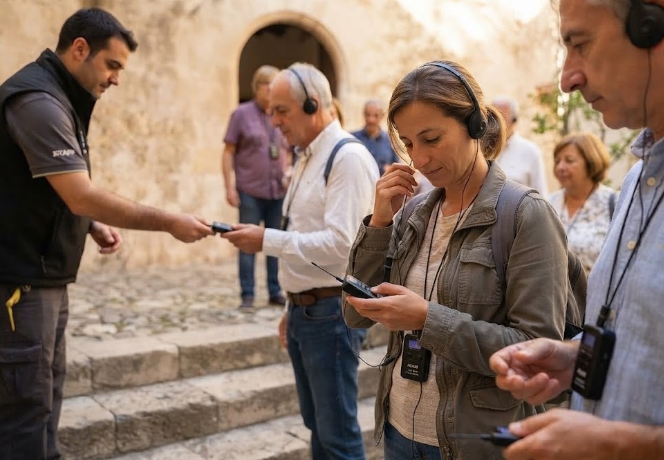
Now the box on the belt. When a receiver is handed out and not checked, three faults travel with the visitor. The volume arrives somewhere between muted and maximum, the unit is switched on but sitting on a channel left over from yesterday's booking, or the earphone is half-seated in the jack. Cross-talk is the fourth and the most confusing, because it sounds exactly like a signal failure: a visitor reports the commentary breaking up when what they actually hear is a different party two streets over. Encryption and clean channel separation are the fix, and so is a rule that no receiver leaves the desk without a ten-second listen. The RC2402 covers this link with one-click frequency synchronisation, intelligent encryption that keeps language groups from bleeding into each other, ten hours on the transmitter against twenty on the receiver, a 200 m open-area range, and full CE, EMC, LVD, RED and RoHS certification for sites that need the paperwork on file.
Link Four: Ears, Fit and the Unspoken Complaint
The last link is the visitor's ear, and it produces the complaint nobody logs. A single earpiece worn on the wrong side puts the driver against bone; an over-ear headset gets pushed off by a scarf; a visitor sharing one receiver with a companion stands too far from the speaker. None of this is a radio fault and none of it appears in a diagnostic check, yet a surprising share of "the audio is bad" comments trace back here. The fix is low-tech: demonstrate the correct ear, offer both earphone styles, and tell companions to walk within arm's reach rather than share a receiver.
| Model | Channels | Transmitter / Receiver Battery | Working Range | Certifications & Protection |
|---|---|---|---|---|
| RC2401 | 50 PLL digital | 10+ h / 20+ h | Up to 200 m, open area | IPX4 splash-proof, CE / RoHS |
| RC2408 | 80 anti-interference | 10 h / 20 h | 200 m, 2.4 GHz ISM | CE / RoHS |
| RC2402 | Not published | 10 h / 20 h | 200 m, open area | CE, EMC, LVD, RED, RoHS |
Weight is left out of that table on purpose. On our wireless tour guide system range pages, only the RC2408 publishes a figure — 59 g transmitter, 50 g receiver — while the RC2402 and RC2401 specifications state none at all. I would rather show a gap than copy a number from a distributor listing.
Three Obstacles That Only Appear in Ancient Buildings
Heritage sites add three obstacles you will not meet in a modern conference wing. The first is the threshold: every doorway is a signal event, and a route with fourteen doorways has fourteen moments where the path can break. Walk-marshalling matters more than any specification here, because keeping the group compact through each threshold does what no amplifier can. The second is the low chamber, the crypt or cellar with a stone ceiling a metre above head height, where reflections arrive almost immediately and clarity suffers even when the signal is strong. The third is the vertical stretch, the tower stair where the queue strings out over several floors and the guide at the top is simply further away than the route plan assumed.
What No One Can Repair Mid-Walk
Some faults are not field-fixable and pretending otherwise wastes the group's time. A battery that has lost capacity from a year of partial charging will run short no matter how carefully you top it up before departure; it belongs in a rotation plan, not in your satchel. A channel plan that was never separated for a two-group day cannot be invented in a lane, which is why separation is a desk job the night before. A receiver with a cracked earphone socket will hold a plug for one walk and then not the next. The honest position is that these three cases should be caught at the ten-minute check, and if they are not, the correct move is to swap hardware and keep the group moving.
A Ten-Minute Check Before the Group Arrives
Ten minutes, in this order, covers most of what goes wrong. Speak into every transmitter and confirm the mute switch by ear. Set and lock channels, then list them on a card for the guide. Walk the archway and the stair turret with a receiver at the back position. Listen to one receiver from each tray, not the whole tray. Check earphone jacks by feel as well as by sound. Count receivers against the booking and add one spare. Note the battery rotation date on the tray. If your site also runs indoor interpretation rooms and multilingual sessions alongside the walking route, the same chain logic applies there, and more of it is set out under explore our solutions. Fault-finding on a heritage route is not about buying your way out of trouble. It is about knowing which of four links is weak before you blame the stone.