.webp)

I have walked guided routes through buildings that were properly retrofitted for wheelchair access, and I have watched the same thing happen more than once. The ramp is built, the door widths are signed off, the accessible toilet is on the plan, and the tour still comes apart somewhere in the middle. Nobody trips, nothing breaks, and yet by the end a third of the group has stopped hearing the commentary and is simply following the person in front. The paperwork said accessible. The experience said something else.
That gap is almost never a straightforward hardware failure. It is a mismatch between the way a route physically unfolds and what the audio kit was originally chosen to do. If you are still at the stage of comparing museum audio guide solutions for a venue with a step-free route, it is worth reading the three points below before anything is specified.
The Door Is Rarely Where It Goes Wrong
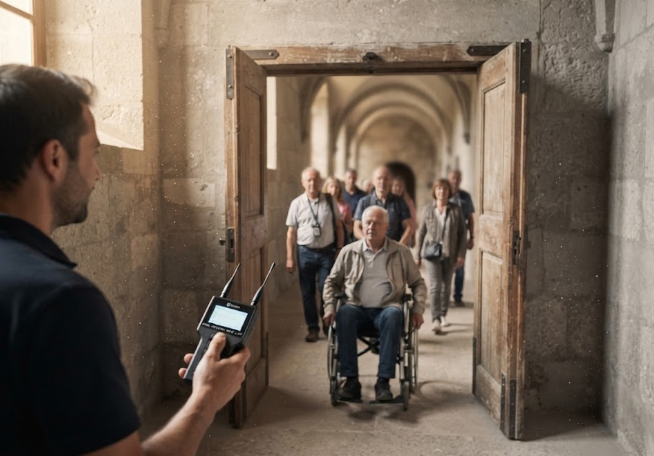
Almost every accessibility survey stops at the threshold. Width, clearance, a level landing, done. But a wheelchair user who clears a doorway cleanly then spends the next forty minutes moving through spaces that were never rebuilt: a stone corridor with a load-bearing pier in the middle, a partitioned gallery, a service passage where the guide walks ahead and turns a corner. The group splits at that pier, and the commentary goes with the guide.
This is where the physics of the building decides the answer, not the price of the kit. The RC085 transmits on UHF digital wireless in the 470-510 MHz band rather than 2.4 GHz, which matters precisely in the kind of masonry that heritage venues are full of. Lower frequencies push through stone and partition where a 2.4 GHz link starts losing the visitor behind the pier. It gives up to 200 metres of transmission, an LCD screen that shows battery and channel at a glance, and two modes: F1 for one-way broadcast on a guided route, F2 when the guide needs a reply from the back. Auto sleep and wake-up stretches the working day, and the unit carries CE, RED and RoHS certification with a three-year warranty on the mainboard.
Held Up at the Lift While the Commentary Keeps Running
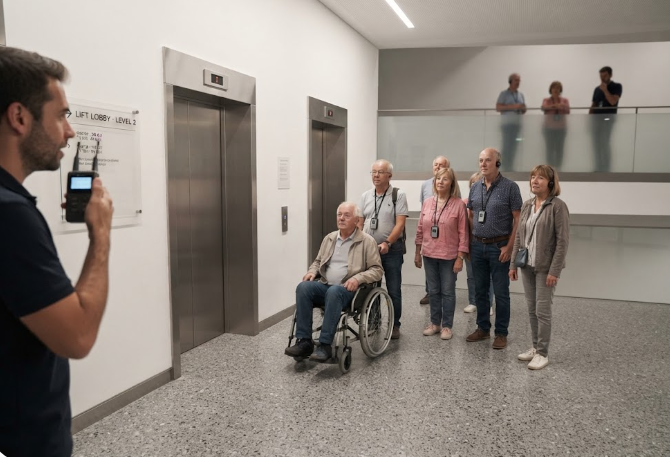
A step-free route usually means one lift, or one ramp, serving the whole party. That creates a queue that a staircase route never has. Eight or ten people wait while two go up, and the guide cannot stand silently at the top for four minutes, so the commentary continues while the group is strung between two floors. Now the audio has to reach people who are in a different room, behind a lift shaft, and about to be joined by the next pair who have no idea where the explanation has got to.
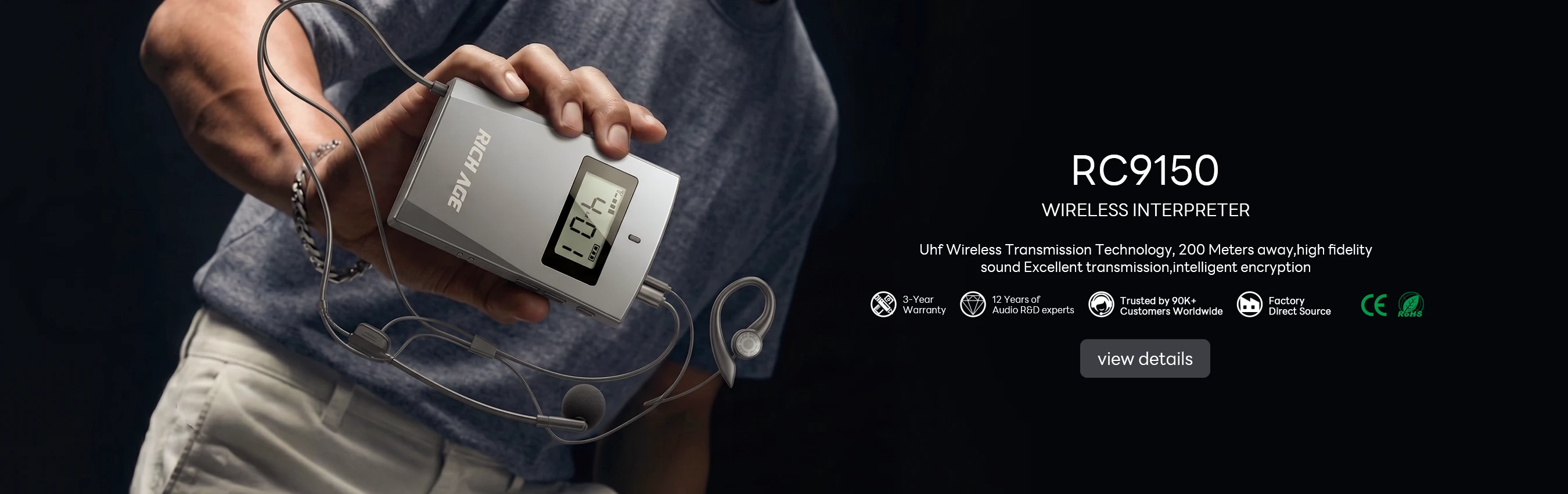
This is a density problem rather than a distance problem, and it is the argument for channels over raw power. The RC9150 runs on 2.4 GHz across 2403-2483 MHz with 100 independent channels, which means a second group queuing for the same lift at the same time does not collide with the first. It gives a 15-hour transmitter and over 30 hours on the receiver, enough that a long accessible route with slow progress does not need a mid-tour battery conversation, and it adds intelligent encryption so the commentary stays inside the party. Certification covers CE, EMC, LVD, RED and RoHS, with the same three-year mainboard warranty.
When the Tail of the Group Is Still on the Ramp
The third failure point is the quietest. On a slow route the party stretches, and the last two visitors are often the ones with the least ability to catch up, so they are exactly the people who most need the audio to be independent of their position. Sharing a receiver between two people, which still happens on school and family visits, breaks down completely here, because whoever holds the unit is the only one who can hear it and the pair moves at a different pace to the guide.
The answer is one receiver per visitor, and that makes handling time the constraint. The RC2501 is built around that: 86 x 50 x 19 mm, small enough for a lanyard or a jacket pocket, with one-click pairing so a volunteer or a temporary steward can hand units out at the entrance without a briefing. It transmits on the 2.4 GHz ISM band over up to 200 metres, runs multi-group independent transmission so two parties in the same hall stay separate, and operates between -10 and 45 degrees Celsius, which covers an unheated stairwell in February as well as a courtyard in July. CE and RoHS certified, three-year mainboard warranty, with OEM and ODM options on colour and logo.

What UHF and 2.4 GHz Each Solve
Reading those three points together explains why the two bands coexist rather than compete. UHF at 470-510 MHz is the choice when the route is dense with building fabric and the signal has to go through it; 2.4 GHz is the choice when the route is wide, the parties are numerous, and channel count and battery life decide the day. Neither is a general answer, which is why a fleet that runs only one band tends to have one weak point on every route.
Where the technology has genuinely moved is not in range figures, which have sat around the same mark for years, but in what happens without operator attention. Auto sleep and wake-up, one-click pairing and channel synchronisation all address the same underlying problem: an accessible route is usually staffed by whoever is available, not by a dedicated technician. A system that needs a channel plan and a briefing is a system that fails on the day a roster changes.
Reading the Numbers Before the Route Is Chosen
| Model | Wireless technology and band | Channels | Working range | Certifications | Warranty |
|---|---|---|---|---|---|
| RC085 | UHF digital wireless, 470-510 MHz | Multi-channel group operation, F1 one-way and F2 two-way | Up to 200 m | CE, RED, RoHS | 3 years, mainboard |
| RC2501 | 2.4 GHz ISM band | Multi-group independent transmission | Up to 200 m | CE, RoHS | 3 years, mainboard |
| RC9150 | 2.4 GHz, 2403-2483 MHz | 100 independent channels | Up to 200 m in open area | CE, EMC, LVD, RED, RoHS | 3 years, mainboard |
Weight is deliberately not a column here. The product pages for all three units publish band, channel architecture, range, certification and warranty, but none of them states a weight figure, and I would rather show a gap than copy a number from a reseller listing. If a procurement form demands one, treat the product pages as the authority and ask the supplier directly. The table above is the part that can be relied on when our wireless tour guide system range is being compared on paper.
Choosing by How the Day Actually Runs
The practical test is not the specification sheet, it is the shape of the route. Count the number of places where the party will be split by architecture or by a queue: piers, lift lobbies, narrow galleries, one-at-a-time ramps. If there are more than two, the band decision matters more than the channel count. If the party is large and the splits are caused by other groups rather than by walls, channel count matters more than band.
Then count the number of people who will hand equipment out, and how often that changes. A venue with a permanent guiding team can absorb a system with a learning curve. A venue that relies on volunteers, seasonal staff or a rotating duty list cannot, and it is worth paying attention to that rather than to a spec table, because an unhanded receiver is worse than no receiver at all.
Where the Next Round of Hardware Is Heading
The direction of travel in accessible touring is towards systems that assume nobody will configure them. Automatic channel assignment, pairing that survives a receiver being swapped mid-route, and batteries that outlast a slow route rather than a fast one are all already present in different units. The next step is combining them without adding a setup screen. A comparison of the RC9150 and the RC085 shows the two philosophies side by side: one leans on channel architecture, the other on band physics, and the RC9150 vs RC085 breakdown is the shortest way to see where each one wins.
If a step-free route is on your plan for next season, the useful first move is not a quotation. Walk the route twice, once at the pace of the slowest visitor, and note where the party separates. That list, rather than any specification table, tells you whether you need one band or two.