.webp)

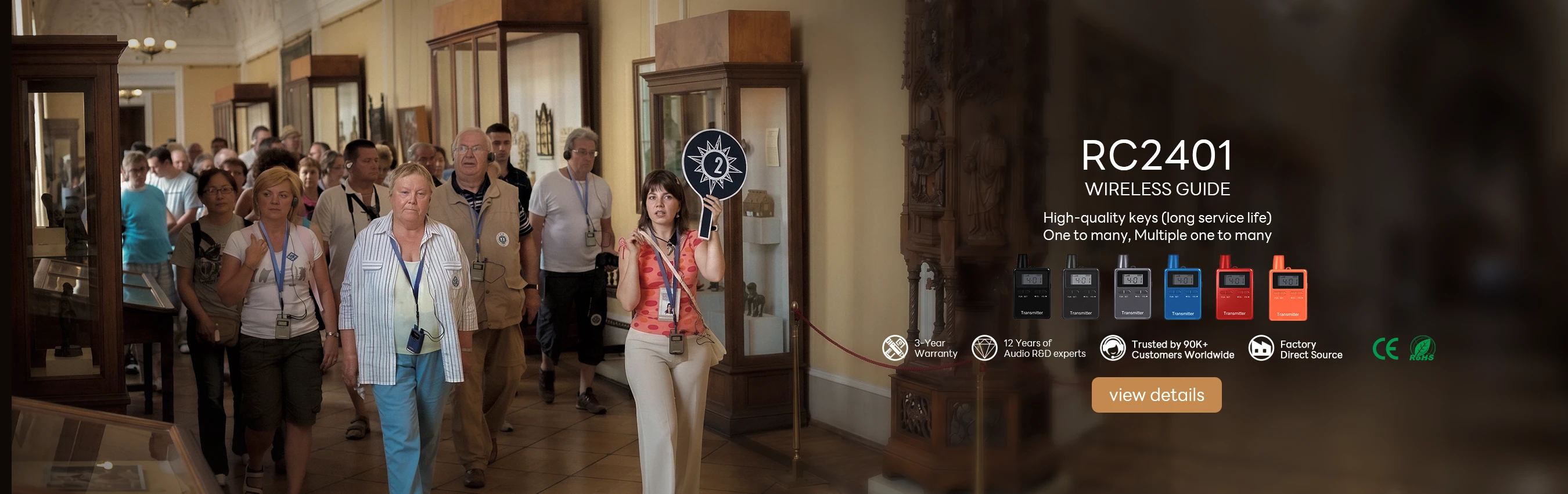
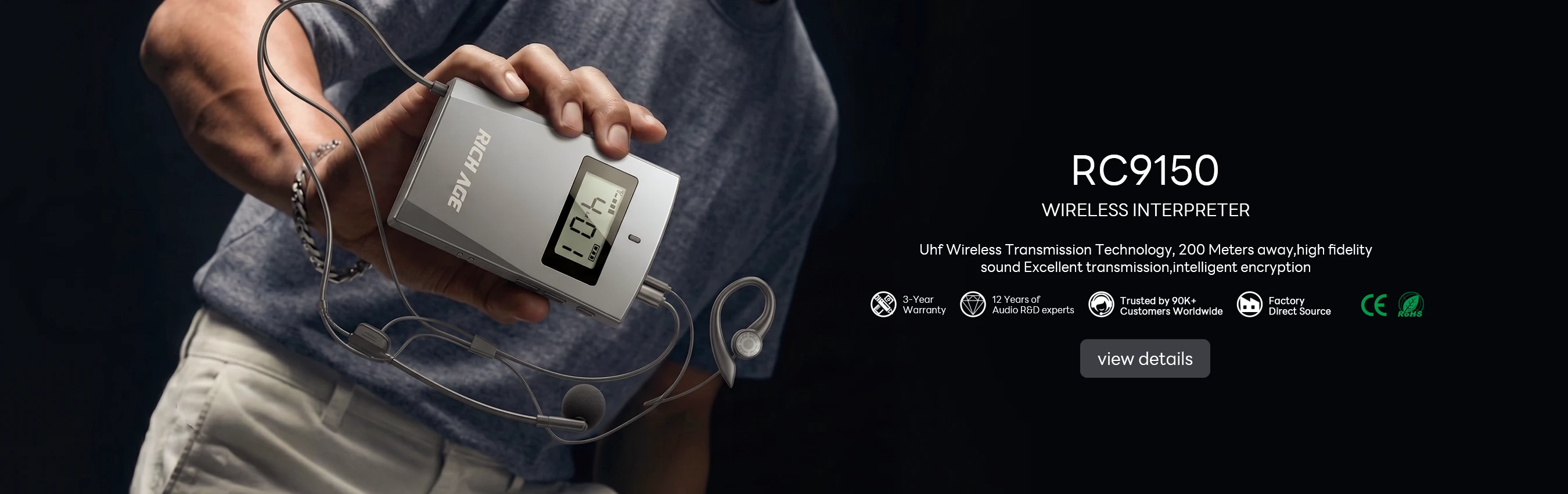
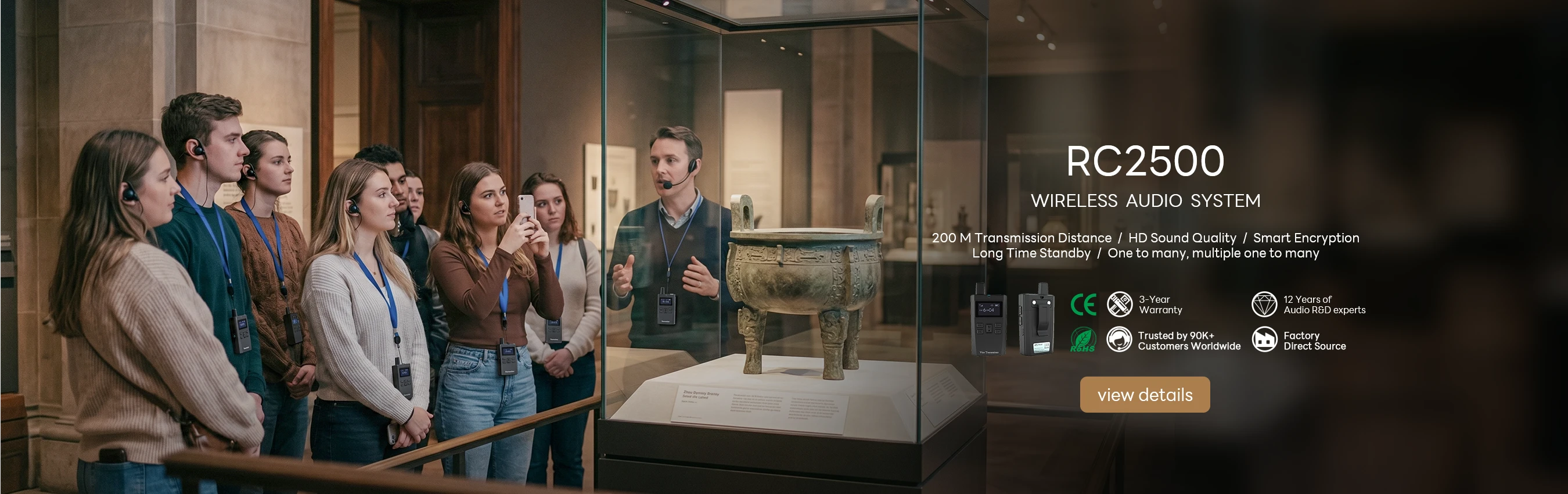
Quiet galleries look like the easiest brief in the catalogue. Then you walk the building and the assumptions fall apart. One wing packs forty labels into ten metres and no single guide can hold that crowd together. The next wing is nineteenth-century load-bearing masonry, and the radio you brought loses depth the moment a party turns a corner. A third corridor has four separate parties passing one another between eleven and noon. No single kit fixes all three.
What changed was not the budget but the unit of decision. Instead of buying one system for the building, the curatorial team treated each wing as its own problem. If you are starting the same exercise, the museum tour solutions we publish organise hardware by room type rather than by price band.
The Wing Where Nobody Stands Still
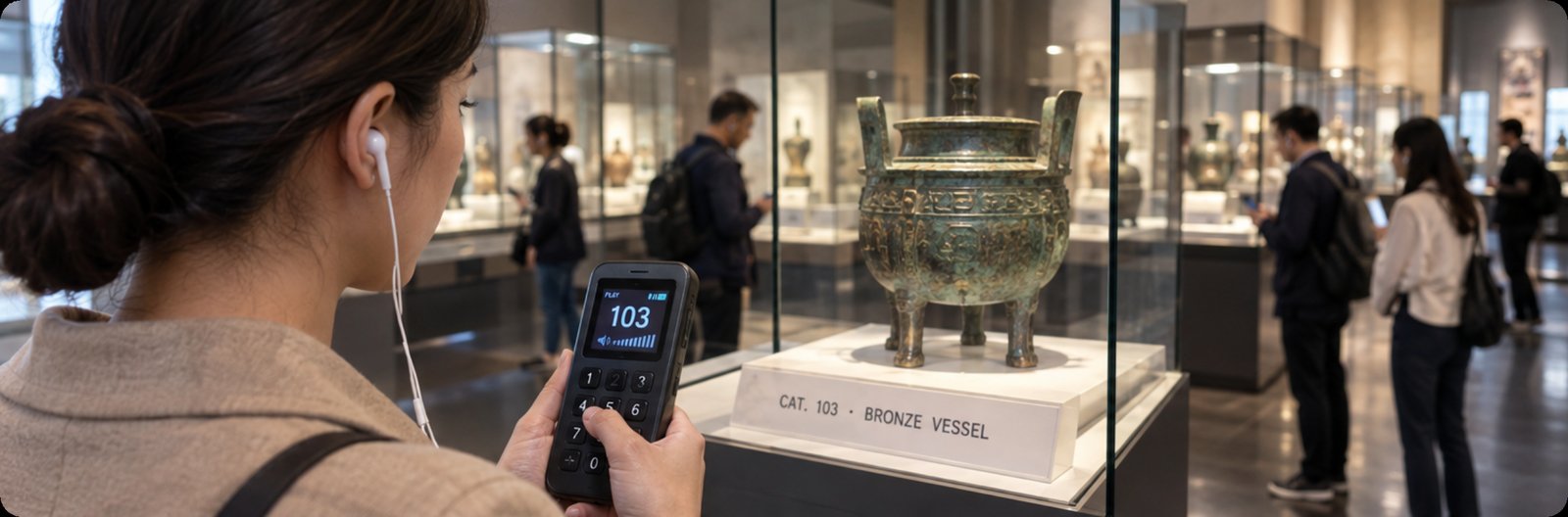
The first problem wing held the densest display in the building: vitrines shoulder to shoulder, a printed label every metre, and no scheduled tours. Visitors arrive in twos and threes, drift apart within a minute, and each stops in front of a different object. There is no group to address and no guide at the front. A handheld player is the only shape that works, because the commentary has to start when the individual visitor decides it should.
For this wing the gallery took the 2.8-Inch Semi-Auto Digital Audio Guide, a point-and-play unit with a 0-9 numeric keypad rather than a touchscreen menu. The visitor keys in the number printed beside an object and the commentary starts on its own. The published specification allows 16 languages and up to 9999 audio files on 2 GB of internal memory, and battery life is rated at up to 18 hours of continuous use over Micro USB, with earphones included.
The trade-off is administration, not audio. A player must be handed back, so the wing needs a counter, a numbered rack and a cleaning routine. That cost lands on staff hours, not on the equipment list.
Where Load-Bearing Stone Swallows the Signal
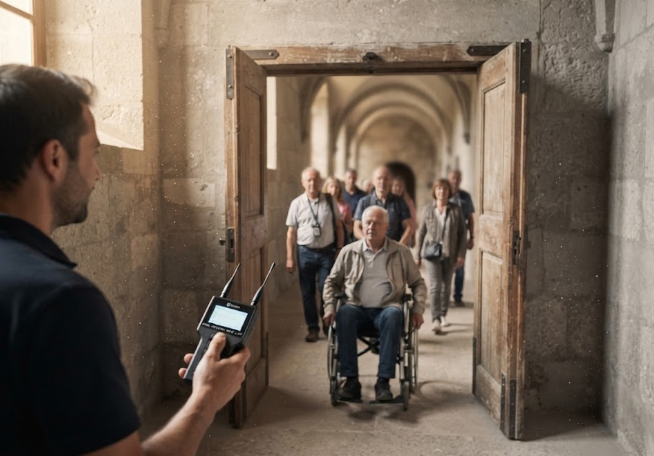
The second wing is the opposite case: a run of connected halls inside a listed building, where a keeper walks a fixed route three times a day with a party of about thirty. The route passes through walls that cannot be chased or lined, and turns enough corners that a high-frequency signal runs out of reach. Consumer 2.4 GHz audio is at its worst here, not because the range figure is wrong but because that figure assumes open ground.
This is where the RC085 earns its place. It carries audio in the 470-510 MHz UHF band with GFSK modulation, which bends around heavy obstacles where 2.4 GHz tends to stop, and the published range is up to 200 metres. It also runs two modes: F1 for one-way broadcast and F2 for two-way working where a second voice joins the conversation, useful during evening lectures when questions had to be answered without walking the party back. Power management sleeps between groups and wakes on use, and the unit carries CE, RED and RoHS listings with a three-year mainboard warranty.
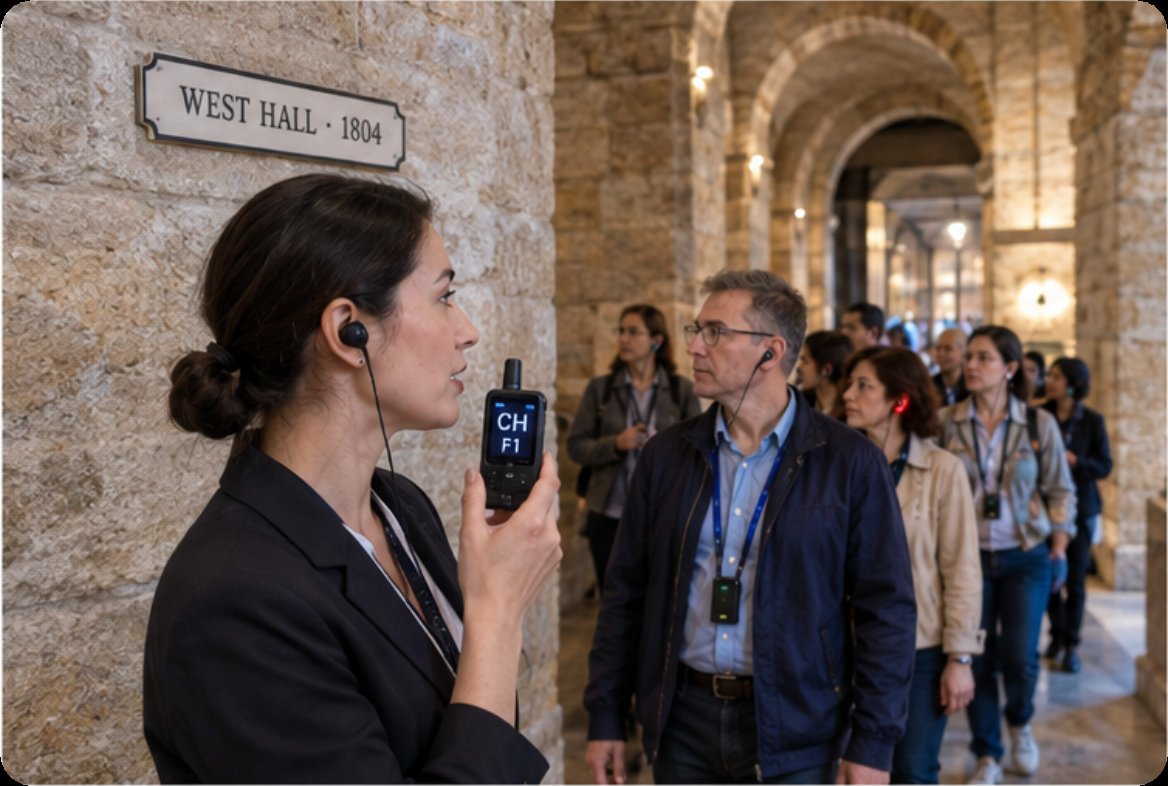
The UHF choice brings one obligation. Frequency use is regulated country by country, so a building that hosts travelling exhibitions should confirm the band is clear before standardising on it.
Four Groups Sharing One Corridor
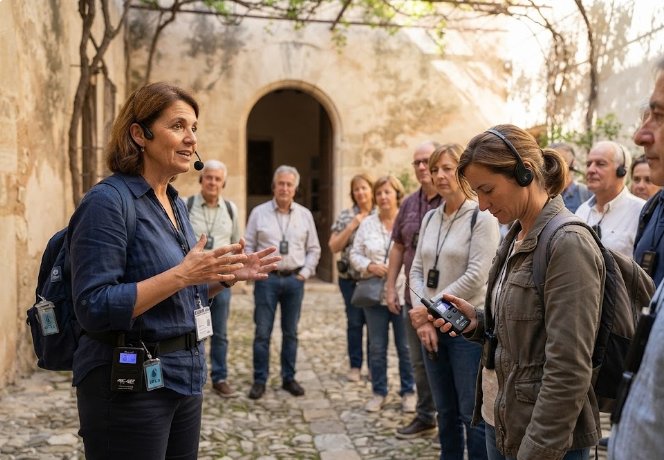
The third problem was logistics rather than physics. Between eleven and noon the gallery runs four overlapping tours along one staircase and one long corridor, and all four parties hear one another if they share a channel. The building needed separation, not reach.
The RC2406 answers that with 80 dedicated channels on the global 2.4 GHz ISM band between 2403 and 2483 MHz, allocated by PLL synthesis so each party occupies its own stream. Range is up to 200 metres in open area, the battery is a 1500 mAh pack rated for full-day use, and the body weighs 50 g, which matters when the same guides wear it through two shifts. It is rated IPX4 against splashes and carries RoHS compliance and the same three-year mainboard warranty.
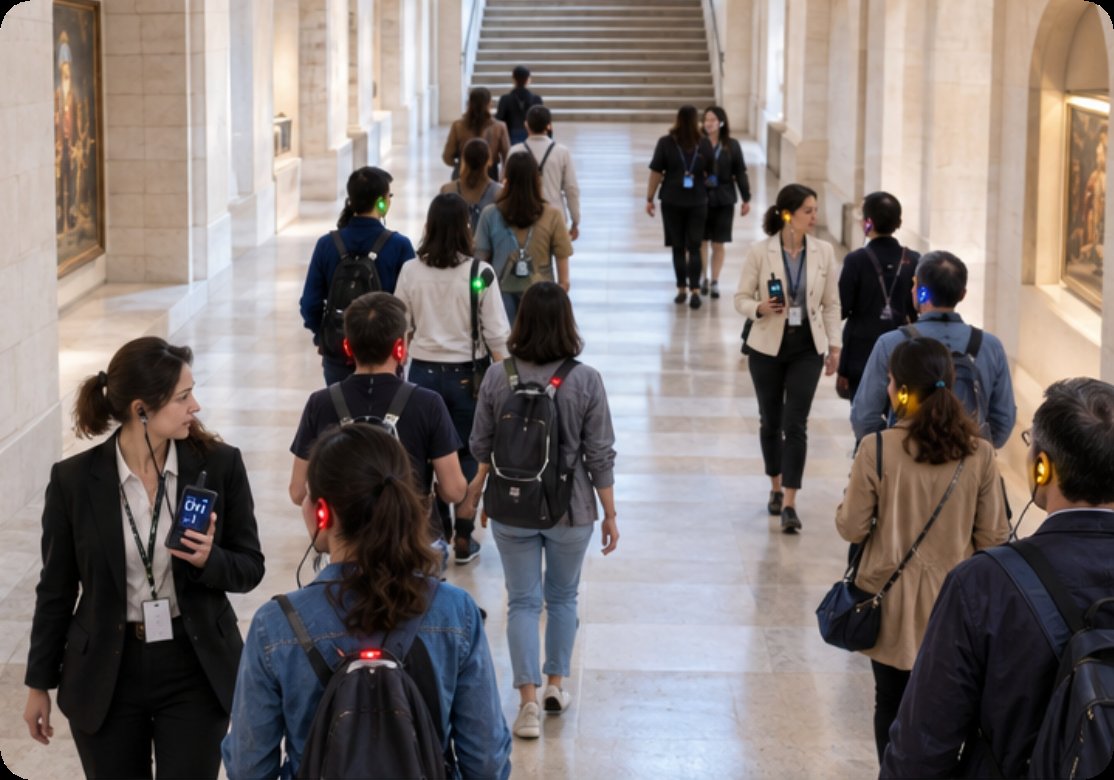
Because the band is licence-free worldwide, this is also the wing that travels best. When the gallery loans a set abroad, the 80-channel unit goes in the case while the rest of the wireless tour guide system range stays on the shelf.
Matching Each Device to Its Section
The table below is the one the curatorial team keeps pinned to the wall, because it states the decision in the language they use: what visitors are doing in a space, and which unit that behaviour selects.
| Section of the building | What visitors do there | Device that fits | Why the others do not |
|---|---|---|---|
| Dense display walls, no scheduled tour | Drift apart and stop wherever they choose | 2.8-Inch Semi-Auto Digital Audio Guide | A transmitter has no fixed audience to address |
| Listed masonry, one keeper, fixed route | Follow a walker through connected halls | RC085 | 2.4 GHz loses depth at every thick corner |
| One corridor, several parties at the same hour | Pass one another along a shared staircase | RC2406 | A single stream would put four parties on one soundtrack |
Weight is published for only one of the three, the RC2406 at 50 g, so it stays out of the table rather than becoming a column of gaps. The remaining figures come straight from each product page, with nothing inferred from a sibling model.
| Published figure | RC085 | RC2406 | 2.8-Inch Semi-Auto Digital Audio Guide |
|---|---|---|---|
| Carrier or playback | UHF 470-510 MHz, GFSK | 2.4 GHz ISM 2403-2483 MHz, PLL | Numeric keypad 0-9, point-and-play |
| Capacity | Multi-channel group operation | 80 channels | 16 languages, up to 9999 files |
| Reach | Up to 200 m | Up to 200 m | Not applicable, no radio link |
| Power | Auto sleep and wake-up | 1500 mAh, full-day use | Up to 18 hours, Micro USB |
| Environment and certification | CE, RED, RoHS | IPX4, RoHS | Not published |
| Warranty | 3 years, mainboard | 3 years, mainboard | 1 year |
What the Curator Asked Us to Change
The plan survived first contact with visitors after three corrections. The first was numbering: the gallery had printed exhibit numbers in its own sequence, unrelated to the audio file order, so every label in the dense wing had to be reprinted. The second was the return point, because players handed out at the entrance meant a visitor finishing at the far end walked the whole building back.
The third was the charging rotation. The players were topped up nightly, which shortened their useful life, while the wireless sets sat on chargers for days. The team settled on one charge cycle per week for the players and a nightly battery swap for the guided wings.
How the Handout Routine Changed
Two very different counters emerged. The dense wing runs a lending desk: a rack of numbered players, a wipe-down between visitors, and a staff member returning each unit to its slot. The guided wings run a crate per party instead, counted in and out by the keeper rather than by a desk. The published deployment we point people to first is the Museum Audio Guide System Case, which shows both patterns running in one building.
What to Check in Your Own Building
Before ordering anything, walk the route with a party of the size you expect and a stopwatch. Count how many groups share a corridor in the same hour; if the answer is more than two, channel capacity outranks range. Measure the thickest wall on the guided route and note what it is made of, because that decides whether a licence-free band reaches the end of the walk. Then ask whether a guide is present in each space. The moment the answer is no, you are shopping for a player rather than a radio.
Two smaller questions settle the rest: how many languages the collection needs, and who owns the numbering on the wall. Both look like trivia until the first busy weekend, when a mismatched label strands a visitor in front of an object with no commentary. If your building has the same three-shape problem, send us the route and the wall materials and we will map each section to the unit that fits it.