.webp)

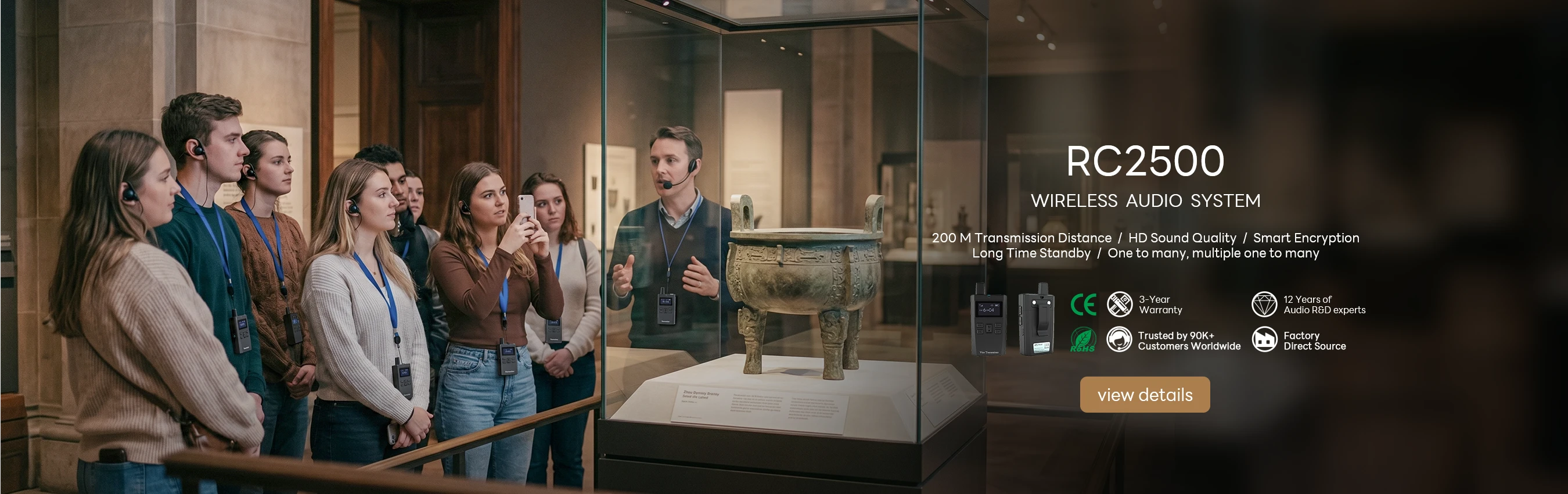
RC2500, RC085 and RC2401: Five Postings on a Car Plant Tour
I have sat through enough car plant tour planning meetings to know that the equipment list is never the hard part. Somebody counts the visitors, divides by twenty, orders the headsets, and considers the job finished. Then the first Wednesday arrives: four parties are moving through the body shop at once, a line has stopped for a changeover, and the plant's own escort wants to know which of our people is allowed to stand where. What breaks is not the audio. It is the absence of a posting list, a plain statement of who holds which responsibility once the gates open. We treat factory tour solutions as a staffing plan first and a hardware order second, and this article is the version of that plan we hand to plant managers.
Where the Numbers Always Miss the Point
The arithmetic everyone reaches for first, visitors divided by group size, tells you how many receivers to charge. It does not tell you who carries the spare. A plant receiving sixty guests in three parties of twenty needs fewer hands than one receiving sixty in six parties of ten, because the second case multiplies every handover: six frequency assignments, six collection points, six chances for a handset to end up in a coat pocket. Car plants add a variable that museums do not have. An outside guide is rarely allowed to walk a group through the stamping or paint areas unaccompanied, so one line in your table is filled by someone you do not employ and cannot reassign. Build the plan around postings and that line sits in the right place. Build it around a head count and the day quietly depends on one person staying late.
One Compact Sender for the Tight Loop
The first posting belongs to whoever walks at the front of a repeated short circuit, the twenty-minute route a plant runs eight times a day. For that job the equipment has to be light, tolerant of a cold body shop, and self-sufficient across a whole shift. The RC2500 is the compact unit we send to that posting: a 20 mW transmitter on the 2.4 GHz ISM band (2403-2483 MHz, licence-free worldwide), 50 independent PLL channels, and up to 200 metres in open area. Its numbers matter to the plan more than to a datasheet. A 12-hour transmitter paired with a 40-hour receiver means one charge covers a full visiting day plus the spare session after it, so nobody has to be scheduled to swap batteries at the halfway point. The operating window runs from -15°C to 50°C, and one-click frequency synchronisation takes the pairing step out of every changeover.

Where the Display Saves a Second Pair of Hands
A car plant is a steel box full of steel boxes, and that changes which radio works. The second posting covers the same route through the machinery-dense middle of the building, and it is where UHF earns its place. The RC085 runs on the 470-510 MHz UHF band with up to 200 metres of range, and it holds up better than 2.4 GHz equipment in exactly the environment a body-in-white hall creates: metal everywhere, and Wi-Fi traffic competing for the same spectrum. Its LCD screen is the part that redraws the staffing sheet. When battery level, channel, and signal strength are readable at a glance, the person handing out units no longer needs a separate checking ritual; the look takes five seconds per headset and the spare-unit decision happens in the room rather than an hour later. F1 one-way and F2 two-way modes, together with auto sleep and wake-up, round it out.

When Two Rooms Run at the Same Hour
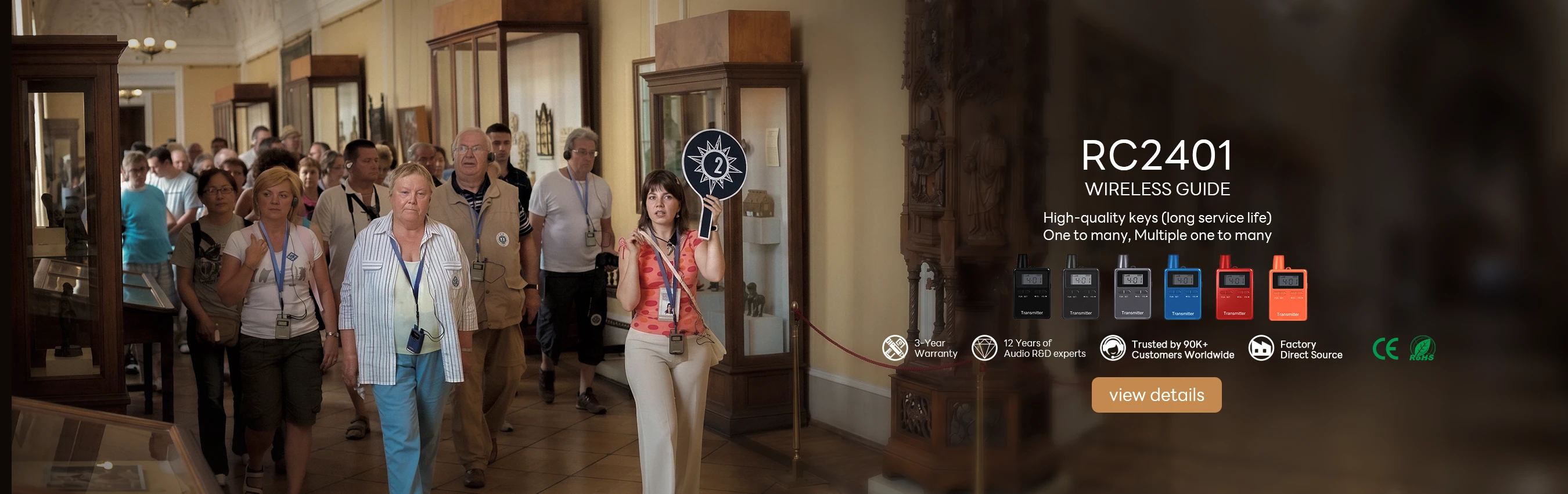
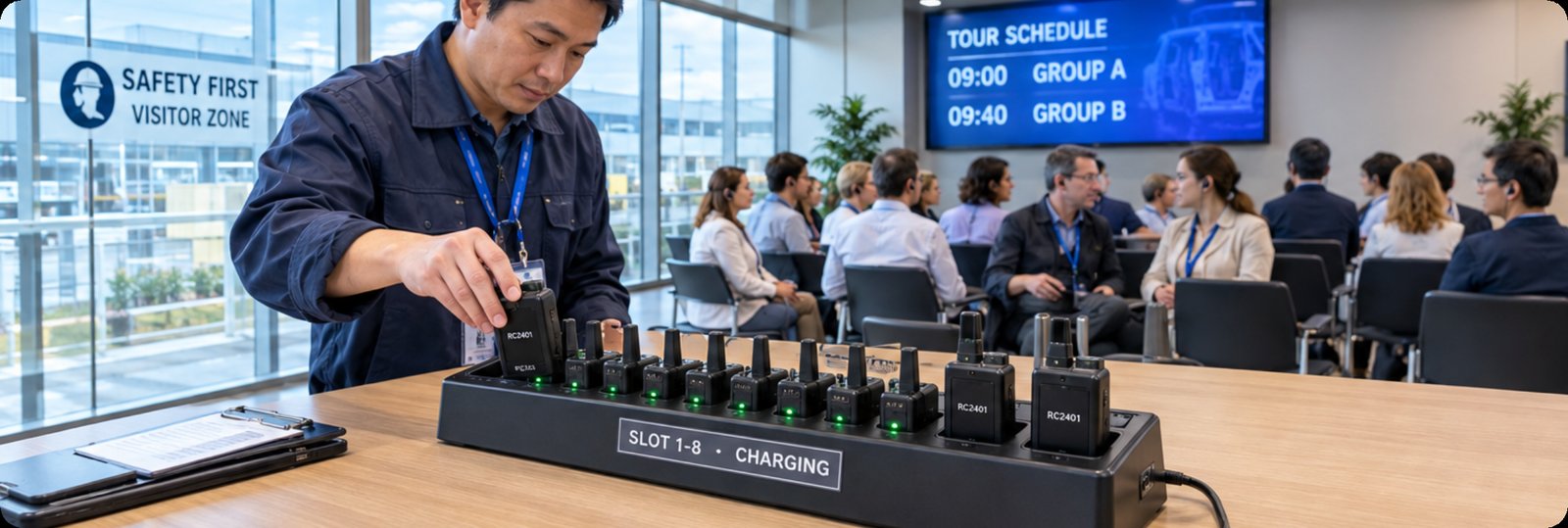
The third posting is the awkward one: a plant that wants a presentation in the visitor centre and a line walk at the same time, drawn from the same pool of equipment. The RC2401 covers it with 50 PLL channels on the 2.4 GHz ISM band, up to 200 metres of range, and a 10+ hour transmitter paired with a 20+ hour receiver. Two details turn it into a staffing answer rather than a specification answer. Its DC charging system accepts several devices at once, which collapses the end-of-day battery routine into one tray on one table. An IPX4 splash-resistant body also survives the wash-down areas that a plant route often crosses. It carries CE and RoHS marks with a three-year warranty on the mainboard, and it is the unit we point at sites that want custom frequency or colour options under OEM/ODM terms.
| Model | Frequency band | Range | Channels | Battery (transmitter / receiver) | Marks on the product page |
|---|---|---|---|---|---|
| RC2500 | 2.4 GHz ISM 2403-2483 MHz | Up to 200 m | 50 PLL | 12 h / 40 h | CE, EMC, LVD, RED, RoHS |
| RC085 | UHF 470-510 MHz | Up to 200 m | Multi-channel group operation (number not published) | Auto sleep and wake-up (hours not published) | CE, RED, RoHS |
| RC2401 | 2.4 GHz ISM 2403-2483 MHz | Up to 200 m | 50 PLL | 10+ h / 20+ h | IPX4, CE, RoHS |
The Frequency Desk Nobody Wants
Between the hardware and the walking sits a task that takes five minutes and wrecks the day when nobody owns it. Fifty channels is a great deal of room, but only if somebody assigns them on purpose. Decide before the gates open which party takes which channel, write it where the escorts can see it, and hand the same sheet to the next shift. The failure mode is predictable: two parties drift within a hundred metres of each other on a shared channel, and the commentary of one arrives in the ears of the other. The fix is not more equipment, it is a named owner. Across our wireless tour guide system range the assignment itself is a one-click operation, but the decision of who goes where still belongs to a person.
Who Leads the Line and Who Walks the Tail
These are two postings rather than one, and the difference shows up in the last ten minutes of a visit. A lead guide who is mid-sentence cannot also be counting heads at the back, and a plant route seldom offers a clean place to stop and recount. The tail walker owns presence: nobody turns a corner alone, nobody is left at a workstation to take a photograph, and the party leaves a hazardous area in the order it entered. On a plant route there is a third name in this part of the sheet, the plant escort, who decides where a group may stand and who is allowed to speak in which zone. Put those three names on one line and the day has a spine.
The Reset Window Between Groups
A plant running eight tours a day does not have long between them. The realistic window is eight to twelve minutes, and it has to absorb five things: collecting the handsets, replacing the microphone covers, confirming charge, recovering the channels, and reissuing the next assignment. Treat it as a posting rather than as spare time. The unit that comes back lowest is the first one out again, the wipe-down happens at the tray rather than in the room, and the channel ledger is updated before the next party is seated. Plants that write this window down tend to fit an extra tour into the day, because the reset stops eating into the briefing.
A Team Sheet That Travels With the Kit
What survives a change of staff is a sheet, not a briefing. One page, five postings, three lines each: what the posting owns, what it has to hand over, and what it must never do. Laminate it and keep it in the case with the transmitters. When a new escort joins on a Thursday morning, the sheet answers the three questions they will actually ask: where the audio comes from, who decides the channels, and who counts the units at the end. That is also the order in which we suggest writing your own plan, postings first and the equipment list second. For the route-by-route version, the published solutions show how plants of different sizes lay the same five postings across their visiting calendar.
If you are rebuilding a visitors' programme and want to know which posting each unit suits, tell us the route, the party sizes, and how many tours run on a peak day. We will come back with a posting list and the equipment that fits it.