A leading China factory specializing in Wireless Tour Guide Systems, Church Audio Guides, and Translation Headphones with premium OEM/ODM solutions.

Tel:+86 13825295213

Email:tiger.wang@richitek.com

RC2402, RC9150 and RC2406: A Wireless Tour Guide System for a Hajj Group That Keeps Splitting

RC2402, RC9150 and RC2406: A Wireless Tour Guide System for a Hajj Group That Keeps Splitting

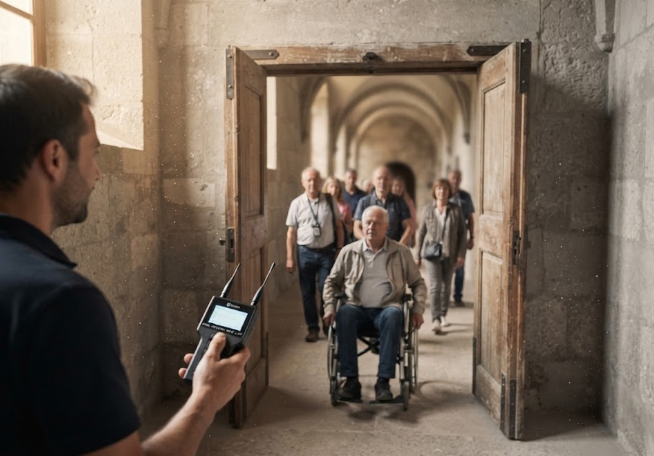
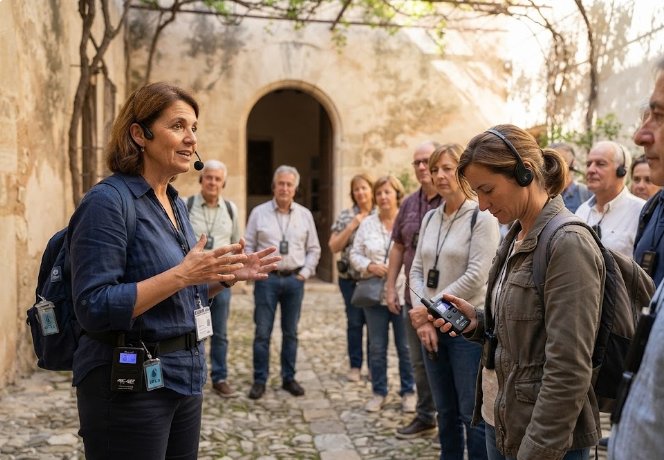
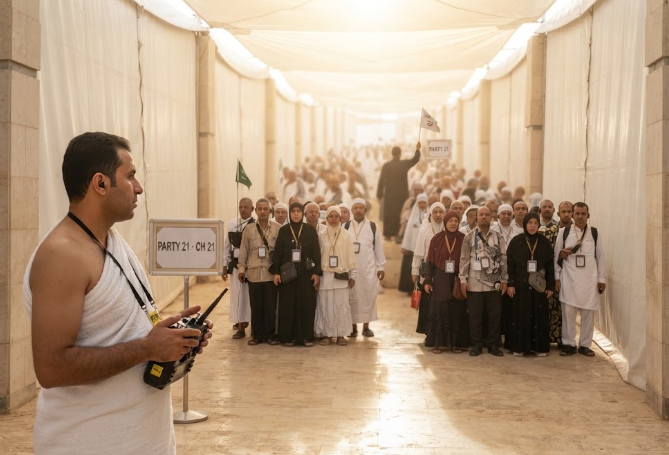
I have equipped Hajj and Umrah operators for enough seasons to notice that the plan itself has changed. It used to be simple: one coach, one guide, one channel, and the only number anyone argued about was range. The delegations we see now arrive together and then split apart. Language sub-groups share a coach, a tent floor mixes four or five nationalities, walking parties leave at different hours, and the person holding the transmitter often changes in the middle of a move.

The equipment question moved with them. It is no longer only whether a signal reaches two hundred meters. It is how many independent conversations can run in the same hour, what happens at a change of hands, and what a receiver weighs on a pilgrim who has already been on their feet for hours. That is where a wireless tour guide system earns its place — not as a loudspeaker, but as the thing that keeps a scattered party behaving like one, and the reason the three systems below are specified so differently. Three systems in the same family answer three different parts of that day, and I will take them one at a time rather than rank them.

📡 Why One Radio Plan Stopped Fitting the Season

A kit designed around a single fixed venue does not survive a season. The same operator now covers Umrah traffic that runs all year and a Hajj period that compresses everything into a few weeks, and the two do not look alike. Umrah parties are smaller, more frequent, and multilingual by default. Hajj parties are larger, split by country and by travel agency, and they move between open ground, tent floors and enclosed prayer areas inside one day. A plan built on one channel and one fixed meeting spot has to be rebuilt every morning, so we stopped writing plans around venues and started writing them around the moments when a party re-forms. Umrah traffic rewards a kit that can be packed down and reissued quickly as well, since one party may run twice in the same week behind two different guides.

🏭 The Assembly Point Becomes the Planning Unit

Where several licensed operators work the same area, the pressure point is rarely the open route. It is the assembly point, where separate parties stand within earshot of each other and every transmitter is switched on at once. That is the moment a channel plan either holds or collapses, which is why the unit we plan around is now the assembly point: how many parties will stand in the same place, in the same hour, with separate languages running in parallel. Operators who handle this well choose channels before departure and treat the walk between two assembly points as a problem of its own. The Hajj and Umrah audio guide kits we assemble for this work are selected for exactly that reason — the kit has to be renumbered between stops, not merely carried between them. A rough count helps at this stage: parties multiplied by languages gives the minimum channel demand for that spot, and anything below it will clash at the busiest hour.

A Sender That Survives a Change of Hands

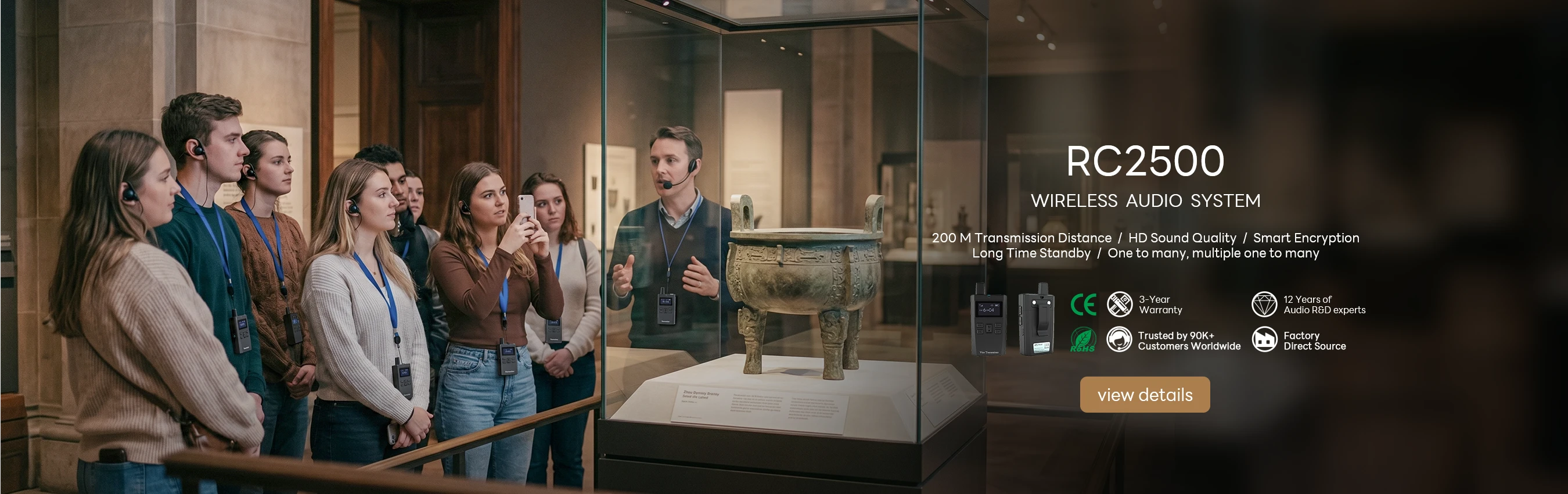
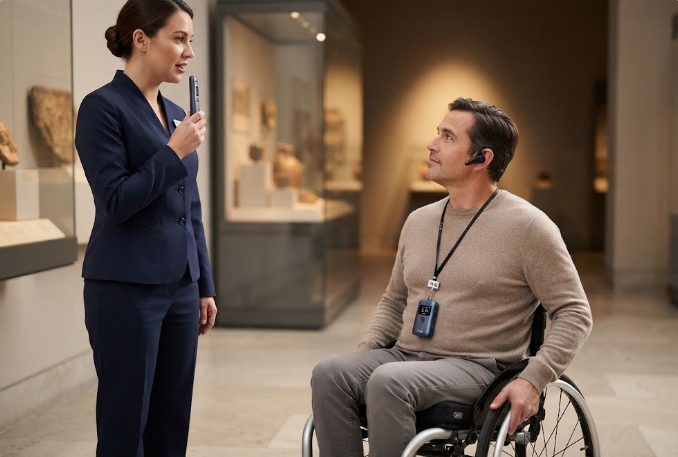
RC2402 is the unit we hand to a deputy leader when the party has to be split at short notice. It works on the 2403-2483MHz band, the license-free 2.4GHz section that is recognised worldwide, which matters when a delegation reaches the kingdom on a charter and the same kit has to be legal on both legs of the journey. Transmission holds up to 200 meters in open area, and the battery figures are published as ten hours on the transmitter and twenty on the receiver. The feature that gets used most, though, is one-click frequency synchronisation: a second guide can take the transmitter over and re-pair the receivers without a technician and without a menu. Every receiver that has already been handed out stays on the party, which is the whole point at a change of hands. The maker also lists this model for pilgrimage work, and that is not something every system in the class can claim.
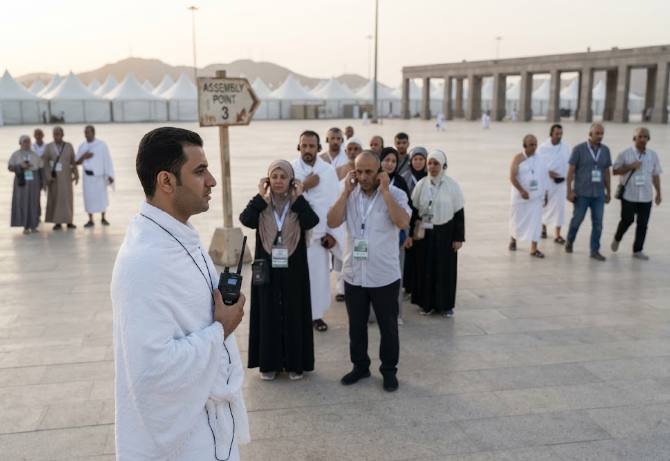
RC2402-hajj_umrah_audio_guide_kits

🎪 Interpretation Grade Without the Booth

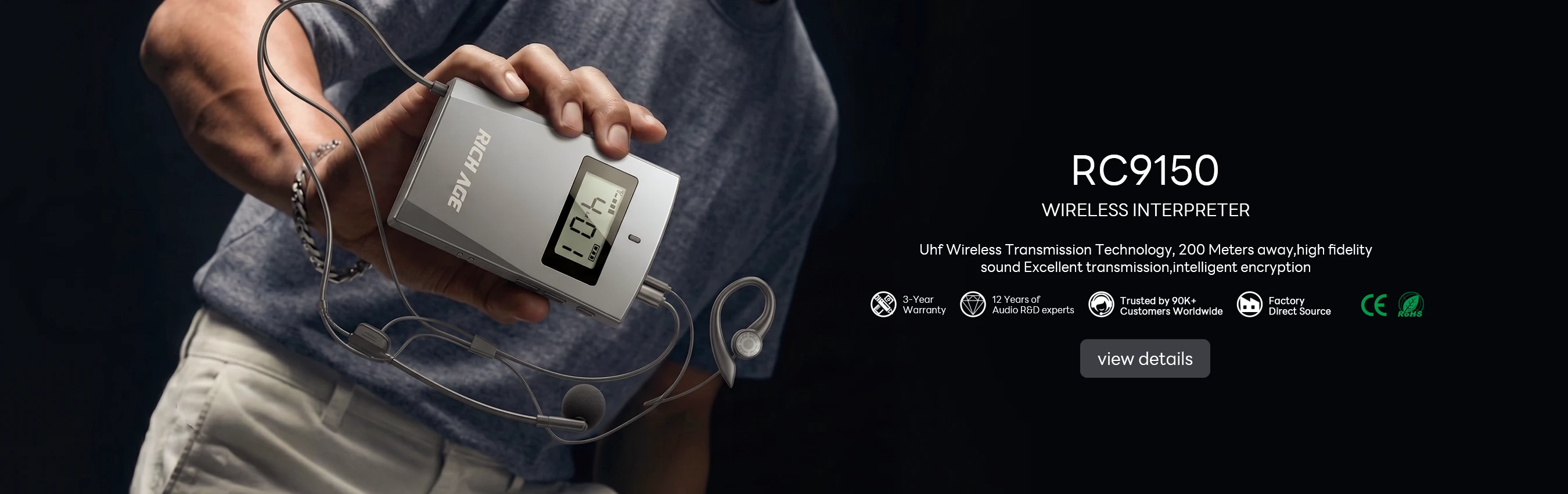
Language mixing is the change that has moved the most. A Hajj party that once needed one voice now needs several running side by side, and the people doing that work are standing in the open rather than sitting behind glass. RC9150 is built for that shift: one transmitter with unlimited receivers, one hundred independent channels, and encryption that keeps neighbouring parties out of each other's audio. Battery life is listed as fifteen hours on the transmitter and thirty or more on the receiver, which covers a long day that starts before dawn and ends in a tent. It sits on the same license-free band, carries CE, EMC, LVD, RED and RoHS certification, and its mainboard is covered for three years. If your operation carries several nationalities in one coach, this is the tier to look at before you shorten the receiver list.
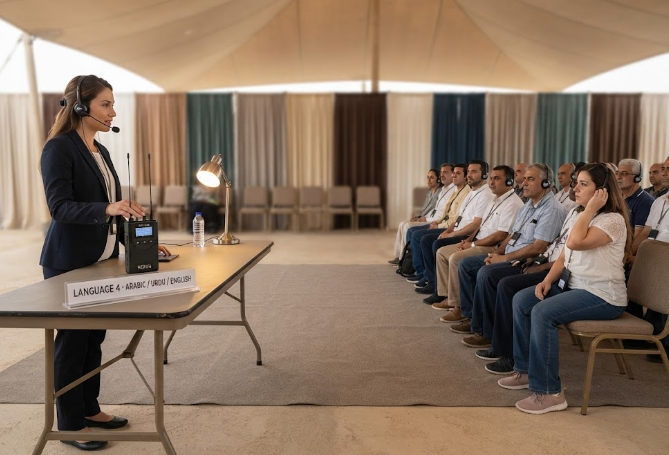
RC9150-hajj_umrah_audio_guide_kits

Many Ears at Once in a Confined Site

Confined ground is the other half of the problem. Around a prayer hall, on a tent floor, or in a corridor where several parties are funnelled past each other, range stops being the limiting factor and channel capacity becomes it. RC2406 answers with eighty channels locked by PLL synthesis so that each party holds its own frequency, and one-click pairing that lets a guide set up without a frequency list. It stays at 50 grams, carries an IPX4 splash rating that matters when the day is hot and hands are wet, and runs from a 1500mAh battery described by the maker as full-day continuous use. On the crowded stretches that combination is what keeps four parties from sounding like one. Splash protection sounds trivial until a party walks in the heat and hands a receiver back wet.
RC2406-hajj_umrah_audio_guide_kits

What the Product Pages Actually List

One habit worth keeping is reading the three pages side by side before writing a specification, because they do not publish the same fields. Only one of the three states a weight, only two state a channel count, and battery is given in hours on two pages and in capacity on the third. So the table below uses only the columns all three publish, and the rest is left to the individual pages rather than guessed at. If you need a figure that is not listed, ask us and we will get it from the factory instead of filling the gap with an estimate. The full range is on our wireless tour guide system range page if you want to compare beyond these three. Channel figures are the clearest example of the gap: one page states one hundred, one states eighty, and the third does not state a figure at all.

ModelSystem typeFrequency bandRangeBattery and working timeCertifications
RC24022.4G Wireless Tour Guide System2403-2483MHz, 2.4GHz ISM band, license-free worldwideUp to 200 meters in open areaTransmitter 10 hours / receiver 20 hoursCE, EMC, LVD, RED, RoHS
RC9150High-end 2.4G Wireless Audio/Radio Guide System, one transmitter with unlimited receivers2403-2483MHz, global ISM band, license-freeUp to 200 meters in open areaTransmitter 15 hours / receiver 30+ hoursCE, EMC, LVD, RED, RoHS
RC2406Wireless Tour Guide System, one transmitter with multiple receivers2403-2483MHz, 2.4GHz ISM band, license-freeUp to 200 meters in open area1500mAh lithium battery, full-day continuous useRoHS

What Buyers Now Put in Writing

The tenders reaching us have changed shape too. A repeat order used to be a quantity and a delivery date. Now it arrives with the language layout for the season attached, a note on how many spare receivers each party should hold, and a request for sample units to be tested on a real delegation before the bulk order is placed. Branding has moved up the list as well: logos on the device body and on the packaging, a different receiver count per package, occasionally an entirely custom housing. That work runs through our OEM and ODM customization line, and it is usually settled months before the first party travels. If you are planning for the coming season, send the language layout first — the channel count and the receiver numbers follow from it far more reliably than from a headcount. Most of the plans that fail in the field were written for a headcount instead.

The direction is clear enough. Groups are getting harder to hold together, not easier, and the systems that survive a season are the ones that can be renumbered quickly, handed to a different guide, and kept light on a pilgrim who is already walking. Ask us for the sample units early and test the change of hands yourself; that is the step where most plans fail in practice.

2026年09月15日 11:01
click: 411

RC2402, RC9150 and RC2406: A Wireless Tour Guide System for a Hajj Group That Keeps Splitting

time: 2026年09月15日 click:411

RC2402, RC9150 and RC2406: A Wireless Tour Guide System for a Hajj Group That Keeps Splitting

I have equipped Hajj and Umrah operators for enough seasons to notice that the plan itself has changed. It used to be simple: one coach, one guide, one channel, and the only number anyone argued about was range. The delegations we see now arrive together and then split apart. Language sub-groups share a coach, a tent floor mixes four or five nationalities, walking parties leave at different hours, and the person holding the transmitter often changes in the middle of a move.

The equipment question moved with them. It is no longer only whether a signal reaches two hundred meters. It is how many independent conversations can run in the same hour, what happens at a change of hands, and what a receiver weighs on a pilgrim who has already been on their feet for hours. That is where a wireless tour guide system earns its place — not as a loudspeaker, but as the thing that keeps a scattered party behaving like one, and the reason the three systems below are specified so differently. Three systems in the same family answer three different parts of that day, and I will take them one at a time rather than rank them.

📡 Why One Radio Plan Stopped Fitting the Season

A kit designed around a single fixed venue does not survive a season. The same operator now covers Umrah traffic that runs all year and a Hajj period that compresses everything into a few weeks, and the two do not look alike. Umrah parties are smaller, more frequent, and multilingual by default. Hajj parties are larger, split by country and by travel agency, and they move between open ground, tent floors and enclosed prayer areas inside one day. A plan built on one channel and one fixed meeting spot has to be rebuilt every morning, so we stopped writing plans around venues and started writing them around the moments when a party re-forms. Umrah traffic rewards a kit that can be packed down and reissued quickly as well, since one party may run twice in the same week behind two different guides.

🏭 The Assembly Point Becomes the Planning Unit

Where several licensed operators work the same area, the pressure point is rarely the open route. It is the assembly point, where separate parties stand within earshot of each other and every transmitter is switched on at once. That is the moment a channel plan either holds or collapses, which is why the unit we plan around is now the assembly point: how many parties will stand in the same place, in the same hour, with separate languages running in parallel. Operators who handle this well choose channels before departure and treat the walk between two assembly points as a problem of its own. The Hajj and Umrah audio guide kits we assemble for this work are selected for exactly that reason — the kit has to be renumbered between stops, not merely carried between them. A rough count helps at this stage: parties multiplied by languages gives the minimum channel demand for that spot, and anything below it will clash at the busiest hour.

A Sender That Survives a Change of Hands

RC2402 is the unit we hand to a deputy leader when the party has to be split at short notice. It works on the 2403-2483MHz band, the license-free 2.4GHz section that is recognised worldwide, which matters when a delegation reaches the kingdom on a charter and the same kit has to be legal on both legs of the journey. Transmission holds up to 200 meters in open area, and the battery figures are published as ten hours on the transmitter and twenty on the receiver. The feature that gets used most, though, is one-click frequency synchronisation: a second guide can take the transmitter over and re-pair the receivers without a technician and without a menu. Every receiver that has already been handed out stays on the party, which is the whole point at a change of hands. The maker also lists this model for pilgrimage work, and that is not something every system in the class can claim.

RC2402-hajj_umrah_audio_guide_kits

🎪 Interpretation Grade Without the Booth

Language mixing is the change that has moved the most. A Hajj party that once needed one voice now needs several running side by side, and the people doing that work are standing in the open rather than sitting behind glass. RC9150 is built for that shift: one transmitter with unlimited receivers, one hundred independent channels, and encryption that keeps neighbouring parties out of each other's audio. Battery life is listed as fifteen hours on the transmitter and thirty or more on the receiver, which covers a long day that starts before dawn and ends in a tent. It sits on the same license-free band, carries CE, EMC, LVD, RED and RoHS certification, and its mainboard is covered for three years. If your operation carries several nationalities in one coach, this is the tier to look at before you shorten the receiver list.

RC9150-hajj_umrah_audio_guide_kits

Many Ears at Once in a Confined Site

Confined ground is the other half of the problem. Around a prayer hall, on a tent floor, or in a corridor where several parties are funnelled past each other, range stops being the limiting factor and channel capacity becomes it. RC2406 answers with eighty channels locked by PLL synthesis so that each party holds its own frequency, and one-click pairing that lets a guide set up without a frequency list. It stays at 50 grams, carries an IPX4 splash rating that matters when the day is hot and hands are wet, and runs from a 1500mAh battery described by the maker as full-day continuous use. On the crowded stretches that combination is what keeps four parties from sounding like one. Splash protection sounds trivial until a party walks in the heat and hands a receiver back wet.

RC2406-hajj_umrah_audio_guide_kits

What the Product Pages Actually List

One habit worth keeping is reading the three pages side by side before writing a specification, because they do not publish the same fields. Only one of the three states a weight, only two state a channel count, and battery is given in hours on two pages and in capacity on the third. So the table below uses only the columns all three publish, and the rest is left to the individual pages rather than guessed at. If you need a figure that is not listed, ask us and we will get it from the factory instead of filling the gap with an estimate. The full range is on our wireless tour guide system range page if you want to compare beyond these three. Channel figures are the clearest example of the gap: one page states one hundred, one states eighty, and the third does not state a figure at all.

ModelSystem typeFrequency bandRangeBattery and working timeCertifications
RC24022.4G Wireless Tour Guide System2403-2483MHz, 2.4GHz ISM band, license-free worldwideUp to 200 meters in open areaTransmitter 10 hours / receiver 20 hoursCE, EMC, LVD, RED, RoHS
RC9150High-end 2.4G Wireless Audio/Radio Guide System, one transmitter with unlimited receivers2403-2483MHz, global ISM band, license-freeUp to 200 meters in open areaTransmitter 15 hours / receiver 30+ hoursCE, EMC, LVD, RED, RoHS
RC2406Wireless Tour Guide System, one transmitter with multiple receivers2403-2483MHz, 2.4GHz ISM band, license-freeUp to 200 meters in open area1500mAh lithium battery, full-day continuous useRoHS

What Buyers Now Put in Writing

The tenders reaching us have changed shape too. A repeat order used to be a quantity and a delivery date. Now it arrives with the language layout for the season attached, a note on how many spare receivers each party should hold, and a request for sample units to be tested on a real delegation before the bulk order is placed. Branding has moved up the list as well: logos on the device body and on the packaging, a different receiver count per package, occasionally an entirely custom housing. That work runs through our OEM and ODM customization line, and it is usually settled months before the first party travels. If you are planning for the coming season, send the language layout first — the channel count and the receiver numbers follow from it far more reliably than from a headcount. Most of the plans that fail in the field were written for a headcount instead.

The direction is clear enough. Groups are getting harder to hold together, not easier, and the systems that survive a season are the ones that can be renumbered quickly, handed to a different guide, and kept light on a pilgrim who is already walking. Ask us for the sample units early and test the change of hands yourself; that is the step where most plans fail in practice.
×

Contact us

email:
name:
subject:
content: