A leading China factory specializing in Wireless Tour Guide Systems, Church Audio Guides, and Translation Headphones with premium OEM/ODM solutions.

Tel:+86 13825295213

Email:tiger.wang@richitek.com

RC2468, RC2402 and RC085: Who an Accessible Wireless Tour Guide System Actually Has to Serve

I have sat through enough accessibility reviews to know where they usually start, and it is almost never in the right place. The first question is nearly always about volume, then channel count, then range. Those numbers are worth knowing, but none of them decides whether a tour is accessible. What decides it is whether the person at the back of the group can use the receiver without asking a stranger for help.

🗺️ Compliance Is About the Whole Group, Not the Average Visitor

Accessibility legislation in Europe and North America asks venues for something deliberately vague and deliberately hard: an experience that is equivalent, not identical, for every visitor. Equivalence is a slippery standard because it is judged per person, and a single guided group can easily contain a wheelchair user, someone who cannot read a small screen, a first-time visitor who will not learn a button, and a carer who has to hear everything twice. A specification written for the average visitor quietly excludes all four. This is why museum teams who take museum tour solutions seriously tend to start with the people in the room rather than the hardware list.

🗺️ The Visitor Using Wheels Reaches for Nothing on a Lap

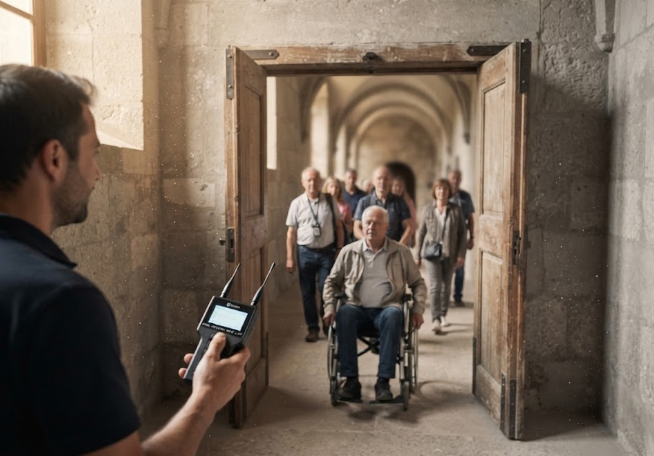
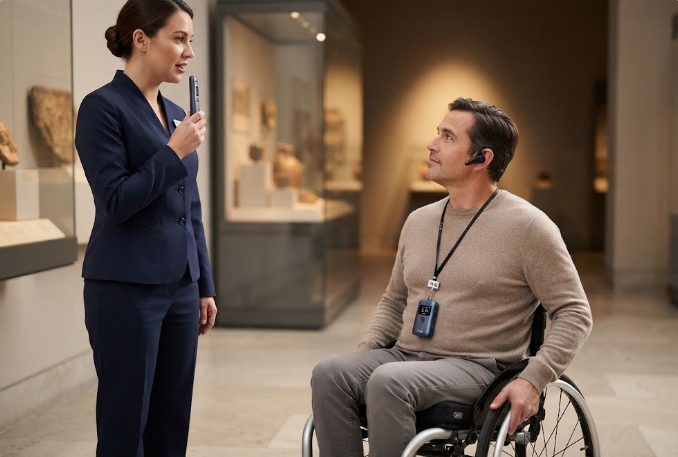
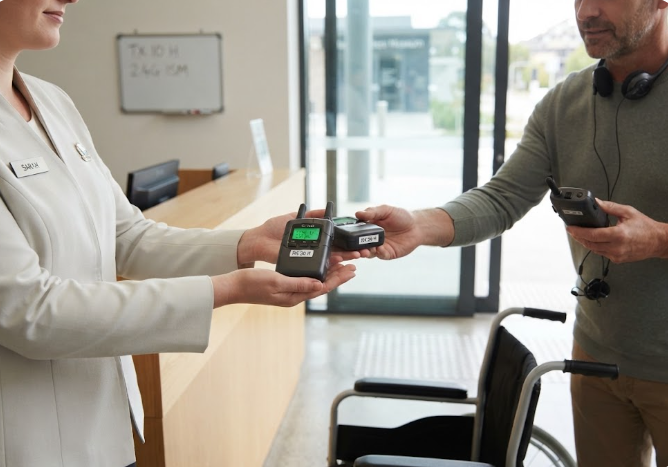
A receiver resting on a lap is a receiver on the floor the first time the chair moves. In practice the workable arrangement is a lanyard, a clip on the armrest, or a chest strap, and the controls have to be reachable one-handed while the other hand is managing a wheel. Anything that requires standing, turning, or a second person to press is not an equivalent experience, no matter how clear the audio is. Placing the receiver and the headset socket where the hand naturally falls solves more compliance problems than any increase in volume ever has.

🖥️ The Visitor Who Cannot Read a Display

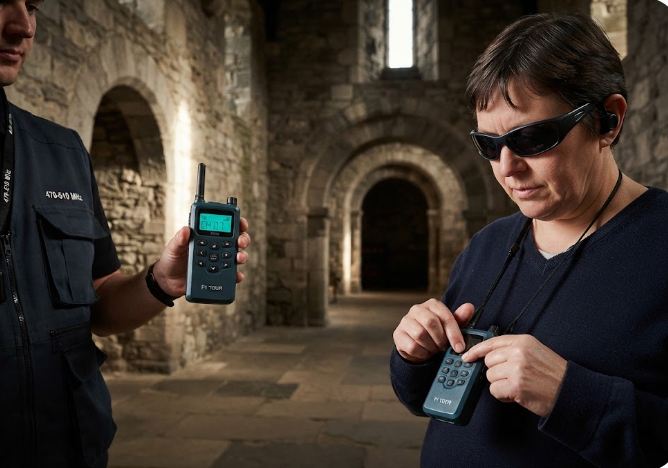
A bright LCD showing channel four is useful to a technician and meaningless to a visitor with low vision. If the route to a working receiver runs through reading a number, the venue has effectively made that receiver conditional on sight. The workable patterns are a device that arrives already set up, tactile markings that identify the power and volume controls by touch, and a headset that does not need to be plugged into a specific hole in a specific orientation. None of these are exotic requirements. They are simply the difference between handing someone a device and handing someone a task.

🗺️ The Visitor Who Will Not Learn a Button

Some visitors will not read instructions, and it would be unfair to treat that as carelessness. Older visitors, guests with cognitive impairments, and anyone on a tight timetable all fall into the same category: if the receiver does not produce sound the moment the earphone goes in, it will not be used, and the tour will continue without them. One-touch pairing and plug-and-play operation are not conveniences here. They are the mechanism by which the equipment stays in the hands of the people who need it instead of returning to the front desk unopened.

The Companion Who Sits Beside and Repeats Everything

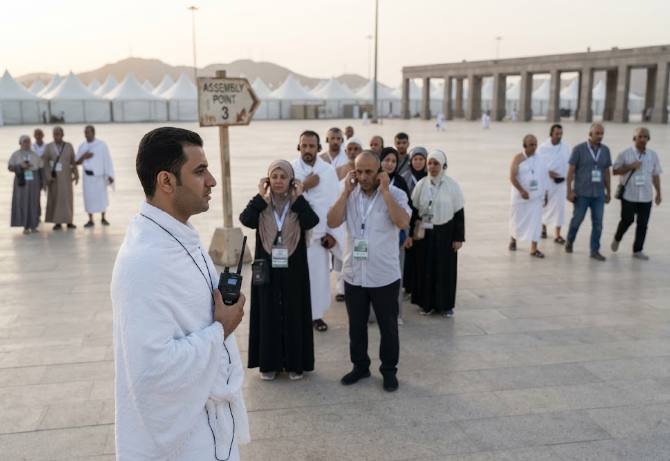
Companions, carers, and family members are the feature of accessible tours that specifications routinely forget. On a real visit, one person is often listening on behalf of another, or following a simultaneous commentary so they can explain it later, and they are doing it while pushing, guiding, or taking notes. A second receiver in the same channel, with a lightweight body pack and a headphone that leaves one ear open, costs very little and prevents the guide's commentary from being relayed twice at the wrong volume. Where venue policy allows it, issuing a unit to the companion is the single cheapest accessibility improvement available.

What Each of the Three Units Changes for Those People

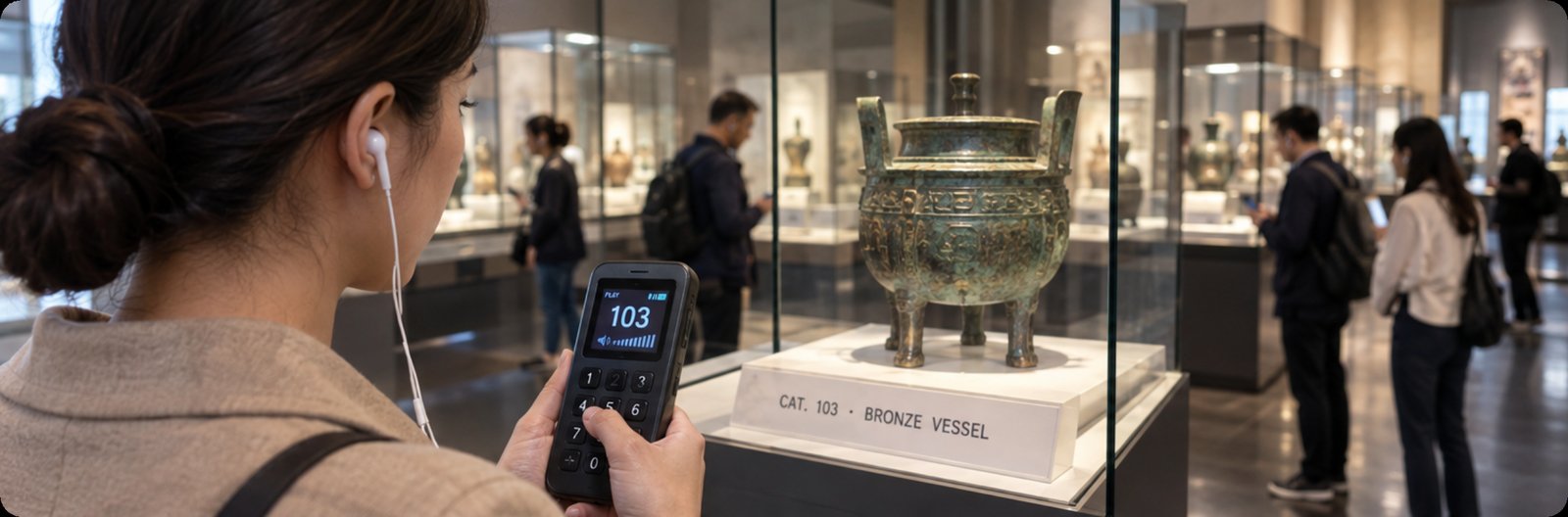
The RC2468 is built around a receiver that weighs 18 grams, and that number does more for accessibility than it first appears to. A device that light can hang from a lanyard for three hours without the visitor wanting to put it down, and it sits flat enough to be clipped to an armrest or a wheelchair frame rather than balanced on a lap. The 2403-2483MHz ISM band keeps it licence-free in most markets, 50 channels allow several groups to run in parallel without crosstalk, and the transmitter holds twelve hours on its 1500mAh cell while the receiver manages ten. For venues that need to hand a unit to a companion as well as a visitor, the arithmetic is straightforward.
RC2468-accessible_tour

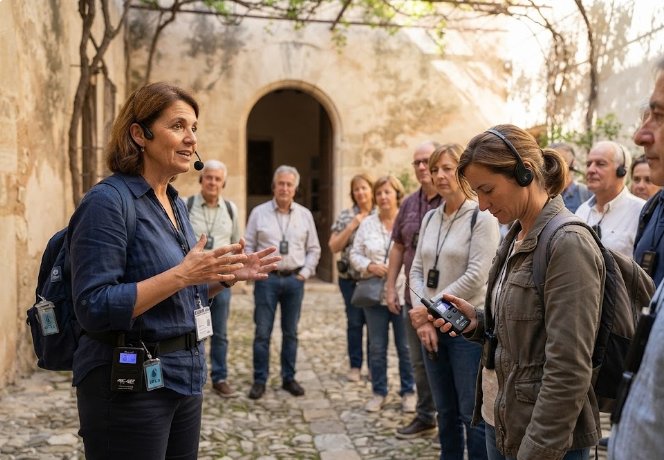
The RC2402 takes the opposite approach and optimises for the setup moment. One-click frequency synchronisation means the transmitter pairs with any number of receivers without anybody reading a manual, and the receiver runs up to twenty hours against the transmitter's ten, which matters on a day when units are handed out at nine and collected at five. Encryption prevents one group's audio bleeding into another's, a genuine problem in shared courtyards. It is the unit to choose when the front-of-house team changes daily and cannot be relied on to configure anything.
RC2402-accessible_tour

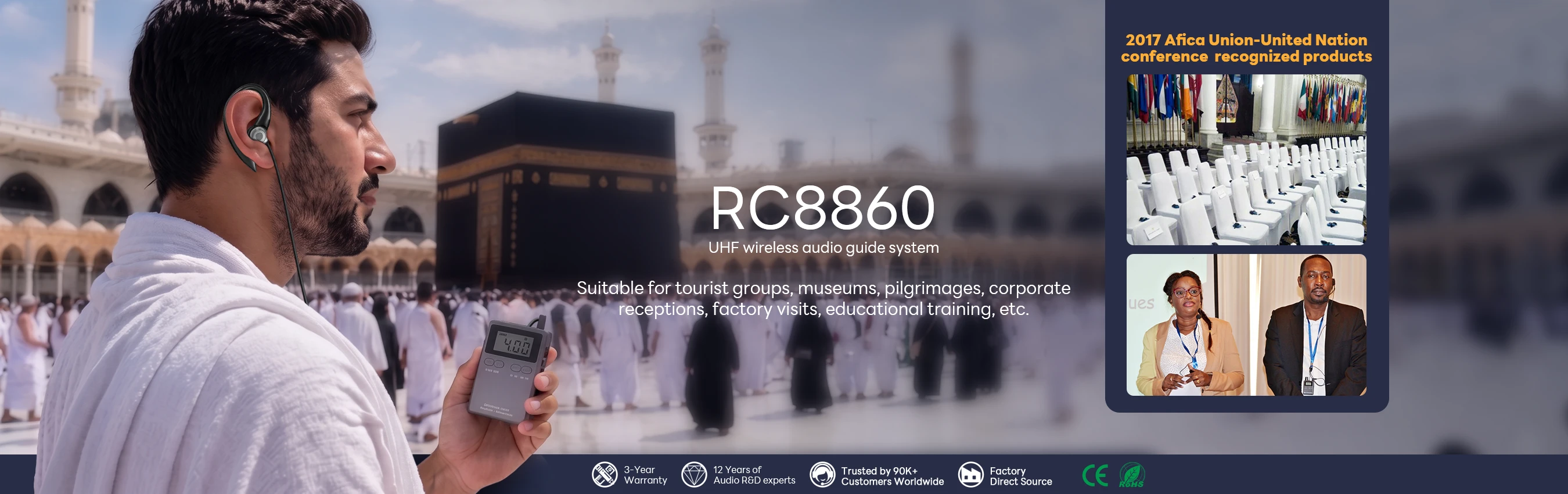
The RC085 runs on UHF at 470-510MHz and offers two modes, one-way broadcast for standard tours and two-way for training or interactive sessions. Its selection is a question of what the building is made of rather than who is in the group: UHF penetrates masonry, machinery, and the thick walls of older venues where 2.4GHz struggles. The LCD screen and automatic sleep-wake behaviour suit staff who check battery and channel state between tours. For a companion or a carer moving in and out of a stone building all afternoon, the steadier signal is the relevant feature.
RC085-accessible_tour

ModelPositioningFrequency bandRangeCertifications
RC2468Ultra-light 2.4G for outdoor hiking and factory tours2403-2483MHz (2.4GHz ISM)Up to 200 mCE, EMC, LVD, RED, RoHS
RC2402Standard 2.4G unit for medium-size guided groups2403-2483MHz (2.4GHz ISM)Up to 200 mCE, EMC, LVD, RED, RoHS
RC085UHF digital unit with LCD for complex, dense buildings470-510MHz (UHF)Up to 200 mCE, RED, RoHS

Two fields are deliberately absent from that table. The RC2402 and RC085 product pages do not publish a receiver weight, and the RC085 page describes its power management as auto sleep and wake-up without quoting a battery capacity. Anyone comparing the three on those two points should read each product page directly rather than infer a figure from the RC2468's 18-gram receiver and 1500mAh transmitter.

Certifications Cover the Paper Half of the Same Argument

Every unit in this comparison carries CE, RED, and RoHS, and the two 2.4GHz models add EMC and LVD. Those marks answer a specific set of questions: that the transmitter stays inside its permitted power envelope, that it will not disturb other equipment, and that it can legally be placed on the market. They say nothing about whether a wheelchair user can reach the volume control. Both halves are required, and venues that treat the certificate as the finish line tend to discover the other half during an audit, when someone asks why the receiver was returned unused.

Specifying a System the Whole Group Can Actually Use

The practical sequence is to list the visitors who will realistically be on the tour, work out what each of them has to do to hear the guide, and only then compare hardware against that list. Weight, battery life, pairing behaviour, and signal penetration matter to different visitors for different reasons, and the wireless tour guide system range covers the combinations most venues end up needing. Where a site has unusual requirements, from a specific colour scheme for wayfinding to a housing that suits a particular mounting arrangement, OEM and ODM manufacturing is available so that the receiver suits the group rather than the group adapting to the receiver. That, in the end, is what equivalent access means.

2026年09月15日 11:37
click: 13

RC2468, RC2402 and RC085: Who an Accessible Wireless Tour Guide System Actually Has to Serve

time: 2026年09月15日 click:13

I have sat through enough accessibility reviews to know where they usually start, and it is almost never in the right place. The first question is nearly always about volume, then channel count, then range. Those numbers are worth knowing, but none of them decides whether a tour is accessible. What decides it is whether the person at the back of the group can use the receiver without asking a stranger for help.

🗺️ Compliance Is About the Whole Group, Not the Average Visitor

Accessibility legislation in Europe and North America asks venues for something deliberately vague and deliberately hard: an experience that is equivalent, not identical, for every visitor. Equivalence is a slippery standard because it is judged per person, and a single guided group can easily contain a wheelchair user, someone who cannot read a small screen, a first-time visitor who will not learn a button, and a carer who has to hear everything twice. A specification written for the average visitor quietly excludes all four. This is why museum teams who take museum tour solutions seriously tend to start with the people in the room rather than the hardware list.

🗺️ The Visitor Using Wheels Reaches for Nothing on a Lap

A receiver resting on a lap is a receiver on the floor the first time the chair moves. In practice the workable arrangement is a lanyard, a clip on the armrest, or a chest strap, and the controls have to be reachable one-handed while the other hand is managing a wheel. Anything that requires standing, turning, or a second person to press is not an equivalent experience, no matter how clear the audio is. Placing the receiver and the headset socket where the hand naturally falls solves more compliance problems than any increase in volume ever has.

🖥️ The Visitor Who Cannot Read a Display

A bright LCD showing channel four is useful to a technician and meaningless to a visitor with low vision. If the route to a working receiver runs through reading a number, the venue has effectively made that receiver conditional on sight. The workable patterns are a device that arrives already set up, tactile markings that identify the power and volume controls by touch, and a headset that does not need to be plugged into a specific hole in a specific orientation. None of these are exotic requirements. They are simply the difference between handing someone a device and handing someone a task.

🗺️ The Visitor Who Will Not Learn a Button

Some visitors will not read instructions, and it would be unfair to treat that as carelessness. Older visitors, guests with cognitive impairments, and anyone on a tight timetable all fall into the same category: if the receiver does not produce sound the moment the earphone goes in, it will not be used, and the tour will continue without them. One-touch pairing and plug-and-play operation are not conveniences here. They are the mechanism by which the equipment stays in the hands of the people who need it instead of returning to the front desk unopened.

The Companion Who Sits Beside and Repeats Everything

Companions, carers, and family members are the feature of accessible tours that specifications routinely forget. On a real visit, one person is often listening on behalf of another, or following a simultaneous commentary so they can explain it later, and they are doing it while pushing, guiding, or taking notes. A second receiver in the same channel, with a lightweight body pack and a headphone that leaves one ear open, costs very little and prevents the guide's commentary from being relayed twice at the wrong volume. Where venue policy allows it, issuing a unit to the companion is the single cheapest accessibility improvement available.

What Each of the Three Units Changes for Those People

The RC2468 is built around a receiver that weighs 18 grams, and that number does more for accessibility than it first appears to. A device that light can hang from a lanyard for three hours without the visitor wanting to put it down, and it sits flat enough to be clipped to an armrest or a wheelchair frame rather than balanced on a lap. The 2403-2483MHz ISM band keeps it licence-free in most markets, 50 channels allow several groups to run in parallel without crosstalk, and the transmitter holds twelve hours on its 1500mAh cell while the receiver manages ten. For venues that need to hand a unit to a companion as well as a visitor, the arithmetic is straightforward.

RC2468-accessible_tour

The RC2402 takes the opposite approach and optimises for the setup moment. One-click frequency synchronisation means the transmitter pairs with any number of receivers without anybody reading a manual, and the receiver runs up to twenty hours against the transmitter's ten, which matters on a day when units are handed out at nine and collected at five. Encryption prevents one group's audio bleeding into another's, a genuine problem in shared courtyards. It is the unit to choose when the front-of-house team changes daily and cannot be relied on to configure anything.

RC2402-accessible_tour

The RC085 runs on UHF at 470-510MHz and offers two modes, one-way broadcast for standard tours and two-way for training or interactive sessions. Its selection is a question of what the building is made of rather than who is in the group: UHF penetrates masonry, machinery, and the thick walls of older venues where 2.4GHz struggles. The LCD screen and automatic sleep-wake behaviour suit staff who check battery and channel state between tours. For a companion or a carer moving in and out of a stone building all afternoon, the steadier signal is the relevant feature.

RC085-accessible_tour

ModelPositioningFrequency bandRangeCertifications
RC2468Ultra-light 2.4G for outdoor hiking and factory tours2403-2483MHz (2.4GHz ISM)Up to 200 mCE, EMC, LVD, RED, RoHS
RC2402Standard 2.4G unit for medium-size guided groups2403-2483MHz (2.4GHz ISM)Up to 200 mCE, EMC, LVD, RED, RoHS
RC085UHF digital unit with LCD for complex, dense buildings470-510MHz (UHF)Up to 200 mCE, RED, RoHS

Two fields are deliberately absent from that table. The RC2402 and RC085 product pages do not publish a receiver weight, and the RC085 page describes its power management as auto sleep and wake-up without quoting a battery capacity. Anyone comparing the three on those two points should read each product page directly rather than infer a figure from the RC2468's 18-gram receiver and 1500mAh transmitter.

Certifications Cover the Paper Half of the Same Argument

Every unit in this comparison carries CE, RED, and RoHS, and the two 2.4GHz models add EMC and LVD. Those marks answer a specific set of questions: that the transmitter stays inside its permitted power envelope, that it will not disturb other equipment, and that it can legally be placed on the market. They say nothing about whether a wheelchair user can reach the volume control. Both halves are required, and venues that treat the certificate as the finish line tend to discover the other half during an audit, when someone asks why the receiver was returned unused.

Specifying a System the Whole Group Can Actually Use

The practical sequence is to list the visitors who will realistically be on the tour, work out what each of them has to do to hear the guide, and only then compare hardware against that list. Weight, battery life, pairing behaviour, and signal penetration matter to different visitors for different reasons, and the wireless tour guide system range covers the combinations most venues end up needing. Where a site has unusual requirements, from a specific colour scheme for wayfinding to a housing that suits a particular mounting arrangement, OEM and ODM manufacturing is available so that the receiver suits the group rather than the group adapting to the receiver. That, in the end, is what equivalent access means.

×

Contact us

email:
name:
subject:
content: