.webp)

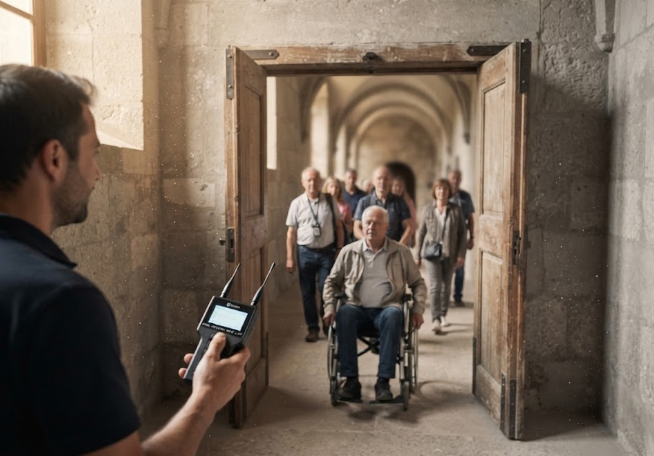
A busy week at a data centre is rarely a staffing problem. It is a permissions problem. Three parties can land in the same seven days - a customer engineering team that may photograph whatever it likes, a compliance audit that may look but not record, and a recruitment group that walks faster than either of them - and all three cover the same corridor past the same racks. The audio setup that suits one is not the setup that suits the next, and swapping hardware between visits does not scale. What scales is deciding ahead of time which unit and which channel number travels with which party.
Off Limits to Cameras, Open to Headsets
The three parties differ less in headcount than in what they are allowed to see and hear. The engineering team wants rack layout, cable routing and airflow detail. The audit party wants process and documentation, and will stand in front of one cabinet for twenty minutes. The recruitment group wants the story of the building rather than its specification, and will be gone inside forty minutes. Because the content changes with the party, the audio has to change with it: one corridor, two scripts, and a firm boundary between what is broadcast on one channel and what stays on the other. That is the same problem that site visit programmes hit in plants and research buildings, which is why the site tour solutions built for those routes are worth reading before you write the visit plan.
Two Teams Ask for Different Briefings
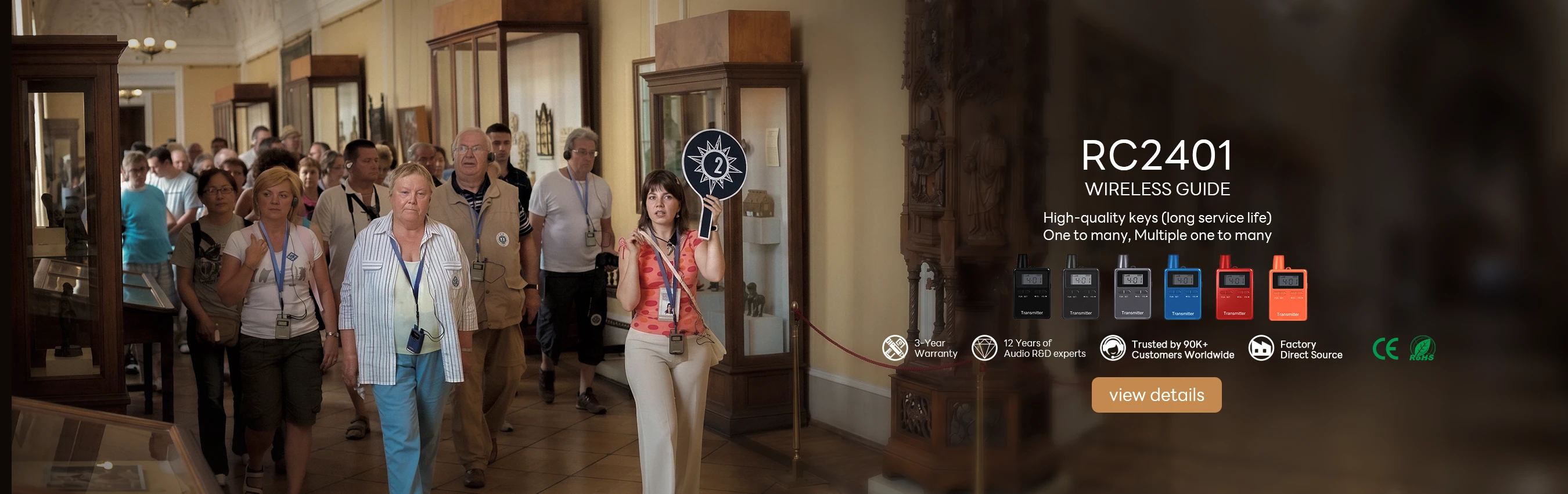
The RC2401 is the unit that makes a two-briefing visit practical without buying a second system. It operates on 2.4GHz in the 2403-2483MHz ISM band with 50 PLL digital channels, and it supports one-way broadcast as well as group communication - which is what lets a single transmitter serve two parties on two channel numbers at once. Stated range is up to 200 metres in open area, transmitter talk time is quoted at 10+ hours, and the housing carries an IPX4 splash rating, which earns its keep in a hall where the air handling is louder than anyone expects. The RC2401 ships with CE and RoHS certification and a three-year warranty covering the mainboard.

One Channel for the Open Hall, One Behind the Glass
Data halls are not uniform in what a visitor may hear. A glassed-in room off the main hall can hold equipment under a customer agreement, and the briefing that is fine in the open aisle is not fine thirty centimetres behind that glass. The workable fix is to put channel numbers into the visit plan the way room numbers go into it: the party cleared for the sensitive version is assigned its own channel before it leaves the lobby, and the escort stops having to remember who was told what. Two channels running at once also lets the audit party stand still in one aisle while the rest of the group keeps moving, with neither side hearing the other's commentary.
Two practical details keep that split honest on the day. The channel number should be written on whatever the visitor carries out of the lobby, because nobody remembers a number that was read out once in a noisy room. And the boundary has to be visible to the escort, who is the only person on the route who can tell when the group is about to cross it.
Why Range Is About Rows of Racks, Not Distance
Quoted range figures are measured across open ground, and a data hall is not open ground - it is a grid of steel, cabling and moving air. What matters in practice is whether the audio survives the moment the group stretches out: the lead walking two rows ahead, the slowest visitor still at the previous cabinet. The RC2408 is specified at up to 200 metres with 80 channels, which leaves room to hold two parties apart on the channel plan, and it runs one-key synchronisation so a receiver picked up mid-round joins the right channel without a manual search. It also carries two-way audio between speakers, which is how an escort ahead of the group reports what is coming without the whole party hearing it. The page quotes the transmitter at 59g and the receiver at 50g.

A Recruit Puts the Receiver On and Forgets About It
The recruitment party is the one that will judge the hardware without meaning to. Candidates and students are not used to wearing a receiver, they move in bursts, and a unit that tugs at the ear or feels heavy after twenty minutes becomes the thing they remember about the building. The RC2468 is the lightest option here: transmitter 59g, receiver 18g, a 1500mAh transmitter battery quoted at 12 hours of continuous talk time and a 300mAh receiver quoted at 10 hours. Range is stated at 1-200 metres and the page notes it holds up through walls and obstacles, which matters when a candidate drifts back toward the lobby. It charges over Micro USB 5V/1A, and the transmitter comes in six colours - a small detail that turns into a real one when three parties have to be sorted at the door.

Weight Decides Which Unit Travels With Which Team
Weight is the least glamorous column in any specification sheet and the one that decides how a week actually runs. The audit party stands still for long stretches, so the lightest receiver belongs with them. The engineering team carries bags and moves at its own pace, which makes the heavier receiver acceptable if the range and channel count are better. The recruitment group needs the fastest handover at the door, so whatever unit pairs in one touch should be reserved for them. One caution worth stating plainly: the RC2401 product page does not publish a weight figure, so no number is invented for it here - measure a sample if the carrying plan depends on it.
| Unit | Channels | Stated range | Transmitter talk time | Group mode |
| RC2401 | 50 PLL | Up to 200 m (open area) | 10+ hours | One-way broadcast and group communication |
| RC2408 | 80 | Up to 200 m | 10 hours | Two-way audio between speakers |
| RC2468 | 50 PLL | 1-200 m (through walls and obstacles) | 12 hours | One-to-many broadcast |
Read that table as a distribution problem rather than a ranking. Two of the three units publish the same 200-metre headroom, so range alone will not separate them; what separates them is how many channels each can hold apart and what the group mode allows the second speaker to do. The unit with the most channels is the one to give the week that has two parties in the building on the same morning.
Booking Units the Way Zones Get Booked
Zones in a data centre are booked. Visitor access is booked. Audio should be booked on the same sheet, because the constraint in a full week is not how many receivers exist but how many can be on separate channels in the same hour. Lay the week out as a grid: days across the top, parties down the side, and the channel number written into each cell before the first visit. Everything the programme can draw on is on the wireless tour guide system range, and the grid tells you which model you need to hold back for the morning that has two parties at once.
Label the machines by zone rather than by size. A unit that belongs to the cold aisle visit is charged, checked and returned to the same cupboard, so the person setting up the next morning does not have to guess which receiver sat on which channel the day before.
What to Settle Before the Weeks Fill Up
Four decisions carry most of the weight. Write the channel plan down and give a copy to the escort, not just to the visitor desk. Count how many parties can realistically be inside at the same time, then check that number against the channel counts above rather than against how many receivers sit in the cupboard. Decide which unit the party that may not be recorded will carry, and keep it with them for the whole visit. Finally, tell the door who is expected: a channel number assigned at the lobby is worth more than any amount of instruction given over the noise of a hall.
Once those four are fixed, a busy week stops being a scramble. If your guest parties differ more than this piece assumes - different languages, different room counts, a mix of indoor and outdoor legs - it is worth seeing the whole series compared before you order, because channel count and group mode are the two figures that decide how many parties a single morning can hold.