A leading China factory specializing in Wireless Tour Guide Systems, Church Audio Guides, and Translation Headphones with premium OEM/ODM solutions.

Tel:+86 13825295213

Email:tiger.wang@richitek.com

RC2406, RC2468 and RC2501: Three Ways an Accessible Tour Loses Its Audio

An accessible tour fails in ways a standard group never sees. The route is built around a step-free path, which means the group is often moved in batches, and one batch is always waiting while the other listens. When the audio goes wrong on a route like that, the instinct is to reach for a spare receiver. It is almost always the wrong move, because what you are looking at is one of three completely different faults, and they share almost no causes. The work starts with deciding which of the three you have.

When the Speaker Side Fails Before Anyone Notices

This is the easiest failure to miss, because the guide is the last person in the group to notice it. A guide hears their own voice directly, so they keep talking at full confidence while the transmitter sits on a channel nobody is listening to, or on a battery that has already given up. On a step-free route the guide also tends to speak more quietly and closer to the listener, which removes the raised voice that would normally give the problem away.

Before touching anything else, confirm that the transmitter is locked to the same channel as the receivers in the group and that its indicator shows a live battery. Then check the microphone itself. Most of these incidents are not radio problems at all. They are a loose headset cable, a muted capsule, or a transmitter that was switched on and then put down while the pairing tone was still running. If your venue runs regular museum tour solutions, this check takes under a minute and saves the whole walk.

When the Route Splits the Group in Two

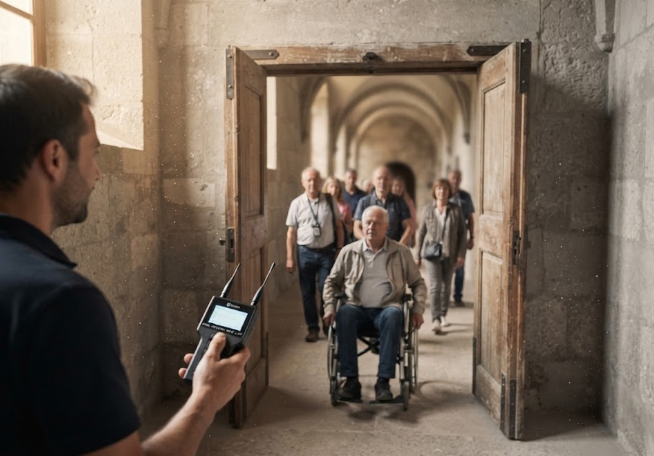
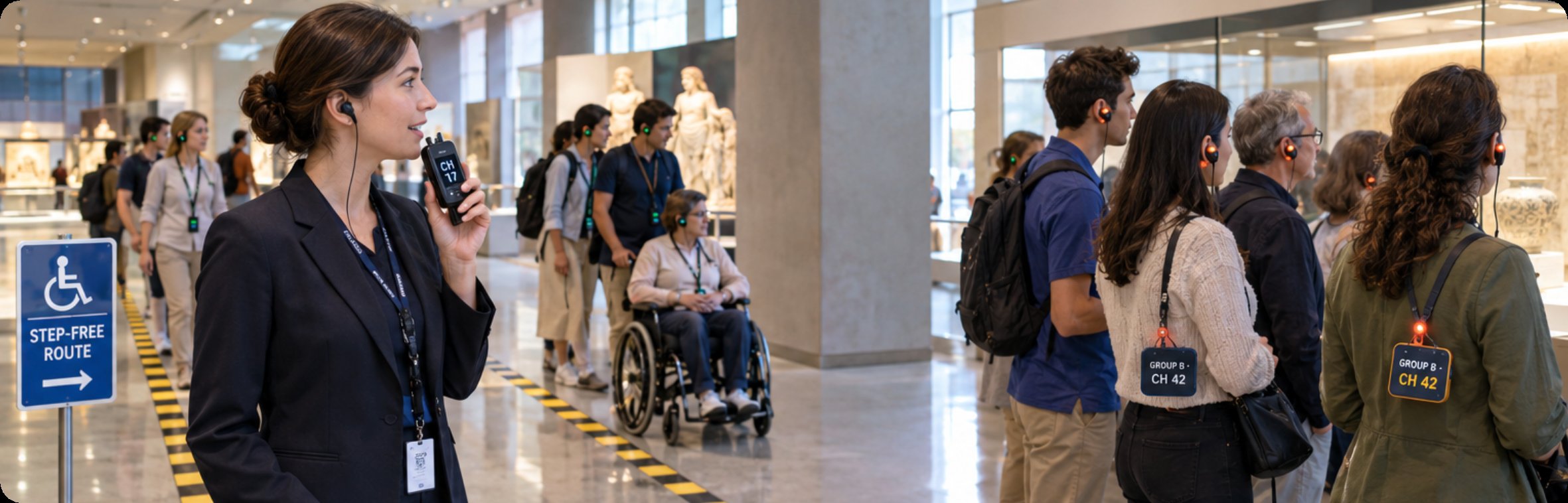
This is the failure that belongs to accessible tours and almost nowhere else. A step-free route rarely lets everyone travel together. One half takes the long way round while the other carries on, or the group is fed through in batches because the space will not hold them all at once. The two halves are now physically apart, sometimes by more than the audio can cover, and the guide is standing in only one of them.

The decision to make is not which batch goes first. It is whether both halves are meant to hear the same commentary. If they are, they belong on one channel and the route needs a fixed regrouping point where the guide waits. If they are not, each batch needs its own channel and its own guide, and the second batch hears the explanation a second time instead of hearing it late. Settling that in advance costs nothing. Settling it in a doorway costs the tour.

There is also a range question hiding inside the split. Two halves in the same building may be 40 metres apart and perfectly audible; the same two halves on an outdoor route can be 300 metres apart with a stone wall between them. Measure the split before you choose, rather than after the first complaint.

When the Sound Arrives and Still Fails

The third failure looks like success on the equipment side. The audio is arriving, the channel is correct, every receiver is live, and the visitor still does not follow what is being said. The causes sit on the person rather than on the radio. A headset that rests over a hearing aid, a single ear cup chosen out of habit, or a speaker who moves faster than the listener can absorb all produce the same result.

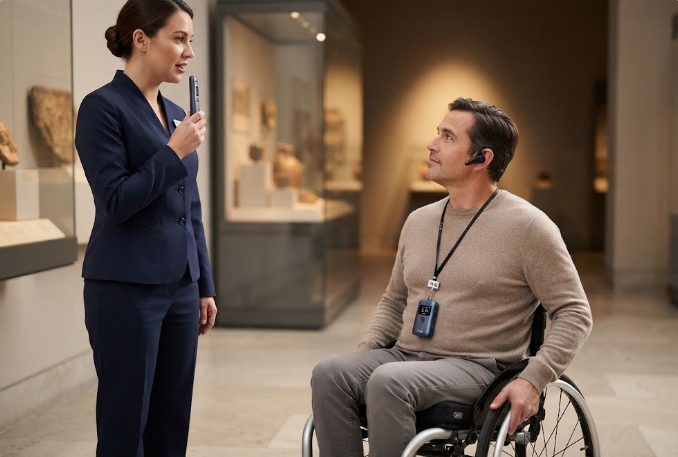
Two habits clear most of it. First, hand the receiver over and watch it being fitted, rather than handing it over and walking away. Second, build one pause into every stop, a moment where nothing new is introduced. That pause is where a visitor who needs longer to process catches up, and it is also where a companion who has been quietly repeating everything stops having to.

The practical answer is a small swap station rather than a table of spares: two or three headset styles laid out where the group forms up, so a visitor can change their own fit in seconds. It costs one extra bag and removes the most common complaint of the day.

What the group reportsWhich end explains itFirst thing to check on siteWhat not to do
Nobody hears anything, including the guideSpeaker sideChannel lock and transmitter batteryHand out spare receivers; the fault is not in them
Half the group goes quiet, and it follows the routeCoverage and the splitWhere the two halves separatedRaise the volume; distance, not level, is the problem
Everyone hears it and nobody followsFit and pacingHow the headset was put onAdd a second earpiece to cover it up

RC2406: Keeping Two Groups Apart in One Room

The RC2406 answers the split directly. It carries 80 channels with PLL frequency locking, enough to keep two batches of one tour, plus a second tour, inside the same gallery without any of them bleeding into another. It runs on the 2403-2483MHz ISM band, so nothing has to be licensed before the visit, and it reaches up to 200 metres in open area. One transmitter feeds multiple receivers.

The remaining numbers are about lasting a whole day. A 1500mAh lithium battery is rated for continuous use across the visit, the transmitter weighs 50g, and the housing is IPX4 splash resistant, which matters on a route that passes a wet entrance or an outdoor section. It is RoHS compliant and carries a three-year warranty covering the mainboard, with headset, microphone and battery listed as wear parts.
RC2406-accessible_tour

RC2468: The Unit That Has to Outlast the Longest Day

A route that runs outdoors asks a different question. The RC2468 puts 50 channels on the same 2.4GHz ISM band and reaches 1-200 metres in open area, and it is rated as usable through walls and obstacles. That last property is the one that keeps a batch audible when it has gone around the outside of a building instead of through it.

Its two batteries are quoted separately: the transmitter at 1500mAh for 12 hours of talk time, the receiver at 300mAh for 10 hours of use. The transmitter weighs 59g and the receiver 18g, which is the figure that decides whether someone keeps it on all afternoon. Audio is quoted at 50Hz-200kHz with a 10mW receiver output, charging is Micro USB 5V/1A, and certification covers CE, EMC, LVD, RED and RoHS.

RC2468-accessible_tour

RC2501: For the Listener Who Cannot Adjust Anything

The RC2501 is built around the visitor who will not stop mid-route to hunt through a menu. Pairing is one-click and operation is described as zero-threshold, so a receiver can be handed over and used without a briefing. Multi-group independent transmission keeps separate batches cleanly apart, and a smart noise-canceling microphone filters the room before the voice is ever transmitted.

It measures 86mm x 50mm x 19mm, covers up to 200 metres in open areas with the signal holding through obstacles, and is rated from -10°C to 45°C. Certification is CE and RoHS compliant, on the same three-year warranty. Two figures other units quote are absent from this page, namely weight and battery capacity, so nothing is quoted here rather than estimated from a sibling model.

RC2501-accessible_tour

What Each Unit Actually Changes

The three units separate on the fields they all publish:

ModelFrequency bandEffective rangeCertifications
RC24062403-2483MHz, 2.4GHz ISM, license-freeUp to 200 m in open areaRoHS compliant
RC24682403-2483MHz, 2.4GHz ISM, license-free1-200 m in open area; usable through wallsCE, EMC, LVD, RED, RoHS
RC25012.4GHz ISM bandUp to 200 m in open area; holds through obstaclesCE, RoHS compliant

Channel counts, weight, battery capacity and ingress protection are deliberately left out of that table. The three product pages do not all publish them, and a column with gaps invites a comparison the published data cannot support. Every figure above is taken word for word from the model's own page on the wireless tour guide system line.

🔍 When the Fix Is to Change the Route

There is a point where no hardware change will help and the honest answer is that the itinerary is producing the fault. If a step-free section forces two batches through at a spot where the guide has something essential to say, move that explanation to the far side of the section and let both batches travel it in silence. Pre-issue receivers during the greeting rather than at the doorway. Place the guide at the junction instead of inside the first batch, so both halves can see where to come back to. And if the same section produces the same complaint on visit after visit, treat it as a route fault and redesign that stretch rather than buying another receiver.

Fifteen minutes of planning removes more failures than any upgrade. If you are still choosing a band before the route is drawn, the two frequency bands compared here cover the trade-off between reach in open space and signal through stone. Once the band is settled, an accessible tour comes down to the three faults above, and to knowing which one you are actually looking at before anyone reaches for a spare.


2026年09月16日 09:34
click: 14

RC2406, RC2468 and RC2501: Three Ways an Accessible Tour Loses Its Audio

time: 2026年09月16日 click:14

An accessible tour fails in ways a standard group never sees. The route is built around a step-free path, which means the group is often moved in batches, and one batch is always waiting while the other listens. When the audio goes wrong on a route like that, the instinct is to reach for a spare receiver. It is almost always the wrong move, because what you are looking at is one of three completely different faults, and they share almost no causes. The work starts with deciding which of the three you have.

When the Speaker Side Fails Before Anyone Notices

This is the easiest failure to miss, because the guide is the last person in the group to notice it. A guide hears their own voice directly, so they keep talking at full confidence while the transmitter sits on a channel nobody is listening to, or on a battery that has already given up. On a step-free route the guide also tends to speak more quietly and closer to the listener, which removes the raised voice that would normally give the problem away.

Before touching anything else, confirm that the transmitter is locked to the same channel as the receivers in the group and that its indicator shows a live battery. Then check the microphone itself. Most of these incidents are not radio problems at all. They are a loose headset cable, a muted capsule, or a transmitter that was switched on and then put down while the pairing tone was still running. If your venue runs regular museum tour solutions, this check takes under a minute and saves the whole walk.

When the Route Splits the Group in Two

This is the failure that belongs to accessible tours and almost nowhere else. A step-free route rarely lets everyone travel together. One half takes the long way round while the other carries on, or the group is fed through in batches because the space will not hold them all at once. The two halves are now physically apart, sometimes by more than the audio can cover, and the guide is standing in only one of them.

The decision to make is not which batch goes first. It is whether both halves are meant to hear the same commentary. If they are, they belong on one channel and the route needs a fixed regrouping point where the guide waits. If they are not, each batch needs its own channel and its own guide, and the second batch hears the explanation a second time instead of hearing it late. Settling that in advance costs nothing. Settling it in a doorway costs the tour.

There is also a range question hiding inside the split. Two halves in the same building may be 40 metres apart and perfectly audible; the same two halves on an outdoor route can be 300 metres apart with a stone wall between them. Measure the split before you choose, rather than after the first complaint.

When the Sound Arrives and Still Fails

The third failure looks like success on the equipment side. The audio is arriving, the channel is correct, every receiver is live, and the visitor still does not follow what is being said. The causes sit on the person rather than on the radio. A headset that rests over a hearing aid, a single ear cup chosen out of habit, or a speaker who moves faster than the listener can absorb all produce the same result.

Two habits clear most of it. First, hand the receiver over and watch it being fitted, rather than handing it over and walking away. Second, build one pause into every stop, a moment where nothing new is introduced. That pause is where a visitor who needs longer to process catches up, and it is also where a companion who has been quietly repeating everything stops having to.

The practical answer is a small swap station rather than a table of spares: two or three headset styles laid out where the group forms up, so a visitor can change their own fit in seconds. It costs one extra bag and removes the most common complaint of the day.

What the group reportsWhich end explains itFirst thing to check on siteWhat not to do
Nobody hears anything, including the guideSpeaker sideChannel lock and transmitter batteryHand out spare receivers; the fault is not in them
Half the group goes quiet, and it follows the routeCoverage and the splitWhere the two halves separatedRaise the volume; distance, not level, is the problem
Everyone hears it and nobody followsFit and pacingHow the headset was put onAdd a second earpiece to cover it up

RC2406: Keeping Two Groups Apart in One Room

The RC2406 answers the split directly. It carries 80 channels with PLL frequency locking, enough to keep two batches of one tour, plus a second tour, inside the same gallery without any of them bleeding into another. It runs on the 2403-2483MHz ISM band, so nothing has to be licensed before the visit, and it reaches up to 200 metres in open area. One transmitter feeds multiple receivers.

The remaining numbers are about lasting a whole day. A 1500mAh lithium battery is rated for continuous use across the visit, the transmitter weighs 50g, and the housing is IPX4 splash resistant, which matters on a route that passes a wet entrance or an outdoor section. It is RoHS compliant and carries a three-year warranty covering the mainboard, with headset, microphone and battery listed as wear parts.

RC2406-accessible_tour

RC2468: The Unit That Has to Outlast the Longest Day

A route that runs outdoors asks a different question. The RC2468 puts 50 channels on the same 2.4GHz ISM band and reaches 1-200 metres in open area, and it is rated as usable through walls and obstacles. That last property is the one that keeps a batch audible when it has gone around the outside of a building instead of through it.

Its two batteries are quoted separately: the transmitter at 1500mAh for 12 hours of talk time, the receiver at 300mAh for 10 hours of use. The transmitter weighs 59g and the receiver 18g, which is the figure that decides whether someone keeps it on all afternoon. Audio is quoted at 50Hz-200kHz with a 10mW receiver output, charging is Micro USB 5V/1A, and certification covers CE, EMC, LVD, RED and RoHS.

RC2468-accessible_tour

RC2501: For the Listener Who Cannot Adjust Anything

The RC2501 is built around the visitor who will not stop mid-route to hunt through a menu. Pairing is one-click and operation is described as zero-threshold, so a receiver can be handed over and used without a briefing. Multi-group independent transmission keeps separate batches cleanly apart, and a smart noise-canceling microphone filters the room before the voice is ever transmitted.

It measures 86mm x 50mm x 19mm, covers up to 200 metres in open areas with the signal holding through obstacles, and is rated from -10°C to 45°C. Certification is CE and RoHS compliant, on the same three-year warranty. Two figures other units quote are absent from this page, namely weight and battery capacity, so nothing is quoted here rather than estimated from a sibling model.

RC2501-accessible_tour

What Each Unit Actually Changes

The three units separate on the fields they all publish:

ModelFrequency bandEffective rangeCertifications
RC24062403-2483MHz, 2.4GHz ISM, license-freeUp to 200 m in open areaRoHS compliant
RC24682403-2483MHz, 2.4GHz ISM, license-free1-200 m in open area; usable through wallsCE, EMC, LVD, RED, RoHS
RC25012.4GHz ISM bandUp to 200 m in open area; holds through obstaclesCE, RoHS compliant

Channel counts, weight, battery capacity and ingress protection are deliberately left out of that table. The three product pages do not all publish them, and a column with gaps invites a comparison the published data cannot support. Every figure above is taken word for word from the model's own page on the wireless tour guide system line.

🔍 When the Fix Is to Change the Route

There is a point where no hardware change will help and the honest answer is that the itinerary is producing the fault. If a step-free section forces two batches through at a spot where the guide has something essential to say, move that explanation to the far side of the section and let both batches travel it in silence. Pre-issue receivers during the greeting rather than at the doorway. Place the guide at the junction instead of inside the first batch, so both halves can see where to come back to. And if the same section produces the same complaint on visit after visit, treat it as a route fault and redesign that stretch rather than buying another receiver.

Fifteen minutes of planning removes more failures than any upgrade. If you are still choosing a band before the route is drawn, the two frequency bands compared here cover the trade-off between reach in open space and signal through stone. Once the band is settled, an accessible tour comes down to the three faults above, and to knowing which one you are actually looking at before anyone reaches for a spare.
×

Contact us

email:
name:
subject:
content: