.webp)

Most installation guides assume the system will still be there next year. An investor visit is the opposite case. The equipment arrives, works for four hours, and leaves the same afternoon. That single fact changes what matters during setup. There is no second day to diagnose a dead receiver, no quiet morning to re-pair a channel, and no chance to walk the route again once the first car has passed the gate. What follows is the sequence I would run for a one-day visit, and where each of three devices earns its place in it.
Why No Second Day Changes the Plan
A permanent installation is forgiving. If a receiver will not pair, you fix it at lunchtime and nobody outside the building ever knows. A one-day visit is unforgiving in the same proportion. Every fault has to be found before the first visitor is handed a device, because the moment the programme starts, nobody on the team can stop it to swap hardware. The practical consequence is that the setup order reverses. On a permanent job you build first and test afterwards. On a one-day job you decide what must come back and how you will count it, and only then decide what goes out. The count is the constraint the rest of the plan has to fit inside.
The Gap Between the Night Shift and the Door Opens
There is a window in every plant between the end of the night shift and the arrival of the first visitor. It is longer than it feels. The mistake is spending it on pairing, which is the slowest thing in the whole setup, and the thing most likely to be interrupted by someone asking where the coffee is. Pairing, charging, receiver numbering and case loading all belong to the day before. What the window is for is position, not configuration: transmitters into the hands of the people who will speak, spares into the room where the visit ends, and one person walking the route to confirm the boundaries still hold with the morning's machinery running. If your programme covers several buildings or production areas, the same reasoning behind a scheduled factory tour setup applies here, just compressed into a single morning.
Dry Run Before Anything Leaves the Case Room
Run the whole chain once, indoors, while everything is still in cases. Transmitter on, receiver on, earpiece in, walk twenty metres and confirm the audio is where you expect it. What this catches is not usually a broken unit. It is a channel that was written down wrongly, a receiver from last month's event that was never re-paired, and the two or three units that were charged on a cable nobody checked. A dry run costs twenty minutes indoors and saves the version of the same fault that happens in front of thirty investors at nine fifteen. The rule I would keep is simple: nothing leaves the case room until it has been heard once.
The Device for a Speaker Who Cannot Repeat Himself
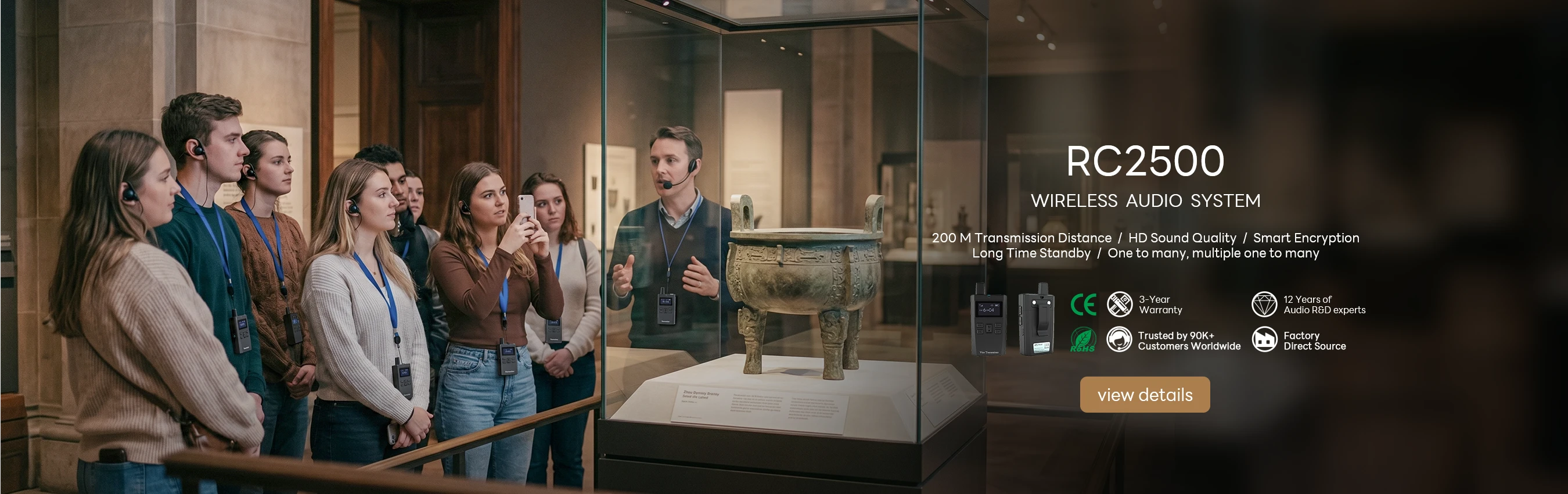
Investor visits put an unusual demand on audio. The person speaking is often senior enough that they will not repeat a sentence for a receiver that missed it, and the questions from the floor are the part of the visit that cannot be reconstructed afterwards. This is where a system built on independent multi-group transmission earns its place, because the interference that ruins these sessions is rarely distance. It is the second group in the same room. The RC2501 wireless receiver runs on the 2.4GHz ISM band with a smart noise-canceling microphone, measures 86 by 50 by 19 millimetres, and holds its link to 200 metres in open areas. In a room with machinery running next door and people moving between two groups, that combination is what keeps a mid-sentence question audible to the people who need it.

When Signal Must Get Past Steel
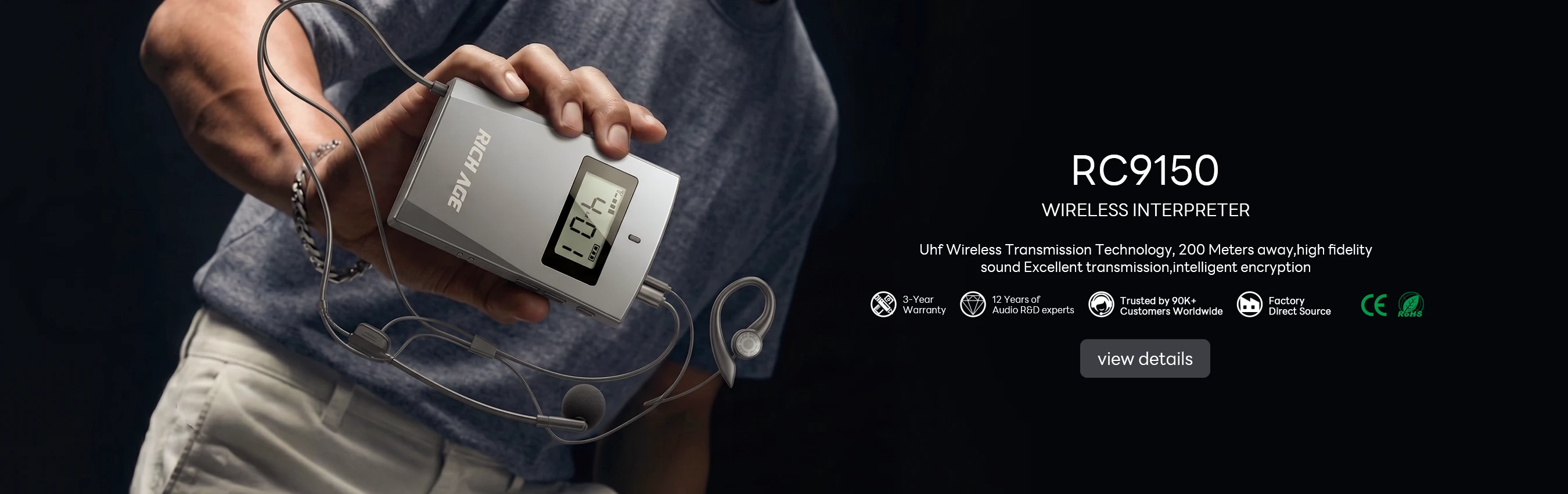
The moment a visit moves from a meeting room into a production hall, the radio problem changes character. Steel frames, machinery housings and dense racking do not simply weaken a 2.4GHz link; they reflect it, and a walkway that looks open on a floor plan can behave like a corridor of mirrors. UHF behaves differently. The RC085 digital transmitter uses the 470 to 510MHz band with GFSK modulation, which tolerates obstructions that stop a higher band, and its LCD screen gives the person carrying it something the rest of the route cannot: a visible confirmation of the channel and mode currently in use. It also supports both F1 one-way broadcast and F2 two-way conversation, which matters when a floor manager joins the walkthrough to answer a question without a handover.

Receiver That Outlasts the Itinerary
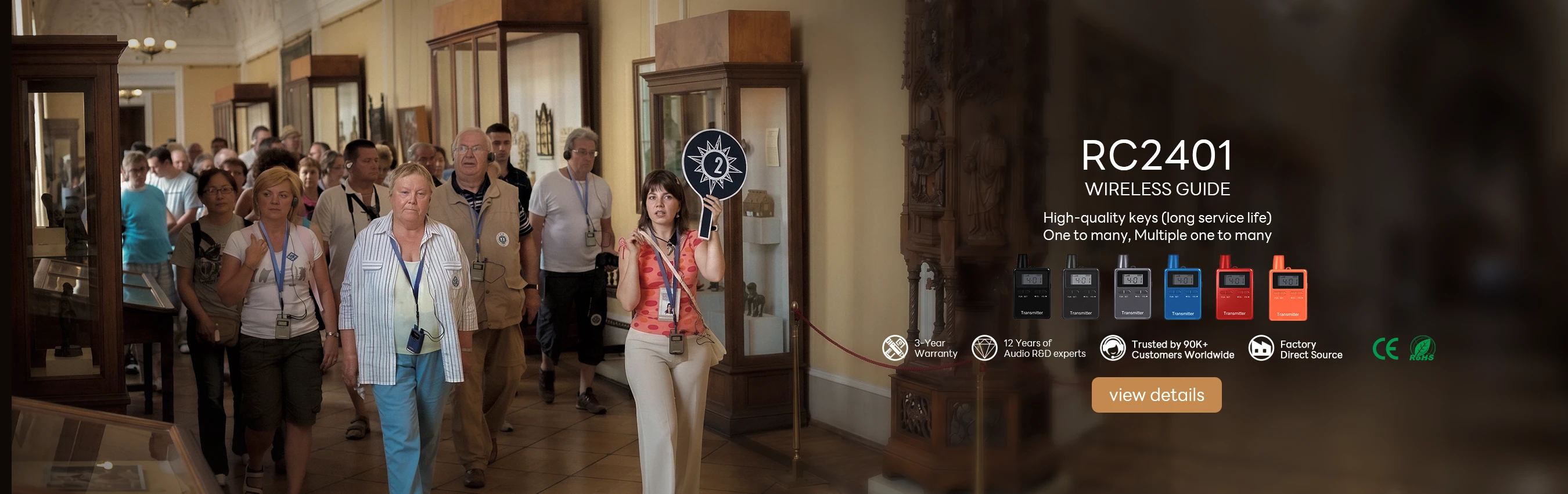
An investor visit has a habit of growing after the invitation list is fixed. Board members arrive, an advisor brings a colleague, and a group planned at twenty is suddenly working with a second transmitter and a second set of receivers that were never in the schedule. Growth is manageable if battery is not the limit. The RC2402 receiver is quoted at twenty hours per charge with ten on the transmitter, runs on the licence-free 2403 to 2483MHz band, and pairs to a transmitter with one click rather than a menu. Intelligent encryption keeps a late-added group from drifting onto another group's channel, and the CE, EMC, LVD, RED and RoHS listings mean the same set travels to a visit outside the country without a separate approval conversation.
The Tally at the Demob Table
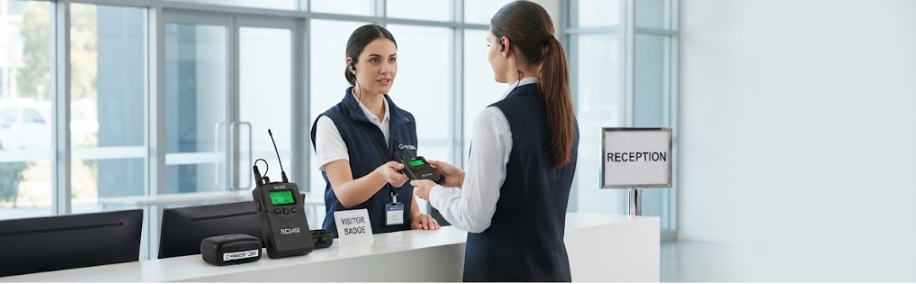
Collection is where one-day visits go wrong quietly. A receiver left in a car park is not discovered until the next booking, and by then nobody remembers who had it. The fix costs nothing. Sign out against a name, sign in against the same name, and run the count at the table rather than at the warehouse. Earpieces are the part that goes missing, so they should be counted with the receiver they were issued with, not separately. The display on the transmitter matters here too, because a receiver still switched on and transmitting somewhere in the building is a channel occupied for the next group. A set that is packed in pairs and counted in pairs is faster to check than one packed by model, which is the argument for keeping a tour guide system range that shares its accessories across models.
What Gets Written Down Before the Van Leaves
The last task belongs to nobody in particular, which is why it is usually skipped. Ten minutes with a notebook before the van leaves is worth more than any post-event email. Which channels were used, and which one was abandoned partway through. Which part of the route produced the first question about volume. How many spares were actually consumed. Whether the second transmitter was needed, and at what point. That page becomes the starting plan for the next visit, and it is the only record of a system that has already been packed away. Plenty of the same reasoning shows up in our wireless tour guide system cases, where a single day's deployment is described the way it actually ran.
What Each Device Has to Cover
| Item | RC2501 | RC085 | RC2402 |
|---|---|---|---|
| Core frequency band | 2403 to 2483MHz | 470 to 510MHz | 2403 to 2483MHz |
| Number of channels | 50 | 100 | 50 |
| Transmission distance | 1 to 200 metres | 1 to 200 metres | 1 to 200 metres |
| Output power | 13mW | 8 to 10mW | 10mW |
| Transmitter battery life | 25 hours | 12 hours | 10 hours |
| Receiver battery life | 40 hours | 20 hours | 20 hours |
| Transmitter weight | 61 g | 60 g | 59 g |
| Receiver weight | 52 g | 65 g | 50 g |
| Control mode | PLL frequency synthesis | PLL frequency synthesis | PLL frequency synthesis |
| Charging port | Type-C | USB | DC |
These figures come from the model comparison sheet our product team maintains, so the three columns are measured the same way rather than pulled from three different datasheets. Two of them matter more than the rest on a one-day visit. The receiver on the smallest of the three is rated at forty hours against twenty-five on its own transmitter, the widest spread of the set, so receivers cover a rehearsal plus a full day without a top-up. The UHF unit carries a hundred channels against fifty on the other two, and that headroom is what lets a second group stay on its own channel when the visitor list outgrows the invitation. Warranty on all three covers the mainboard over three years, with earpieces, microphones and batteries treated as consumables, so a spare earpiece is a stocking item rather than a claim.
The Morning, Hour by Hour
| Window | What happens | Why it cannot move later |
|---|---|---|
| Day before | Charge, pair, label and load receivers | Pairing is the slowest task and the easiest to interrupt |
| Early morning | Dry run indoors with the full chain | A fault found here costs minutes, not the opening session |
| Night shift ends | Transmitters to speakers, spares to the end point | Speakers become unavailable once their own programme starts |
| Before the gate | Walk the route, confirm channels still hold | Machinery state changes the radio environment |
| After the visit | Tally at the demob table, then write the notes | Nobody remembers the details a day later |
A one-day visit is not a smaller version of a permanent installation. It is a different job, and the parts that matter most are the ones that happen before anyone arrives and after everyone has gone. If your team is setting up a visit like this, the starting point is not a hardware list but a count: how many devices go out, how many come back, and who is holding each one in between.