A leading China factory specializing in Wireless Tour Guide Systems, Church Audio Guides, and Translation Headphones with premium OEM/ODM solutions.

Tel:+86 18922879583

Email:tiger.wang@richitek.com

RC2402, RC2500 and RC2468: Walking a Winery Route When the Harvest Crowd Arrives

Every estate has a fortnight that decides the year's reputation, and it is never the quiet one. Harvest brings the pickers at dawn, the trade buyers at eleven, the public tours all afternoon and the private tasting at six, and by the second day the visitor route is no longer a route at all — it is a rota of groups sharing the same footpaths, the same crush hall and the same cellar steps. I have watched guides lose a group at the top of a vine row simply because a tractor started up between them.

Wineries are an unusual case for a wireless tour guide system, because the walk is long, the noise changes four times between the gate and the tasting room, and the visitor is already carrying a glass. This is a look at how three Richitek units divide the job across that walk, and at what has to be settled before the busiest fortnight begins. If you already run guided visits on production sites, the same logic applies to winery and production-site tour solutions more generally.

Why Harvest Week Reads Differently to a Headset

The mistake most estates make is planning for headcount. Volume is rarely what breaks a harvest tour; overlap does. Four groups of fifteen spread across a morning will each have a worse experience than one group of sixty, because the problem is never how loud the guide is — it is how many guides are speaking inside the same stone building at the same time. Channel separation, not amplifier power, is what the week actually tests. All three units here carry fifty channels with PLL synthesis, which is the baseline you should expect before you look at anything else in the specification.

The Outdoor Stretch Is Where Voices Disappear

Between the gate and the crush hall there is a stretch of open vine rows, and it behaves nothing like a room. Wind moves across the canopy, the group strings out over thirty or forty metres, and the guide at the front has no way of knowing whether the person at the back is still with them. A RC2402 transmitter and receiver set is the sensible default here: ten hours on the transmitter and twenty on the receiver will cover a full day of outdoor walking without a charging window, the working range runs to two hundred metres in open ground, and the unit is light enough that a guide can carry it through four or five circuits and forget it is there. Pairing is a single button press rather than a menu, which matters when you are training seasonal staff who will use the kit for six weeks and then hand it back.
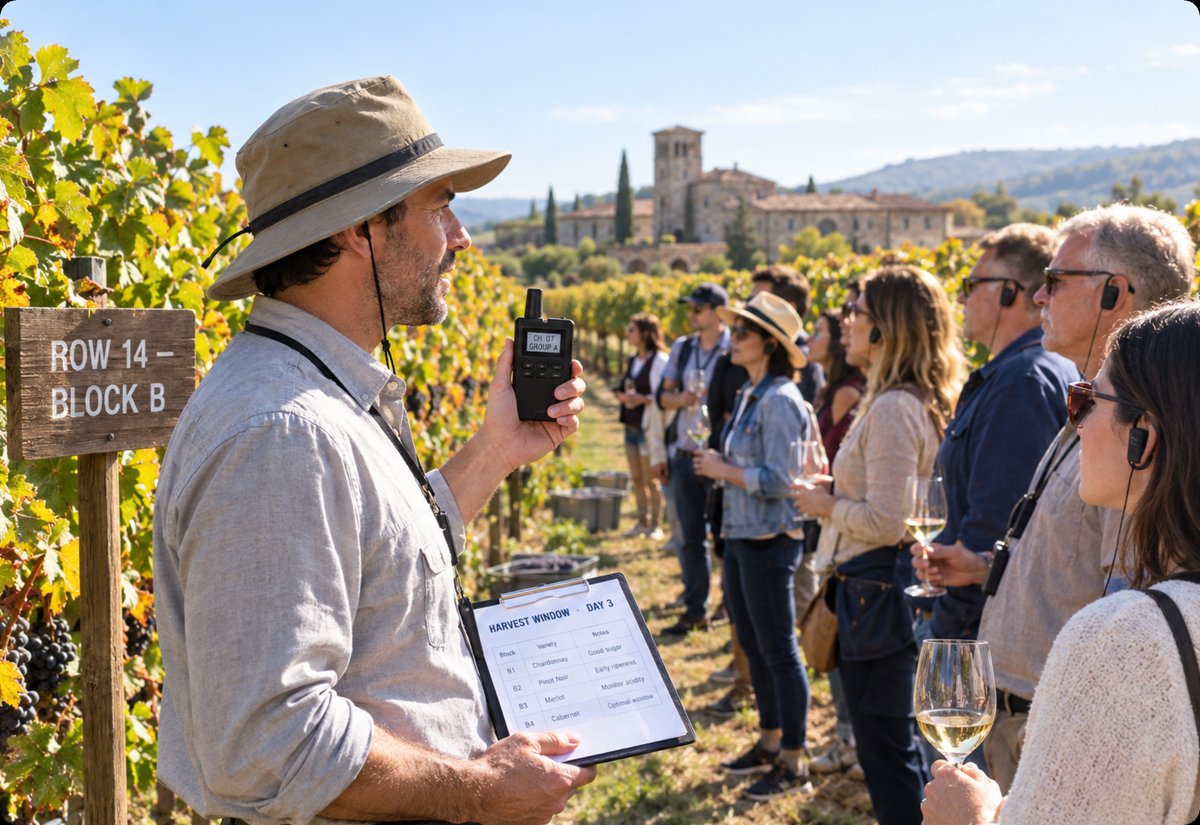
RC2402-winery_brewery_tour

Inside the Crush Hall, Nothing Sits Still

The crush hall is the opposite environment: enclosed, hard-surfaced, full of stainless steel, and running machinery throughout the tour window. Moving parts generate broadband noise, and the guide's voice has to travel over it without the receiver clipping or hissing. This is where a RC2500 earns its place. It runs fifty PLL channels, fifteen hours on the transmitter and more than thirty-five on the receiver, and its working temperature band stretches from fifteen below zero to fifty degrees, which is the sort of range you want in a building that goes from chilled tank room to warm loading bay within a single group's walk. Battery capacity on both halves is 1800 mAh, so the set is not the thing that ends your day.

RC2500-winery_brewery_tour

A Cellar Rewards Discipline and Punishes Volume

Underground, the acoustics invert. A barrel cellar is damp, curved and lined with wood and stone, and it carries sound much further than the crush hall does. The instinct to raise your voice is exactly wrong down there, because the guide on the next route will be audible through the wall whether or not anyone is listening to them. Two habits solve most of it: keep channels strictly assigned per route rather than per guide, and never let two groups converge in the same barrel bay at the same time. A system with clean channel separation and no crosstalk lets a guide speak at normal conversational level, which is both easier on the voice and quieter for the group ahead.

The Tasting Room Is the Quietest Test of All

The final room looks like the easiest and is usually the hardest. It is small, the floor is hard, the visitor is stationary and attentive, and the ambient noise floor is close to nothing — so any hiss, breakthrough or channel bleed that was masked all the way down the route suddenly becomes the only thing anyone can hear. It is also the room where several tours are most likely to be running at once, because tastings are booked back to back and a delayed group will overlap with the next arrival. Book the tasting slots and the channel numbers together, not separately; the pair is what protects the room.

How Many Groups Fit in One Day

Once the route is settled, the week is a battery arithmetic question, and this is where the three units separate rather than converge. Receiver runtime is the limiting factor, because receivers stay with visitors from the first group to the last while transmitters can be rotated at a station.

SpecificationRC2402RC2500RC2468
Transmitter runtime10 h15 h10 h
Receiver runtime20 h35+ h8 h approx.
Transmitter battery1500 mAh1800 mAh1500 mAh
Receiver battery1000 mAh1800 mAh300 mAh
Transmitter weight59 g104 g59 g
Receiver weight50 g104 g18 g ear-hook
Charging portDCType-CUSB

Read the receiver runtime row as a scheduling constraint, not a ranking. A twenty-hour receiver comfortably covers a two-session day with charging between groups; an eight-hour receiver does not, and if you plan three back-to-back tastings on the light unit you will be swapping units mid-afternoon. The two longer-runtime models exist precisely so that a full harvest diary can be run on a single charge cycle.

The Receiver Nobody Notices After Ten Minutes

Weight is the specification nobody puts in a brochure and everybody notices by the second hour. A hundred and four grams hanging on a visitor's neck through a long outdoor walk becomes a complaint; eight grams does not register at all. The RC2468 takes that logic as far as it goes, with an eighteen-gram ear-hook receiver and a fifty-nine gram transmitter. It carries the same fifty channels and the same two-hundred metre working range as the heavier units, charges over micro USB, and pairs on a single touch. What it trades away is receiver runtime — roughly eight hours per charge from a 300 mAh cell — so it suits the long walking route where comfort matters more than session count, and it suits a fleet that is happy to charge between groups. The full wireless tour guide system range is worth comparing against your own rota before you commit to a single model across every route.
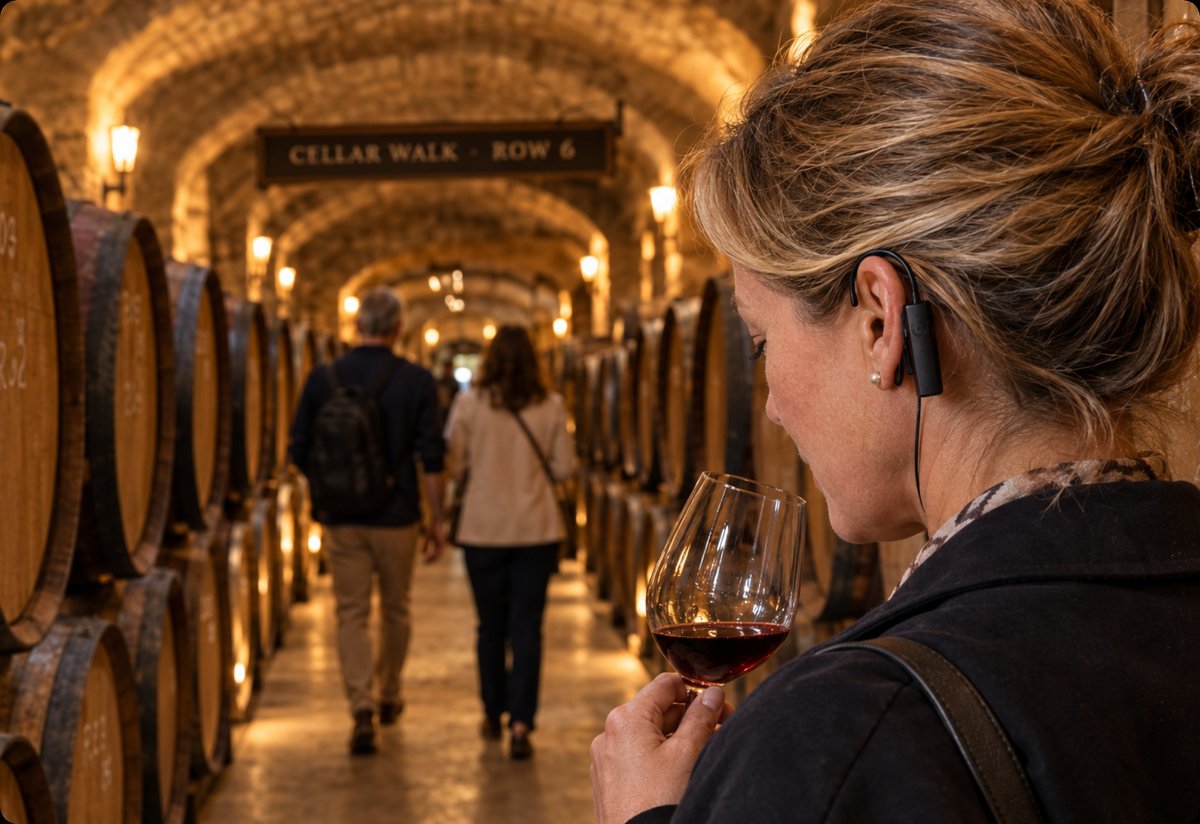
RC2468-winery_brewery_tour

The Decisions That Cannot Wait Until Morning

Two weeks before the crowds, three things are worth locking. Assign a channel to each route rather than each guide, so a staffing change on the morning does not force a re-plan. Count your receivers against your largest single session and then add a spare set per route, because a dead unit found at the gate is a group standing in the sun. And check the charging logistics: a Type-C or USB bay can be run from a laptop bank at the guide station, while a DC set needs its own adapters and a socket you have actually tested. Estates that get through harvest without a complaint are not the ones with the loudest equipment; they are the ones whose equipment was already counted, charged and assigned before the first bus arrived.

If you would like to see how operators on other multi-group sites have laid out their routes and charging stations, our wireless tour guide system case studies walk through the arrangements in detail.

If you are planning the coming season and want a channel plan, a battery count and a recommended model mix for your own estate, tell us the length of your route and the size of your largest group. We will put the numbers together and come back with a configuration you can run in the week that matters most.

2026年09月17日 09:16
click: 12

RC2402, RC2500 and RC2468: Walking a Winery Route When the Harvest Crowd Arrives

time: 2026年09月17日 click:12

Every estate has a fortnight that decides the year's reputation, and it is never the quiet one. Harvest brings the pickers at dawn, the trade buyers at eleven, the public tours all afternoon and the private tasting at six, and by the second day the visitor route is no longer a route at all — it is a rota of groups sharing the same footpaths, the same crush hall and the same cellar steps. I have watched guides lose a group at the top of a vine row simply because a tractor started up between them.

Wineries are an unusual case for a wireless tour guide system, because the walk is long, the noise changes four times between the gate and the tasting room, and the visitor is already carrying a glass. This is a look at how three Richitek units divide the job across that walk, and at what has to be settled before the busiest fortnight begins. If you already run guided visits on production sites, the same logic applies to winery and production-site tour solutions more generally.

Why Harvest Week Reads Differently to a Headset

The mistake most estates make is planning for headcount. Volume is rarely what breaks a harvest tour; overlap does. Four groups of fifteen spread across a morning will each have a worse experience than one group of sixty, because the problem is never how loud the guide is — it is how many guides are speaking inside the same stone building at the same time. Channel separation, not amplifier power, is what the week actually tests. All three units here carry fifty channels with PLL synthesis, which is the baseline you should expect before you look at anything else in the specification.

The Outdoor Stretch Is Where Voices Disappear

Between the gate and the crush hall there is a stretch of open vine rows, and it behaves nothing like a room. Wind moves across the canopy, the group strings out over thirty or forty metres, and the guide at the front has no way of knowing whether the person at the back is still with them. A RC2402 transmitter and receiver set is the sensible default here: ten hours on the transmitter and twenty on the receiver will cover a full day of outdoor walking without a charging window, the working range runs to two hundred metres in open ground, and the unit is light enough that a guide can carry it through four or five circuits and forget it is there. Pairing is a single button press rather than a menu, which matters when you are training seasonal staff who will use the kit for six weeks and then hand it back.

RC2402-winery_brewery_tour

Inside the Crush Hall, Nothing Sits Still

The crush hall is the opposite environment: enclosed, hard-surfaced, full of stainless steel, and running machinery throughout the tour window. Moving parts generate broadband noise, and the guide's voice has to travel over it without the receiver clipping or hissing. This is where a RC2500 earns its place. It runs fifty PLL channels, fifteen hours on the transmitter and more than thirty-five on the receiver, and its working temperature band stretches from fifteen below zero to fifty degrees, which is the sort of range you want in a building that goes from chilled tank room to warm loading bay within a single group's walk. Battery capacity on both halves is 1800 mAh, so the set is not the thing that ends your day.

RC2500-winery_brewery_tour

A Cellar Rewards Discipline and Punishes Volume

Underground, the acoustics invert. A barrel cellar is damp, curved and lined with wood and stone, and it carries sound much further than the crush hall does. The instinct to raise your voice is exactly wrong down there, because the guide on the next route will be audible through the wall whether or not anyone is listening to them. Two habits solve most of it: keep channels strictly assigned per route rather than per guide, and never let two groups converge in the same barrel bay at the same time. A system with clean channel separation and no crosstalk lets a guide speak at normal conversational level, which is both easier on the voice and quieter for the group ahead.

The Tasting Room Is the Quietest Test of All

The final room looks like the easiest and is usually the hardest. It is small, the floor is hard, the visitor is stationary and attentive, and the ambient noise floor is close to nothing — so any hiss, breakthrough or channel bleed that was masked all the way down the route suddenly becomes the only thing anyone can hear. It is also the room where several tours are most likely to be running at once, because tastings are booked back to back and a delayed group will overlap with the next arrival. Book the tasting slots and the channel numbers together, not separately; the pair is what protects the room.

How Many Groups Fit in One Day

Once the route is settled, the week is a battery arithmetic question, and this is where the three units separate rather than converge. Receiver runtime is the limiting factor, because receivers stay with visitors from the first group to the last while transmitters can be rotated at a station.

SpecificationRC2402RC2500RC2468
Transmitter runtime10 h15 h10 h
Receiver runtime20 h35+ h8 h approx.
Transmitter battery1500 mAh1800 mAh1500 mAh
Receiver battery1000 mAh1800 mAh300 mAh
Transmitter weight59 g104 g59 g
Receiver weight50 g104 g18 g ear-hook
Charging portDCType-CUSB

Read the receiver runtime row as a scheduling constraint, not a ranking. A twenty-hour receiver comfortably covers a two-session day with charging between groups; an eight-hour receiver does not, and if you plan three back-to-back tastings on the light unit you will be swapping units mid-afternoon. The two longer-runtime models exist precisely so that a full harvest diary can be run on a single charge cycle.

The Receiver Nobody Notices After Ten Minutes

Weight is the specification nobody puts in a brochure and everybody notices by the second hour. A hundred and four grams hanging on a visitor's neck through a long outdoor walk becomes a complaint; eight grams does not register at all. The RC2468 takes that logic as far as it goes, with an eighteen-gram ear-hook receiver and a fifty-nine gram transmitter. It carries the same fifty channels and the same two-hundred metre working range as the heavier units, charges over micro USB, and pairs on a single touch. What it trades away is receiver runtime — roughly eight hours per charge from a 300 mAh cell — so it suits the long walking route where comfort matters more than session count, and it suits a fleet that is happy to charge between groups. The full wireless tour guide system range is worth comparing against your own rota before you commit to a single model across every route.

RC2468-winery_brewery_tour

The Decisions That Cannot Wait Until Morning

Two weeks before the crowds, three things are worth locking. Assign a channel to each route rather than each guide, so a staffing change on the morning does not force a re-plan. Count your receivers against your largest single session and then add a spare set per route, because a dead unit found at the gate is a group standing in the sun. And check the charging logistics: a Type-C or USB bay can be run from a laptop bank at the guide station, while a DC set needs its own adapters and a socket you have actually tested. Estates that get through harvest without a complaint are not the ones with the loudest equipment; they are the ones whose equipment was already counted, charged and assigned before the first bus arrived.

If you would like to see how operators on other multi-group sites have laid out their routes and charging stations, our wireless tour guide system case studies walk through the arrangements in detail.

If you are planning the coming season and want a channel plan, a battery count and a recommended model mix for your own estate, tell us the length of your route and the size of your largest group. We will put the numbers together and come back with a configuration you can run in the week that matters most.

×

Contact us

email:
name:
subject:
content: