A leading China factory specializing in Wireless Tour Guide Systems, Church Audio Guides, and Translation Headphones with premium OEM/ODM solutions.

Tel:+86 18922879583

Email:tiger.wang@richitek.com

RC2406, RC2401 and RC085: Which Kit Goes Ashore

The ship docks at seven and sails at five. In between, a party of forty has to be walked through a town, fed, brought back and counted, and the guide has to manage all of it while the harbour fills with three other vessels doing the same thing. There is no second attempt at a shore day. Either the group hears the commentary at the second stop, or that part of the itinerary is simply lost, and the coach waiting beyond the terminal will not hold its slot for long.

That is why choosing a wireless tour guide kit for shore days is not the same exercise as equipping a fixed venue. Three Rich Age units sit inside that decision — RC2401, RC2406 and RC085 — and two of them read almost identically on a spec sheet. What separates them only appears once you count how many parties walk at the same time, and once you ask which slice of the radio spectrum the port has already used up.

The Window Between the Gangway and the Coach

A shore day compresses everything a normal guided tour spreads across a morning. Guests clear the gangway in one wave, the party reforms on the pier, and the first commentary begins before the coach has finished loading. The setting makes the audio job harder rather than easier: open ground, no walls to keep a signal inside, and a crowd that drifts in and out of earshot at every photo stop. Teams that plan this well tend to start from city tour solutions rather than from a device list, because the shape of the day decides the hardware and not the other way round.

Two Machines That Differ by One Number

The RC2401 and the RC2406 are the two units most guides compare first, and the comparison is shorter than people expect. Both transmit between 2403 and 2483 MHz, both quote a working range of 1-200 m, both run a 10 mW output stage, ten hours on the transmitter and twenty on the receiver, and their handsets sit within a gram of each other on a scale. Read down the two columns and a single figure moves: channel count.
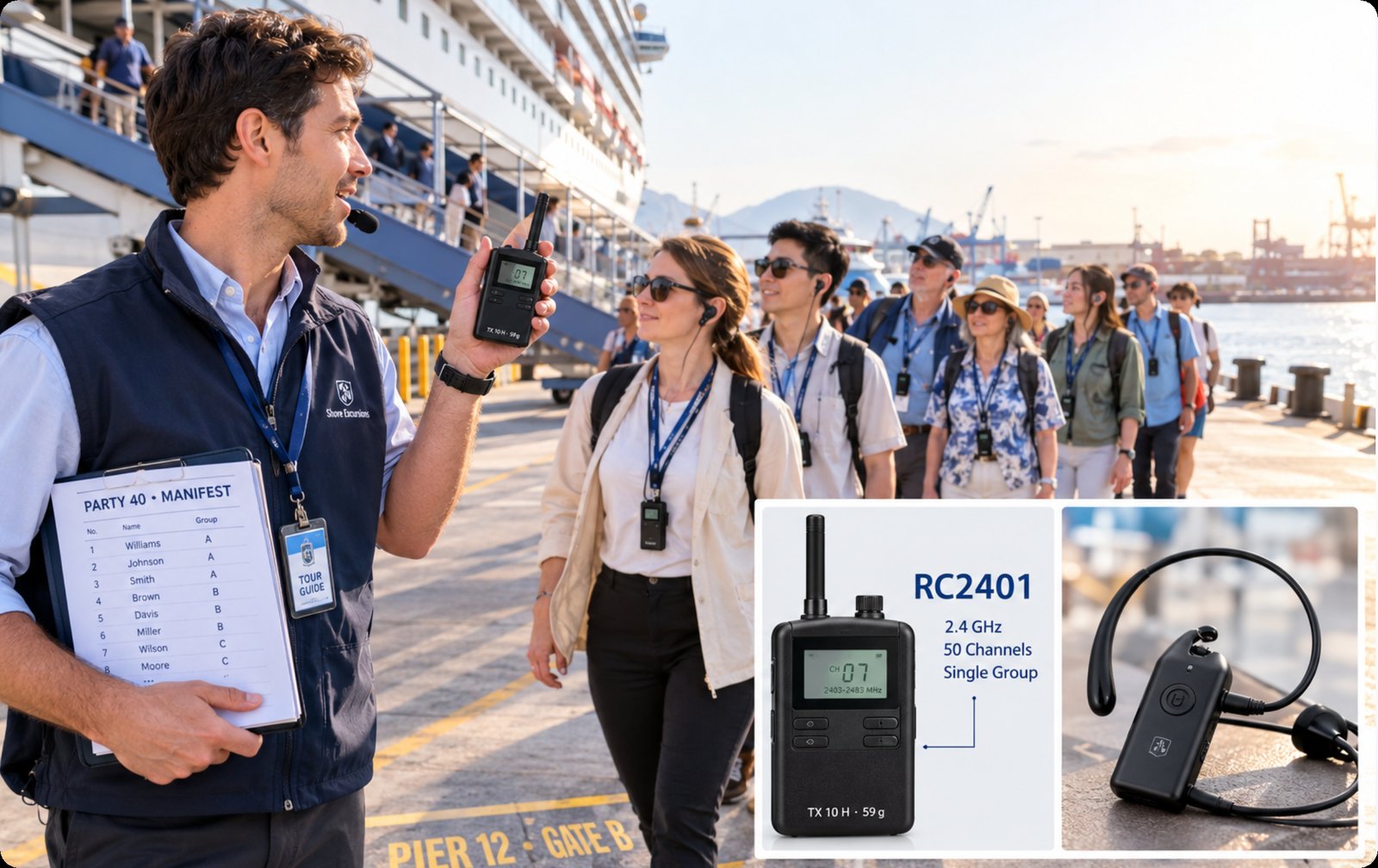
RC2401-cruise_shore_excursion

That one difference is not cosmetic. Fifty channels is plenty for one party with a translator, which is what the RC2401 was built around — a straightforward 2.4 GHz unit that a seasonal guide can hand out and explain in under a minute. Eighty channels buys something else entirely, and it only matters on the days when the pier is crowded.

Eighty Ways to Avoid Sharing a Channel

Ports are busy radio rooms. Every vessel in the harbour runs its own Wi-Fi, the terminal building has access points on both floors, and if three tour operators are disembarking at eight in the morning, three sets of transmitters are competing for the same air. The practical question is not whether interference exists, but how many clean slots you have left once it does. The RC2406 answers with eighty channels against fifty, which is the headroom that lets four or five parties walk the same route in the same hour without stepping on one another.
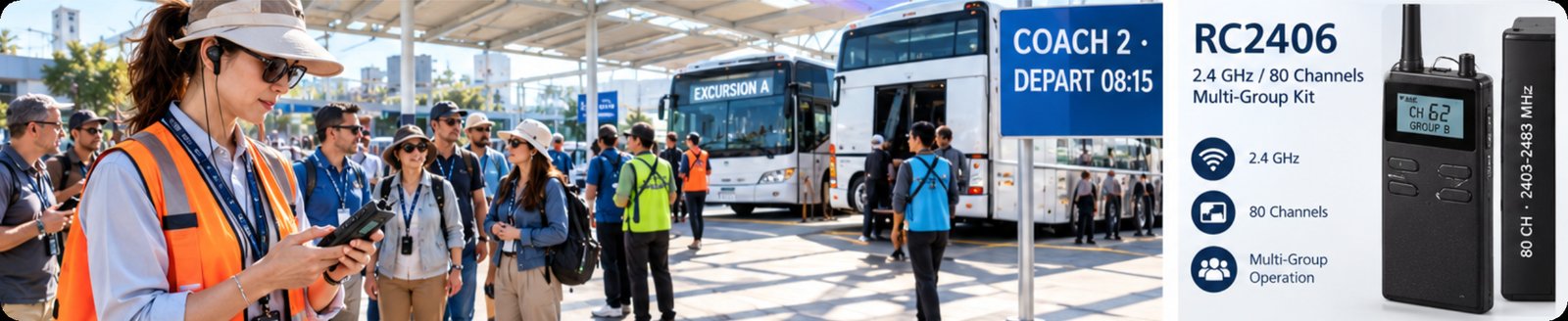
RC2406-cruise_shore_excursion

It is worth being precise about what that headroom buys. Two parties on the same frequency will hear each other, and the failure is not gradual — the second group simply receives the wrong commentary. A company running two coaches out of one terminal has to budget channels before it budgets anything else. The RC2406 is the unit that keeps that arithmetic comfortable.

The Kit That Steps Off 2403-2483 MHz

The RC085 is the odd one out, and it is odd in the most useful way. It does not transmit in the 2.4 GHz range at all; it works between 470 and 510 MHz. In a harbour where the crowded band is exactly the one everyone else is using, leaving it is a genuine strategy rather than a specification detail. The unit also carries a hundred channels, which is the largest count in the three-way comparison, so a large operation can keep its groups apart without negotiating with anyone.
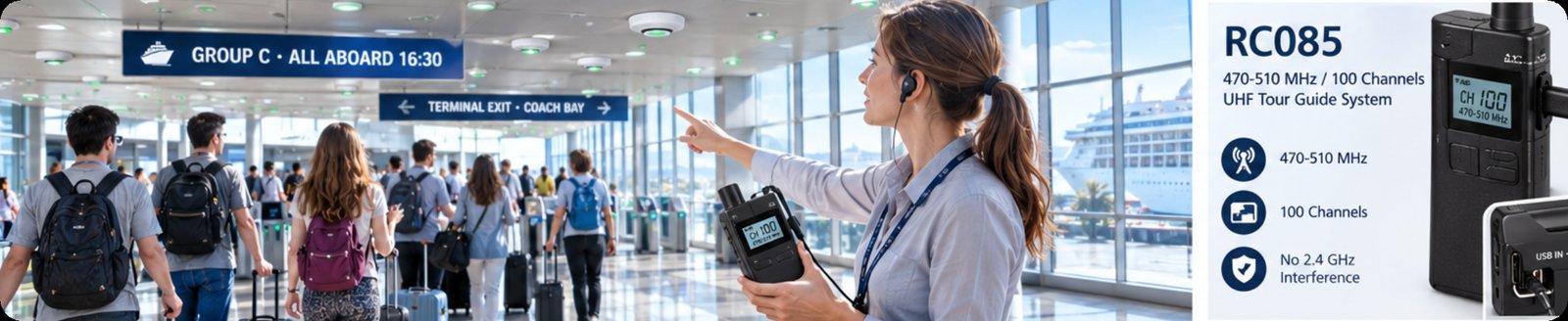
RC085-cruise_shore_excursion

The trade is straightforward and worth stating plainly. A band outside 2.4 GHz is not automatically licence-free in every market, so a company sailing a fixed itinerary should confirm the local position before committing a whole season to it. What the RC085 offers in return is twelve hours on the transmitter — the longest of the three — and a route through the spectrum that nobody on the pier is competing for.

One Hundred Channels and a USB Port

Two further details on the RC085 tend to decide the purchase once a guide has actually used the kit. The first is the charging port: it takes USB, where the RC2401 and RC2406 use a DC jack. On a ship or a coach, a barrel connector means a dedicated adapter that has to travel with the case and can be left in a cabin; a USB port means the same cable as a phone, and the socket behind the seat in the coach. The second is the microphone arrangement, which accepts a headset or a lavalier, a useful option when a guide is also holding a sign or a boarding list.

Fifty Grams on a Neck, All Day

Weight decides how long a receiver stays on a guest's neck without being noticed. The RC2401 and RC2406 both ship a 50 g receiver and a 59 g transmitter, while the RC085 is heavier at 60 g and 65 g respectively. On a ninety-minute museum walk the gap is irrelevant. On a six-hour day with a walking stretch, a lunch stop and photographs at three viewpoints, it is the difference between a guest who forgets the earpiece and one who hands it back before the coach returns.

This is where the lighter pair earns its place, and it explains why the RC085 is usually specified for a different kind of day. Reach for the heavier unit when the group size and the radio environment are the hard constraints; reach for the lighter one when the day itself is long and the itinerary keeps moving.

The Numbers Each Manufacturer Publishes

SpecificationRC2401RC2406RC085
Core frequency band2403-2483 MHz2403-2483 MHz470-510 MHz
Number of channels5080100
Transmission distance1-200 m1-200 m1-200 m
Output power10 mW10 mW8-10 mW
Transmitter battery life10 h10 h12 h
Receiver battery life20 h20 h20 h
Transmitter weight59 g59 g65 g
Receiver weight50 g50 g60 g
Charging portDC jackDC jackUSB

Two rows in that table are identical for the first two units, and that is not an omission — it is the finding. The RC2401 and RC2406 share a radio stage, a battery stage and a handset weight, and a buyer who wants to save money should understand that the saving costs exactly one thing: forty channels of separation on a crowded pier. The full range sits under our wireless tour guide system range if you want to line the three up against the rest of the family.

What Has to Be Back on Board

The end of a shore day is a counting problem. Somebody has to reconcile forty receivers against forty names while the coach idles and the gangway closes, and a missing handset is not something a guide can resolve politely later. This is where simpler kits quietly win: fewer channels to reset, fewer modes to explain, and a unit that a guest can hand back without a demonstration. A transmitter that runs ten or twelve hours also means nobody is swapping batteries at three in the afternoon.

For operators who want to see how these two units behave side by side on a previous route, RC2401 vs RC2406 walks through a direct comparison. Choose the fifty-channel unit for a single party and a predictable schedule, the eighty-channel unit when the pier is shared, and the UHF unit when the air around the terminal is already full. Rich Age builds all three, and the right one is simply the one that matches the day you actually run.


2026年09月17日 10:13
click: 41

RC2406, RC2401 and RC085: Which Kit Goes Ashore

time: 2026年09月17日 click:41

The ship docks at seven and sails at five. In between, a party of forty has to be walked through a town, fed, brought back and counted, and the guide has to manage all of it while the harbour fills with three other vessels doing the same thing. There is no second attempt at a shore day. Either the group hears the commentary at the second stop, or that part of the itinerary is simply lost, and the coach waiting beyond the terminal will not hold its slot for long.

That is why choosing a wireless tour guide kit for shore days is not the same exercise as equipping a fixed venue. Three Rich Age units sit inside that decision — RC2401, RC2406 and RC085 — and two of them read almost identically on a spec sheet. What separates them only appears once you count how many parties walk at the same time, and once you ask which slice of the radio spectrum the port has already used up.

The Window Between the Gangway and the Coach

A shore day compresses everything a normal guided tour spreads across a morning. Guests clear the gangway in one wave, the party reforms on the pier, and the first commentary begins before the coach has finished loading. The setting makes the audio job harder rather than easier: open ground, no walls to keep a signal inside, and a crowd that drifts in and out of earshot at every photo stop. Teams that plan this well tend to start from city tour solutions rather than from a device list, because the shape of the day decides the hardware and not the other way round.

Two Machines That Differ by One Number

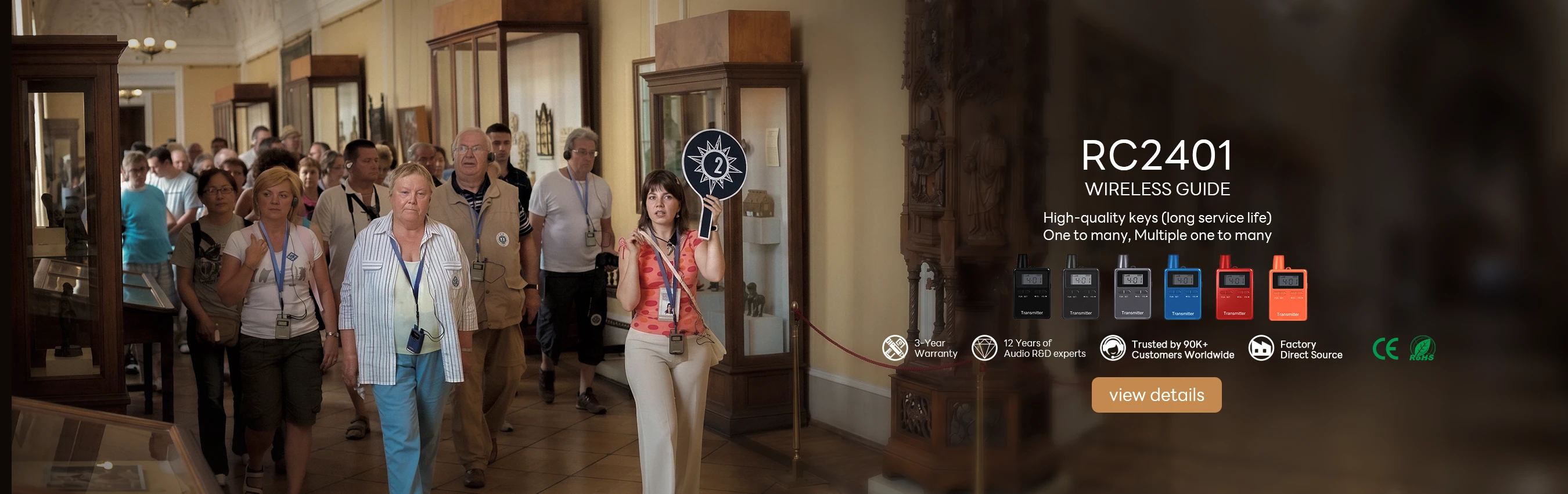
The RC2401 and the RC2406 are the two units most guides compare first, and the comparison is shorter than people expect. Both transmit between 2403 and 2483 MHz, both quote a working range of 1-200 m, both run a 10 mW output stage, ten hours on the transmitter and twenty on the receiver, and their handsets sit within a gram of each other on a scale. Read down the two columns and a single figure moves: channel count.

RC2401-cruise_shore_excursion

That one difference is not cosmetic. Fifty channels is plenty for one party with a translator, which is what the RC2401 was built around — a straightforward 2.4 GHz unit that a seasonal guide can hand out and explain in under a minute. Eighty channels buys something else entirely, and it only matters on the days when the pier is crowded.

Eighty Ways to Avoid Sharing a Channel

Ports are busy radio rooms. Every vessel in the harbour runs its own Wi-Fi, the terminal building has access points on both floors, and if three tour operators are disembarking at eight in the morning, three sets of transmitters are competing for the same air. The practical question is not whether interference exists, but how many clean slots you have left once it does. The RC2406 answers with eighty channels against fifty, which is the headroom that lets four or five parties walk the same route in the same hour without stepping on one another.

RC2406-cruise_shore_excursion

It is worth being precise about what that headroom buys. Two parties on the same frequency will hear each other, and the failure is not gradual — the second group simply receives the wrong commentary. A company running two coaches out of one terminal has to budget channels before it budgets anything else. The RC2406 is the unit that keeps that arithmetic comfortable.

The Kit That Steps Off 2403-2483 MHz

The RC085 is the odd one out, and it is odd in the most useful way. It does not transmit in the 2.4 GHz range at all; it works between 470 and 510 MHz. In a harbour where the crowded band is exactly the one everyone else is using, leaving it is a genuine strategy rather than a specification detail. The unit also carries a hundred channels, which is the largest count in the three-way comparison, so a large operation can keep its groups apart without negotiating with anyone.

RC085-cruise_shore_excursion

The trade is straightforward and worth stating plainly. A band outside 2.4 GHz is not automatically licence-free in every market, so a company sailing a fixed itinerary should confirm the local position before committing a whole season to it. What the RC085 offers in return is twelve hours on the transmitter — the longest of the three — and a route through the spectrum that nobody on the pier is competing for.

One Hundred Channels and a USB Port

Two further details on the RC085 tend to decide the purchase once a guide has actually used the kit. The first is the charging port: it takes USB, where the RC2401 and RC2406 use a DC jack. On a ship or a coach, a barrel connector means a dedicated adapter that has to travel with the case and can be left in a cabin; a USB port means the same cable as a phone, and the socket behind the seat in the coach. The second is the microphone arrangement, which accepts a headset or a lavalier, a useful option when a guide is also holding a sign or a boarding list.

Fifty Grams on a Neck, All Day

Weight decides how long a receiver stays on a guest's neck without being noticed. The RC2401 and RC2406 both ship a 50 g receiver and a 59 g transmitter, while the RC085 is heavier at 60 g and 65 g respectively. On a ninety-minute museum walk the gap is irrelevant. On a six-hour day with a walking stretch, a lunch stop and photographs at three viewpoints, it is the difference between a guest who forgets the earpiece and one who hands it back before the coach returns.

This is where the lighter pair earns its place, and it explains why the RC085 is usually specified for a different kind of day. Reach for the heavier unit when the group size and the radio environment are the hard constraints; reach for the lighter one when the day itself is long and the itinerary keeps moving.

The Numbers Each Manufacturer Publishes

SpecificationRC2401RC2406RC085
Core frequency band2403-2483 MHz2403-2483 MHz470-510 MHz
Number of channels5080100
Transmission distance1-200 m1-200 m1-200 m
Output power10 mW10 mW8-10 mW
Transmitter battery life10 h10 h12 h
Receiver battery life20 h20 h20 h
Transmitter weight59 g59 g65 g
Receiver weight50 g50 g60 g
Charging portDC jackDC jackUSB

Two rows in that table are identical for the first two units, and that is not an omission — it is the finding. The RC2401 and RC2406 share a radio stage, a battery stage and a handset weight, and a buyer who wants to save money should understand that the saving costs exactly one thing: forty channels of separation on a crowded pier. The full range sits under our wireless tour guide system range if you want to line the three up against the rest of the family.

What Has to Be Back on Board

The end of a shore day is a counting problem. Somebody has to reconcile forty receivers against forty names while the coach idles and the gangway closes, and a missing handset is not something a guide can resolve politely later. This is where simpler kits quietly win: fewer channels to reset, fewer modes to explain, and a unit that a guest can hand back without a demonstration. A transmitter that runs ten or twelve hours also means nobody is swapping batteries at three in the afternoon.

For operators who want to see how these two units behave side by side on a previous route, RC2401 vs RC2406 walks through a direct comparison. Choose the fifty-channel unit for a single party and a predictable schedule, the eighty-channel unit when the pier is shared, and the UHF unit when the air around the terminal is already full. Rich Age builds all three, and the right one is simply the one that matches the day you actually run.

×

Contact us

email:
name:
subject:
content: