A leading China factory specializing in Wireless Tour Guide Systems, Church Audio Guides, and Translation Headphones with premium OEM/ODM solutions.

Tel:+86 18922879583

Email:tiger.wang@richitek.com

RC085, RC9150 and RC2468: What a Data Centre Lets a Wireless Tour Guide System Bring In

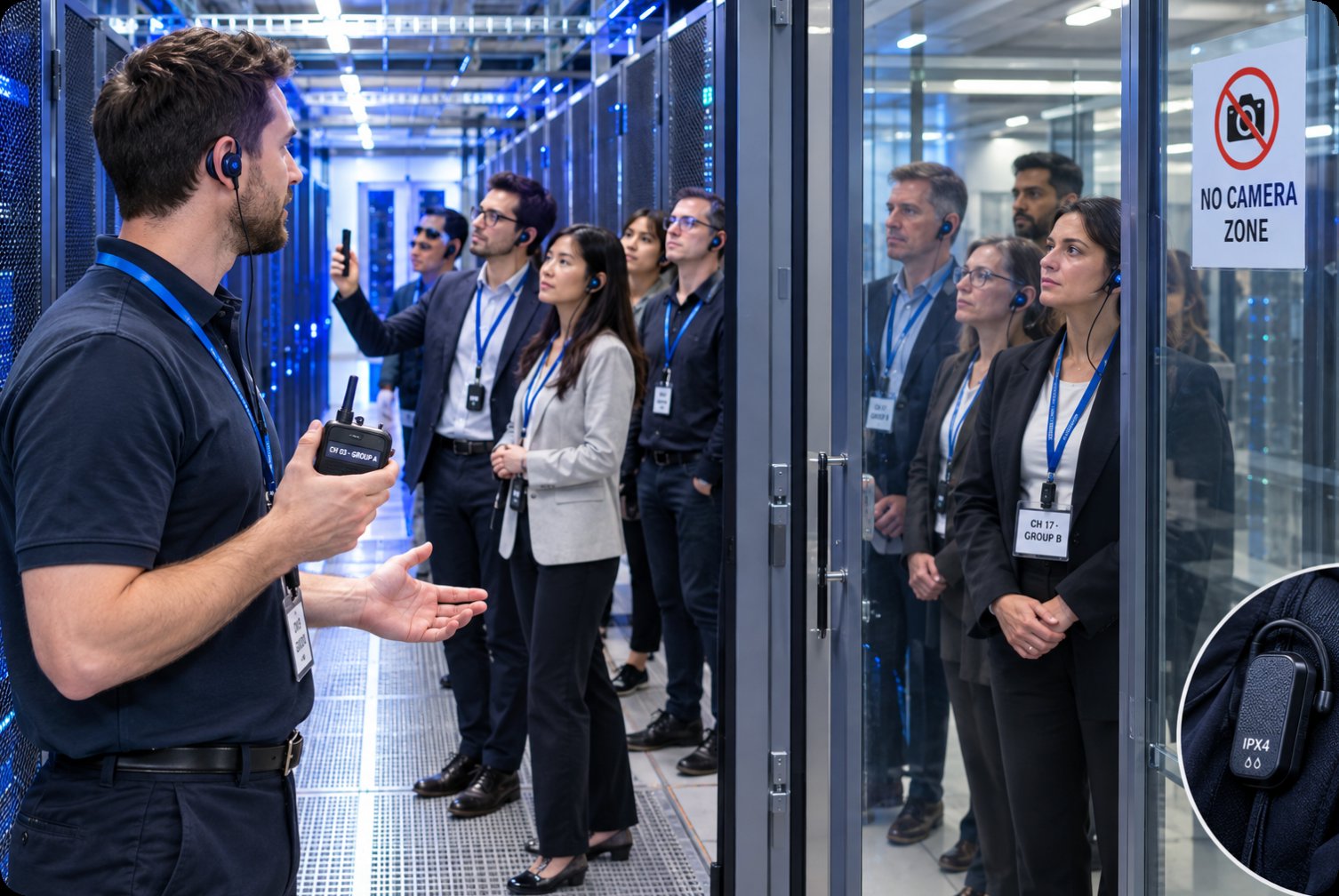
A data centre tour runs the usual tour logic backwards. Everywhere else, the question is whether the visitors can be let in. Inside a colocation hall, the question is whether the kit can be let in, and that question is answered by people whose job is to keep a client's racks running through the afternoon. I have watched a tour get turned around at the door over a handheld camera, and the guide set is judged by the same standard. Three things get checked, and only three: whether the set can leave a recording behind, whether it adds radio traffic to a hall that already has plenty, and whether every piece that walked in walks back out.

Why the Guide Set Is Part of the Audit

Access control is the product a data centre actually sells. Visitors arrive against a name, they are escorted the whole way, and the equipment they carry is logged on the way in and reconciled on the way out. A wireless tour guide system is therefore not a convenience the facility tolerates; it is a line item on that log. The facility manager is not being difficult when they ask about frequency, storage and piece count. They are answering to an audit that will ask them the same questions later.

That framing changes what a good kit looks like. If you are planning a technical site visit, the site-tour systems we build for technical facilities are specified around exactly this three-part test, and the rest of this article walks through each part and what it does to the hardware choice.

A Receiver That Cannot Hold a Word

The first requirement is the easiest to state and the easiest to fail. Nothing in the set may have a path back to a file. Plenty of consumer tour gear ships with a record function, a microSD slot or a replay button, because on a normal city walk those features look like value. In a hall holding client infrastructure, the same feature is a liability: the tour commentary describes cabinet rows, redundancy paths and access procedures, and a recording of that is a document nobody agreed to create.

A receiver built as a receive-only unit has no microphone, no storage and no playback, and a transmitter that only streams has no archive either. The pairing is worth checking before the visit, because the answer has to be a flat no rather than a policy the guide promises to respect. On all three units below the commentary exists only while it is being spoken.

The Hall Has Its Own Radio Traffic

The second requirement is the one that produces the most argument, because the objection is never about the guide set alone. A live hall is a busy radio room. Wireless access points serve the management network, DCIM sensors report temperature and power from the floor, building systems talk to their controllers, and asset tags answer readers at the rack doors. Most of that traffic sits in the 2.4 GHz band, which is also where the majority of tour guide systems operate. Adding twenty or thirty receivers that are listening continuously does not switch anything off, but it does raise the noise floor that every one of those management links depends on, and the person who owns that network is right to care.

This is the point where the conversation usually stops being about audio quality and starts being about where the signal is allowed to live. A set that stays in 2.4 GHz asks the facility to accept extra load on the band its own operations run on. A set that works somewhere else asks for nothing.

Why a UHF Set Crosses a Threshold the Others Cannot

The RC085 is the odd one out in our range for a reason that only matters in a room like this. It transmits in the 470-510 MHz band, which puts it outside 2.4 GHz altogether. Whether that is a technical advantage at a museum is arguable. At a data centre it settles the argument before it starts, because the kit is no longer competing with the network the facility is paid to protect.

The rest of the unit holds up under the same scrutiny. It carries 100 channels, so several groups can be walked through neighbouring zones without sharing a frequency, and a 12 h transmitter runtime with a 20 h receiver runtime covers a long visit without a charging break. The transmitter weighs 65 g and the receiver 60 g, both light enough for a two-hour walk, and the charging port is USB, so a set can be topped up from the same banks the client already uses. The UHF sensitivity figure of around -102 dBm is the part engineers ask about first, and it is what keeps a clean signal in a hall full of steel.
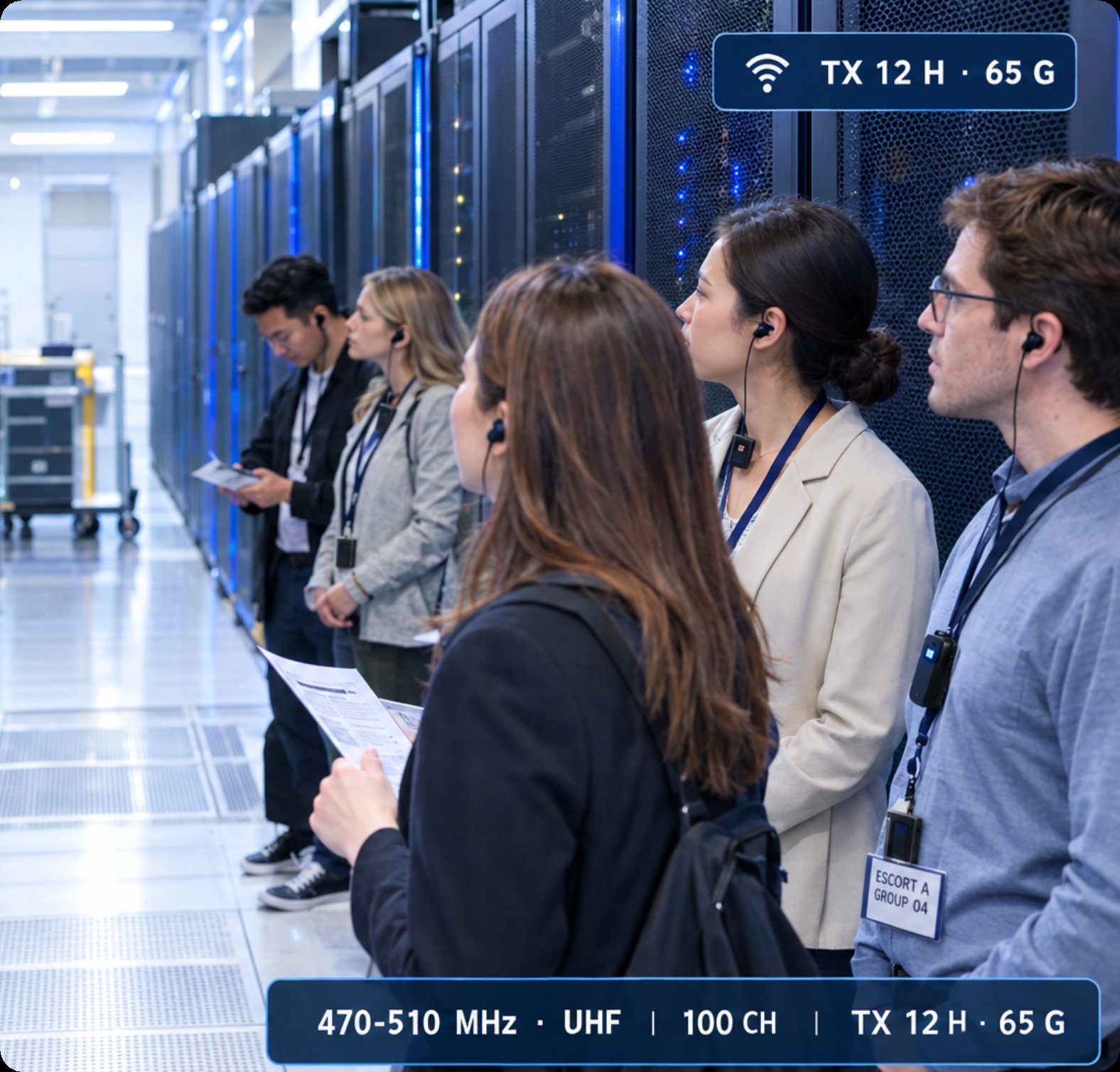
RC085-data_center_tour

Who Is Holding the Other End of the Channel

For facilities that can live with 2.4 GHz, the second question is how many conversations have to happen at once. A data centre visit rarely moves as one block. A client group, a compliance auditor and an internal engineering walk can be in different aisles on the same morning, and each of those needs its own channel with no bleed into the next. The RC9150 carries 100 channels, which is the widest count we build, and it pairs that with a 15 h transmitter runtime and a receiver that keeps going for 35 h and beyond.

The trade is weight. At 97.5 g the transmitter and receiver are the heaviest of the three, and the unit charges over Type-C rather than USB. On a short escorted walk that weight never registers. On a two-hour plant-and-hall route with a stop at the loading bay it is the difference between a set that disappears on the visitor and a set they keep adjusting.
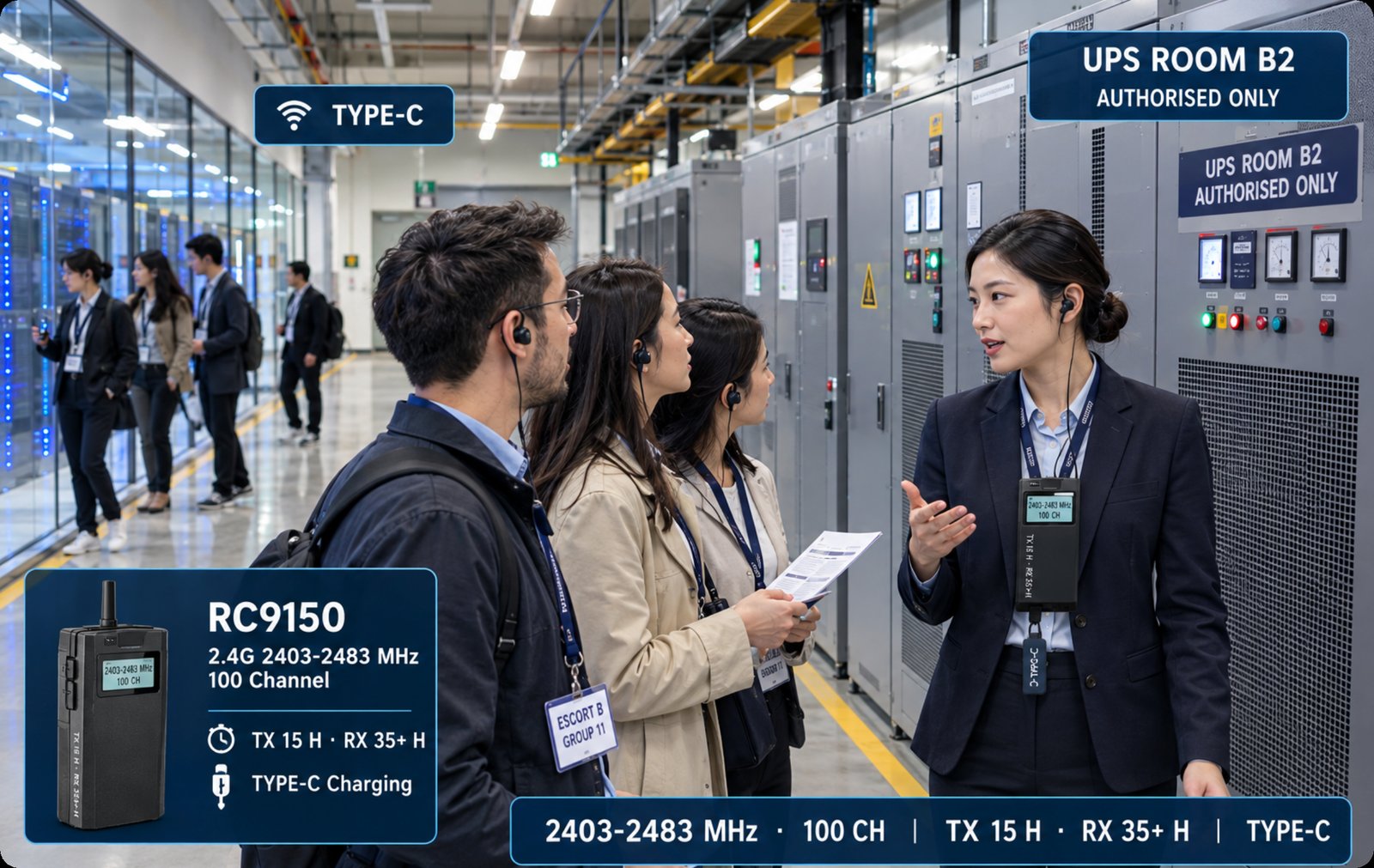
RC9150-data_center_tour

Escorted Access and the Count at the Door

The third requirement is procedural rather than technical, and it is where the lightweight option gets interesting. Every receiver handed out at the door has to come back through it, and the count happens while the escort is still standing there. A receiver that clips into a pocket is easy to account for. A receiver that hangs on an ear is easy to walk off with, and it is the piece most often found in a jacket two days later.

The RC2468 is built for the opposite trade-off. Its receiver weighs 18 g in an ear-hook form, which is the lightest we make, and the transmitter is 59 g with a 50-channel set. Walkers forget they are wearing it, which is exactly the point on a long route, but it also means the door count has to be run properly rather than assumed. Its receiver runs for around 8 h against a 10 h transmitter, so a full-day programme needs a spare set in the charge rotation rather than a longer battery.
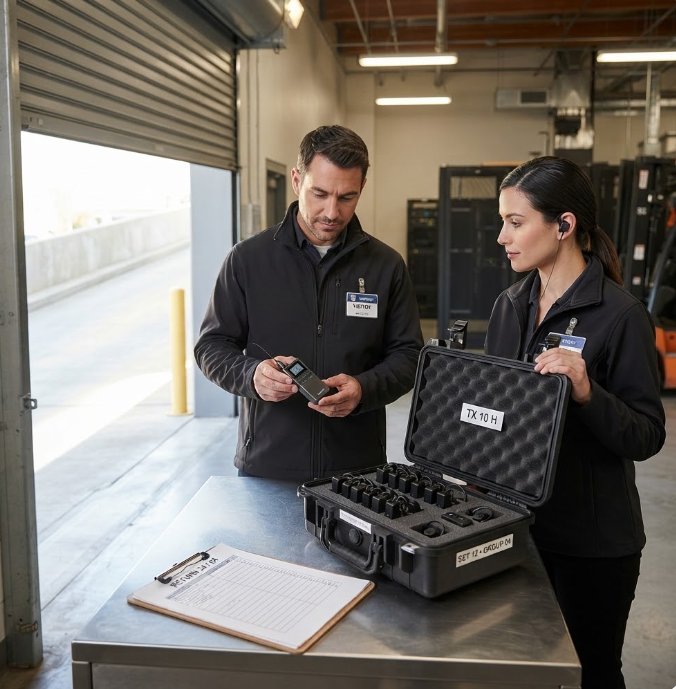
RC2468-data_center_tour

The Numbers a Data Centre Will Ask For

Facility teams tend to ask for the same figures in the same order, so it helps to have them on one line before the visit is booked. The table below lists what each unit publishes for the questions that come up at the gate.

SpecificationRC085RC9150RC2468
Core frequency band470-510 MHz2403-2483 MHz2403-2483 MHz
Number of channels10010050
Output power8-10 mW10 mW10 mW
Transmitter battery life12 h15 h10 h
Receiver battery life20 h35+ h8 h approx.
Transmitter weight65 g97.5 g59 g
Receiver weight60 g97.5 g18 g ear-hook
Charging portUSBType-CUSB
Transmission distance1-200 m1-200 m1-200 m

What Has to Be in the Bag Before the Door Opens

The choice usually comes down to which of the three checks the facility weights most. If the hall runs a dense management network and the answer on 2.4 GHz is a firm no, the RC085 is the only one of the three that clears the requirement without a negotiation, and its 100 channels and 12 h transmitter runtime mean the visit plan does not have to shrink around it. If the facility is comfortable on 2.4 GHz and the morning has several groups moving at once, the RC9150 answers the channel question with room to spare and keeps going for the whole day. If the route is long, the group is small and the escorts are disciplined about the door count, the RC2468 is the one visitors stop noticing.

It is worth settling the recording and frequency questions in writing before the visit, because those are the two that end a tour at reception. If you want to see how the three compare against the wider range, the RC085 against the RC8860 is the closest neighbouring comparison, and the full wireless tour guide system range covers the rest of the band options. Send us the hall layout and the group count, and we will tell you which of the three we would put in the bag.
2026年09月17日 11:00
click: 15
no data

RC085, RC9150 and RC2468: What a Data Centre Lets a Wireless Tour Guide System Bring In

time: 2026年09月17日 click:15

A data centre tour runs the usual tour logic backwards. Everywhere else, the question is whether the visitors can be let in. Inside a colocation hall, the question is whether the kit can be let in, and that question is answered by people whose job is to keep a client's racks running through the afternoon. I have watched a tour get turned around at the door over a handheld camera, and the guide set is judged by the same standard. Three things get checked, and only three: whether the set can leave a recording behind, whether it adds radio traffic to a hall that already has plenty, and whether every piece that walked in walks back out.

Why the Guide Set Is Part of the Audit

Access control is the product a data centre actually sells. Visitors arrive against a name, they are escorted the whole way, and the equipment they carry is logged on the way in and reconciled on the way out. A wireless tour guide system is therefore not a convenience the facility tolerates; it is a line item on that log. The facility manager is not being difficult when they ask about frequency, storage and piece count. They are answering to an audit that will ask them the same questions later.

That framing changes what a good kit looks like. If you are planning a technical site visit, the site-tour systems we build for technical facilities are specified around exactly this three-part test, and the rest of this article walks through each part and what it does to the hardware choice.

A Receiver That Cannot Hold a Word

The first requirement is the easiest to state and the easiest to fail. Nothing in the set may have a path back to a file. Plenty of consumer tour gear ships with a record function, a microSD slot or a replay button, because on a normal city walk those features look like value. In a hall holding client infrastructure, the same feature is a liability: the tour commentary describes cabinet rows, redundancy paths and access procedures, and a recording of that is a document nobody agreed to create.

A receiver built as a receive-only unit has no microphone, no storage and no playback, and a transmitter that only streams has no archive either. The pairing is worth checking before the visit, because the answer has to be a flat no rather than a policy the guide promises to respect. On all three units below the commentary exists only while it is being spoken.

The Hall Has Its Own Radio Traffic

The second requirement is the one that produces the most argument, because the objection is never about the guide set alone. A live hall is a busy radio room. Wireless access points serve the management network, DCIM sensors report temperature and power from the floor, building systems talk to their controllers, and asset tags answer readers at the rack doors. Most of that traffic sits in the 2.4 GHz band, which is also where the majority of tour guide systems operate. Adding twenty or thirty receivers that are listening continuously does not switch anything off, but it does raise the noise floor that every one of those management links depends on, and the person who owns that network is right to care.

This is the point where the conversation usually stops being about audio quality and starts being about where the signal is allowed to live. A set that stays in 2.4 GHz asks the facility to accept extra load on the band its own operations run on. A set that works somewhere else asks for nothing.

Why a UHF Set Crosses a Threshold the Others Cannot

The RC085 is the odd one out in our range for a reason that only matters in a room like this. It transmits in the 470-510 MHz band, which puts it outside 2.4 GHz altogether. Whether that is a technical advantage at a museum is arguable. At a data centre it settles the argument before it starts, because the kit is no longer competing with the network the facility is paid to protect.

The rest of the unit holds up under the same scrutiny. It carries 100 channels, so several groups can be walked through neighbouring zones without sharing a frequency, and a 12 h transmitter runtime with a 20 h receiver runtime covers a long visit without a charging break. The transmitter weighs 65 g and the receiver 60 g, both light enough for a two-hour walk, and the charging port is USB, so a set can be topped up from the same banks the client already uses. The UHF sensitivity figure of around -102 dBm is the part engineers ask about first, and it is what keeps a clean signal in a hall full of steel.

RC085-data_center_tour

Who Is Holding the Other End of the Channel

For facilities that can live with 2.4 GHz, the second question is how many conversations have to happen at once. A data centre visit rarely moves as one block. A client group, a compliance auditor and an internal engineering walk can be in different aisles on the same morning, and each of those needs its own channel with no bleed into the next. The RC9150 carries 100 channels, which is the widest count we build, and it pairs that with a 15 h transmitter runtime and a receiver that keeps going for 35 h and beyond.

The trade is weight. At 97.5 g the transmitter and receiver are the heaviest of the three, and the unit charges over Type-C rather than USB. On a short escorted walk that weight never registers. On a two-hour plant-and-hall route with a stop at the loading bay it is the difference between a set that disappears on the visitor and a set they keep adjusting.

RC9150-data_center_tour

Escorted Access and the Count at the Door

The third requirement is procedural rather than technical, and it is where the lightweight option gets interesting. Every receiver handed out at the door has to come back through it, and the count happens while the escort is still standing there. A receiver that clips into a pocket is easy to account for. A receiver that hangs on an ear is easy to walk off with, and it is the piece most often found in a jacket two days later.

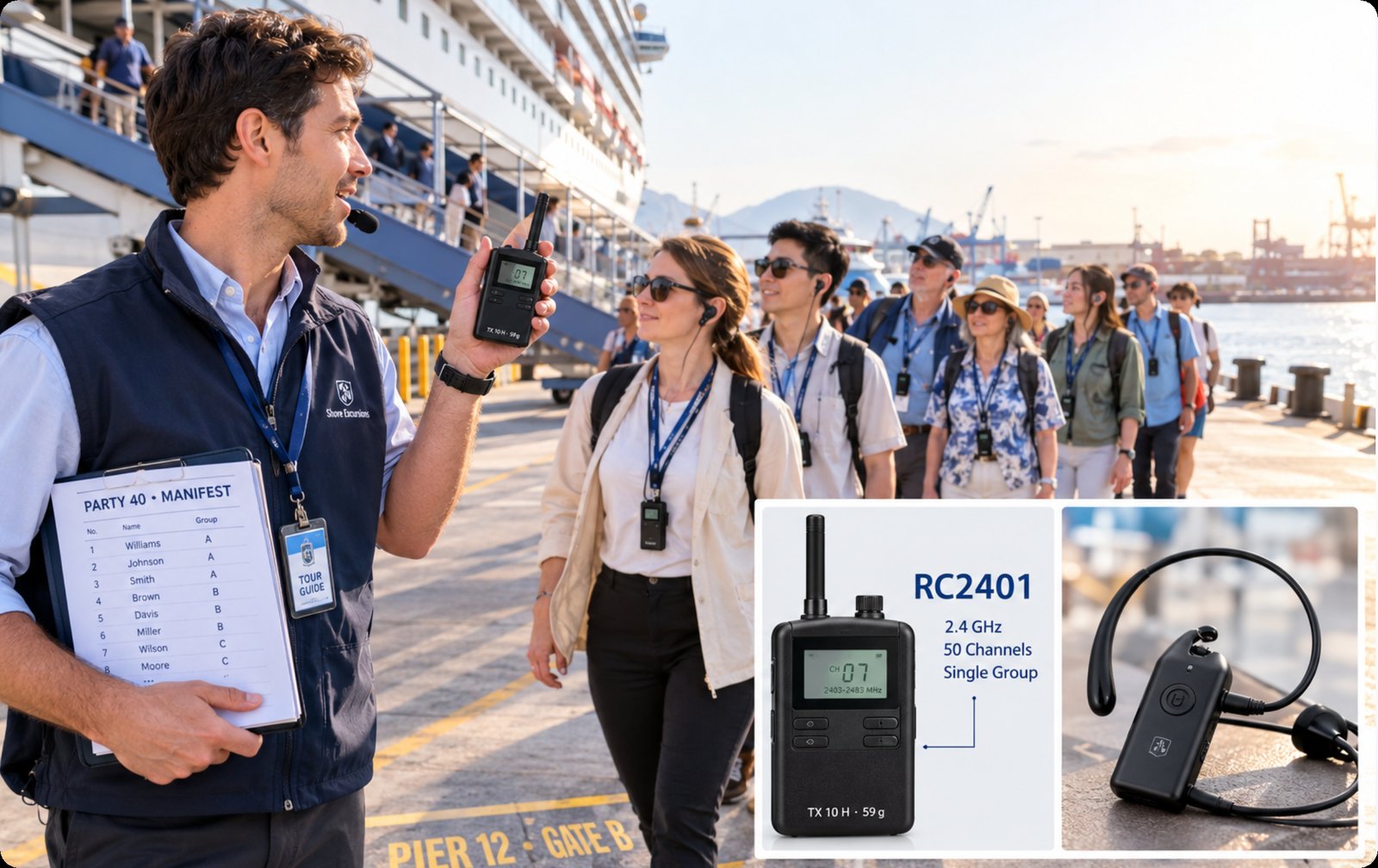
The RC2468 is built for the opposite trade-off. Its receiver weighs 18 g in an ear-hook form, which is the lightest we make, and the transmitter is 59 g with a 50-channel set. Walkers forget they are wearing it, which is exactly the point on a long route, but it also means the door count has to be run properly rather than assumed. Its receiver runs for around 8 h against a 10 h transmitter, so a full-day programme needs a spare set in the charge rotation rather than a longer battery.

RC2468-data_center_tour

The Numbers a Data Centre Will Ask For

Facility teams tend to ask for the same figures in the same order, so it helps to have them on one line before the visit is booked. The table below lists what each unit publishes for the questions that come up at the gate.

SpecificationRC085RC9150RC2468
Core frequency band470-510 MHz2403-2483 MHz2403-2483 MHz
Number of channels10010050
Output power8-10 mW10 mW10 mW
Transmitter battery life12 h15 h10 h
Receiver battery life20 h35+ h8 h approx.
Transmitter weight65 g97.5 g59 g
Receiver weight60 g97.5 g18 g ear-hook
Charging portUSBType-CUSB
Transmission distance1-200 m1-200 m1-200 m

What Has to Be in the Bag Before the Door Opens

The choice usually comes down to which of the three checks the facility weights most. If the hall runs a dense management network and the answer on 2.4 GHz is a firm no, the RC085 is the only one of the three that clears the requirement without a negotiation, and its 100 channels and 12 h transmitter runtime mean the visit plan does not have to shrink around it. If the facility is comfortable on 2.4 GHz and the morning has several groups moving at once, the RC9150 answers the channel question with room to spare and keeps going for the whole day. If the route is long, the group is small and the escorts are disciplined about the door count, the RC2468 is the one visitors stop noticing.

It is worth settling the recording and frequency questions in writing before the visit, because those are the two that end a tour at reception. If you want to see how the three compare against the wider range, the RC085 against the RC8860 is the closest neighbouring comparison, and the full wireless tour guide system range covers the rest of the band options. Send us the hall layout and the group count, and we will tell you which of the three we would put in the bag.

no data
×

Contact us

email:
name:
subject:
content: