.webp)

A city walking route has no gate. There is no counter where units change hands, no turnstile counting people back in, and no door that closes when the last guest leaves. The group forms on a pavement, moves through streets that stay open to everyone else, and breaks up at a corner that is not the same corner every season.
That sounds like a staging detail. It is the reason the cost structure of a city walk looks nothing like the cost structure of a museum or a factory. On a closed site the building fixes the cost lines for you: one entrance, one desk, one room, one exit. On an open route those lines follow the street instead, and they change as the street changes. This is where the budget actually goes when there is no gate, and what the three units in our city tour solutions range bring to each of those lines.
💰 Why an Unfenced Route Adds Cost Lines
An indoor tour pays for the room. A street tour pays for the parts of the day that have nothing to do with audio. Four of those parts appear the first time a group forms outdoors, and they stay on the books for every departure afterwards.
| Cost line | What triggers it | What it is measured in |
|---|---|---|
| Handing units out | A group forming on a public pavement | Staff minutes per departure |
| Recovery at the end | No fixed exit to count units against | Units not returned |
| A guest leaving early | Someone stepping out before the last stop | Stock written off |
| A late joiner | Someone attaching at a mid-route stop | Extra setup time |
None of the four is an audio problem, and all four are drawn from the same budget as the equipment. That is why a specification sheet on its own never explains the bill. The question a street operator has to answer is whether a given unit shortens any of those lines, or whether it only performs well once the group is already walking.
Handing Units Out on the Pavement
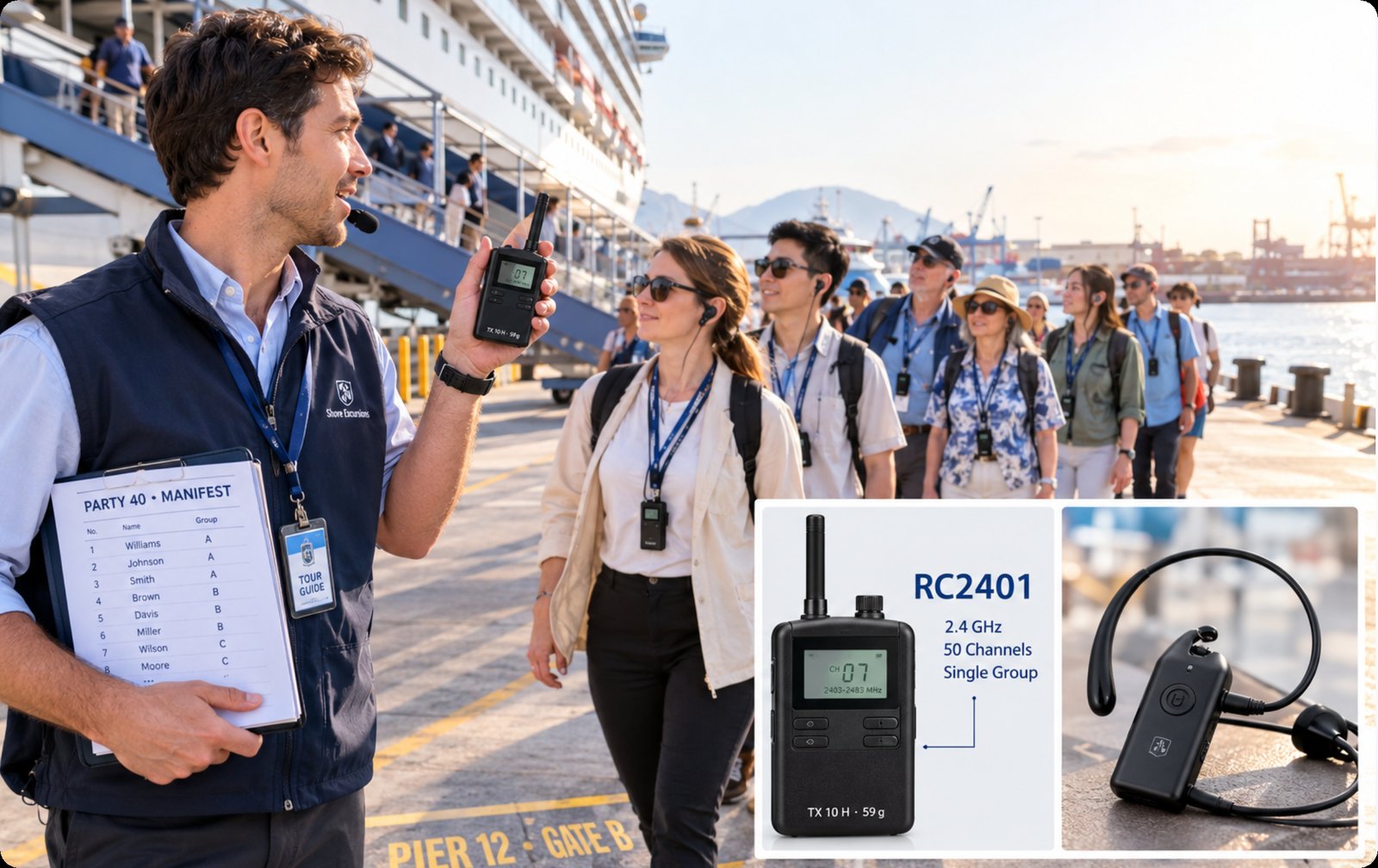
There is no desk to pair devices on. Units come out of a bag at the meeting point, in front of people who are still arriving, and every minute spent matching receivers to a transmitter is a minute the whole group stands still. What counts here is how little procedure the pairing needs, not how clever the pairing is.

RC2402 answers that with one-click frequency synchronisation, where a single transmitter pairs with an unlimited number of receivers in seconds. It carries 50 channels and weighs 59 g at the transmitter and 50 g at the receiver, so passing a stack of them around a pavement costs almost no time. Its transmitter runs for 10 hours against 20 hours on the receiver, and its published certification list covers CE, EMC, LVD, RED and RoHS, which matters on routes that carry the same kit across a border.
🏨 The Guest Who Steps Off Halfway
On a closed site, a guest who leaves is noticed at the exit. On a street, the first sign is usually a receiver that never comes back. Stepping out early is not a fault in an open route. People get tired, spot a shop, or keep an appointment elsewhere, and it happens while the guide is mid-sentence.
Two habits keep that from turning into an unattended cost line. The first is counting in groups rather than in people, so a shortfall shows up while the group is still on the street instead of at a desk that does not exist. The second is collecting at the last stop, in one movement, while everyone is still together. The equipment only helps at the margin, but it does help: a receiver at 50 g is a device a guest hands back without being asked twice.
Someone Always Joins at the Second Stop
A route with no gate has no entry list either. Someone walking past the second stop can join, and on a busy street that is a sale rather than a problem. It does mean an extra receiver has to go live in the middle of the walk, on a channel that does not disturb the group already listening.
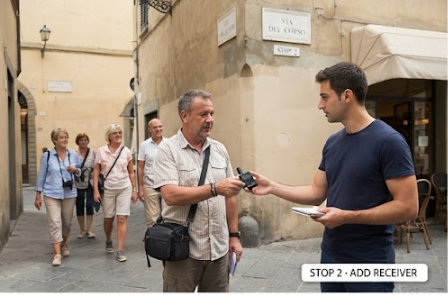
The street is also crowded in a way a room is never crowded. Wireless networks, trams and other operators share the same 2.4 GHz space, and the crowd itself moves. RC2406 is built for that: 80 dedicated channels on PLL synthesis, with one-key synchronisation so a late receiver can be added without interrupting anyone. Its audio is tuned for English-guided work, which is what most international city walks run on, and its published sheet lists splash resistance, a practical point on a route that carries on through a shower.
An End Point Which Moves Every Season
The end of a street route is not a fixed asset. Roadworks move it, the season changes what is worth stopping for, and a permit that covered one square does not automatically cover the next. Redrawing the route is therefore a routine cost rather than an exceptional one, and that changes what a sensible purchase looks like.
A unit that only works on the street it was bought for is expensive to keep. Because the radio side does not change with the address, the same kit can be redeployed when the route is drawn again: 2403-2483 MHz, 10 mW output, and a working range of 1-200 m whatever the postcode. What actually limits redeployment is the channel count, because that is what decides how many groups one street can carry at the same time.
🔋 Where the Charge Gives Out First
A city walk is a day-length product, and the economics of the day sit on one question: how much of it runs on a single charge. Across all three units the split is the same, and it is deliberate. The transmitter, which does the work, runs for 10 hours. The receiver, which most of the group is wearing, runs for 20. So the shortfall always lands on the guide's unit, in the middle of the day, and never on the crowd.
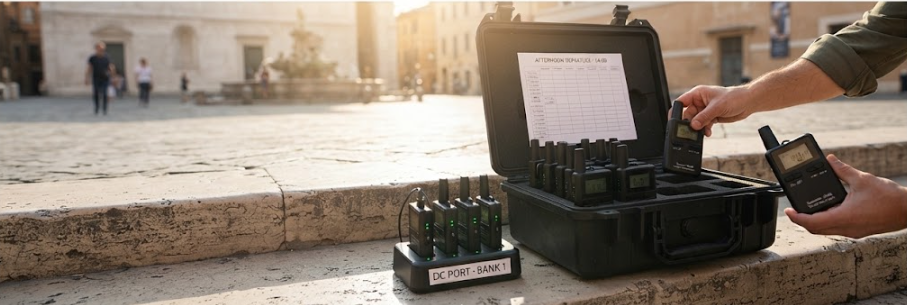
RC2408 is the one shaped for a full commercial day of that kind. It carries 80 channels with one-key synchronisation, weighs 59 g at the transmitter and 50 g at the receiver, and charges through a DC port. It is also one of the units that publishes both CE and RoHS on its sheet. A spare transmitter in the bag, swapped once between the morning and afternoon departures, is a cheaper answer than running the whole group on short days.
What Each Unit Is Actually Rated For
The three units are closer to each other than their model numbers suggest. On the sheet they read as one radio in two channel tiers, with everything else either identical or a difference in published paperwork.
| Specification | RC2402 | RC2406 | RC2408 |
|---|---|---|---|
| Frequency band | 2403-2483 MHz | 2403-2483 MHz | 2403-2483 MHz |
| Channels | 50 channels | 80 channels | 80 channels |
| Working range | 1-200 m | 1-200 m | 1-200 m |
| Output power | 10 mW | 10 mW | 10 mW |
| Transmitter battery life | 10 h | 10 h | 10 h |
| Receiver battery life | 20 h | 20 h | 20 h |
| Transmitter weight | 59 g | 59 g | 59 g |
| Receiver weight | 50 g | 50 g | 50 g |
| Charging port | DC Port | DC Port | DC Port |
| Certification marks | CE, EMC, LVD, RED, RoHS | Only RoHS | CE and RoHS |
One row is deliberately missing. An ingress protection rating is published for one unit only, so a comparison column would imply the other two had failed a test they were never given. Working temperature is the same case, and none of the three publishes it. Where the sheet says nothing, this article says nothing, which leaves two rows that actually separate the units: how many groups they can carry at once, and how far their paperwork travels.
Choosing the Mix Before the Spring Diary Fills
Because the radio side is shared, the purchasing decision is not which unit is best. It is how many channel tiers a fleet needs. A route that runs one group per departure is served by the 50-channel unit, and the money saved there buys a second transmitter for the busy days. A route that runs two groups past each other, or two languages along the same street, needs the 80-channel units, and needs them before the season rather than during it.
Most street operators end up with a mixed fleet for exactly that reason, and the mix is worth settling while the diary is still quiet. Browse our wireless tour guide system range, or go straight to explore our solutions for the routes these units are usually bought for. Tell us how many groups share a street at once and how long a departure lasts, and we will size the mix from that rather than from a catalogue page.