A leading China factory specializing in Wireless Tour Guide Systems, Church Audio Guides, and Translation Headphones with premium OEM/ODM solutions.

Tel:+86 18922879583

Email:tiger.wang@richitek.com

RC2468, RC2401 and RC2408: Sorting a Factory Tour Crew by Wear Time

Every factory tour I have helped equip opened with the same question, and it was never quite the right one. The plant manager would ask how many receivers to order. The honest answer is that the receiver count is the last number worth fixing, because it depends on something nobody writes into the brief: how long each person on the crew is genuinely wearing the thing. A guide who walks two kilometres through a press shop and a guide who stands at one cell repeating the same cycle for six hours are doing different jobs, even on the same morning shift.

Once we started timing the crew instead of counting it, the kit list sorted itself out. Three units in the current Richitek line cover almost every rota a visitor-facing plant needs, and what separates them is precisely what matters when you hand equipment to people who are also doing their day job at the same time.

How Many Hours the Receiver Is Worn Decides the Model

The transmitter is rarely the limiting component. All three units here run a 2403-2483 MHz core band at 10 mW and rate their transmitter at ten hours, which comfortably covers a single visiting window. The receiver is where a rota starts to bite, because the receiver is the half that never leaves the visitor's body. Rated figures differ sharply across the range, and that spread is the first thing worth reading off a specification sheet before anyone talks about quantities.

Take the trial plant we equipped last spring. Their factory tour solutions ran three visiting windows a day, which meant some receivers went out twice before the evening charge. Knowing which units hold a second window and which need swapping at lunch changed the equipment list more than any headcount exercise we had run previously.

The Person Who Never Sits Down

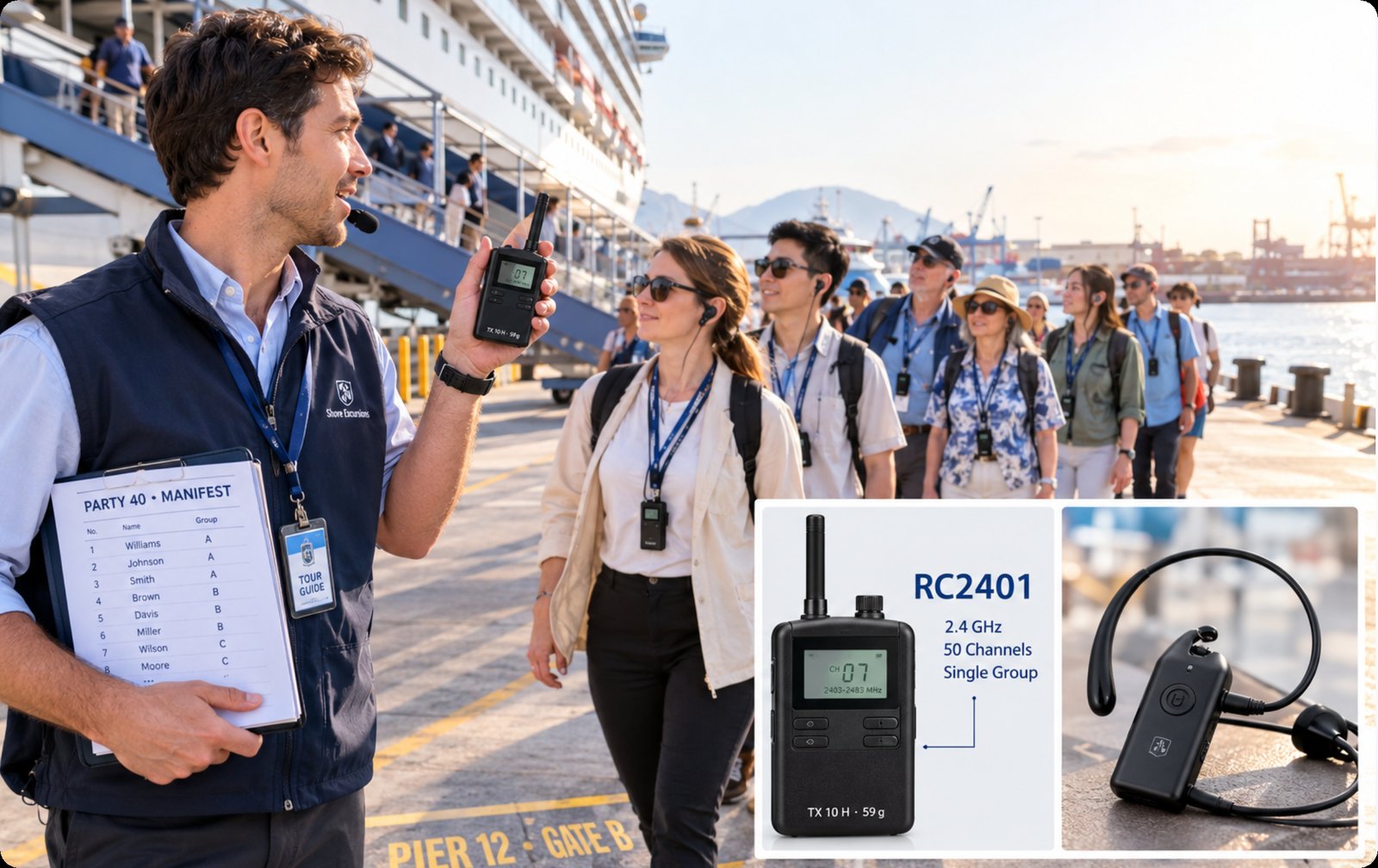
Start with the crew member who covers the most ground. On most plant routes this is a host who walks the full circuit, often twice, opening doors and keeping the group together. That person is wearing a receiver from the first greeting to the last handshake, so weight matters more here than anywhere else on the route. The RC2468 is built for exactly this post: its receiver weighs 18 g and hangs on an ear hook rather than a neck lanyard, and at 59 g the transmitter is light enough to clip to a collar without pulling a shirt out of shape. It carries fifty channels across the same 2403-2483 MHz band as the rest of the line and reaches 1-200 m in open plant areas, with a transmitter rated at ten hours.

RC2468-factory_tour

The Person Who Talks for Six Hours Straight

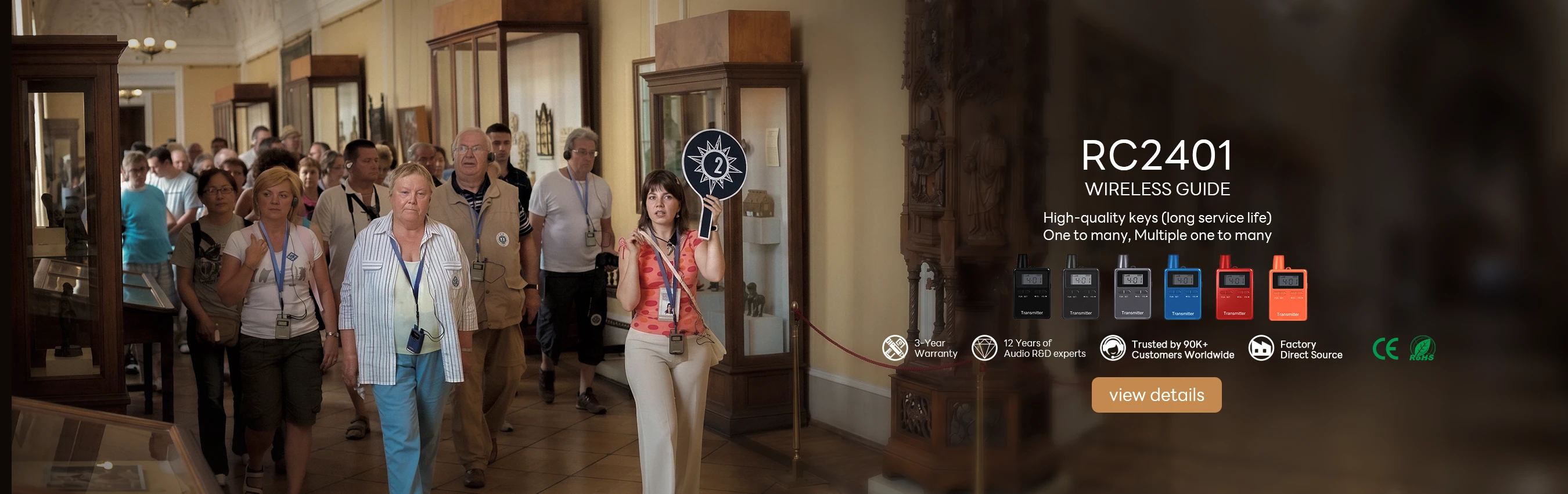
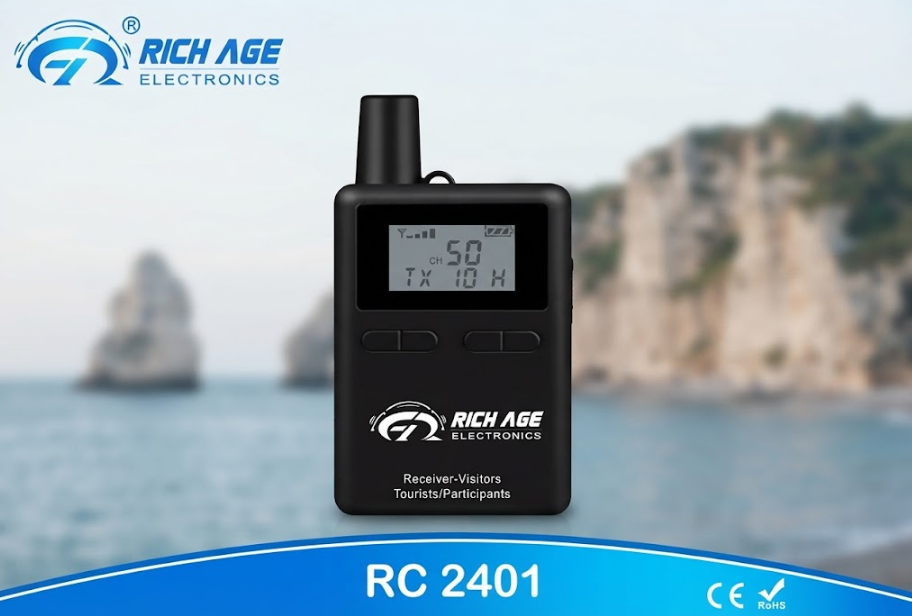
The second post is the opposite problem. A process host parked at one work cell may speak almost continuously for a whole visiting day, and their receiver sits under a lanyard while they gesture, point and lean over a control panel. Continuous speech drains a transmitter faster in practice than its rated figure suggests, and a heavy receiver becomes a nuisance long before the shift ends. The RC2401 is the straightforward answer for that post: a fifty-channel 2.4G unit with a transmitter rated at ten hours and a receiver rated at twenty, drawing on a 1000 mAh receiver battery rather than the smaller cell used further down the range.
RC2401-factory_tour

💡 Where an Ear Hook Stops Being an Advantage

An ear hook is not automatically the better choice, and it is worth saying so plainly before anyone orders a full set. Two situations push against it. The first is personal protective equipment: where a plant requires over-ear defenders or a hard hat with a chin strap, an ear-hook receiver competes for the same real estate as the safety gear, and a lanyard unit is easier to hand over. The second is sharing. The lighter a receiver is and the closer it sits to the ear, the more it feels personal, and visitors notice when a unit has clearly been worn by the person in front of them.

The practical rule we now use is to reserve the light ear-hook units for staff posts with the longest continuous wear, and to issue a lanyard-style receiver wherever units are handed out and collected at a door. Both approaches use the same band, the same 10 mW output and the same 1-200 m range, so mixing them across a route does not create a compatibility problem.

Three Plugs, Three Charging Tables

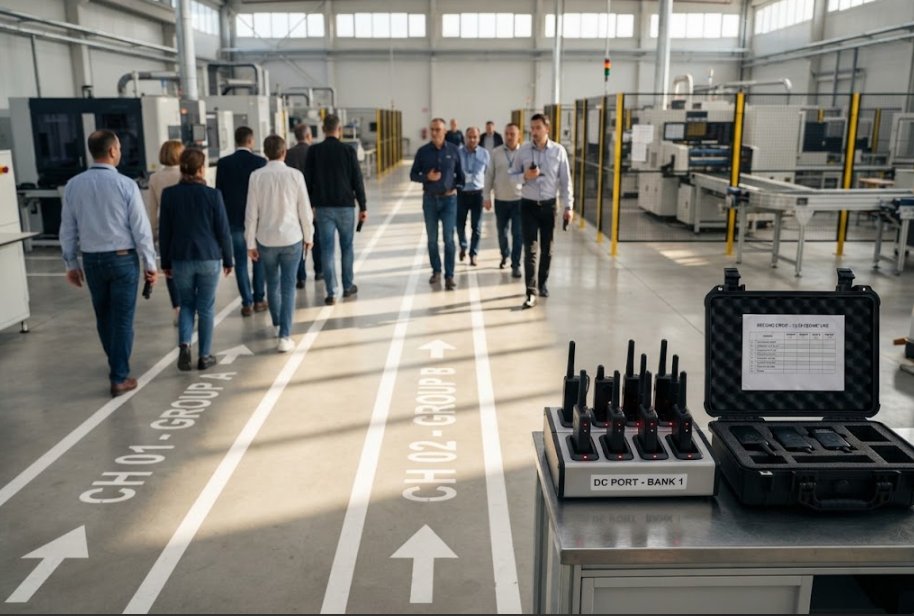
Charging is the part of a factory tour kit that people plan last and complain about first. The range does not use one connector throughout, and that detail reshapes the charging bench more than most buyers expect. Some units take a USB feed; the rest take a DC port. A bench built around a single multi-way USB strip will therefore leave part of the fleet with nowhere to go overnight, and the fix is either a mixed bench or a deliberate decision to standardise the whole order on one charging family.

It is also worth walking the charging bench past the crew before the kit arrives. Whoever opens the plant in the morning needs the receivers back in the case in the order the first group will use them, and that is a physical layout question as much as an electrical one. Everything in the our wireless tour guide system range answers the same core specification, so a standardised order is genuinely possible where a mixed one is not.

What a Second Crew Does to the Channel Budget

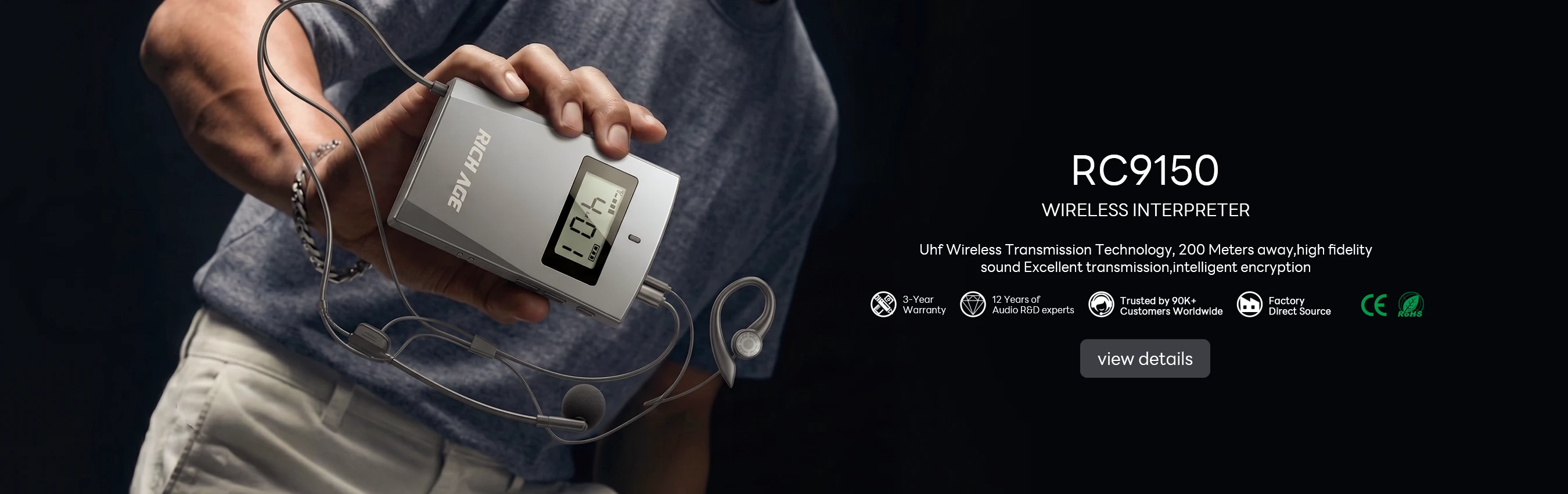
Add a second visiting group running at the same time and the arithmetic changes again. Two crews on one plant are two transmitter conversations happening within a few hundred metres of each other, and the channel count stops being a marketing number and becomes a scheduling constraint. Fifty channels sounds generous until two hosts, a maintenance escort and a safety officer all need their own clear slot on the same morning. The RC2408 answers that situation with eighty channels on the shared 2403-2483 MHz band, a transmitter rated at ten hours and a receiver rated at twenty, so a morning and an afternoon window can both run off the same charge.
RC2408-factory_tour

The table below collects the figures that decide how a crew is assigned. Everything in it comes from the published specification rather than a site test, and no figure is an estimate.

What it decidesRC2468RC2401RC2408
Channels carried50 channels50 channels80 channels
Receiver hours per charge8 hours approx.20 hours20 hours
Receiver weight18 g ear hook50 g lanyard50 g lanyard
Receiver battery300 mAh cell1000 mAh cell1000 mAh cell
Transmitter hours per charge10 hours10 hours10 hours
Transmitter weight59 g59 g59 g
Working range1-200 m1-200 m1-200 m
Charging connectorUSB feedDC portDC port

🔋 Building the Handover Around the Charge Window

A handover between crews is the moment a factory tour kit quietly fails. The outgoing host is thinking about the group they have just released; the incoming host wants the case and the channel list. If the units that went out first are also the ones that come back last, the second crew starts the afternoon on a partly drained fleet. The fix costs nothing once you know the numbers: assign the twenty-hour receivers to whichever post runs two windows a day, and keep the shorter-life units for posts that finish before lunch.

It also helps to settle the same thinking by browsing our published solutions before the next visiting season, so the next host knows which unit is which without opening a manual. A short line per post is enough. The point is that the assignment survives a crew change, and that is a staffing outcome as much as an equipment one.

📱 Settling the Assignment While the Crew Is Still Small

The best time to fix a wear-time assignment is before the crew grows. A plant running one host and one escort can test three units across three posts in a fortnight and learn which one people stop noticing. A plant running six hosts across two lines cannot, because by then a change of policy means re-briefing everyone at once. Start the timing exercise on the smallest crew you have, and let the kit list follow the evidence.

My usual advice to a plant planning its first guided visitor programme is to borrow one unit of each kind, run a normal week, and then ask the crew which receiver they forgot they were wearing. That answer is worth more than any capacity calculation, and it is the number I would put at the top of the page.


2026年09月18日 10:04
click: 11

RC2468, RC2401 and RC2408: Sorting a Factory Tour Crew by Wear Time

time: 2026年09月18日 click:11

Every factory tour I have helped equip opened with the same question, and it was never quite the right one. The plant manager would ask how many receivers to order. The honest answer is that the receiver count is the last number worth fixing, because it depends on something nobody writes into the brief: how long each person on the crew is genuinely wearing the thing. A guide who walks two kilometres through a press shop and a guide who stands at one cell repeating the same cycle for six hours are doing different jobs, even on the same morning shift.

Once we started timing the crew instead of counting it, the kit list sorted itself out. Three units in the current Richitek line cover almost every rota a visitor-facing plant needs, and what separates them is precisely what matters when you hand equipment to people who are also doing their day job at the same time.

How Many Hours the Receiver Is Worn Decides the Model

The transmitter is rarely the limiting component. All three units here run a 2403-2483 MHz core band at 10 mW and rate their transmitter at ten hours, which comfortably covers a single visiting window. The receiver is where a rota starts to bite, because the receiver is the half that never leaves the visitor's body. Rated figures differ sharply across the range, and that spread is the first thing worth reading off a specification sheet before anyone talks about quantities.

Take the trial plant we equipped last spring. Their factory tour solutions ran three visiting windows a day, which meant some receivers went out twice before the evening charge. Knowing which units hold a second window and which need swapping at lunch changed the equipment list more than any headcount exercise we had run previously.

The Person Who Never Sits Down

Start with the crew member who covers the most ground. On most plant routes this is a host who walks the full circuit, often twice, opening doors and keeping the group together. That person is wearing a receiver from the first greeting to the last handshake, so weight matters more here than anywhere else on the route. The RC2468 is built for exactly this post: its receiver weighs 18 g and hangs on an ear hook rather than a neck lanyard, and at 59 g the transmitter is light enough to clip to a collar without pulling a shirt out of shape. It carries fifty channels across the same 2403-2483 MHz band as the rest of the line and reaches 1-200 m in open plant areas, with a transmitter rated at ten hours.

RC2468-factory_tour

The Person Who Talks for Six Hours Straight

The second post is the opposite problem. A process host parked at one work cell may speak almost continuously for a whole visiting day, and their receiver sits under a lanyard while they gesture, point and lean over a control panel. Continuous speech drains a transmitter faster in practice than its rated figure suggests, and a heavy receiver becomes a nuisance long before the shift ends. The RC2401 is the straightforward answer for that post: a fifty-channel 2.4G unit with a transmitter rated at ten hours and a receiver rated at twenty, drawing on a 1000 mAh receiver battery rather than the smaller cell used further down the range.

RC2401-factory_tour

💡 Where an Ear Hook Stops Being an Advantage

An ear hook is not automatically the better choice, and it is worth saying so plainly before anyone orders a full set. Two situations push against it. The first is personal protective equipment: where a plant requires over-ear defenders or a hard hat with a chin strap, an ear-hook receiver competes for the same real estate as the safety gear, and a lanyard unit is easier to hand over. The second is sharing. The lighter a receiver is and the closer it sits to the ear, the more it feels personal, and visitors notice when a unit has clearly been worn by the person in front of them.

The practical rule we now use is to reserve the light ear-hook units for staff posts with the longest continuous wear, and to issue a lanyard-style receiver wherever units are handed out and collected at a door. Both approaches use the same band, the same 10 mW output and the same 1-200 m range, so mixing them across a route does not create a compatibility problem.

Three Plugs, Three Charging Tables

Charging is the part of a factory tour kit that people plan last and complain about first. The range does not use one connector throughout, and that detail reshapes the charging bench more than most buyers expect. Some units take a USB feed; the rest take a DC port. A bench built around a single multi-way USB strip will therefore leave part of the fleet with nowhere to go overnight, and the fix is either a mixed bench or a deliberate decision to standardise the whole order on one charging family.

It is also worth walking the charging bench past the crew before the kit arrives. Whoever opens the plant in the morning needs the receivers back in the case in the order the first group will use them, and that is a physical layout question as much as an electrical one. Everything in the our wireless tour guide system range answers the same core specification, so a standardised order is genuinely possible where a mixed one is not.

What a Second Crew Does to the Channel Budget

Add a second visiting group running at the same time and the arithmetic changes again. Two crews on one plant are two transmitter conversations happening within a few hundred metres of each other, and the channel count stops being a marketing number and becomes a scheduling constraint. Fifty channels sounds generous until two hosts, a maintenance escort and a safety officer all need their own clear slot on the same morning. The RC2408 answers that situation with eighty channels on the shared 2403-2483 MHz band, a transmitter rated at ten hours and a receiver rated at twenty, so a morning and an afternoon window can both run off the same charge.

RC2408-factory_tour

The table below collects the figures that decide how a crew is assigned. Everything in it comes from the published specification rather than a site test, and no figure is an estimate.

What it decidesRC2468RC2401RC2408
Channels carried50 channels50 channels80 channels
Receiver hours per charge8 hours approx.20 hours20 hours
Receiver weight18 g ear hook50 g lanyard50 g lanyard
Receiver battery300 mAh cell1000 mAh cell1000 mAh cell
Transmitter hours per charge10 hours10 hours10 hours
Transmitter weight59 g59 g59 g
Working range1-200 m1-200 m1-200 m
Charging connectorUSB feedDC portDC port

🔋 Building the Handover Around the Charge Window

A handover between crews is the moment a factory tour kit quietly fails. The outgoing host is thinking about the group they have just released; the incoming host wants the case and the channel list. If the units that went out first are also the ones that come back last, the second crew starts the afternoon on a partly drained fleet. The fix costs nothing once you know the numbers: assign the twenty-hour receivers to whichever post runs two windows a day, and keep the shorter-life units for posts that finish before lunch.

It also helps to settle the same thinking by browsing our published solutions before the next visiting season, so the next host knows which unit is which without opening a manual. A short line per post is enough. The point is that the assignment survives a crew change, and that is a staffing outcome as much as an equipment one.

📱 Settling the Assignment While the Crew Is Still Small

The best time to fix a wear-time assignment is before the crew grows. A plant running one host and one escort can test three units across three posts in a fortnight and learn which one people stop noticing. A plant running six hosts across two lines cannot, because by then a change of policy means re-briefing everyone at once. Start the timing exercise on the smallest crew you have, and let the kit list follow the evidence.

My usual advice to a plant planning its first guided visitor programme is to borrow one unit of each kind, run a normal week, and then ask the crew which receiver they forgot they were wearing. That answer is worth more than any capacity calculation, and it is the number I would put at the top of the page.

×

Contact us

email:
name:
subject:
content: