A leading China factory specializing in Wireless Tour Guide Systems, Church Audio Guides, and Translation Headphones with premium OEM/ODM solutions.

Tel:+86 18922879583

Email:tiger.wang@richitek.com

RC085, RC8860 and RC2408: A Programme a Living Collection Keeps Rewriting

A zoo with a botanical garden attached looks like one site on a map. On the ground it is a set of places that keep changing what they hold. A glasshouse is emptied and replanted between shows. A paddock moves an animal from one month to the next. A border is worth talking about for three weeks and then worth walking past. Our team is usually called in at the point where a group programme has quietly stopped matching the site it was written for.

The brief behind this piece came from a collection with one ticket, one set of paths, and a talk list that had been printed, laminated and pinned up a year earlier. Three units went out on trial that spring. What follows is what the season taught the site team, and why the answer turned out not to be a larger transmitter but a different way of deciding what goes into the bag each morning. Operators who run paid routes through open ground tend to recognise the same problem, and it sits close to the work we do on city tour solutions.

What Arrived With the Enquiry

The first document was a season plan. Twelve dates, fixed start times, four named stops, one lead guide per slot, and a note at the foot asking whether forty receivers would be enough. It read like a factory visit schedule, and it had been built the way most sites build one: by listing the places that are interesting in June and assuming they stay interesting.

Two months in, the plan had drifted. A glasshouse closed early for replanting. The bird collection moved feeding to the morning because of a heat spell. A new walkway opened at the far end, and the talk written for it did not exist yet. None of that was a radio failure. It was a planning failure, and it was the reason the equipment question kept coming back to the desk.

A Feeding Round Sets the Clock, Not the Office

In a zoo, the talk schedule sits downstream of the animal care schedule. Feed rounds happen when they happen, and a keeper talk that a visitor has travelled to hear has to land on top of one of them or it has nothing to show. Start times therefore move with the collection rather than with the marketing calendar. When the cats went to an earlier feed for the summer, four of the twelve printed dates had to be rewritten in a single morning.

This is where a fixed installation stops being enough. The staff who lead talks are not the staff who own the equipment, and the exchange happens twice a day at the gate. What matters at that exchange is how quickly a unit can be put into different hands and pointed at a different group. A kit that needs a specialist to configure it will not survive a morning where the rota has already been rewritten twice, which is why the site settled on units any member of the team can hand out.

Greenhouses That Change What They Hold

A botanical garden is a set of rooms refurnished from the ground up at fixed points in the year. A glasshouse given over to a display is emptied, replanted and reopened on a date nobody controls precisely, because it depends on the plants. A bed that is the whole point of a route in April is bare in June. A talk list has to survive that, and a paper list does not.

The practical consequence is that the number of live stops on a given day varies more than the number of visitors does. A guide arriving for a morning shift may be running four stops or seven, and the split between them changes what the party has to be divided into.

💡 Why Three Bands Travel in One Bag

Three different frequency ranges ended up in the same kit bag, and the reason was grouping rather than distance. The RC085 works in the 470 to 510 MHz band and offers 100 channels. On a day when a site is running several parties through overlapping ground, channel count is the resource being spent, and a hundred of them means a party can be split again without anyone having to renegotiate with another group. Its transmitter runs 12 hours against the receiver's 20, and the two halves weigh 65 g and 60 g. A small LCD and the F1 and F2 modes let a guide change group without walking back to the desk, and the frequency response is quoted at 50Hz to 12kHz with PLL frequency synthesis holding the channel steady.
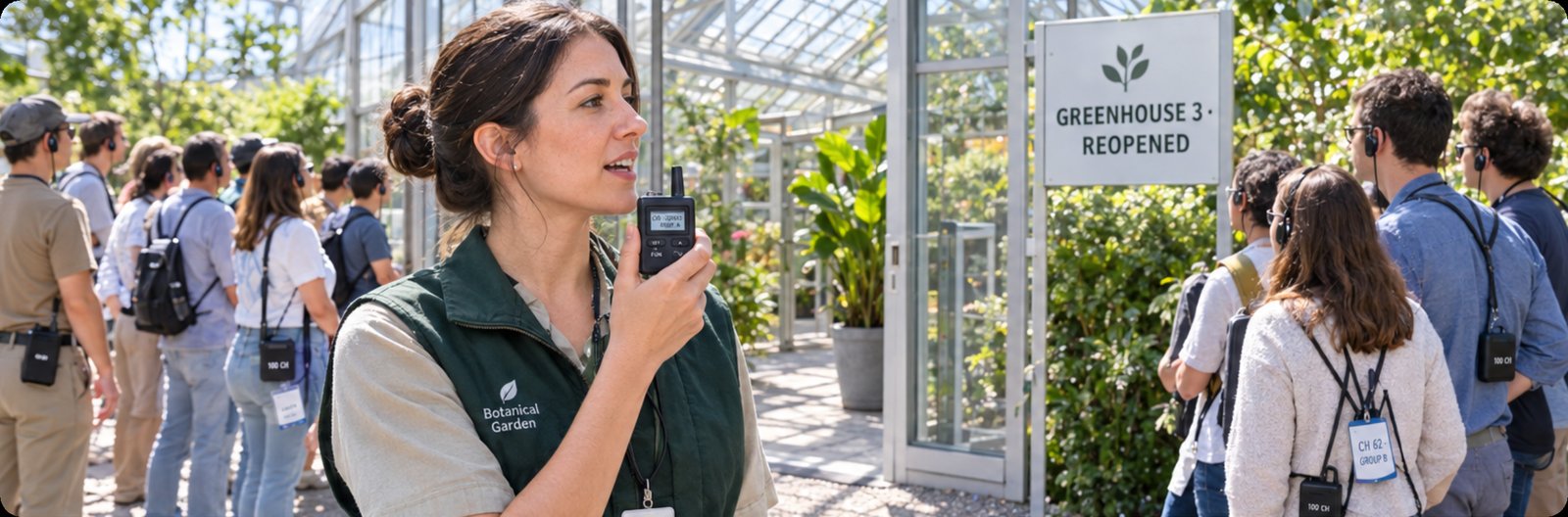
RC085-zoo_botanical_garden

On the day the glasshouse reopened, that channel count was the difference between three talks running at once and one.

Two Feedings, Five Parties, One Afternoon

The RC8860 sits in the 860 to 870 MHz band with 20 channels, a 10 hour transmitter and a 20 hour receiver, at 59 g and 50 g. Twenty channels is not a lot until you notice what it is used for here: one talk, one party, no splitting. On feed rounds it carries a single group that has to stay together, which is exactly the case where a low channel count costs nothing.
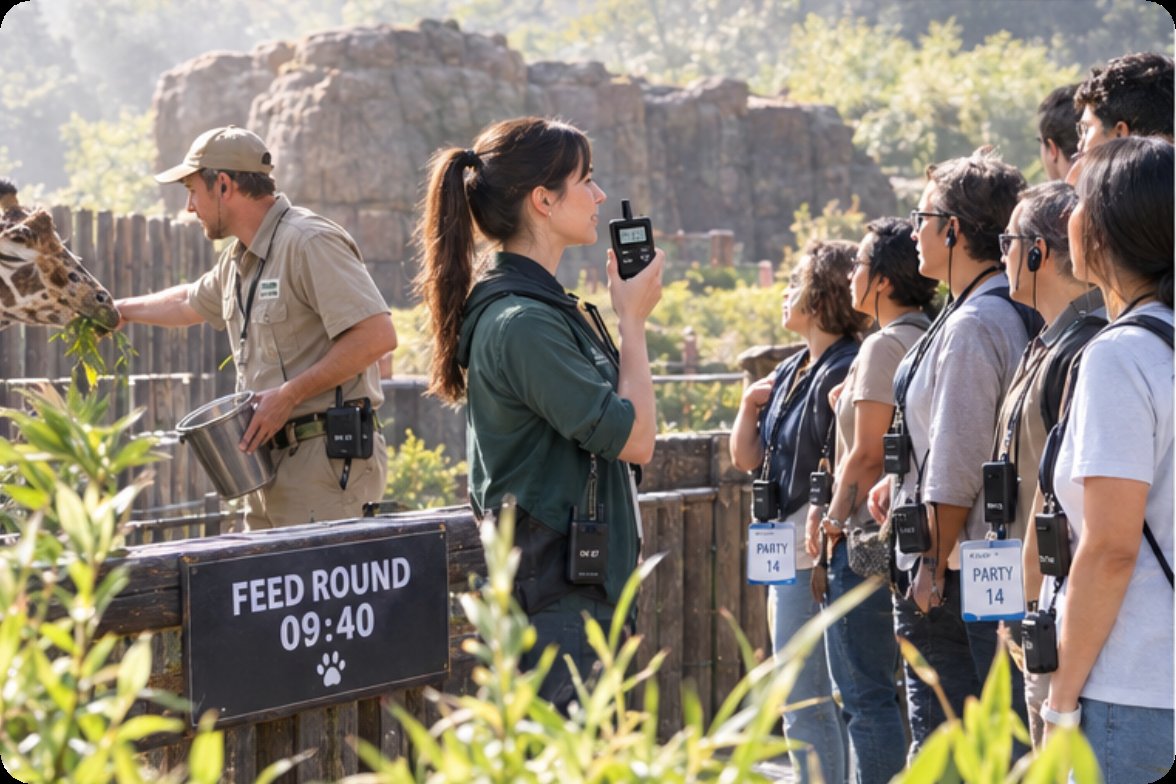
RC8860-zoo_botanical_garden

Both units accept a charge from a DC port, so the overnight routine is the same for two thirds of the bag, and a guide moving between a feed round and a garden walk does not have to learn a second procedure. The band it works in is a single UHF range rather than a spread, so a site that settles on it is committing to one slice of spectrum and one set of spares rather than two.

The Three Units, Field by Field

The RC2408 is the 2.4 GHz unit of the three, on the 2403 to 2483 MHz band, with 80 channels, a 10 hour transmitter, a 20 hour receiver, and the same 59 g and 50 g split. Eighty channels lands between the other two and covers the ordinary case: a route with three or four parties and a need to re-cut them once or twice a day, with enough headroom that the channel plan stays a line on the morning sheet rather than a document in its own right.
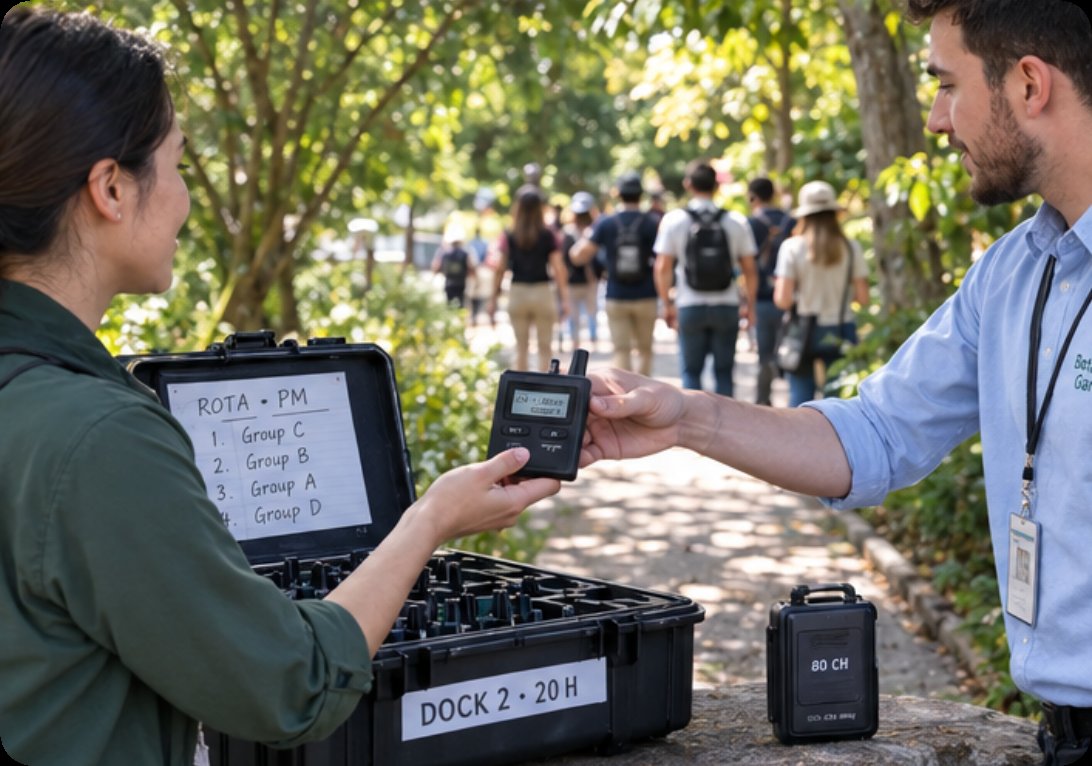
RC2408-zoo_botanical_garden

DimensionRC085RC8860RC2408
Frequency band470-510 MHz860-870 MHz2403-2483 MHz
Channels1002080
Quoted range1-200 m1-200 m1-200 m
Output power8-10 mW10 mW10 mW
Transmitter battery life12 h10 h10 h
Receiver battery life20 h20 h20 h
Transmitter weight65 g59 g59 g
Receiver weight60 g50 g50 g
Charging portUSBDC PortDC Port

Enclosure ratings and certifications are left out of the table on purpose. The three models do not publish those fields on the same basis, and a row that stacks unlike figures side by side invites a wrong decision. Anything a tender needs here should be requested as one sheet from one source. What the table does show is where the three genuinely part company: band, channel count, transmitter life, and the two weights.

The Week the Printed Sheet Stopped Working

The test came in the fourth month. A glasshouse due to reopen on a Saturday reopened on a Wednesday, a paddock move pulled two keepers off the talk rota, and the morning feed shifted forward twice in three days. The laminated sheet was useless by Tuesday lunchtime. What held the week together was the channel count sitting in the bag: parties were re-cut three times, twice in the same afternoon, and no group had to be turned away or merged with another. Two of the three talks that ran on the Wednesday were led by staff who had not been down for them on the Sunday.

The site team's own summary afterwards was blunt. They had bought for coverage and had ended up relying on grouping. Distance was never the constraint on a site walked at two or three kilometres an hour. The constraint was how many separate conversations the site could run at once, and how fast those could be broken up and put back together.

What the Wall Chart Holds Now

The sheet is still on the wall. It is written in pencil now, and it carries three columns the printed version never had: which stops are live this week, how the parties divide, and which unit went out with which group. Nothing about the site has become more predictable. The programme simply stopped pretending that it was.

For a collection running its own talk rota with a small team and a mixed fleet, that is the useful part. If your site is drawing up the same list and finding it out of date before the ink dries, it is worth reading the wider wireless tour guide system range with grouping in mind rather than distance, and looking at a field day on an open site that reached the same conclusion.


2026年09月18日 11:06
click: 12
no data

RC085, RC8860 and RC2408: A Programme a Living Collection Keeps Rewriting

time: 2026年09月18日 click:12

A zoo with a botanical garden attached looks like one site on a map. On the ground it is a set of places that keep changing what they hold. A glasshouse is emptied and replanted between shows. A paddock moves an animal from one month to the next. A border is worth talking about for three weeks and then worth walking past. Our team is usually called in at the point where a group programme has quietly stopped matching the site it was written for.

The brief behind this piece came from a collection with one ticket, one set of paths, and a talk list that had been printed, laminated and pinned up a year earlier. Three units went out on trial that spring. What follows is what the season taught the site team, and why the answer turned out not to be a larger transmitter but a different way of deciding what goes into the bag each morning. Operators who run paid routes through open ground tend to recognise the same problem, and it sits close to the work we do on city tour solutions.

What Arrived With the Enquiry

The first document was a season plan. Twelve dates, fixed start times, four named stops, one lead guide per slot, and a note at the foot asking whether forty receivers would be enough. It read like a factory visit schedule, and it had been built the way most sites build one: by listing the places that are interesting in June and assuming they stay interesting.

Two months in, the plan had drifted. A glasshouse closed early for replanting. The bird collection moved feeding to the morning because of a heat spell. A new walkway opened at the far end, and the talk written for it did not exist yet. None of that was a radio failure. It was a planning failure, and it was the reason the equipment question kept coming back to the desk.

A Feeding Round Sets the Clock, Not the Office

In a zoo, the talk schedule sits downstream of the animal care schedule. Feed rounds happen when they happen, and a keeper talk that a visitor has travelled to hear has to land on top of one of them or it has nothing to show. Start times therefore move with the collection rather than with the marketing calendar. When the cats went to an earlier feed for the summer, four of the twelve printed dates had to be rewritten in a single morning.

This is where a fixed installation stops being enough. The staff who lead talks are not the staff who own the equipment, and the exchange happens twice a day at the gate. What matters at that exchange is how quickly a unit can be put into different hands and pointed at a different group. A kit that needs a specialist to configure it will not survive a morning where the rota has already been rewritten twice, which is why the site settled on units any member of the team can hand out.

Greenhouses That Change What They Hold

A botanical garden is a set of rooms refurnished from the ground up at fixed points in the year. A glasshouse given over to a display is emptied, replanted and reopened on a date nobody controls precisely, because it depends on the plants. A bed that is the whole point of a route in April is bare in June. A talk list has to survive that, and a paper list does not.

The practical consequence is that the number of live stops on a given day varies more than the number of visitors does. A guide arriving for a morning shift may be running four stops or seven, and the split between them changes what the party has to be divided into.

💡 Why Three Bands Travel in One Bag

Three different frequency ranges ended up in the same kit bag, and the reason was grouping rather than distance. The RC085 works in the 470 to 510 MHz band and offers 100 channels. On a day when a site is running several parties through overlapping ground, channel count is the resource being spent, and a hundred of them means a party can be split again without anyone having to renegotiate with another group. Its transmitter runs 12 hours against the receiver's 20, and the two halves weigh 65 g and 60 g. A small LCD and the F1 and F2 modes let a guide change group without walking back to the desk, and the frequency response is quoted at 50Hz to 12kHz with PLL frequency synthesis holding the channel steady.

RC085-zoo_botanical_garden

On the day the glasshouse reopened, that channel count was the difference between three talks running at once and one.

Two Feedings, Five Parties, One Afternoon

The RC8860 sits in the 860 to 870 MHz band with 20 channels, a 10 hour transmitter and a 20 hour receiver, at 59 g and 50 g. Twenty channels is not a lot until you notice what it is used for here: one talk, one party, no splitting. On feed rounds it carries a single group that has to stay together, which is exactly the case where a low channel count costs nothing.

RC8860-zoo_botanical_garden

Both units accept a charge from a DC port, so the overnight routine is the same for two thirds of the bag, and a guide moving between a feed round and a garden walk does not have to learn a second procedure. The band it works in is a single UHF range rather than a spread, so a site that settles on it is committing to one slice of spectrum and one set of spares rather than two.

The Three Units, Field by Field

The RC2408 is the 2.4 GHz unit of the three, on the 2403 to 2483 MHz band, with 80 channels, a 10 hour transmitter, a 20 hour receiver, and the same 59 g and 50 g split. Eighty channels lands between the other two and covers the ordinary case: a route with three or four parties and a need to re-cut them once or twice a day, with enough headroom that the channel plan stays a line on the morning sheet rather than a document in its own right.

RC2408-zoo_botanical_garden

DimensionRC085RC8860RC2408
Frequency band470-510 MHz860-870 MHz2403-2483 MHz
Channels1002080
Quoted range1-200 m1-200 m1-200 m
Output power8-10 mW10 mW10 mW
Transmitter battery life12 h10 h10 h
Receiver battery life20 h20 h20 h
Transmitter weight65 g59 g59 g
Receiver weight60 g50 g50 g
Charging portUSBDC PortDC Port

Enclosure ratings and certifications are left out of the table on purpose. The three models do not publish those fields on the same basis, and a row that stacks unlike figures side by side invites a wrong decision. Anything a tender needs here should be requested as one sheet from one source. What the table does show is where the three genuinely part company: band, channel count, transmitter life, and the two weights.

The Week the Printed Sheet Stopped Working

The test came in the fourth month. A glasshouse due to reopen on a Saturday reopened on a Wednesday, a paddock move pulled two keepers off the talk rota, and the morning feed shifted forward twice in three days. The laminated sheet was useless by Tuesday lunchtime. What held the week together was the channel count sitting in the bag: parties were re-cut three times, twice in the same afternoon, and no group had to be turned away or merged with another. Two of the three talks that ran on the Wednesday were led by staff who had not been down for them on the Sunday.

The site team's own summary afterwards was blunt. They had bought for coverage and had ended up relying on grouping. Distance was never the constraint on a site walked at two or three kilometres an hour. The constraint was how many separate conversations the site could run at once, and how fast those could be broken up and put back together.

What the Wall Chart Holds Now

The sheet is still on the wall. It is written in pencil now, and it carries three columns the printed version never had: which stops are live this week, how the parties divide, and which unit went out with which group. Nothing about the site has become more predictable. The programme simply stopped pretending that it was.

For a collection running its own talk rota with a small team and a mixed fleet, that is the useful part. If your site is drawing up the same list and finding it out of date before the ink dries, it is worth reading the wider wireless tour guide system range with grouping in mind rather than distance, and looking at a field day on an open site that reached the same conclusion.

no data
×

Contact us

email:
name:
subject:
content: