A leading China factory specializing in Wireless Tour Guide Systems, Church Audio Guides, and Translation Headphones with premium OEM/ODM solutions.

Tel:+86 18922879583

Email:tiger.wang@richitek.com

RC2501 RC2406 RC085 Sports Stadium Commentary Guided Tour Industry Trends

RC2501, RC2406 and RC085: Stadium Audio Enters Its Multi-Tenant Era

A stadium used to be one tenant with one sound system. The building hosted home fixtures every other weekend and sat half-dark in between. That business model is gone. Operators now pack concert tours, esports finals, community open days and paid venue tours into the same calendar, and each of those audiences brings its own guiding and commentary needs. Our read of the trend is blunt: the winner in venue audio over the next few years will not be whoever sells the most units, but whoever builds the most reusable pool.

That shift changes what buyers should even be comparing. Instead of asking which single transmitter sounds best on match day, venue managers increasingly ask which mix of wireless tour guide systems can rotate through a hundred event days without a charging crisis or a frequency fight. Three of our units keep coming up in those conversations — the RC2501, the RC2406 and the RC085 — because together they cover the three jobs a multi-tenant building actually needs done.

💡 Why One Venue Now Serves Five Different Crowds

The economics explain themselves. A stadium's costs land whether the gates open or not, so every extra event day on the calendar is nearly pure margin. Venue tours, fitness mornings, fan meet-ups and corporate hospitality all sell access to the same building, and most of them need the same thing: a guide talking to a moving group over crowd noise. When we visit operators, the conversation has moved from "how many receivers for the fixture" to "how many simultaneous groups can this building run on a Saturday in August". That is a pooling question, not a purchase question.

The Equipment Pool Replaces the Equipment Room

Under the old model, each department owned its kit and guarded it. Under the new one, a central pool checks units out to whichever event needs them, which puts three new demands on the hardware itself. Batteries must survive back-to-back bookings without a full reset between them. Frequencies must coexist when several groups operate inside one bowl at once. And the units must be light enough that a rotating crew of casual staff can hand them out at the gate without training. Those three demands map almost perfectly onto the three products below.
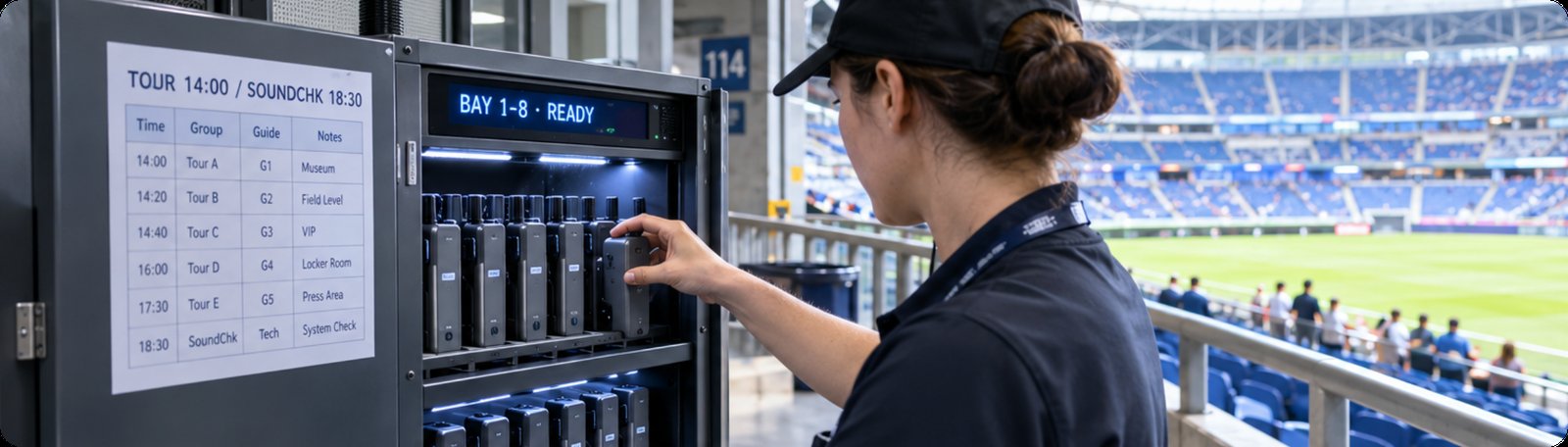
RC2501-sports_stadium

Long Days Need Transmitters That Outlast the Encore

The first job is endurance, and this is where the RC2501 earns its slot in the pool. Its transmitter runs 15 hours on a 3.7V 1500mAh cell and its receivers hold 35 hours or more, so a unit issued for a morning venue tour still has juice for the evening soundcheck walk-through. At 13mW output it carries farther than most of the range, and at 47 grams per unit — transmitter and receiver alike — gate staff can hand out two hundred of them without a logistics plan. Type-C charging means one common cable family across the charging cabinet, and the optional headworn or lapel mic matters when a stadium docent needs both hands free. For a pool, units that come back charged are units that go out again tomorrow.

Eighty Channels for a Building That Never Goes Quiet

The second job is coexistence. On a busy day, three tour groups, a press brigade and a sponsors' walkaround may all be moving through the same concourse, and two groups sharing a channel is how operators lose clients. The RC2406 was built for exactly this crowding: 80 channels on the 2.4GHz band with interference resistance as its core design goal, inside the same 2403-2483MHz window as the rest of the fleet. Output is a venue-friendly 10mW with a 200-meter working range, transmitters run 10 hours against 20 on the receivers, and the DC-port charging suits a fixed charging cabinet bolted to the equipment room wall. When the pool scales past a dozen simultaneous groups, channel count stops being a spec and becomes the whole product.
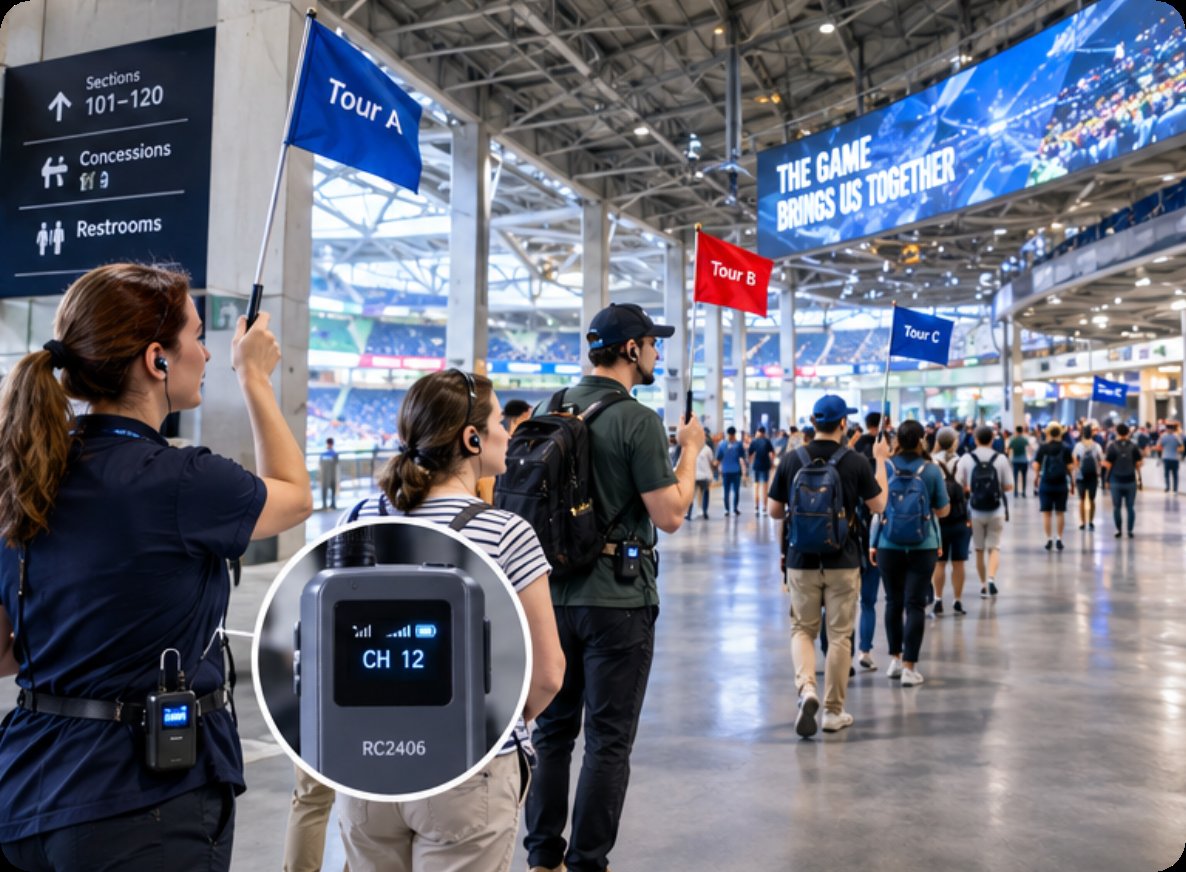
RC2406-sports_stadium

💡 Why Some Houses Still Ask for UHF

The third job is the awkward venue. Older concrete bowls, steel truss roofs and basement levels chew on 2.4GHz in ways a site survey sometimes cannot fully predict, and operators who have been burned before ask for a fallback on a different band. That is the RC085: it works the 470-510MHz UHF range with 100 channels and roughly -102dBm sensitivity, which behaves very differently around steel and mass concrete than a crowded shared band. It puts out 8-10mW across the same 200-meter class of range, runs 12 hours on the transmitter and 20 on the receiver, and keeps the same optional headworn or lapel mic so guides can switch bands without changing technique. A pool that holds a UHF wing rarely has to tell a client "that area is a dead zone".
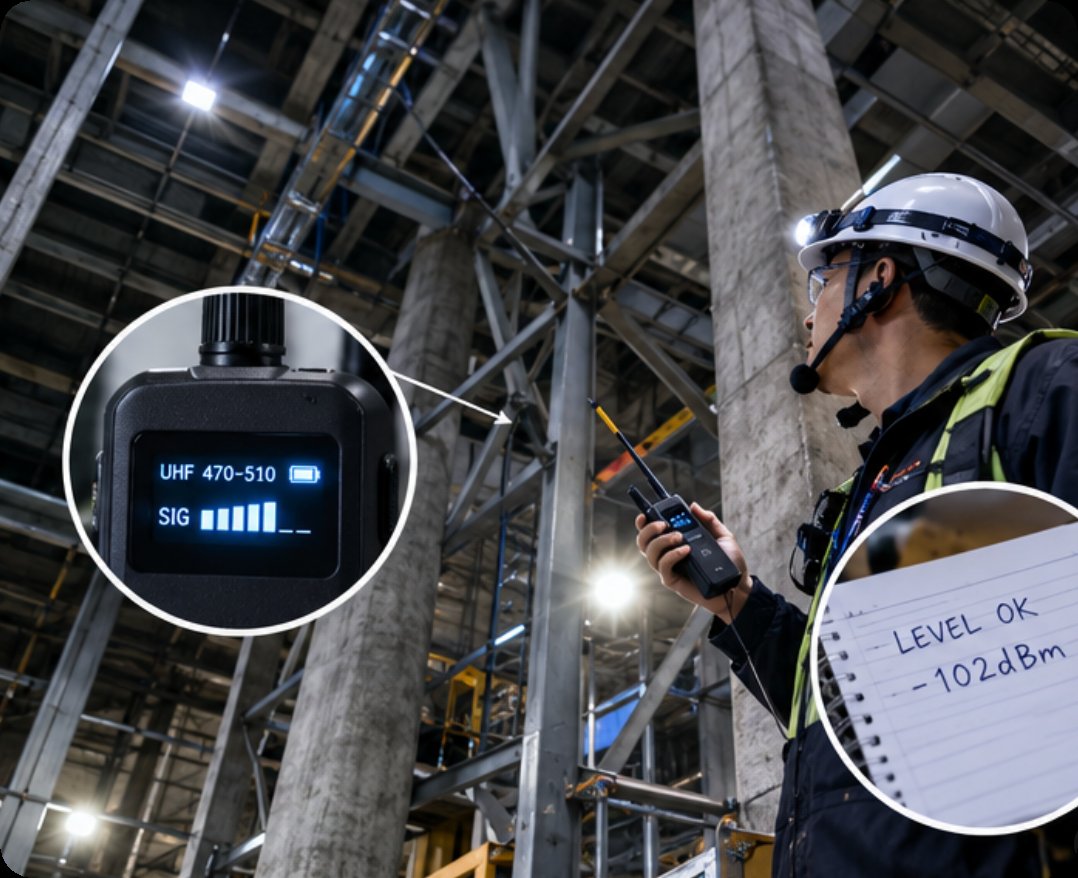
RC085-sports_stadium

A Table for the Pool Manager

UnitBandChannelsBattery (TX / RX)Weight (TX / RX)Role in the pool
RC25012.4GHz5015h / 35+h47g / 47gAll-day bookings, fast turnaround
RC24062.4GHz8010h / 20h59g / 50gMany groups at once, interference-heavy days
RC085UHF 470-510MHz10012h / 20h65g / 60gSteel-and-concrete zones, band fallback

All three share the same 1-200m working range and PLL control, which is what makes them one pool rather than three separate inventories. Charging ports differ — Type-C, DC and USB respectively — so the charging cabinet should be planned around the mix, not ordered as an afterthought.

🔮 What This Trend Changes Before Your Next Order

If your building is drifting toward multi-tenant operation, the tender document is the wrong place to discover it. Write the pool requirements down first: peak simultaneous groups, longest single booking, the zones where 2.4GHz has already misbehaved, and who on staff resets and reissues the units. Colors can be customized at volume on all three units, so branding the pool per tenant is a routine request rather than a special favor — our OEM ODM line handles exactly this kind of venue-specific configuration. Buyers who specify the pool scenario upfront consistently end up with fewer units doing more work than those who buy by head count alone.

Tell Us the Season, Not Just the Head Count

When you are ready to plan, send us the building's event calendar sketch instead of a receiver quantity. From the calendar we can tell you how the tour guide system pool should split across long-day units, high-channel units and a UHF fallback wing, and where a solutions-level plan saves money over per-event rentals. The stadiums that made this transition earliest all started with the same step: they stopped counting seats and started counting event days. Bring us yours, and we will size the pool around it.
2026年09月21日 09:00
click: 231

RC2501 RC2406 RC085 Sports Stadium Commentary Guided Tour Industry Trends

time: 2026年09月21日 click:231

RC2501, RC2406 and RC085: Stadium Audio Enters Its Multi-Tenant Era

A stadium used to be one tenant with one sound system. The building hosted home fixtures every other weekend and sat half-dark in between. That business model is gone. Operators now pack concert tours, esports finals, community open days and paid venue tours into the same calendar, and each of those audiences brings its own guiding and commentary needs. Our read of the trend is blunt: the winner in venue audio over the next few years will not be whoever sells the most units, but whoever builds the most reusable pool.

That shift changes what buyers should even be comparing. Instead of asking which single transmitter sounds best on match day, venue managers increasingly ask which mix of wireless tour guide systems can rotate through a hundred event days without a charging crisis or a frequency fight. Three of our units keep coming up in those conversations — the RC2501, the RC2406 and the RC085 — because together they cover the three jobs a multi-tenant building actually needs done.

💡 Why One Venue Now Serves Five Different Crowds

The economics explain themselves. A stadium's costs land whether the gates open or not, so every extra event day on the calendar is nearly pure margin. Venue tours, fitness mornings, fan meet-ups and corporate hospitality all sell access to the same building, and most of them need the same thing: a guide talking to a moving group over crowd noise. When we visit operators, the conversation has moved from "how many receivers for the fixture" to "how many simultaneous groups can this building run on a Saturday in August". That is a pooling question, not a purchase question.

The Equipment Pool Replaces the Equipment Room

Under the old model, each department owned its kit and guarded it. Under the new one, a central pool checks units out to whichever event needs them, which puts three new demands on the hardware itself. Batteries must survive back-to-back bookings without a full reset between them. Frequencies must coexist when several groups operate inside one bowl at once. And the units must be light enough that a rotating crew of casual staff can hand them out at the gate without training. Those three demands map almost perfectly onto the three products below.

RC2501-sports_stadium

Long Days Need Transmitters That Outlast the Encore

The first job is endurance, and this is where the RC2501 earns its slot in the pool. Its transmitter runs 15 hours on a 3.7V 1500mAh cell and its receivers hold 35 hours or more, so a unit issued for a morning venue tour still has juice for the evening soundcheck walk-through. At 13mW output it carries farther than most of the range, and at 47 grams per unit — transmitter and receiver alike — gate staff can hand out two hundred of them without a logistics plan. Type-C charging means one common cable family across the charging cabinet, and the optional headworn or lapel mic matters when a stadium docent needs both hands free. For a pool, units that come back charged are units that go out again tomorrow.

Eighty Channels for a Building That Never Goes Quiet

The second job is coexistence. On a busy day, three tour groups, a press brigade and a sponsors' walkaround may all be moving through the same concourse, and two groups sharing a channel is how operators lose clients. The RC2406 was built for exactly this crowding: 80 channels on the 2.4GHz band with interference resistance as its core design goal, inside the same 2403-2483MHz window as the rest of the fleet. Output is a venue-friendly 10mW with a 200-meter working range, transmitters run 10 hours against 20 on the receivers, and the DC-port charging suits a fixed charging cabinet bolted to the equipment room wall. When the pool scales past a dozen simultaneous groups, channel count stops being a spec and becomes the whole product.

RC2406-sports_stadium

💡 Why Some Houses Still Ask for UHF

The third job is the awkward venue. Older concrete bowls, steel truss roofs and basement levels chew on 2.4GHz in ways a site survey sometimes cannot fully predict, and operators who have been burned before ask for a fallback on a different band. That is the RC085: it works the 470-510MHz UHF range with 100 channels and roughly -102dBm sensitivity, which behaves very differently around steel and mass concrete than a crowded shared band. It puts out 8-10mW across the same 200-meter class of range, runs 12 hours on the transmitter and 20 on the receiver, and keeps the same optional headworn or lapel mic so guides can switch bands without changing technique. A pool that holds a UHF wing rarely has to tell a client "that area is a dead zone".

RC085-sports_stadium

A Table for the Pool Manager

UnitBandChannelsBattery (TX / RX)Weight (TX / RX)Role in the pool
RC25012.4GHz5015h / 35+h47g / 47gAll-day bookings, fast turnaround
RC24062.4GHz8010h / 20h59g / 50gMany groups at once, interference-heavy days
RC085UHF 470-510MHz10012h / 20h65g / 60gSteel-and-concrete zones, band fallback

All three share the same 1-200m working range and PLL control, which is what makes them one pool rather than three separate inventories. Charging ports differ — Type-C, DC and USB respectively — so the charging cabinet should be planned around the mix, not ordered as an afterthought.

🔮 What This Trend Changes Before Your Next Order

If your building is drifting toward multi-tenant operation, the tender document is the wrong place to discover it. Write the pool requirements down first: peak simultaneous groups, longest single booking, the zones where 2.4GHz has already misbehaved, and who on staff resets and reissues the units. Colors can be customized at volume on all three units, so branding the pool per tenant is a routine request rather than a special favor — our OEM ODM line handles exactly this kind of venue-specific configuration. Buyers who specify the pool scenario upfront consistently end up with fewer units doing more work than those who buy by head count alone.

Tell Us the Season, Not Just the Head Count

When you are ready to plan, send us the building's event calendar sketch instead of a receiver quantity. From the calendar we can tell you how the tour guide system pool should split across long-day units, high-channel units and a UHF fallback wing, and where a solutions-level plan saves money over per-event rentals. The stadiums that made this transition earliest all started with the same step: they stopped counting seats and started counting event days. Bring us yours, and we will size the pool around it.
×

Contact us

email:
name:
subject:
content: