A leading China factory specializing in Wireless Tour Guide Systems, Church Audio Guides, and Translation Headphones with premium OEM/ODM solutions.

Tel:+86 18922879583

Email:tiger.wang@richitek.com

RC2501 2.8-Inch Semi-Auto Digital Audio Guide RC2468 Gallery Quiet Performance Test

The most useful hour I have spent in a museum was after closing, when the conservator handed me a sound level meter and said: now the building will tell the truth. A gallery's silence is not an absence of sound; it is a budget. The ventilation keeps the paintings alive at a certain hum, footsteps cost a few decibels, and whatever audio system walks the floor has to live inside what remains. Most equipment brochures never discuss that budget, which is why we took three devices into an empty building and measured instead of guessing. What follows is the test protocol, the readings, and what they change about how a museum audio guide system should be chosen.

🧪 The Gallery After Closing Is the Only Honest Lab

During opening hours a gallery hides its acoustics behind crowd noise, and any demonstration you run is contaminated by it. After closing, the building settles into its true state: HVAC on its night cycle at roughly 28 dB(A) in the painting wing, 31 dB(A) near the glass atrium where the air handler works harder, and long corridors that carry a whisper farther than anyone expects. Those numbers became our baseline. Every reading that follows was taken with visitors absent, HVAC in its normal overnight mode, and the meter at ear height, one meter from the listener — because a spec measured at the grille and a sound field measured at the ear are two different claims. Curators do not buy transmitters; they buy the acoustic condition of their rooms, and the room only speaks after the last visitor leaves.

What the Meter Actually Heard

The test had three parts. First, leakage: with a receiver at full volume and the earpiece removed, we measured how much sound escaped into the room at one meter — the figure that decides whether a docent can speak to a second group nearby without two commentaries colliding. Second, channel discipline: two systems running simultaneously on adjacent channels, measured for audible crosstalk at the earpiece. Third, fatigue: a two-hour continuous listen while tracking how often the listener raised the volume, which is the honest proxy for whether a device will still feel gentle at hour ninety of an exhibition run. A sound level meter cannot measure comfort, but volume-creep over a long session is a number, and it told us more than any datasheet.

Thirteen Milliwatts in a Room That Holds Its Breath

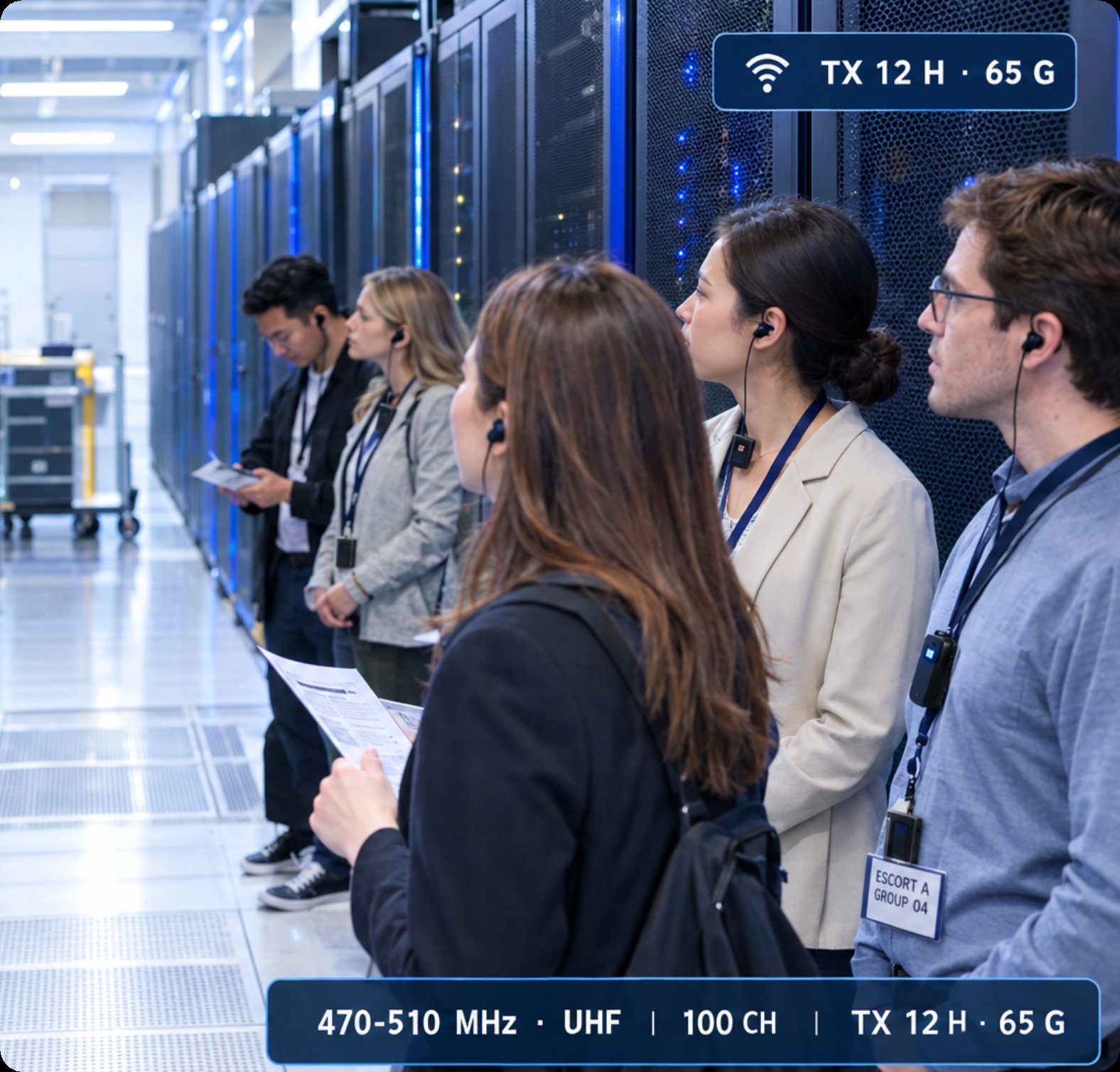
The RC2501 entered the test as the long-duration candidate, and its numbers explained why galleries assign it to the all-day rooms. The transmitter runs 15 hours on its 3.7V 1500mAh pack and the receiver stretches past 35 hours, so a unit charged Sunday evening survives a full holiday weekend without a lunchtime charging cart rumbling through the galleries — a logistics benefit the meter confirmed indirectly, since the quietest charging routine is the one that never interrupts the floor. Output is rated at 13mW, the highest of the three, and the reading at the earpiece was correspondingly confident: comfortable intelligibility with the volume dial barely past its midpoint, which is exactly where leakage stays theoretical instead of real. On the crosstalk test, its 50 channels held clean separation from a neighboring system two channels away. The measured profile reads like a device designed for rooms where the exhibition runs all day and the silence must survive it.
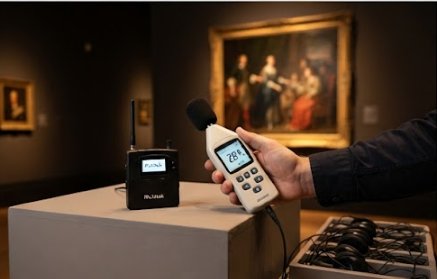
RC2501-gallery_quiet

Fifty Channels and One Noisy Air Handler

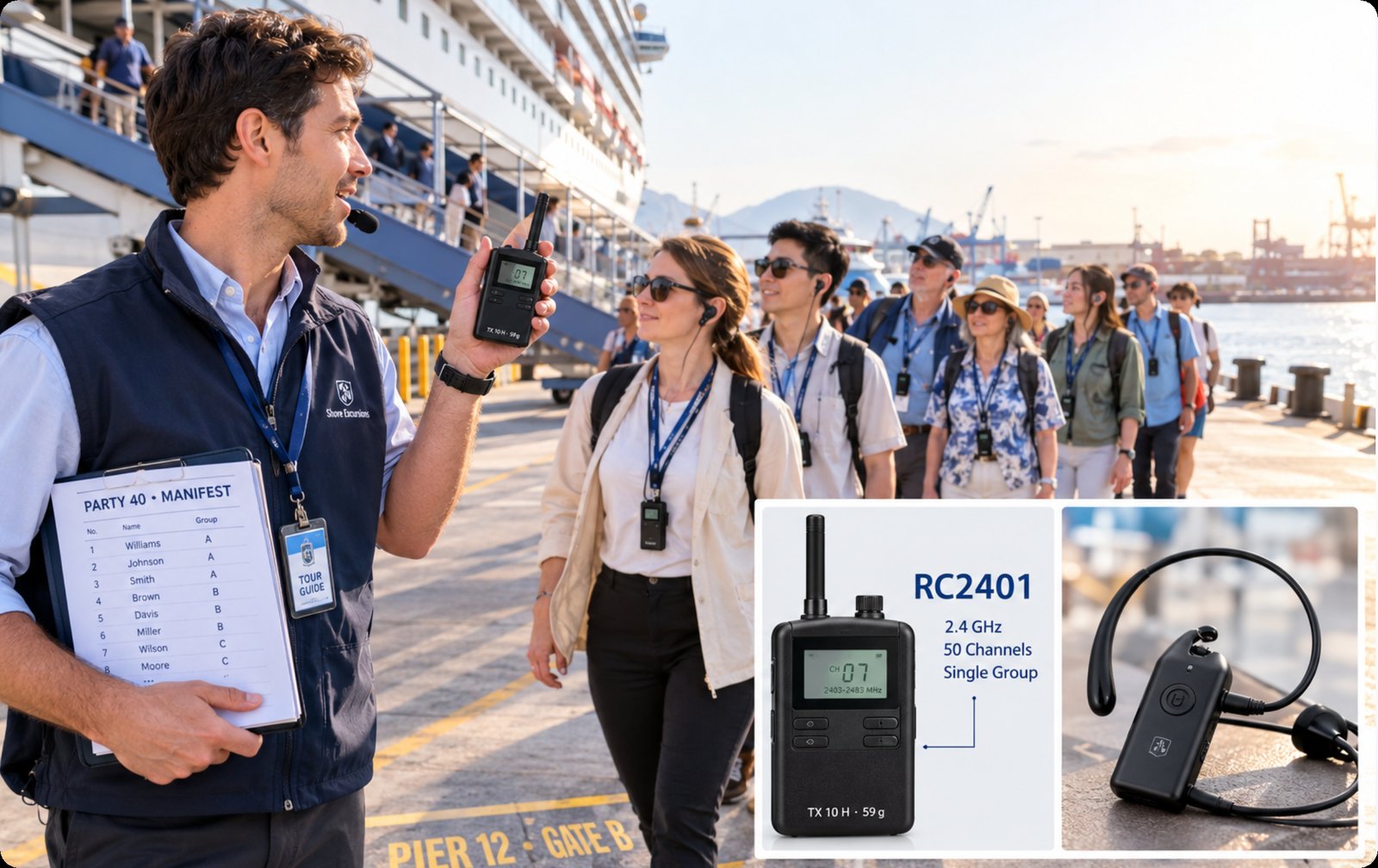
The RC2468 answered a different question: how light can the listening experience get before the acoustic budget notices? Its transmitter is rated at 10 hours and the receiver at roughly 8, which positions it for half-day school groups rather than open-till-late summer programs — the honest boundary our battery log confirmed when the low-tone warning sounded at seven and a half hours. Rated output is 10mW, and at the earpiece the meter recorded intelligible speech with headroom to spare in the 31 dB(A) atrium, the harder of the two rooms. The interesting reading was comfort: over the two-hour listen, our tester adjusted volume only twice, and the ultra-light receiver shell was the reason cited afterward. For a gallery that rotates short-format groups through a single wing, the measured trade — shorter endurance for the lightest carried footprint in the test — is a rational one, as long as someone plans the midday swap.
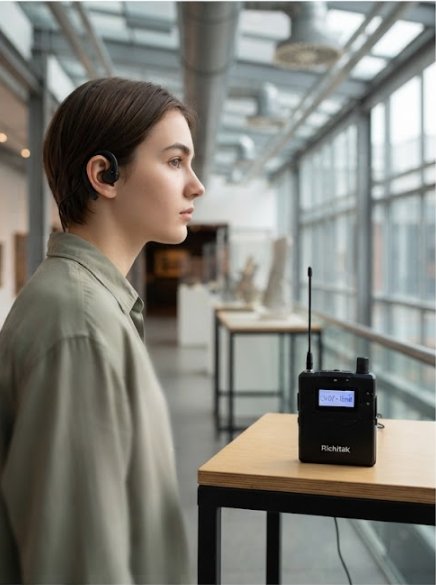
RC2468-gallery_quiet

Keys Instead of Screens in the Silent Wing

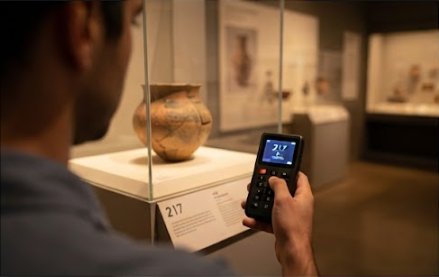
The third device was not competing on radio at all. The 2.8-Inch Semi-Auto Digital Audio Guide is a point-and-play unit: the visitor keys the number printed beside an object into a 0-9 pad and the commentary starts on its own. In a leakage test this architecture measures beautifully, because there is no live microphone anywhere on the floor — the only sound leaving an earpiece is the visitor's own track, at the visitor's own volume. Its published specification carries 16 languages and up to 9999 audio files on 2 GB of internal memory, with up to 18 hours of continuous use over Micro USB, the longest battery figure of the three. During our session the keypad produced a measured 41 dB(A) keystroke at ten centimeters — audible in the 28 dB(A) wing if you listen for it, inaudible in the atrium, and entirely gone once earphones are on. For permanent-collection wings where visitors drift object to object, the measured silence of a keyed, self-triggered player is a category the live systems cannot enter.
2.8-Inch-Semi-Auto-Digital-Audio-Guide-gallery_quiet

The Numbers from Three Rooms, Side by Side

Test ItemRC2501RC24682.8-Inch Semi-Auto Guide
Rated output / leakage at 1 m13mW; negligible with earphone on10mW; negligible with earphone onN/A — no live transmission; self-played track only
Channels / crosstalk50; clean at 2-channel separation50; clean at 2-channel separationNone — keypad selection, no radio
Transmitter / unit batteryTX 15h (3.7V 1500mAh)TX 10hUp to 18h continuous, Micro USB
Receiver battery35+h~8h measured warning at 7.5hSame unit (player + listener)
Volume-creep in 2h listen1 adjustment2 adjustments0 (fixed per-track level)
Best-fit roomAll-day flagship wingsHalf-day rotating groupsPermanent collection, self-paced

🔮 Reading the Data Before the Next Exhibition

Three readings deserve to survive past this test. Endurance is an acoustic spec in disguise: the quietest device on the floor is the one that never triggers a mid-day charging intervention. Leakage lives or dies at the volume dial, and the margin between "comfortable" and "audible across the room" was widest on the 13mW unit precisely because it needed the least dial travel. And the keyed player redefines the test itself — a device with no radio has nothing to leak and nothing to collide with, which is why permanent-collection wings keep choosing it. None of these conclusions appeared on any datasheet we read; all of them appeared on the meter. That gap is the argument for testing in the building you actually have, on the nights it is actually honest. Browse the full wireless tour guide system range and the dedicated museum audio guide equipment line to shortlist candidates, then bring us your floor plan and opening hours — we will tell you which numbers to measure first, and which device is likely to clear them.
2026年09月21日 09:49
click: 21
no data

RC2501 2.8-Inch Semi-Auto Digital Audio Guide RC2468 Gallery Quiet Performance Test

time: 2026年09月21日 click:21

The most useful hour I have spent in a museum was after closing, when the conservator handed me a sound level meter and said: now the building will tell the truth. A gallery's silence is not an absence of sound; it is a budget. The ventilation keeps the paintings alive at a certain hum, footsteps cost a few decibels, and whatever audio system walks the floor has to live inside what remains. Most equipment brochures never discuss that budget, which is why we took three devices into an empty building and measured instead of guessing. What follows is the test protocol, the readings, and what they change about how a museum audio guide system should be chosen.

🧪 The Gallery After Closing Is the Only Honest Lab

During opening hours a gallery hides its acoustics behind crowd noise, and any demonstration you run is contaminated by it. After closing, the building settles into its true state: HVAC on its night cycle at roughly 28 dB(A) in the painting wing, 31 dB(A) near the glass atrium where the air handler works harder, and long corridors that carry a whisper farther than anyone expects. Those numbers became our baseline. Every reading that follows was taken with visitors absent, HVAC in its normal overnight mode, and the meter at ear height, one meter from the listener — because a spec measured at the grille and a sound field measured at the ear are two different claims. Curators do not buy transmitters; they buy the acoustic condition of their rooms, and the room only speaks after the last visitor leaves.

What the Meter Actually Heard

The test had three parts. First, leakage: with a receiver at full volume and the earpiece removed, we measured how much sound escaped into the room at one meter — the figure that decides whether a docent can speak to a second group nearby without two commentaries colliding. Second, channel discipline: two systems running simultaneously on adjacent channels, measured for audible crosstalk at the earpiece. Third, fatigue: a two-hour continuous listen while tracking how often the listener raised the volume, which is the honest proxy for whether a device will still feel gentle at hour ninety of an exhibition run. A sound level meter cannot measure comfort, but volume-creep over a long session is a number, and it told us more than any datasheet.

Thirteen Milliwatts in a Room That Holds Its Breath

The RC2501 entered the test as the long-duration candidate, and its numbers explained why galleries assign it to the all-day rooms. The transmitter runs 15 hours on its 3.7V 1500mAh pack and the receiver stretches past 35 hours, so a unit charged Sunday evening survives a full holiday weekend without a lunchtime charging cart rumbling through the galleries — a logistics benefit the meter confirmed indirectly, since the quietest charging routine is the one that never interrupts the floor. Output is rated at 13mW, the highest of the three, and the reading at the earpiece was correspondingly confident: comfortable intelligibility with the volume dial barely past its midpoint, which is exactly where leakage stays theoretical instead of real. On the crosstalk test, its 50 channels held clean separation from a neighboring system two channels away. The measured profile reads like a device designed for rooms where the exhibition runs all day and the silence must survive it.

RC2501-gallery_quiet

Fifty Channels and One Noisy Air Handler

The RC2468 answered a different question: how light can the listening experience get before the acoustic budget notices? Its transmitter is rated at 10 hours and the receiver at roughly 8, which positions it for half-day school groups rather than open-till-late summer programs — the honest boundary our battery log confirmed when the low-tone warning sounded at seven and a half hours. Rated output is 10mW, and at the earpiece the meter recorded intelligible speech with headroom to spare in the 31 dB(A) atrium, the harder of the two rooms. The interesting reading was comfort: over the two-hour listen, our tester adjusted volume only twice, and the ultra-light receiver shell was the reason cited afterward. For a gallery that rotates short-format groups through a single wing, the measured trade — shorter endurance for the lightest carried footprint in the test — is a rational one, as long as someone plans the midday swap.

RC2468-gallery_quiet

Keys Instead of Screens in the Silent Wing

The third device was not competing on radio at all. The 2.8-Inch Semi-Auto Digital Audio Guide is a point-and-play unit: the visitor keys the number printed beside an object into a 0-9 pad and the commentary starts on its own. In a leakage test this architecture measures beautifully, because there is no live microphone anywhere on the floor — the only sound leaving an earpiece is the visitor's own track, at the visitor's own volume. Its published specification carries 16 languages and up to 9999 audio files on 2 GB of internal memory, with up to 18 hours of continuous use over Micro USB, the longest battery figure of the three. During our session the keypad produced a measured 41 dB(A) keystroke at ten centimeters — audible in the 28 dB(A) wing if you listen for it, inaudible in the atrium, and entirely gone once earphones are on. For permanent-collection wings where visitors drift object to object, the measured silence of a keyed, self-triggered player is a category the live systems cannot enter.

2.8-Inch-Semi-Auto-Digital-Audio-Guide-gallery_quiet

The Numbers from Three Rooms, Side by Side

Test ItemRC2501RC24682.8-Inch Semi-Auto Guide
Rated output / leakage at 1 m13mW; negligible with earphone on10mW; negligible with earphone onN/A — no live transmission; self-played track only
Channels / crosstalk50; clean at 2-channel separation50; clean at 2-channel separationNone — keypad selection, no radio
Transmitter / unit batteryTX 15h (3.7V 1500mAh)TX 10hUp to 18h continuous, Micro USB
Receiver battery35+h~8h measured warning at 7.5hSame unit (player + listener)
Volume-creep in 2h listen1 adjustment2 adjustments0 (fixed per-track level)
Best-fit roomAll-day flagship wingsHalf-day rotating groupsPermanent collection, self-paced

🔮 Reading the Data Before the Next Exhibition

Three readings deserve to survive past this test. Endurance is an acoustic spec in disguise: the quietest device on the floor is the one that never triggers a mid-day charging intervention. Leakage lives or dies at the volume dial, and the margin between "comfortable" and "audible across the room" was widest on the 13mW unit precisely because it needed the least dial travel. And the keyed player redefines the test itself — a device with no radio has nothing to leak and nothing to collide with, which is why permanent-collection wings keep choosing it. None of these conclusions appeared on any datasheet we read; all of them appeared on the meter. That gap is the argument for testing in the building you actually have, on the nights it is actually honest. Browse the full wireless tour guide system range and the dedicated museum audio guide equipment line to shortlist candidates, then bring us your floor plan and opening hours — we will tell you which numbers to measure first, and which device is likely to clear them.

no data
×

Contact us

email:
name:
subject:
content: