
.webp)
An investor visit is not booked by the weather. It is booked by a date that already matters: a set of annual figures, a half-year review, a budget that closes at the end of a quarter, or a plant walk promised to a fund that wants to see the line running. That single fact changes how a fleet gets planned. Nobody scheduling a conference and visit programme asks what the season looks like; they ask which weeks are already spoken for. The equipment question follows from the same calendar, because the headset that has to work on a Tuesday morning in a boardroom may be the same one walking a production floor on the Thursday.
The Busiest Weeks Follow the Reporting Cycle
Spread twelve months of visitor bookings across a chart and the shape is not weather-shaped at all. Clusters land after results are published, ahead of a board cycle, or in the fortnight when a capital decision is being weighed. Everything in between is quiet, and the quiet is not evenly distributed. For whoever prepares the kit, that moves the question from "how many headsets do we own" to "how many have to be ready on the same morning". Two visits in one week is a different planning problem from two visits a month apart, even when the total headcount is identical, because the second one lets you clean, charge and re-case in between and the first does not.
Three Visits in One Quarter, Three Different Rooms
A single quarter can hold three visits that share nothing except the script. The first is a boardroom briefing with the finance team, twenty people around a table, no noise floor to fight. The second walks the production floor, stopping at a cell while a machine runs, then moving on. The third finishes outdoors at a loading yard or a site under construction, where the wind is doing most of the talking. The same crew often runs all three in the same week. A receiver that suits a quiet boardroom is not automatically the one that survives a walk past a running compressor, and the specification that decides which is which is rarely the one printed largest on the box.
The Same script, a Louder Room Each Time
What changes between those three rooms is not the content but the cost of repeating it. In the boardroom a transmitter is a convenience. On the floor it is the only way a group of twenty hears a guide who cannot shout over machinery. Outdoors, volume stops being about comfort and starts being about whether anyone at the back can follow at all. That is why receiver endurance matters more in this scenario than in most: a visit is not a fifteen-minute demo, it is a two-hour walk with a Q and A at the end, and the receiver has to still be working when the questions start. Endurance of twenty hours, or thirty-five, is the difference between a spare box carried unnoticed and a mid-walk swap.
What the Gap Weeks Are For
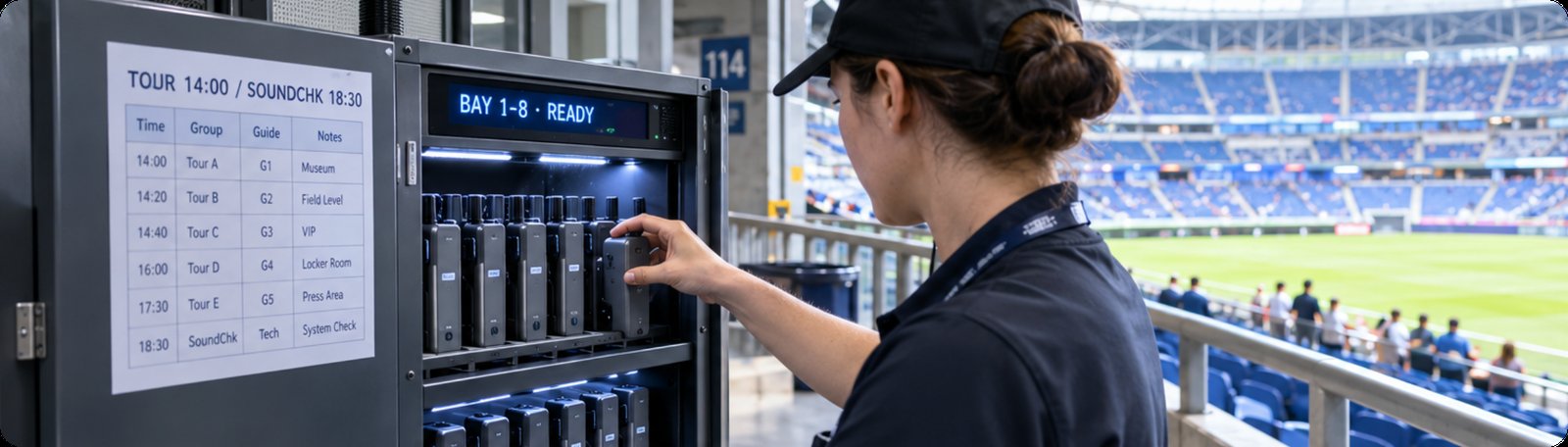
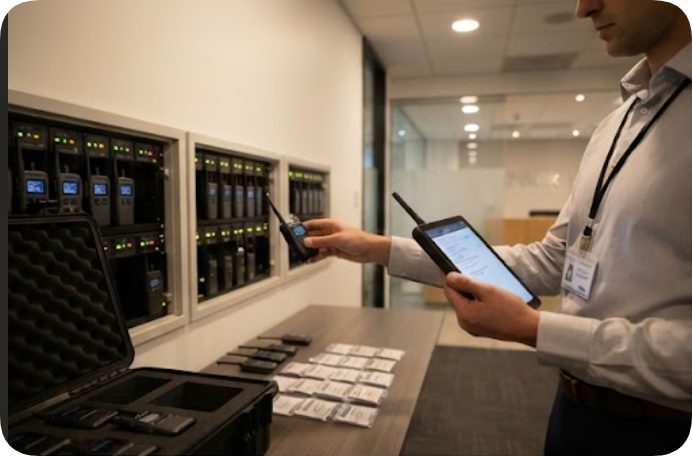
The weeks with no visit are not idle weeks for the kit. They are the only window in which a charge cycle, a channel record and a count can be completed without a group standing in the lobby. Readiness is a narrower standard than maintenance: the question is not whether a unit is in good condition, it is whether it will work on the morning it is next needed. Three things get checked in that window — charge state across the whole set, the channel list written down so the next visit does not re-tune from scratch, and a physical count that matches the case. None of it is complicated, and all of it is impossible to do at nine o'clock on the morning of a visit.
Three Charging Ports, Three Sets of Cables
This is where the three units in this article diverge most in daily use, and it is not a specification anyone writes on a shortlist. One charges over Type-C. One takes a DC port. One uses USB. Three units, three cable types, and three different spares boxes once a venue starts keeping the fleet in one cabinet. On a week when two visits land back to back, a missing cable is not an inconvenience, it is a unit that goes out at partial charge. The practical answer is not to standardise the hardware but to standardise the label: a cable bag per unit type, named on the outside, checked in the same gap week that the charge state is checked. The alternative is discovering the mismatch at the moment the group is already at the door.
Buying by Cycle Rather Than by Attendance
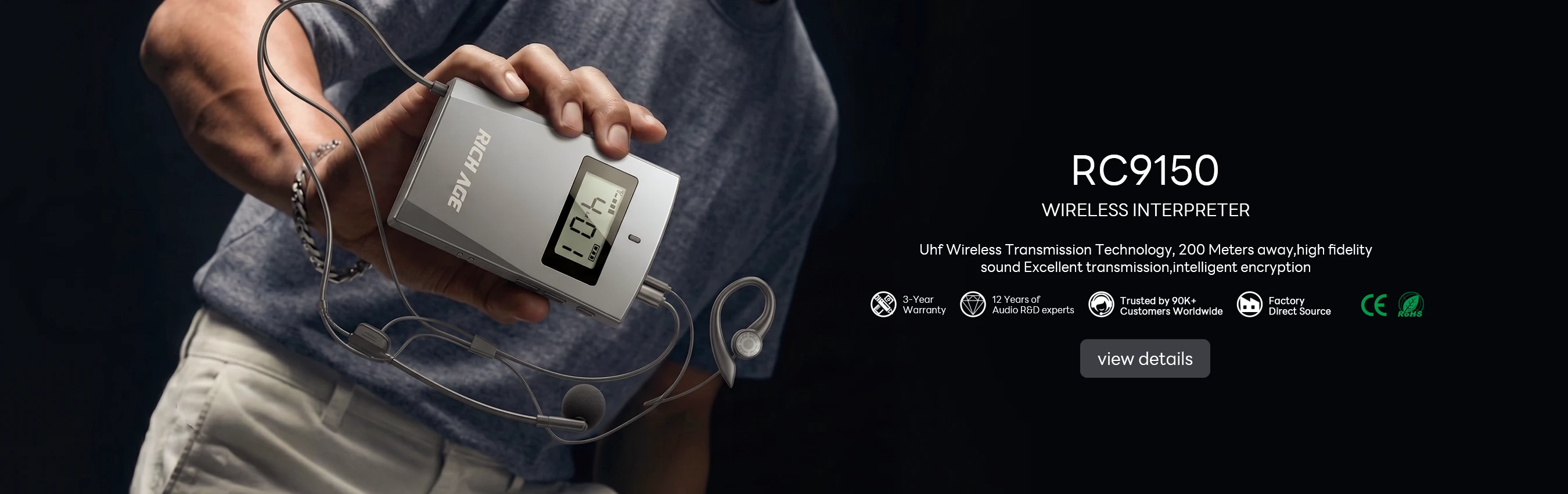
The RC9150 is the unit for the week that holds more than one visit: 100 channels across 2.4 GHz, fifteen hours of transmitter life and better than thirty-five on the receiver, with a 1800mAh cell on both ends and charging over Type-C. It is the one to book when back-to-back days leave no window for a charge.
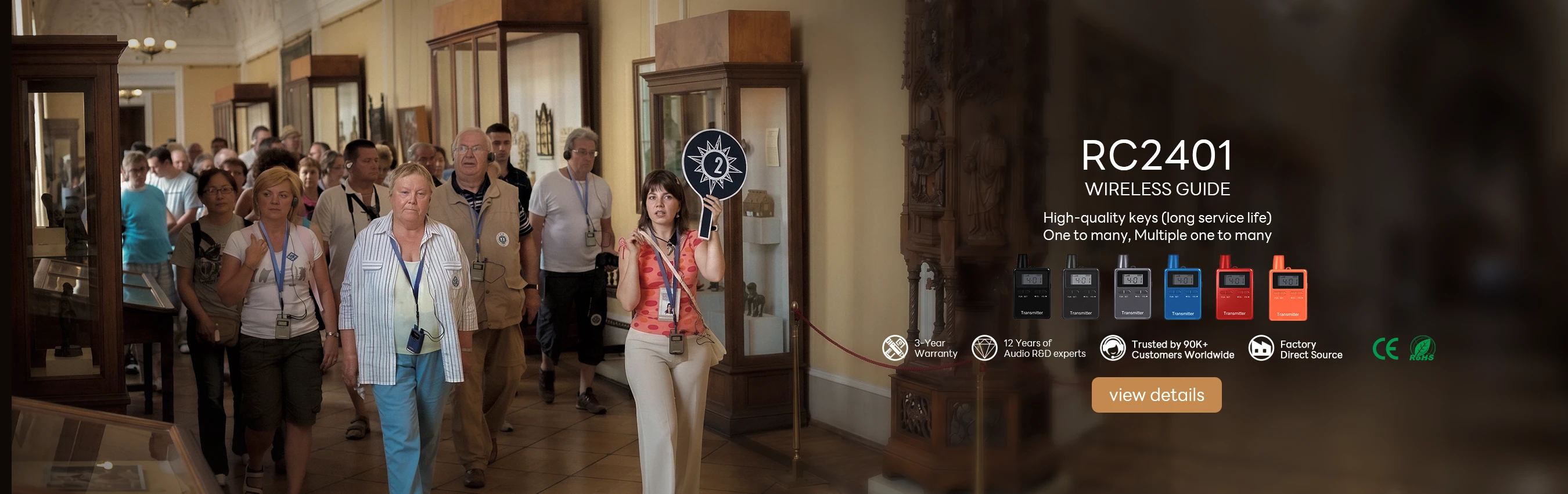
The RC2401 is the volume unit: fifty channels, ten hours of transmitter life and twenty on the receiver, 59g in the hand, charged from a DC port. For a programme of short briefings and boardroom sessions, it covers the year at the lowest cost per visit, and it is the model most venues already own in quantity.

The RC085 is the one for buildings and sites where a 2.4 GHz signal has to survive: it runs on UHF between 470 and 510 MHz, carries 100 channels, twelve hours on the transmitter and twenty on the receiver, and charges over USB. Where an investor walk crosses steel, levels or a long outdoor stretch, this is the unit that keeps the commentary in the ear.

Three Units on One Table
| Specification | RC9150 | RC2401 | RC085 |
|---|---|---|---|
| Frequency band | 2403-2483 MHz | 2403-2483 MHz | 470-510 MHz (UHF) |
| Channels | 100 | 50 | 100 |
| Transmitter battery life | 15h | 10h | 12h |
| Receiver battery life | 35+h | 20h | 20h |
| Transmitter weight | 97.5g | 59g | 65g |
| Receiver weight | 97.5g | 50g | 60g |
| Charging port | Type-C | DC Port | USB |
🔮 Drawing Next Year's Diary First
Before the next order goes out, the useful exercise is not a specification review but a calendar exercise. Mark the reporting dates that are already fixed, then count the weeks that will hold more than one visit. That number, not the annual headcount, is the one the fleet has to survive, and it settles the split between formats at the same time. The calendar is usually published long before the budget is agreed, and it is a far better guide to what to buy than a headcount taken on the day of the busiest visit of the year.
The pattern worth holding on to is that none of the three columns is the safe default. A calendar with clustered visits needs endurance and channels; a calendar of short briefings needs coverage per unit and a low cost per visitor; a building that fights a 2.4 GHz signal needs a band that gets through. Buying for the busiest week and renting nothing is how venues end up with flagships that sit in a cabinet for eleven months. Buying for the average week is how they end up short on the one morning it matters. The middle path is to size the fleet against the reporting calendar and keep a wireless tour guide system spread across two formats, so a week with three visits never depends on one model. Where the choice comes down to two units and one visit, our RC9150 and RC085 comparison works through the same decision on a single page.