
A leading China factory specializing in Wireless Tour Guide Systems, Church Audio Guides, and Translation Headphones with premium OEM/ODM solutions.

Tel:+86 18922879583

Email:tiger.wang@richitek.com

RC2401, RC2468 and RC2402: Matching a Shore Party to a Ship's List

💡 Why the Cabin Number Is the Wrong Starting Point

A shore day begins with a list. The excursion desk closes the night before, the coaches are assigned by departure slot, and the ship's system prints a page with a cabin number beside every guest who signed up. That page is accurate, and the port agent will ask to see it. What it is not arranged around is the thing that decides whether the morning runs smoothly.

For anyone putting together a city tours kit, the useful question is not how many people booked. It is how many separate conversations will be running at once by mid-morning, and who is holding the microphone for each of them. A cabin list answers the first question thoroughly and says nothing at all about the second.

Guests sort themselves the moment they step off the gangway. Families stay together, two couples who met at dinner discover they both want the same viewpoint, and one guest who walks slowly drifts twenty metres behind the rest. None of that appears on the booking page, and none of it can be predicted from a deck plan.

🏟️ Where the Ship's Team Stops and Yours Starts

There is a definite moment when responsibility changes hands, and it is worth naming out loud in front of the group. It arrives at the assembly point, once the vessel's own staff have counted everybody off the ship and the local guide takes the party for the day. Everything before that moment belongs to the ship, and everything after it belongs to whoever is holding the transmitter.

That transfer is easier to run when it is treated as an equipment question rather than a courtesy. The guide who takes the party is the person who signs for the kit, checks the channel, and decides how the group will be divided at the first stop. If two guides are walking out that morning, two transmitters leave the vessel with them, not one.

The kit is small enough that none of this feels like logistics. Three units, a charging cable and a clipboard fit into one shoulder bag, and the guide carrying it is the same person who answers questions at the second stop. What matters is that the answer has been settled before the gangway drops, rather than improvised in front of two waiting coaches.

A Wet Morning and a Table Full of Chargers

The RC2401 wireless tour guide system is the straightforward answer to a port day that may turn wet. Its receiver carries IPX4 splash resistance, which is the difference between a shower at a viewpoint and a bag of silent units by lunchtime. Fifty channels across the 2403-2483 MHz band let several parties work the same pier without negotiating with anybody.

RC2401-cruise_shore_excursion

The charging side matters more than it looks at the quotation stage. This unit refills over a DC port and supports multi-device charging, so one table can bring a whole kit back overnight instead of a row of separate adaptors fighting for sockets. The transmitter runs for 10 hours and the receiver for 20, which covers a full port day with hours in hand.

Six Colours Do the Grouping for You

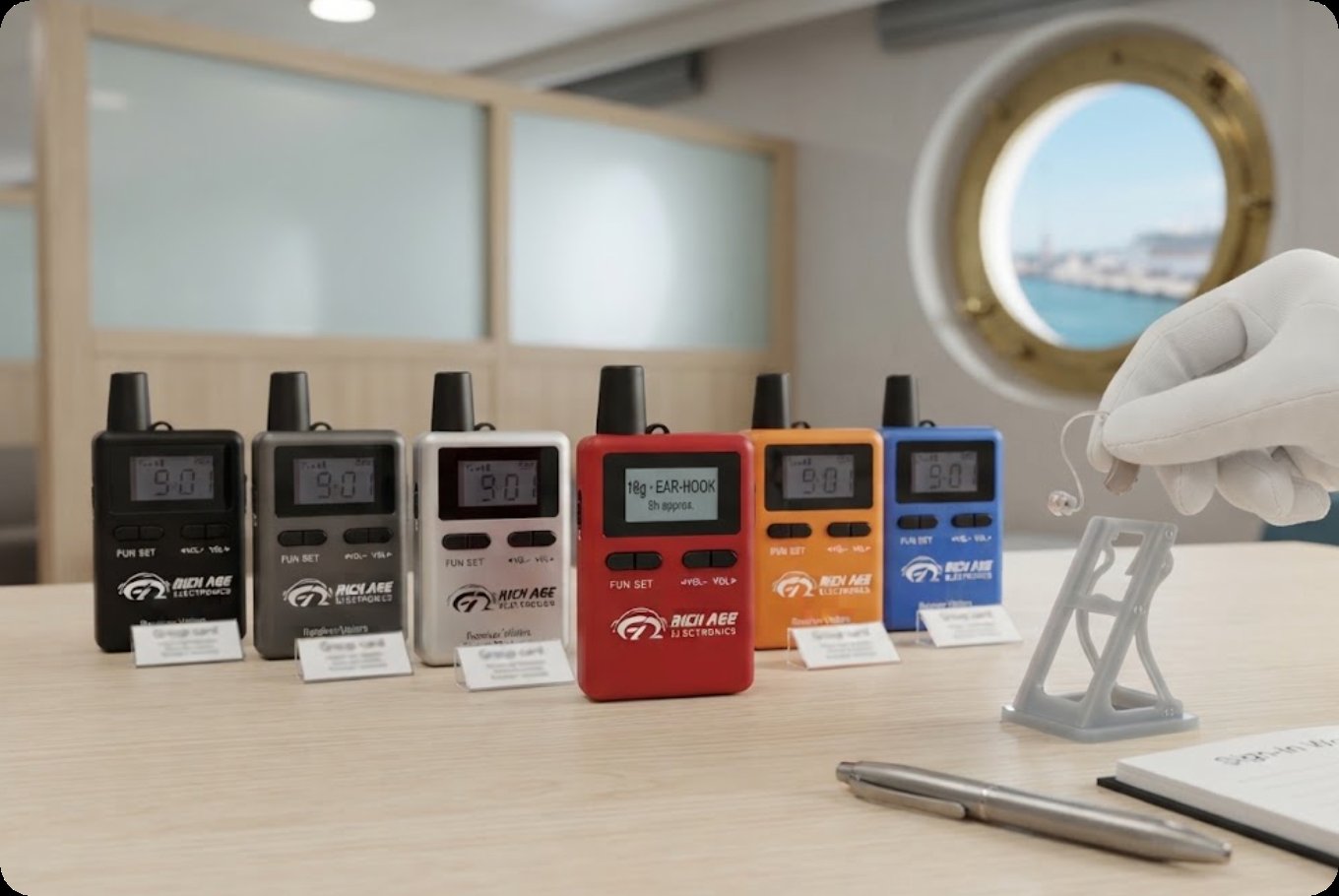
The RC2468 ultra-light tour guide system solves a different problem, namely the guest who stops noticing what is on their ear. Its headset receiver weighs 18 grammes and hooks over the ear rather than resting on the neck, and the transmitter is finished in six colours. Those colours are not a design flourish on a shore day.
RC2468-cruise_shore_excursion

Six transmitter colours are the cheapest group marker a guide can carry: red for the walking party, blue for the coach group, orange for the guests who join after lunch. The trade is on the receiving end, where the cell is smaller at 300mAh and gives roughly 8 hours, so receivers are topped up between outings rather than trusted across a double shift.

Two Coaches, One Pier, No Shared Voices

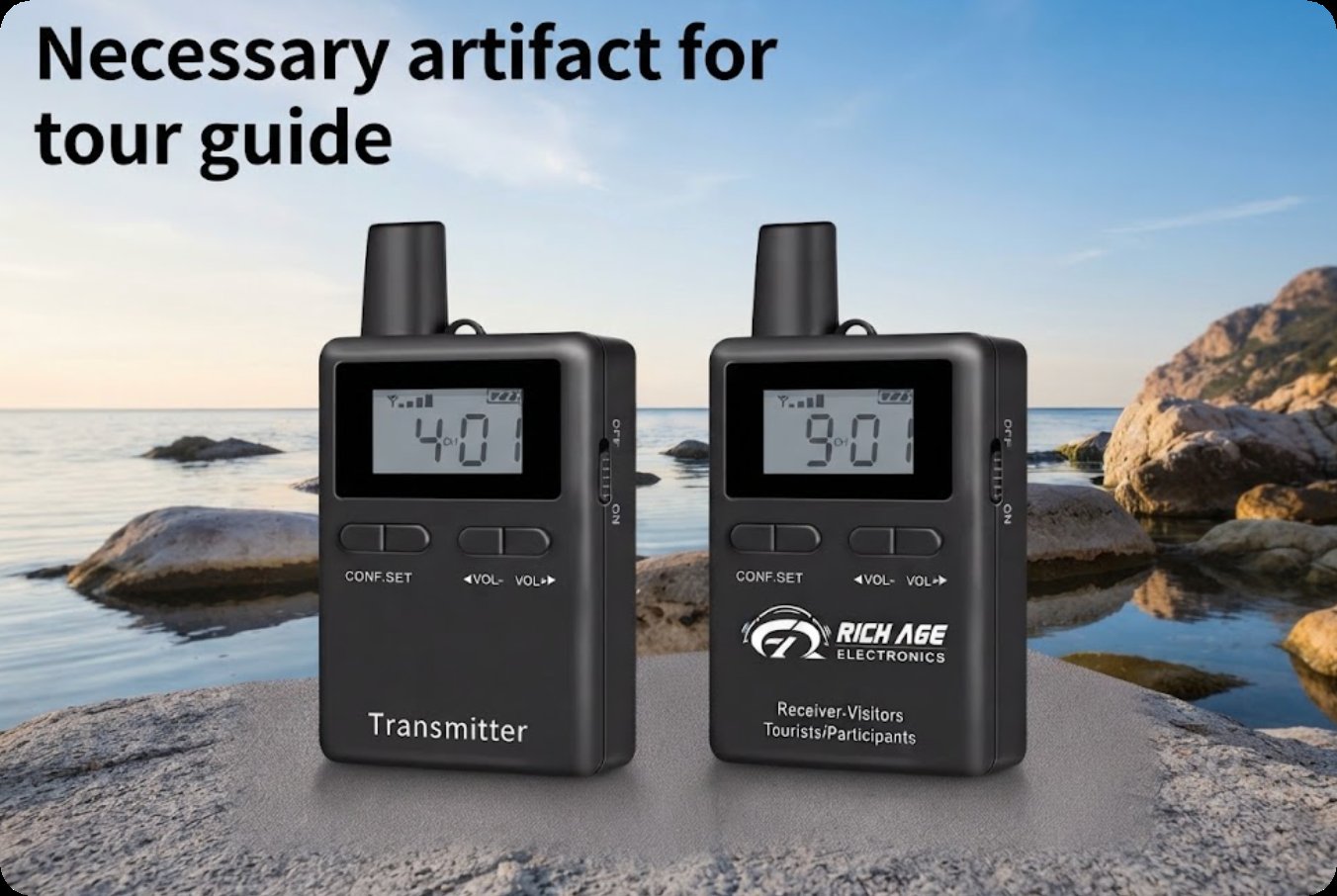
The RC2402 wireless tour guide system is the one to reach for when two coaches leave the same pier in the same quarter hour and the parties are going to cross paths. It pairs on a single click and carries intelligent encryption, so a second party working the next channel along does not overhear the first even while standing in the same square.
RC2402-cruise_shore_excursion

On endurance this unit sits with the RC2401 rather than the light one: 10 hours on the transmitter and 20 on the receiver, drawn from 1500mAh and 1000mAh cells. It charges over the same DC port, so a single spare cable in the guide's bag covers both models and there is no second adaptor to remember.

Reading the Specification Before the Roster Is Fixed

Three figures decide how a shore party gets split before anyone boards a coach. The first is receiver weight, because it sets how long a guest will tolerate wearing the unit. The second is receiver battery life, because a short figure forces a charging stop into the middle of an already tight day. The third is the charging port, which decides what has to be carried ashore.

Everything else the three units share. They work the same 2.4 GHz band, carry the same 50 channels, give the same 10 hours on the transmitter, and put the same 59 grammes in the guide's hand. Every meaningful difference lives on the receiving end, which is precisely where a shore party lives too.

A specification sheet does not travel well onto a pier. What travels is the answer to a guest's question, and those questions repeat: will this still reach me if I stop to take a photograph, how long does it last, and why is the earpiece on some units lighter than on others. Each of those maps onto one published figure.

The Three Units Side by Side

SpecificationRC2401RC2468RC2402
Receiver battery life20h8h approx.20h
Receiver weight50g18g ear-hook50g
Receiver battery3.7V 1000mAh3.7V 300mAh3.7V 1000mAh
Charging portDC PortUSB (Micro USB 5V/1A)DC Port
Transmitter colour optionsMulti-colourSix coloursMulti-colour
CertificationCE / RoHSCE / EMC / LVD / RED / RoHSCE / EMC / LVD / RED / RoHS
Warranty, mainboard3 years3 yearsNot published

Read down the receiver rows and the three units stop looking like each other. The light model gives up battery life and cell capacity to reach 18 grammes, which is the right trade when guests wear the unit for six hours at a stretch. The other two hold 20 hours and a 1000mAh cell, and separate on encryption, charging and certification depth rather than on endurance.

Moment on the shore dayWhat changes handsWho holds it afterwards
Assembly point, before the coachThe kit and the head countThe guide who signed for the transmitters
First stop, where the party spreadsControl of the pace and the colour codingWhichever guide owns that channel
Return leg, at the coach doorReceivers, batteries and spare unitsThe person who kept the charging table

That second table is the one worth copying onto the excursion desk. It maps the three moments where a shore party actually comes apart, and names what has to change hands at each of them. A team that fills it in before the season opens stops renegotiating the same questions at the foot of the gangway every single port day.

What to Settle Before the Coaches Are Loaded

Three decisions are worth writing down before the first coach loads. Decide who signs for the kit, and whether two transmitters leave the ship when two guides walk out. Decide whether guests will be grouped by colour, and if so which colour belongs to which party. Decide where receivers are charged, and whose job that table is.

None of it requires a larger kit, only a clearer one. Operators who want the whole range in a single place can browse our wireless tour guide system line, and anyone still weighing approaches can explore our solutions for port days well before the season opens.


2026年09月23日 09:48
click: 23

RC2401, RC2468 and RC2402: Matching a Shore Party to a Ship's List

time: 2026年09月23日 click:23

💡 Why the Cabin Number Is the Wrong Starting Point

A shore day begins with a list. The excursion desk closes the night before, the coaches are assigned by departure slot, and the ship's system prints a page with a cabin number beside every guest who signed up. That page is accurate, and the port agent will ask to see it. What it is not arranged around is the thing that decides whether the morning runs smoothly.

For anyone putting together a city tours kit, the useful question is not how many people booked. It is how many separate conversations will be running at once by mid-morning, and who is holding the microphone for each of them. A cabin list answers the first question thoroughly and says nothing at all about the second.

Guests sort themselves the moment they step off the gangway. Families stay together, two couples who met at dinner discover they both want the same viewpoint, and one guest who walks slowly drifts twenty metres behind the rest. None of that appears on the booking page, and none of it can be predicted from a deck plan.

🏟️ Where the Ship's Team Stops and Yours Starts

There is a definite moment when responsibility changes hands, and it is worth naming out loud in front of the group. It arrives at the assembly point, once the vessel's own staff have counted everybody off the ship and the local guide takes the party for the day. Everything before that moment belongs to the ship, and everything after it belongs to whoever is holding the transmitter.

That transfer is easier to run when it is treated as an equipment question rather than a courtesy. The guide who takes the party is the person who signs for the kit, checks the channel, and decides how the group will be divided at the first stop. If two guides are walking out that morning, two transmitters leave the vessel with them, not one.

The kit is small enough that none of this feels like logistics. Three units, a charging cable and a clipboard fit into one shoulder bag, and the guide carrying it is the same person who answers questions at the second stop. What matters is that the answer has been settled before the gangway drops, rather than improvised in front of two waiting coaches.

A Wet Morning and a Table Full of Chargers

The RC2401 wireless tour guide system is the straightforward answer to a port day that may turn wet. Its receiver carries IPX4 splash resistance, which is the difference between a shower at a viewpoint and a bag of silent units by lunchtime. Fifty channels across the 2403-2483 MHz band let several parties work the same pier without negotiating with anybody.

RC2401-cruise_shore_excursion

The charging side matters more than it looks at the quotation stage. This unit refills over a DC port and supports multi-device charging, so one table can bring a whole kit back overnight instead of a row of separate adaptors fighting for sockets. The transmitter runs for 10 hours and the receiver for 20, which covers a full port day with hours in hand.

Six Colours Do the Grouping for You

The RC2468 ultra-light tour guide system solves a different problem, namely the guest who stops noticing what is on their ear. Its headset receiver weighs 18 grammes and hooks over the ear rather than resting on the neck, and the transmitter is finished in six colours. Those colours are not a design flourish on a shore day.

RC2468-cruise_shore_excursion

Six transmitter colours are the cheapest group marker a guide can carry: red for the walking party, blue for the coach group, orange for the guests who join after lunch. The trade is on the receiving end, where the cell is smaller at 300mAh and gives roughly 8 hours, so receivers are topped up between outings rather than trusted across a double shift.

Two Coaches, One Pier, No Shared Voices

The RC2402 wireless tour guide system is the one to reach for when two coaches leave the same pier in the same quarter hour and the parties are going to cross paths. It pairs on a single click and carries intelligent encryption, so a second party working the next channel along does not overhear the first even while standing in the same square.

RC2402-cruise_shore_excursion

On endurance this unit sits with the RC2401 rather than the light one: 10 hours on the transmitter and 20 on the receiver, drawn from 1500mAh and 1000mAh cells. It charges over the same DC port, so a single spare cable in the guide's bag covers both models and there is no second adaptor to remember.

Reading the Specification Before the Roster Is Fixed

Three figures decide how a shore party gets split before anyone boards a coach. The first is receiver weight, because it sets how long a guest will tolerate wearing the unit. The second is receiver battery life, because a short figure forces a charging stop into the middle of an already tight day. The third is the charging port, which decides what has to be carried ashore.

Everything else the three units share. They work the same 2.4 GHz band, carry the same 50 channels, give the same 10 hours on the transmitter, and put the same 59 grammes in the guide's hand. Every meaningful difference lives on the receiving end, which is precisely where a shore party lives too.

A specification sheet does not travel well onto a pier. What travels is the answer to a guest's question, and those questions repeat: will this still reach me if I stop to take a photograph, how long does it last, and why is the earpiece on some units lighter than on others. Each of those maps onto one published figure.

The Three Units Side by Side

SpecificationRC2401RC2468RC2402
Receiver battery life20h8h approx.20h
Receiver weight50g18g ear-hook50g
Receiver battery3.7V 1000mAh3.7V 300mAh3.7V 1000mAh
Charging portDC PortUSB (Micro USB 5V/1A)DC Port
Transmitter colour optionsMulti-colourSix coloursMulti-colour
CertificationCE / RoHSCE / EMC / LVD / RED / RoHSCE / EMC / LVD / RED / RoHS
Warranty, mainboard3 years3 yearsNot published

Read down the receiver rows and the three units stop looking like each other. The light model gives up battery life and cell capacity to reach 18 grammes, which is the right trade when guests wear the unit for six hours at a stretch. The other two hold 20 hours and a 1000mAh cell, and separate on encryption, charging and certification depth rather than on endurance.

Moment on the shore dayWhat changes handsWho holds it afterwards
Assembly point, before the coachThe kit and the head countThe guide who signed for the transmitters
First stop, where the party spreadsControl of the pace and the colour codingWhichever guide owns that channel
Return leg, at the coach doorReceivers, batteries and spare unitsThe person who kept the charging table

That second table is the one worth copying onto the excursion desk. It maps the three moments where a shore party actually comes apart, and names what has to change hands at each of them. A team that fills it in before the season opens stops renegotiating the same questions at the foot of the gangway every single port day.

What to Settle Before the Coaches Are Loaded

Three decisions are worth writing down before the first coach loads. Decide who signs for the kit, and whether two transmitters leave the ship when two guides walk out. Decide whether guests will be grouped by colour, and if so which colour belongs to which party. Decide where receivers are charged, and whose job that table is.

None of it requires a larger kit, only a clearer one. Operators who want the whole range in a single place can browse our wireless tour guide system line, and anyone still weighing approaches can explore our solutions for port days well before the season opens.

×

Contact us

email:
name:
subject:
content: