
.webp)
What Leaves With the Kit
A botanical garden rarely keeps its whole audio set on one site. The education team takes a case of players to a school for a week, a sister garden borrows the receivers for a festival weekend, and once the season closes the rest goes back into a store room. Set-ups like these are routine across gardens, zoos and open-air sites, and every one of those moves is a small compliance event. Almost none of it is about the sound. It is about the cell inside each unit, and about whose name sits against that cell while the kit is away.
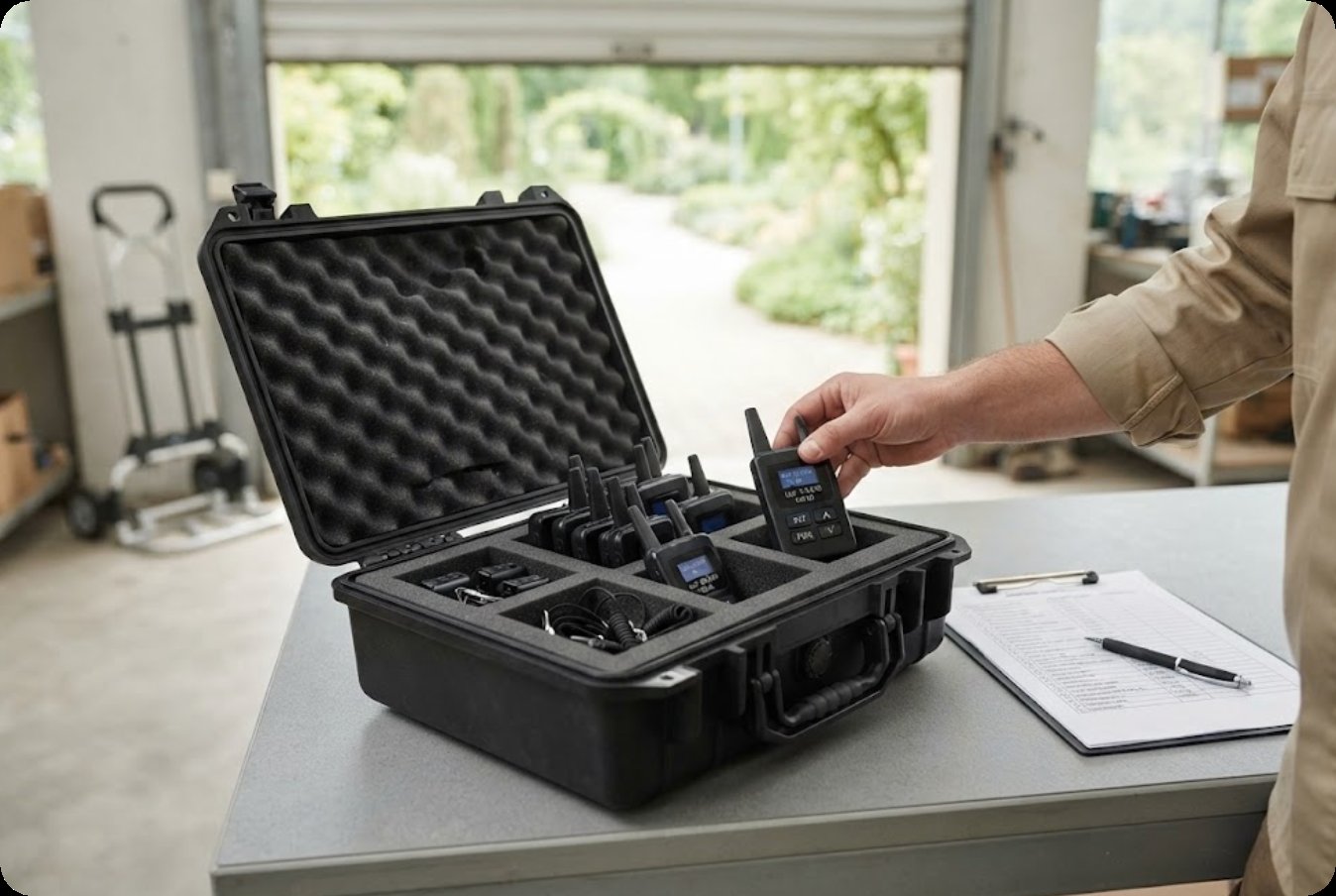
Three units travel in that case, and they are not the same kind of object. One is a standalone player with its own memory and a sealed cell that is not meant to come out. The other two are wireless sets, each carrying a pack in the transmitter and another in the receiver. That single difference decides what a venue has to produce when the kit leaves the grounds, and it is worth reading the three against each other before the first outing is agreed.
A Player That Keeps Its Cell Inside
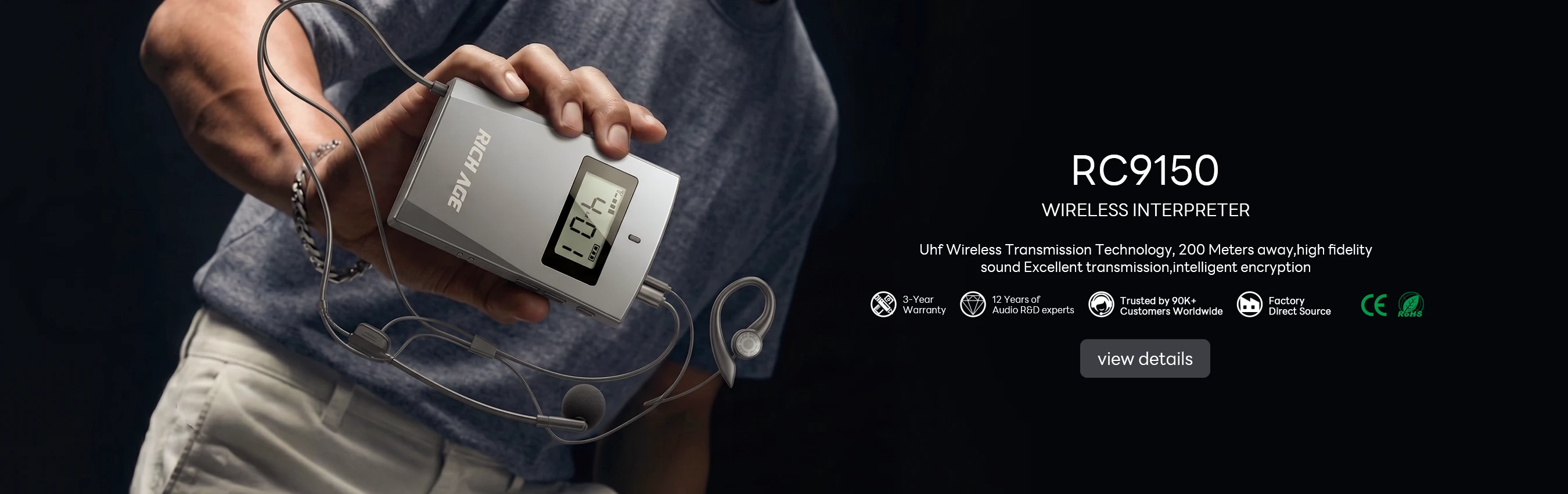
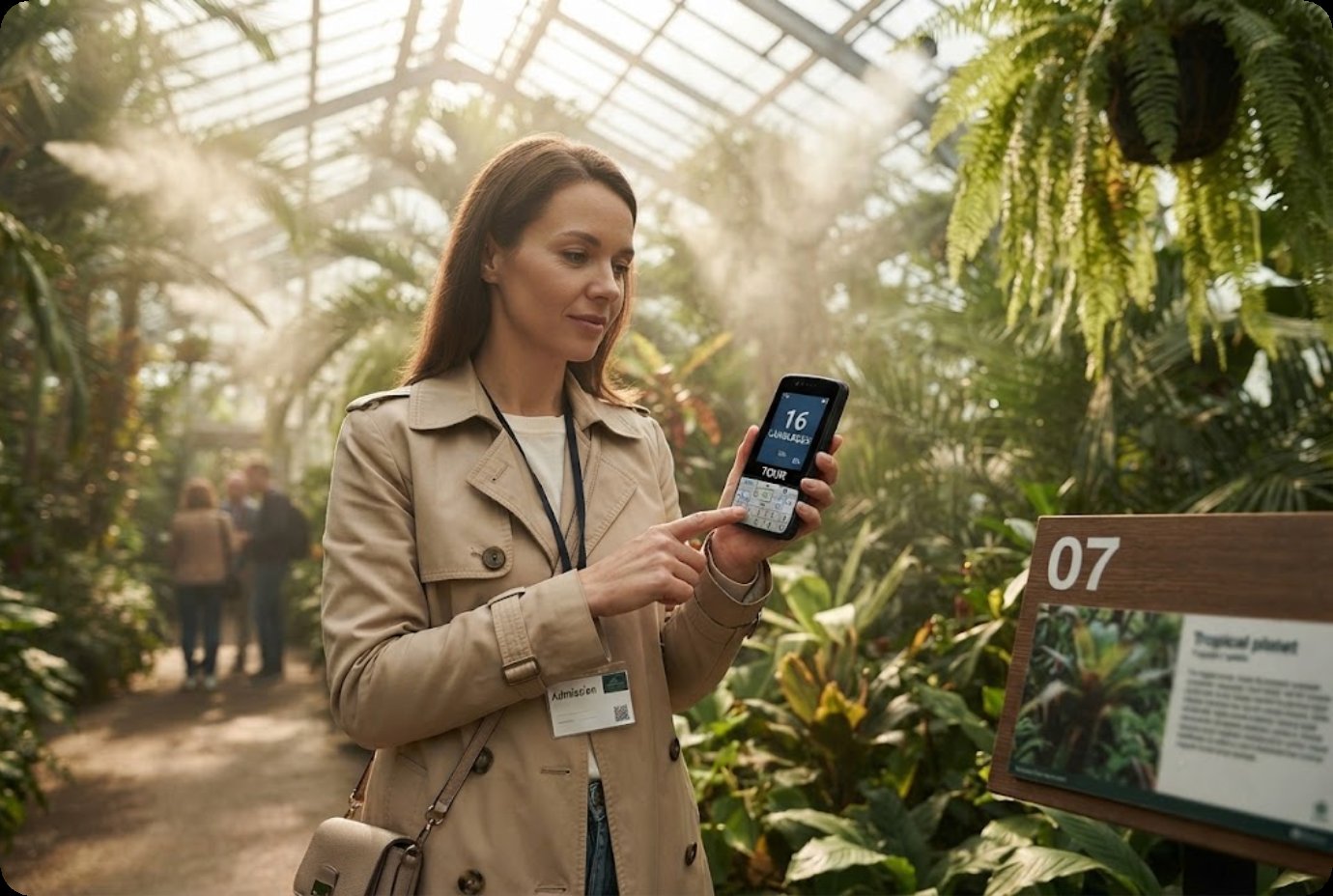
The 2.8-Inch Semi-Auto Digital Audio Guide is the simplest of the three to explain and the fiddliest to move. A visitor keys in the number printed beside an exhibit and the commentary plays, with separate buttons for play, pause and volume and no menu to learn. It holds 16 languages and up to 9,999 files in 2GB of built-in memory, and runs for up to 18 hours through a Micro USB port that also suits multi-slot charging boxes. What the sheet does not give is a capacity in mAh; only the 18 hours appears. That gap matters, because the cell sits inside the body and is not designed to come out. A unit sent to another country travels as equipment with a battery enclosed in it, so the test summary covering the pack has to cover the whole device, and nothing can be posted separately.
The Lightest Cells in the Bag
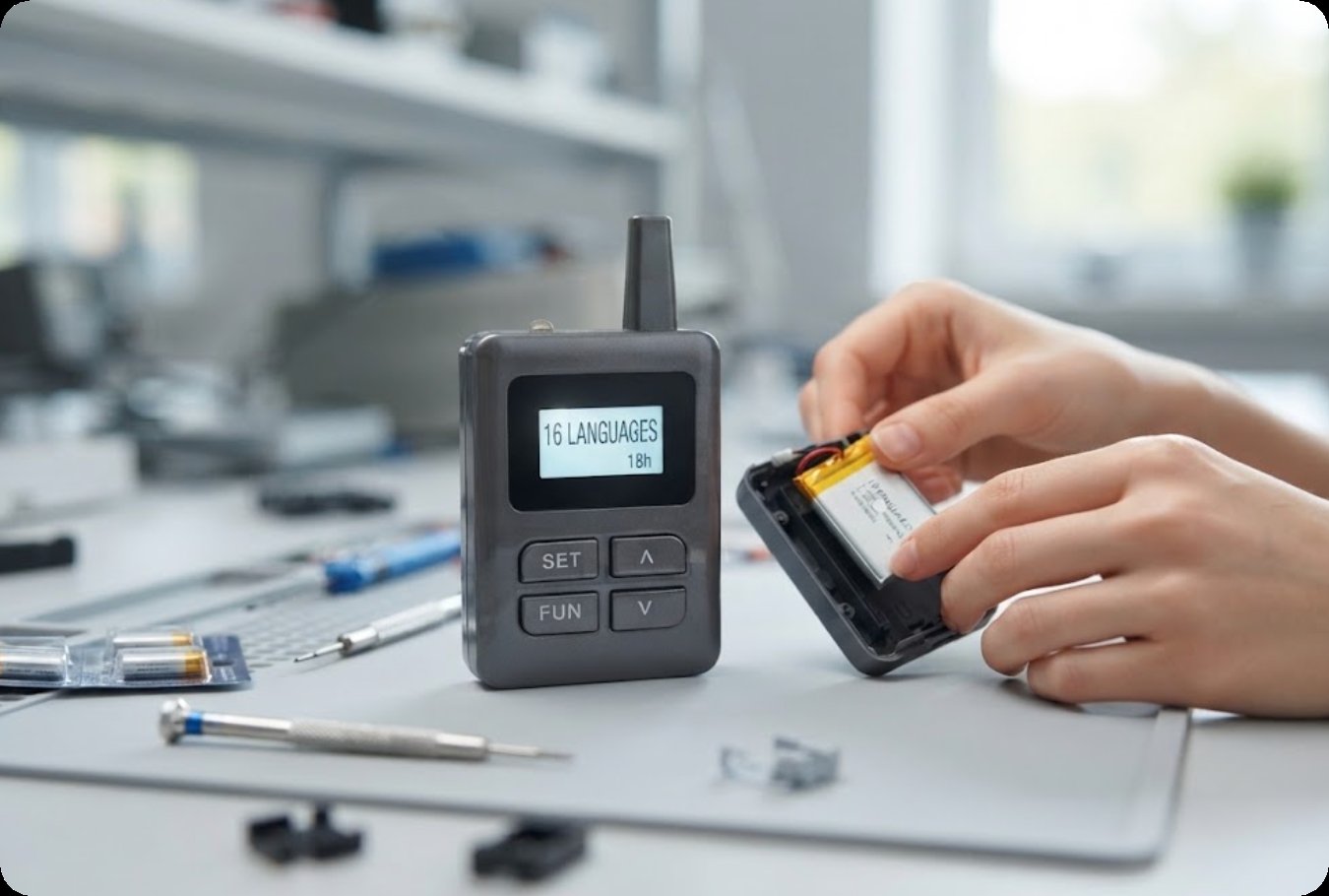
The RC2468 goes the other way. Both cells come out. The transmitter carries a 3.7V 1500mAh pack and the receiver a 3.7V 300mAh one, and at 18g in its ear-hook form the receiver is light enough that a visitor forgets it is there. The set runs in the 2.4GHz band across 50 channels and 1-200m at 10mW, gives 10 hours from the transmitter and about 8 hours from the receiver, and charges through Micro USB at 5V/1A. Because the packs are removable, a unit that fails in service can be drained and posted back as a shell, with the cells handled on their own. For a garden that returns a single faulty receiver several times a season, that is the difference between sending hardware and sending a battery.
💾 More Capacity, Same Paperwork
The RC085 is the heaviest of the three once the cells are counted. It works in the 470-510MHz UHF band over 100 channels, gives 12 hours from a 3.7V 1200mAh transmitter pack and 20 hours from a 3.7V 1000mAh receiver pack, and accepts optional headset or lapel microphones. Transmitter and receiver weigh 65g and 60g, and both charge through the same USB port as the smaller set. More capacity does not change the questions a carrier asks; it changes how carefully the answers have to be written. A garden that mixes the UHF kit and the 2.4GHz kit in one case ends up with two sets of cells in the same box, described as what the box actually holds.
Reading the Three Side by Side
| Unit | Cell arrangement | Capacity on the sheet | What a carrier asks for first |
|---|---|---|---|
| 2.8-Inch Semi-Auto player | Sealed inside the body, not removable | Not published, 18 hours runtime only | A test summary that covers the enclosed pack |
| RC2468 | Two removable packs | 1500mAh transmitter, 300mAh receiver | One figure for each pack |
| RC085 | Two removable packs | 1200mAh transmitter, 1000mAh receiver | The same, plus any microphones in the case |
All three figures are small, and none of the packs is large enough to turn a shipment into dangerous goods on its own account. The column that decides the work is the second one. A sealed cell makes the device the unit of paperwork, while removable packs let the batteries be dealt with apart from the hardware.
The Desk That Asks First
Before anything is loaded, a freight desk wants three things: a test summary for the cell, a safety data sheet, and a plain statement of what is in the box. A garden that has never posted a kit abroad meets this list the first time it tries. The questions arrive in a predictable order, so having the answers already in a folder is most of the preparation. On a domestic road move the same documents sit unread in the file for years; the moment the destination crosses a border, somebody asks to see them.
| Stage | What the rule is about | Who holds the record | Where it usually slips |
|---|---|---|---|
| Out on loan | Which unit went where, and who answers for it while it is away | The venue lending the kit | The form is signed, the serial number is not written down |
| In transit | What the cell is, and whether it can travel as ordinary freight | Whoever books the movement | A safety data sheet older than the packs |
| In store | How charged cells are kept when nothing is running | The store room | A shelf shared with unrelated equipment |
| At the end | What happens to the cell when the unit stops holding charge | The venue retiring it | The unit goes to waste with the pack still inside |
Most of that file comes from the manufacturer rather than from the venue. A test summary covering the cell and a safety data sheet travel with the goods, and a supplier who sells into several countries usually keeps both current in the languages a carrier expects. What the venue adds is the part nobody else can write: a description of the shipment as it actually leaves, naming the units, the spare packs and the accessories that share the same box. A garden that copies the previous season's description without touching the quantities is the one that ends up with a consignment held at a depot while somebody counts receivers over the phone.
None of those four stages needs a specialist. Each of them needs one name on the folder, a line in the season plan and the habit of writing a serial number down. That is a smaller ask than it sounds, and a great deal smaller than the fortnight it takes to rebuild the same record after a carrier has already stopped the shipment.
The Months a Fleet Sits in a Cupboard
The closed season is where most of a garden's compliance quietly lapses. A hundred receivers come back from the last tour, get stacked in a room that also holds rope and paint, and stay there until spring. Lithium packs do not enjoy that. They hold up best at a partial charge rather than a flat one, at a temperature that does not swing, and on a shelf that is not shared with anything likely to knock them about. A written store room rule costs nothing next to replacing a season's worth of cells.
Retirement is the stage nobody plans. When a player at last stops holding a charge, it becomes electronic waste, and the cell inside decides how it has to be handled. A garden that has bought the same model for years ends with a stack of identical units and no record of which packs have been through how many cycles. Agreeing the disposal route at the start of a season costs nothing; working it out at the end, with a contractor asking for paperwork nobody kept, costs a fortnight.
Writing It Into the Season Plan
None of this needs a new role. It needs the three units described honestly on paper: the player whose cell cannot come out, and the two wireless sets whose packs can. Our wireless tour guide system range is built so that the battery is a documented part of the kit rather than a detail discovered at a counter, and the solutions we have delivered to gardens, zoos and museums show how the record is kept between seasons.