A working winery hands a tour operator more numbers than almost any other site visit. Output power, channel count, battery hours, the distance a voice still arrives intact, the level a guide reaches at the far end of a barrel hall. When those figures come back from a single afternoon and land in a procurement file, they look interchangeable. They are not. Some of them describe the equipment and will repeat wherever the kit is taken. Others describe the building the test happened in, and will change the moment the group walks into a different one.
This is a record of one measurement day inside a working winery with three receivers from the same family, and of the sorting that followed afterwards. The question is not which unit won on the day. The question is which of the figures a buyer can carry forward into next season, and which ones have to be earned again at the next venue before anyone signs anything.
What the Cellar Adds to a Reading
A cellar is a room engineered to hold temperature and sound still, and that same design work applies to radio in ways few visitors notice. Stainless fermentation tanks return a signal the way a mirror returns light. Oak barrels standing in rows absorb energy that a hard wall would have bounced back. Cut stone gives the signal several paths to arrive by, some of them longer than the direct one. A bottling line adds motors, and a washdown leaves moisture in the air for the rest of the morning. None of that belongs to the receiver. All of it shows up inside the reading, which is why operators running guided tours across working sites learn to treat a single-visit figure as a local result rather than a property of the hardware.
🗺️ Figures That Travel With the Receivers
Some numbers survive a change of building without moving at all, and the 2.4G wireless audio guide system sold as RC2401 is the clearest example in this group. Its channel count of 50 is a setting, not a measurement. Its transmitter runs for 10 hours and its receiver for 20 hours on batteries rated 3.7V 1500mAh and 3.7V 1000mAh, and those hours hold whether the group is standing between tanks or walking a vineyard row. The weights are fixed too: 59g on the transmitter, 50g on the receiver, before anyone has added a lanyard. Any of these figures can be compared across venues, quoted in a tender, and checked on delivery without repeating the site visit.

What Only Shows Up on a Wearer
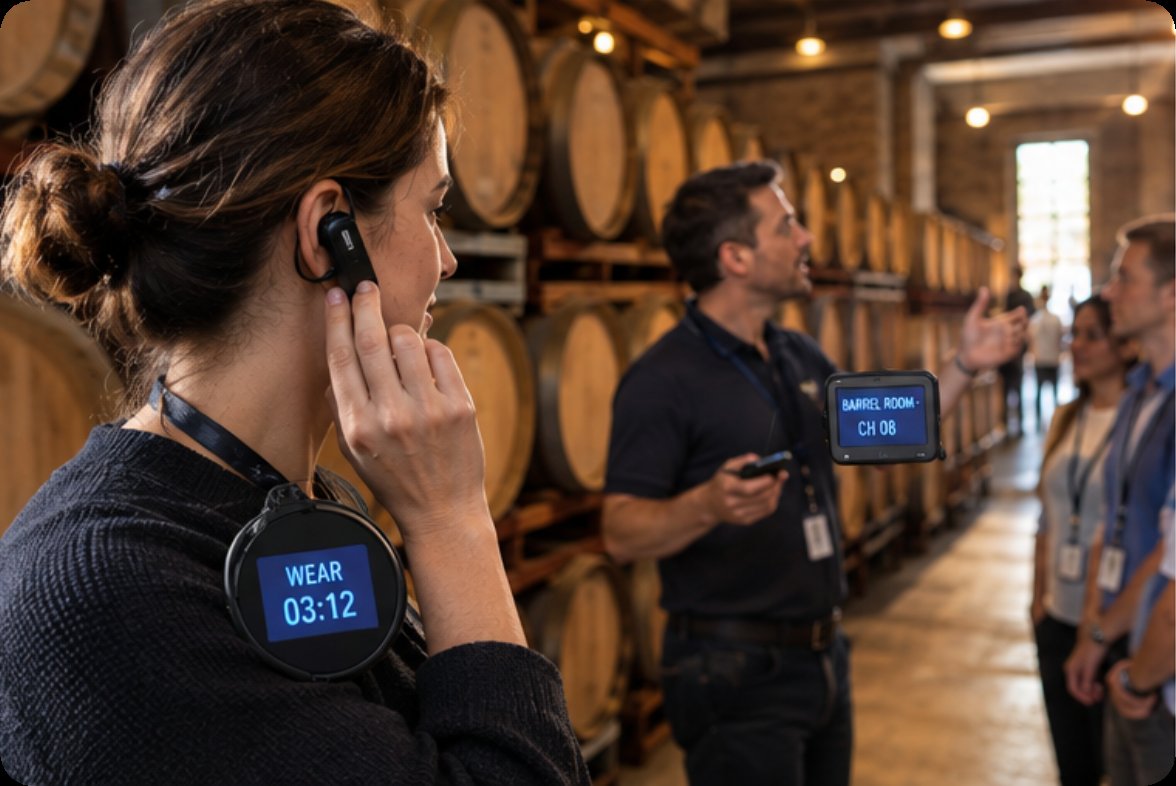
The 50-channel receiver sold as RC2402 sits in the same family as the unit above, at the same 20-hour figure on its receiver, and it is the one visitors end up judging with their shoulders rather than their ears. A 50g receiver is light in the hand and noticeable after the third hour, because the load lands on one ear while the group stands still listening to a cooper explain a barrel. The device contributes the grams and the battery hours, and both are measurable and repeatable. What the cellar contributes is how long those hours are actually used: a cold barrel room encourages people to keep hands in pockets, a bright tasting room with seating lets them rest the hook, and a long outdoor stretch between the crush pad and the vine rows keeps every unit moving. The same receiver behaves differently across those three stretches.
Range Is Borrowed From the Room
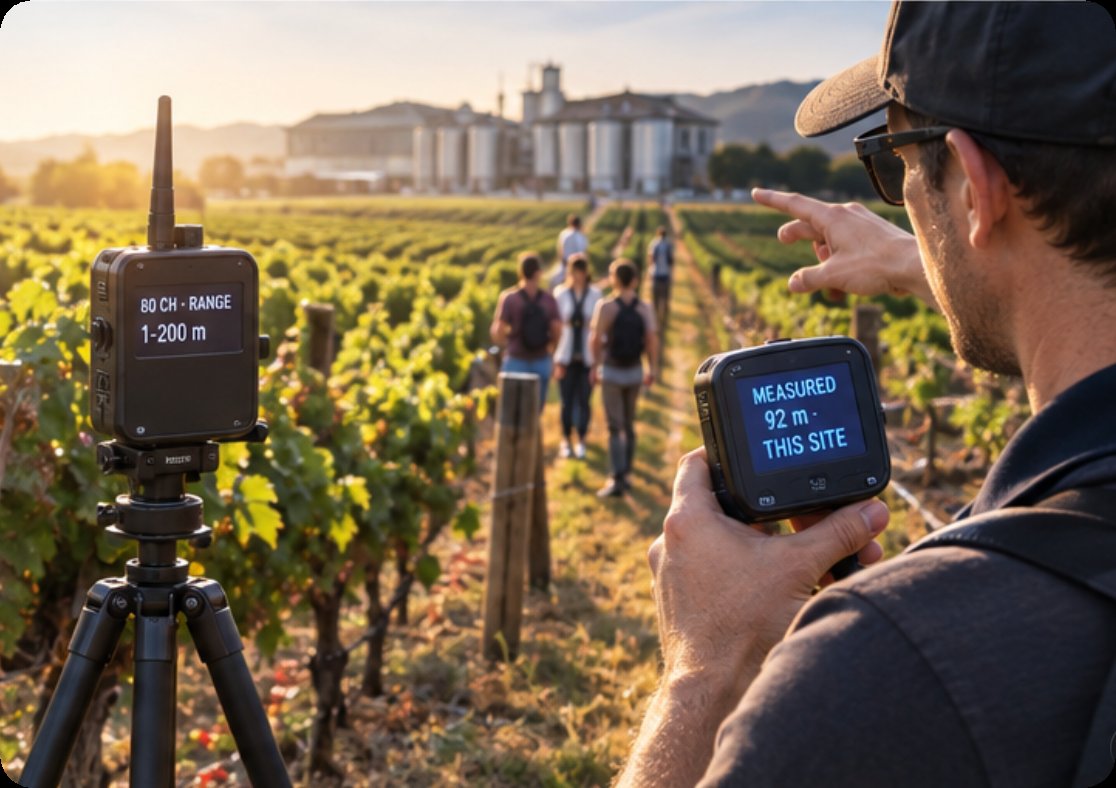
Every unit in this family is published as covering 1 to 200 metres, and the 80-channel interference-resistant guide labelled RC2408 is the one operators reach for when the route is long, not because it travels further on paper but because 80 channels leave room to move groups apart. On the day itself the number that matters is the one the building allows. A tank hall with a low steel ceiling will cut the working distance well below the published figure. The same transmitter in an open vineyard row between two trellises will hold far past the point where the guide stops being visible. The figure on the sheet tells the buyer how the unit compares with its siblings. The figure measured on site tells the buyer what this particular winery will do, and it belongs to the winery.
Three Units Side by Side on the Sheet
The device-owned column is short, and it is worth seeing all three units in it at once, because the differences are smaller than the venue-to-venue variation most operators see during a season. The table below lists only fields that stay true in any building.
| Device figure | RC2401 | RC2402 | RC2408 |
|---|---|---|---|
| Core frequency band | 2403-2483 MHz | 2403-2483 MHz | 2403-2483 MHz |
| Channel count | 50 | 50 | 80 |
| Transmitter output power | 10 mW | 10 mW | 10 mW |
| Transmitter weight | 59g | 59g | 59g |
| Receiver weight | 50g | 50g | 50g |
| Transmitter run time | 10 h | 10 h | 10 h |
| Receiver run time | 20 h | 20 h | 20 h |
| Frequency response, transmitter | 50 Hz to 200 kHz | 50 Hz to 200 kHz | 50 Hz to 200 kHz |
Read this way, the only field that separates the three units is channel count, which is exactly the sort of figure that can be settled before delivery and never has to be measured again. Everything an operator observes about reach, clarity and quiet at the back of the group is a joint result of the hardware and the building, which is why two visits to the same winery can produce two different tables.
Tank Skin, Stone and Oak Behave Differently
Three surfaces do most of the work inside a winery, and each one changes what a reading means. Polished stainless reflects, so a group standing in a tight line between two tanks can hear more clearly than the open floor would suggest, and a reading taken there will flatter any unit. Dense stone and concrete return energy from several directions, so the same voice arrives twice with a short delay and the test protocol needs to say whether the second arrival was counted. Oak absorbs, which makes the barrel room quietly forgiving and quietly misleading in equal measure, since the level a receiver produces there will not be reproduced on the crush pad. A measuring sheet that does not name the surface is not a measurement. It is a number with a story attached to it, and the wireless tour guide system range that covers all of these rooms is worth looking at as a whole before fixing a specification.
Two Columns for the Procurement File
Splitting the file into two columns saves arguments later. The device column takes channel count, output power, battery capacity and weight, all of it comparable between suppliers and all of it testable on arrival without a site visit. The site column takes working distance, usable clarity at the far end of the group, and the number of groups that can run at once in this building. Those entries belong to the venue and should be dated and re-taken whenever the route changes, a tank is moved, or a new building is added to the programme. Buyers who keep the two columns separate stop paying for a product on the strength of a building, and stop blaming a product for a room it was never measured in.
What Changes Past the Vineyard Gate
Take the same three units to a different kind of site and the device column survives the move untouched. A 50-channel receiver is still a 50-channel receiver, an 80-channel unit is still the one with room for more groups, and 20 hours of receiver time does not shorten because the ceiling changed. The site column has to be filled in again, and it is usually faster the second time because the operator knows which three questions to ask: what the walls are made of, how much metal stands between the guide and the back of the group, and whether the route stays inside one surface or crosses three. That habit is portable even when the numbers are not, and it is the only part of a measurement day that never has to be repeated. If the programme is moving into a new venue next season, it helps to explore our solutions for the room the group will actually stand in.