
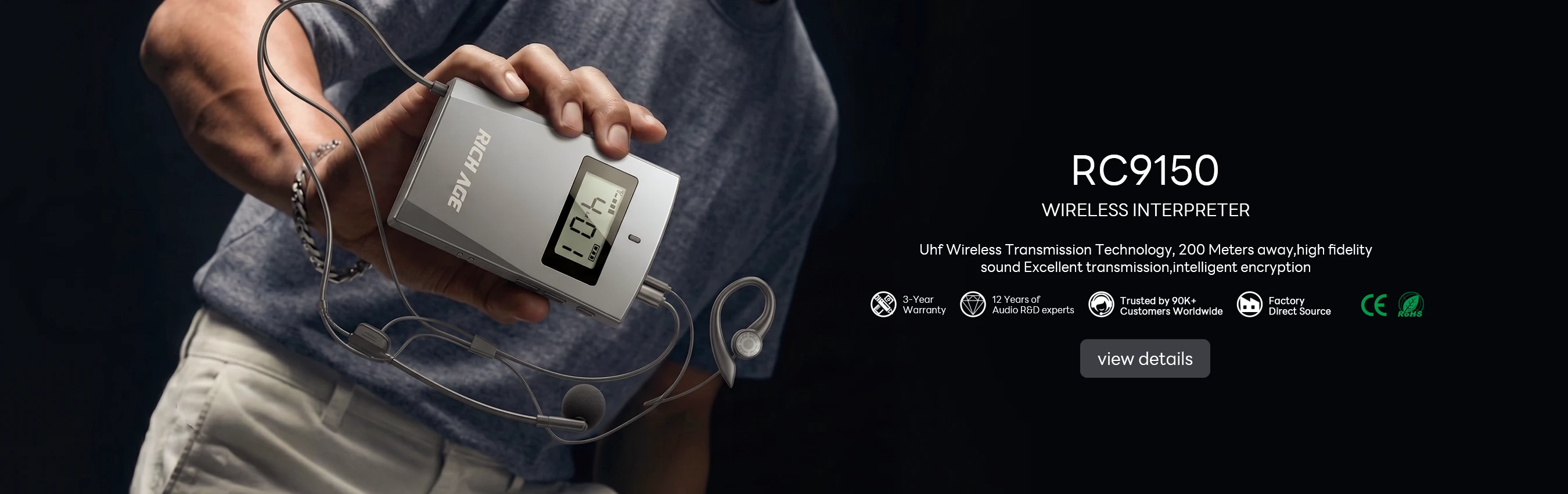
.webp)
The fault report from a corporate training day almost never names the receiver. It names the room. A workshop that ran cleanly in the boardroom on Tuesday comes apart in the training suite on Wednesday, and both rooms were booked by the same coordinator with the same kit. What changed was the building: a partition wall with steel studs, a ceiling crowded with metal ductwork, a second session running on the other side of a stud wall. The audio system was the thing that reported the problem, not the thing that caused it.
Triage in a training venue therefore starts somewhere unusual. Before anyone swaps a handset or dials a new channel, the useful question is what the signal has to cross. Three units sit at the different answers to that question: the RC085 on UHF, the RC2408 with eighty channels on the licence-free 2.4 GHz band, and the RC2402 with fifty. This is a fault-finding order, not a specification race.
📡 What a Glass Partition Does to a Radio Path
The 2.4 GHz band behaves much like light. It wants a clear path, and it pays for every surface it has to cross. Office dividers that look transparent from the doorway are rarely transparent to radio: the glass carries a low-emissivity coating, the frame is steel, and the cavity behind it holds insulation backed with foil. None of that appears on a floor plan. A facilitator who walks into the room with a receiver and hears nothing has usually found a building, not a fault.
UHF changes the arithmetic. A signal at 470 to 510 MHz has a longer wavelength and loses less energy crossing the same stud wall, which is why industrial sites and older municipal buildings kept UHF in service long after 2.4 GHz became the default. If a training suite sits inside a converted building, a corporate training audio solution that survives the walls is worth more than one with a longer feature list. The first entry on the triage sheet should be the construction of the room, not the model of the receiver.
RC085: UHF for Rooms With Steel in Them
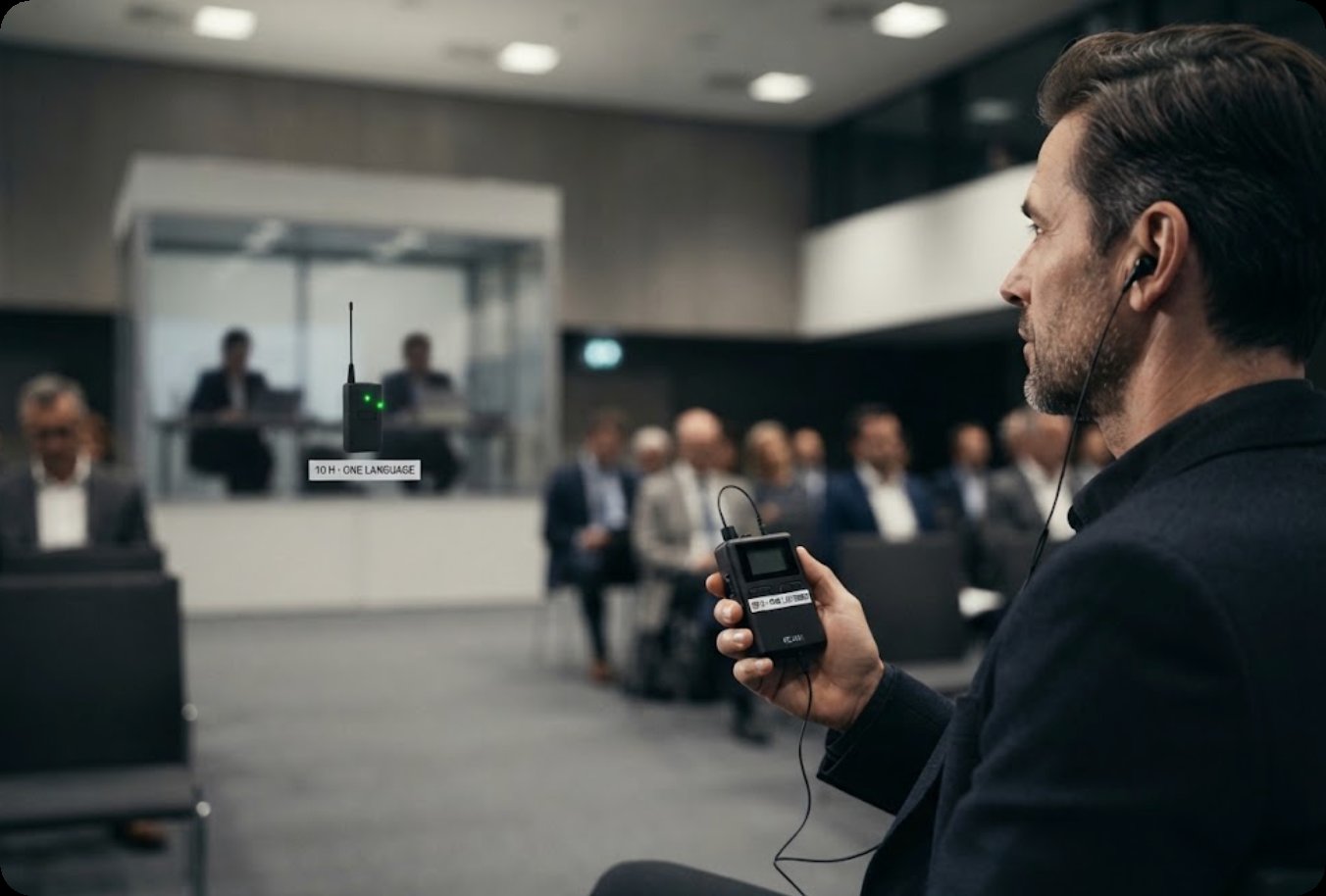
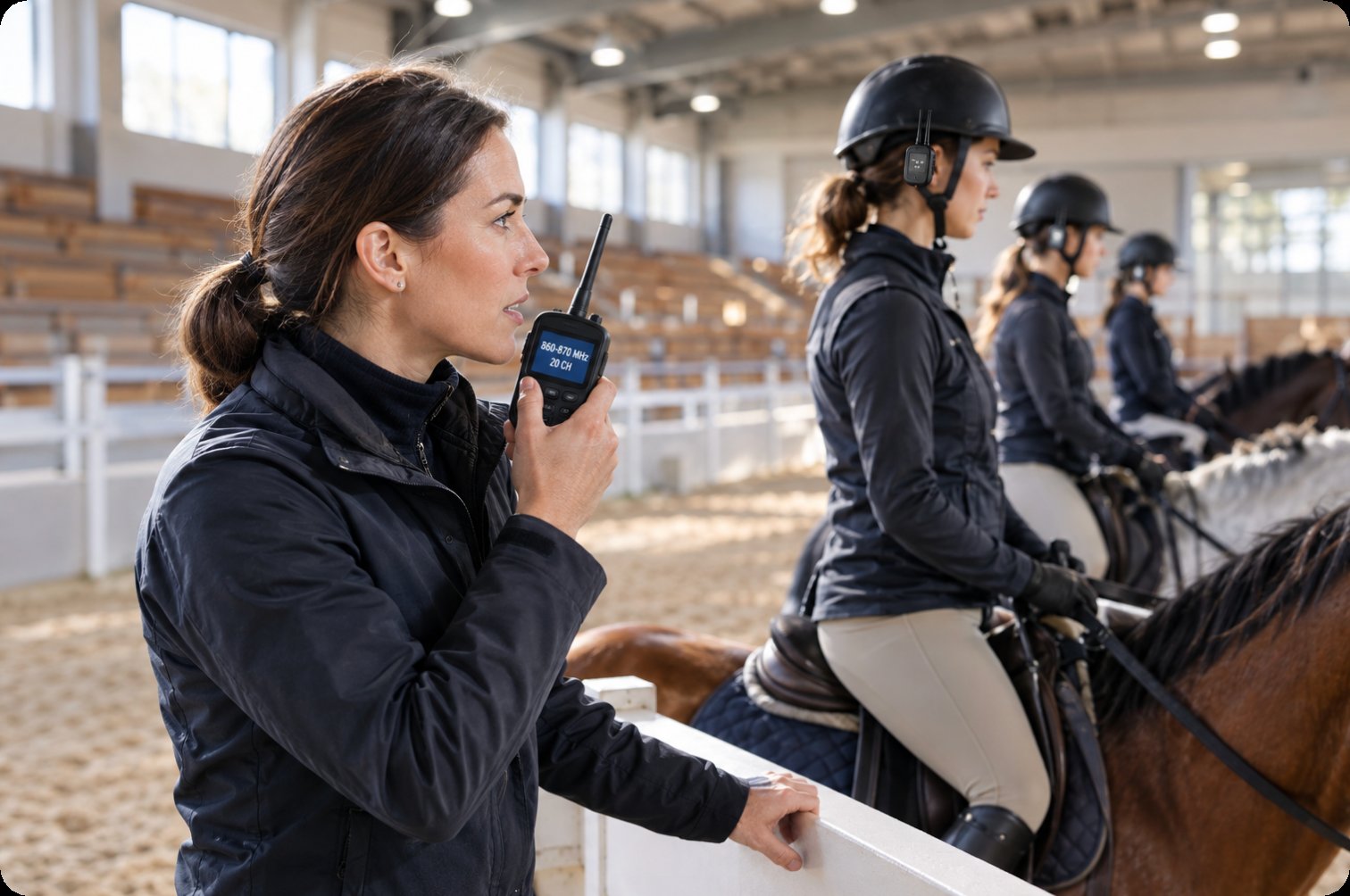
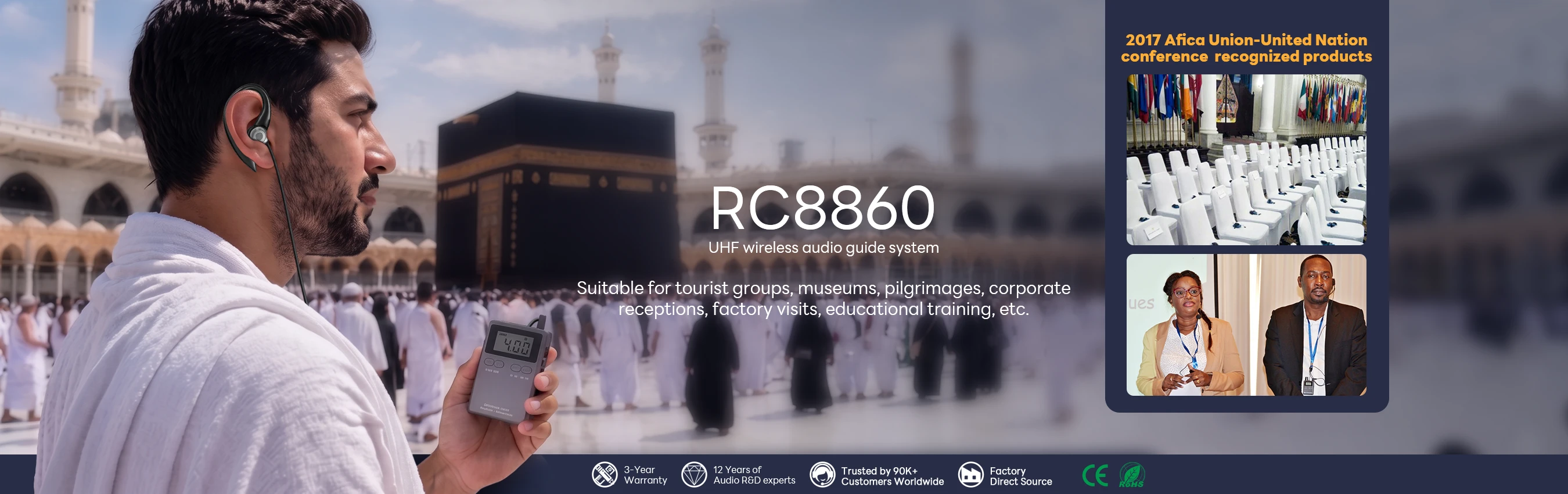
The RC085 is the unit to reach for when a room has already defeated a 2.4 GHz set. It transmits on the 470 to 510 MHz UHF band with a hundred channels and two switchable modes: F1 for one-way broadcast to a seated group, F2 when the session needs the floor to answer back. An LCD screen on the handset shows battery, channel and signal state, so the fault is visible before anyone speaks. Its transmitter runs twelve hours and the receiver twenty, at 65 g and 60 g respectively, and it charges over USB — the one unit of the three that does.
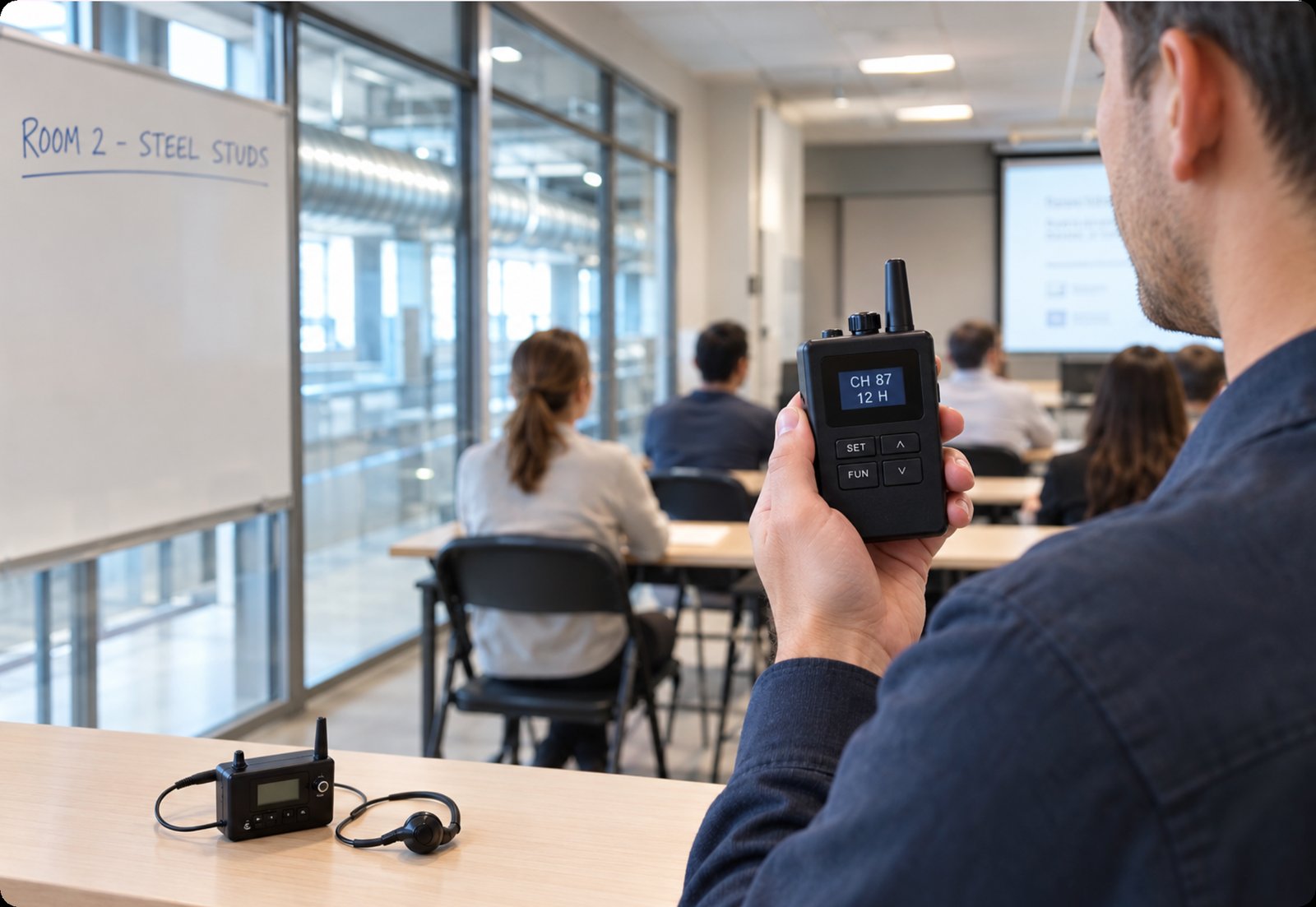
🔮 RC2408: Eighty Channels Against the Session Next Door
The RC2408 works the other way round. It is built for the crowded end of a training floor, where four breakout rooms run at once and the interference arrives from outside the room rather than across it. The handset works the license-free 2.4 GHz ISM band between 2403 and 2483 MHz with eighty channels, one-key synchronisation and a two-way mode for paired speakers. Range reaches two hundred metres and the receiver lasts twenty hours, ten for the handset, at 59 g and 50 g. When the failure sounds like the room next door is on my channel, the channel count is the fix.
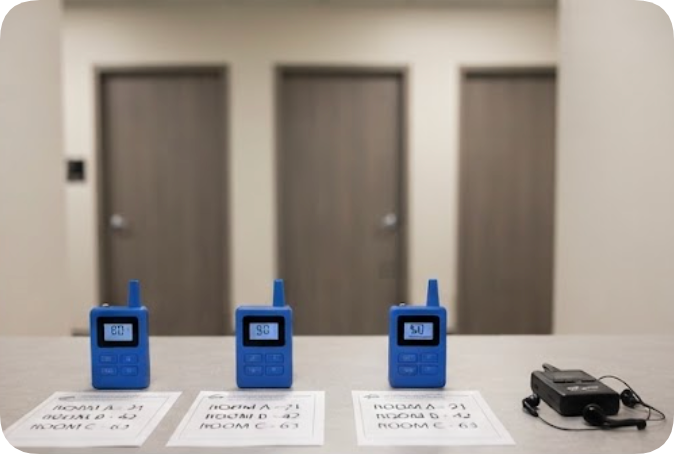
RC2402: Fifty Channels and Encrypted Groups
The RC2402 covers the case where groups are sequential rather than simultaneous. Fifty channels on the same 2.4 GHz band are enough for two or three back-to-back workshops, and its encryption is the part that matters when two clients book the same floor and neither should hear the other. One-click frequency synchronisation pairs a transmitter with unlimited receivers, and the receiver again runs twenty hours against ten for the handset. Weights are 59 g and 50 g. It also carries the widest certification set of the three — CE, EMC, LVD, RED and RoHS — and is open to OEM or ODM work.
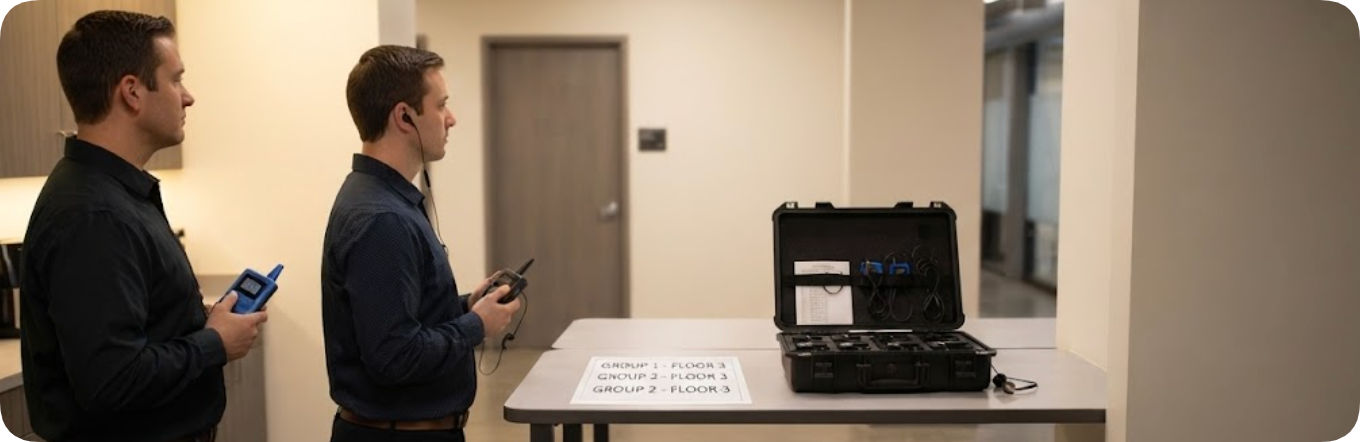
Three Specifications Side by Side
| Specification | RC085 | RC2408 | RC2402 |
|---|---|---|---|
| Band | UHF 470-510 MHz | 2.4 GHz 2403-2483 MHz | 2.4 GHz 2403-2483 MHz |
| Channels | 100 | 80 | 50 |
| Modes | F1 one-way, F2 two-way | One-key sync, two-way | One-key sync, encrypted |
| Handset and receiver weight | 65 g / 60 g | 59 g / 50 g | 59 g / 50 g |
| Transmitter runtime | 12 h | 10 h | 10 h |
| Charging port | USB | DC | DC |
| Certification | CE, RED, RoHS | CE, RoHS | CE, EMC, LVD, RED, RoHS |
The table is short on purpose, because most of what differs between these units will never decide a training day. Band, channel count, handset weight, charging port and transmitter runtime are the rows that come up in a fault conversation. Receiver runtime is not one of them: all three reach twenty hours, which is longer than any single session and usually longer than the venue stays open.
The Drawer at the Podium and Two Cable Ends
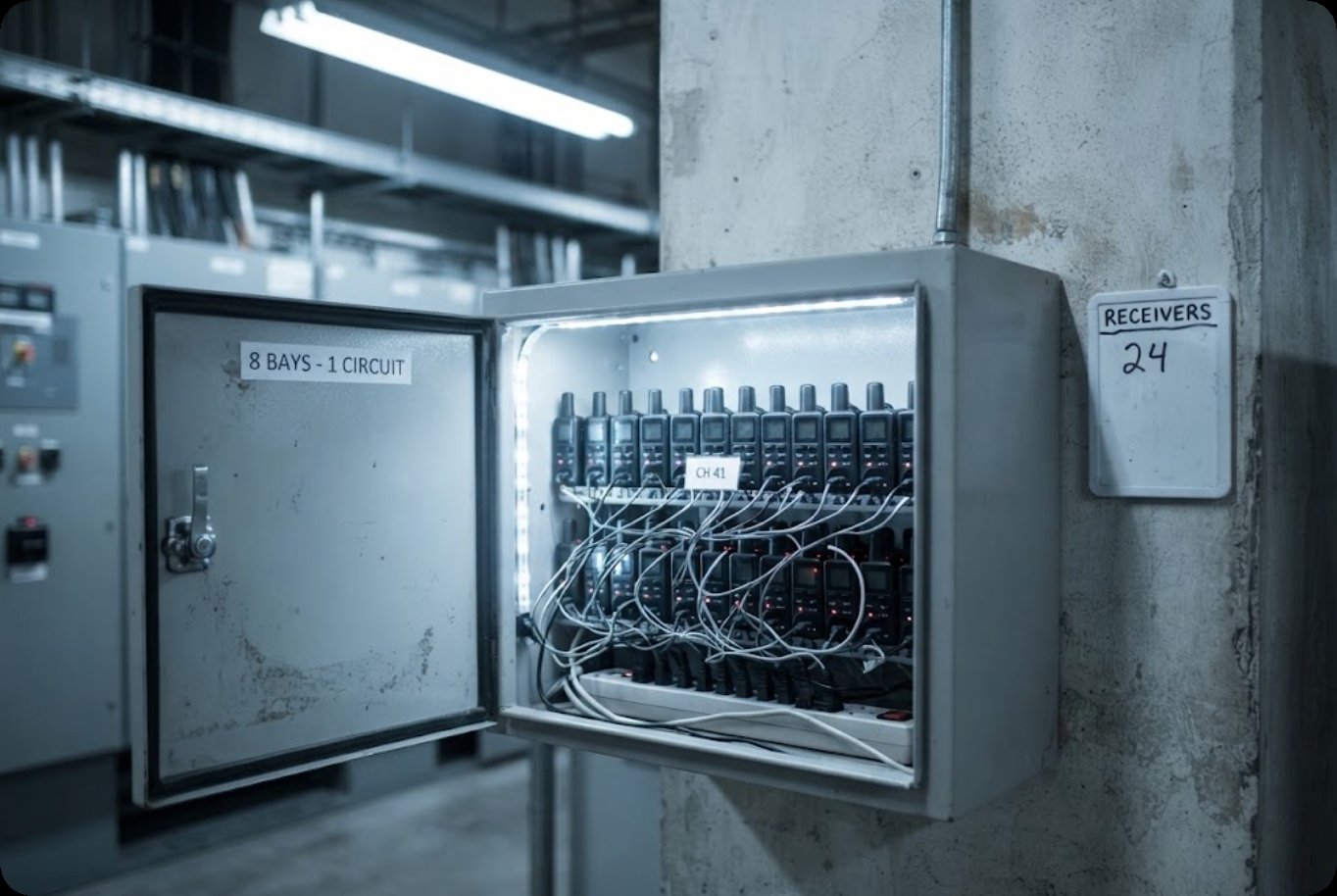
The most common false report in a training venue is a flat battery. A handset comes back from a lunch break showing nothing on the display, and the kit is blamed. In practice the unit was never charged, because the podium drawer holds a bundle of USB leads and the handset needs a DC barrel plug. Both 2.4 GHz models here use a DC port; only the RC085 takes USB. A venue with one drawer and one cable type will fail whichever units it did not buy leads for. Sorting cable ends before the first session removes this whole class of callout.
The second false report is a dead channel. A handset left switched on overnight looks identical to one with a fault, and a receiver showing a locked channel can be a receiver that was never re-synchronised after the last session. Reading the display, re-pairing, and swapping a receiver for a known-good one takes under a minute and settles most calls before the facilitator has to improvise. What it cannot settle is the room itself, and that is the fault that repeats.
What the Facilitator Can Reset in a Minute
A short sequence covers the faults that are actually recoverable mid-session. Check the channel against the plan for that room. Check the handset is awake rather than asleep, a feature the RC085 has built in and the other two manage through their pairing state. Check the mute. Then swap the receiver rather than the transmitter, because the receiver is the cheaper part to lose and the faster swap. If none of that changes anything, move the handset away from the lectern's steel PC tower and the AV rack; both are invisible obstacles sitting exactly where the speaker stands.
Battery planning belongs in the same list. The receiver is rarely the constraint at twenty hours; the handset is, at ten to twelve. A day with a morning workshop, a lunch break that is not used for charging, and an evening session will finish on the transmitter's last hour. A spare charged handset per room costs less than the credibility lost when a session stops mid-sentence, and it removes the only fault on the list that a facilitator cannot talk their way past.
🔮 Writing the Fault Pattern Into the Next Booking
The value of a triage order is that it produces a record. A two-line note against the venue — which room sits behind steel, which floor needs the UHF set, how many breakout rooms share the band at once — turns the next booking into a packing decision rather than a repeat of the same morning. Rooms do not change their construction between events, and the rooms that eat a 2.4 GHz signal will eat it again in the same place.
For venues that run training programmes continuously, the equipment list tends to settle into a pattern: one UHF set for the difficult rooms, one high-channel 2.4 GHz set for the breakout floors, and a smaller 2.4 GHz set for single-room days. Our wireless tour guide system range covers all three, and you can explore our solutions by venue type before the next booking goes out. Getting the band right first is what stops the room from deciding the outcome.