
A leading China factory specializing in Wireless Tour Guide Systems, Church Audio Guides, and Translation Headphones with premium OEM/ODM solutions.

Tel:+86 18922879583

Email:tiger.wang@richitek.com

RC2406, RC2408 and RC2401: The Installation Order a Live Factory Enforces

A factory tour system is not installed in the order a catalogue suggests. The site decides that. Where the sockets are, how long the loop runs, which gates the visitor group must clear and how often the shift changes all sit upstream of the equipment, and each one constrains what can be done on the day the kit arrives. Teams that unpack first and plan second end up re-running the cable runs after the first group has already walked through.

The three units that make up most factory tour audio installations share a great deal. All three work on the same license-free band between 2403 and 2483 MHz, all three reach up to 200 meters in the open, and all three charge from a DC supply rather than a dock. What separates them is the channel budget and the role each was built for. That difference is what a commissioning order has to respect.

🔋 Power Before Audio

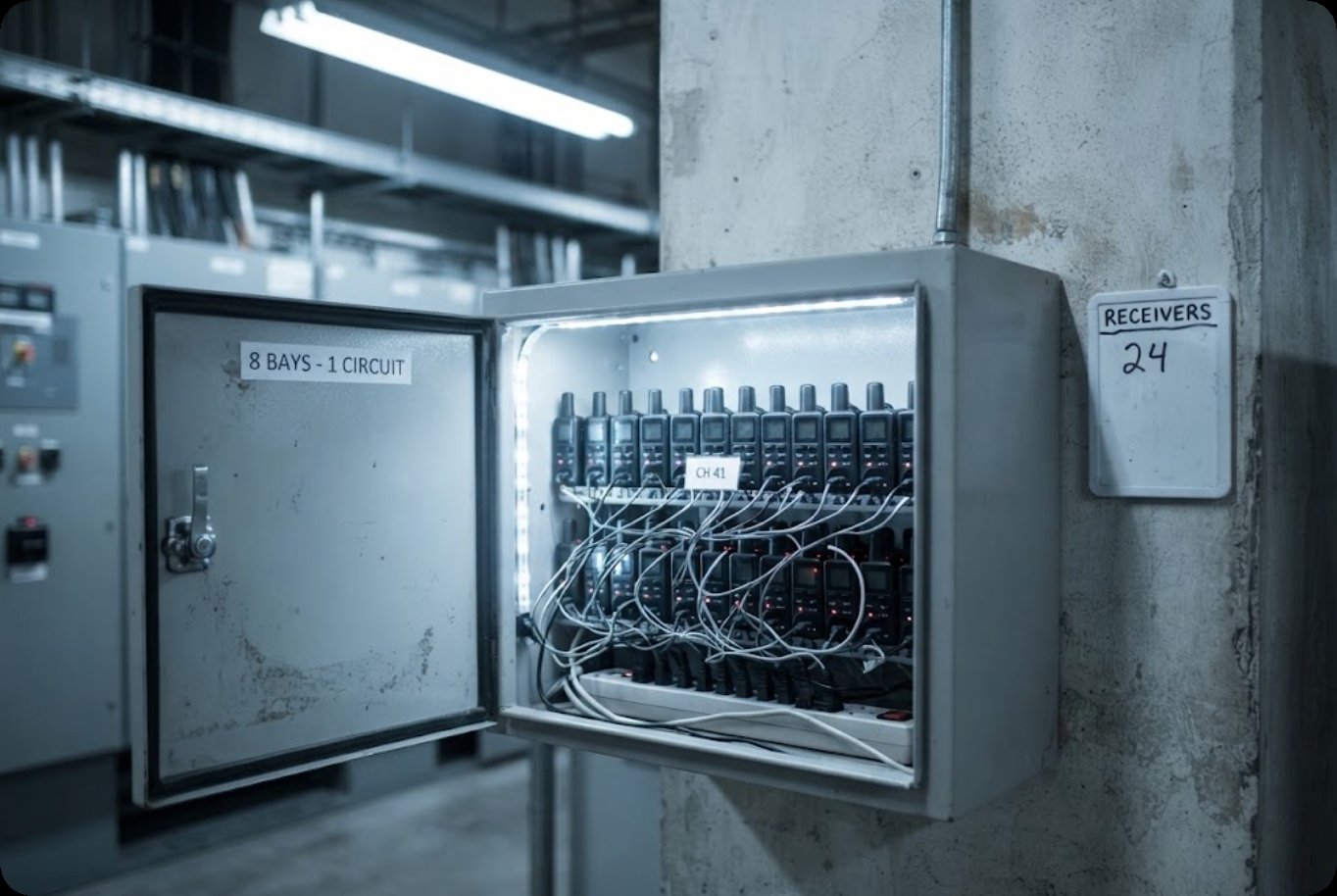
The first number to settle is not a frequency. It is the count of receivers that can be charged overnight in the room the client is willing to give up. A receiver that leaves the rack at 60 percent is a receiver that dies near the third station, and no amount of channel planning recovers that. Walk the room with the client before discussing anything else and count the outlets that can be dedicated to the kit.
RC2406-factory_tour_case

Charging on these units is handled over a DC connection, and the practical constraint is how many leads can be run from a single supply without the wall looking like a temporary installation. Where the site has a lockable cabinet, the charging rack belongs inside it.

Route First, Frequencies Second

Once the power is settled, walk the visitor route end to end at the pace a group actually moves. The purpose is to divide that route into zones by what the audio has to survive rather than by what the floor plan calls them. A press bay with running conveyors and a quiet inspection room are two different problems.

Assign channels to zones afterwards, not before. The two eighty-channel units give the dense zones room to keep groups apart, while the fifty-channel unit, the RC2401, covers the segments where only one or two groups will ever be in earshot at the same time. Writing the channel number onto the zone sheet at this point saves a second visit later.

Two Groups Sharing One Passage

Most factory layouts have at least one stretch where two visitor groups must pass each other or run in parallel, usually a link corridor or a shared lift lobby. This is where channel separation stops being a technical detail and becomes the thing the guide notices. Both eighty-channel units, the RC2408 and the unit beside it in the range, use phase-locked loop frequency synthesis, which keeps each group locked to its own channel rather than drifting into a neighbour.

Confirm the separation on site rather than on paper. Two receivers set to adjacent channels should be carried through the shared passage at the same time by two people, one on each side, while both transmitters stay live. If the separation holds there, it will hold in the parts of the route that are less crowded than the test itself.

Numbering That Survives a Shift Change

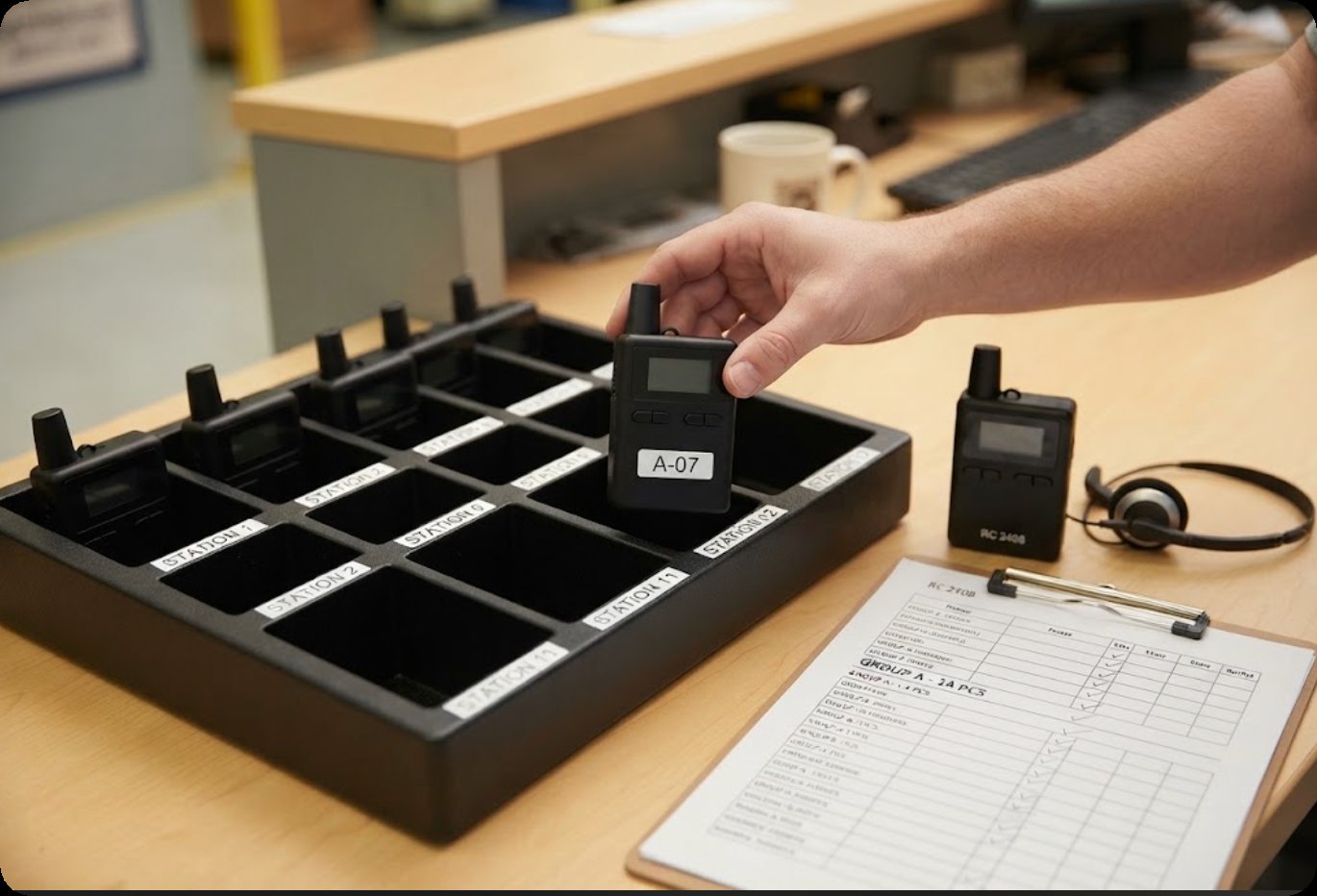
A visitor kit is handed out by whoever is on the desk that morning, and that person changes. Numbering has to work for someone who has never seen the route. Pair each receiver with a station number printed on the case, then mirror that number in the group leader's sheet. When a receiver comes back with a station number, the fault report writes itself.
RC2408-factory_tour_case

The units themselves carry no visitor-facing identity, which is useful: the printed case number is the only label anyone needs to read. Where several languages run on one route, the numbering should carry the language as a prefix, so a receiver left in the wrong rack is visible at a glance.

What the Receiver Hears at the Far End

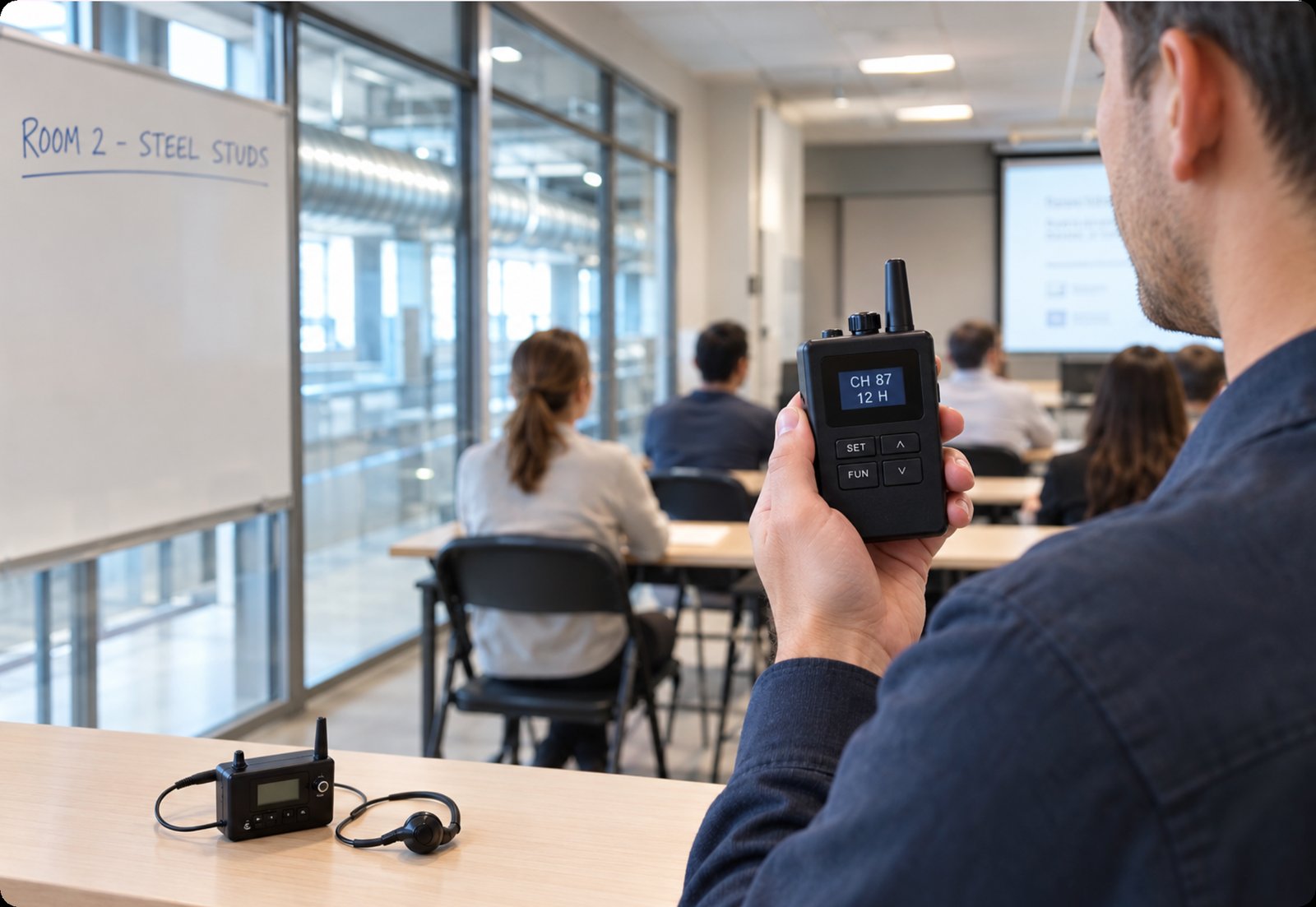
The published figure of 200 meters applies to open ground. Inside a production hall, steel racks, overhead cranes and stacked product all shorten the usable distance considerably, and the reduction is not uniform along the route. The place to check is the furthest point from the guide's normal standing position, tested while the hall is running its normal shift rather than during a quiet weekend.

Walk that far point with a receiver in hand and the guide at the front of the group. If the voice breaks up, the answer is usually a change of where the guide stands, not a change of equipment.

The Dry Run Nobody Books

A rehearsal that only tests sound quality misses the failures that actually stop a tour. The dry run should time the things around the audio instead. How long does it take to hand out forty receivers and confirm each one is on the right channel? How quickly can a guide swap a dead unit without stopping the group? How clearly does the spare kit live in its case so that a second person can find it?

Run it once with the people who will actually operate the system, not with the installer. The gap between those two runs is the real measure of whether the installation is finished. Anything that needs explaining twice is a labelling problem, and labelling is cheaper to fix on a rehearsal day.

Spares That Earn Their Case Space

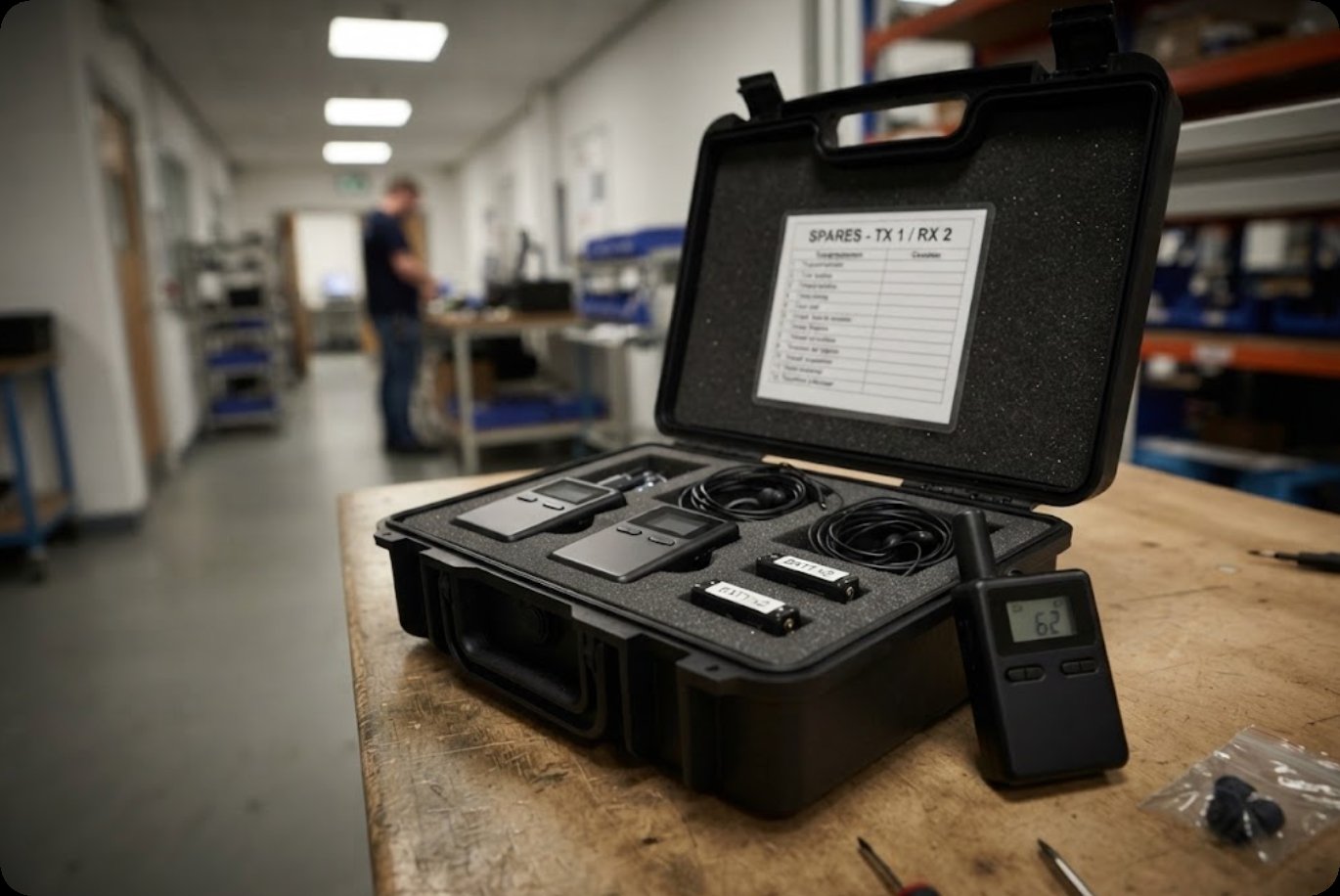
The spare ratio is decided by the length of the day, not by the size of the order. A half-day tour through a single hall can carry one spare transmitter and two spare receivers. A full-day route with multiple groups and a lunch break needs a wider margin, because there is no window in which a failed unit can be quietly swapped out of sight of visitors.

Keep the spares charged to the same level as the working kit and store them in the same case. A spare that has to be retrieved from an office is not a spare; it is a delay with a label on it. Three years of cover on the mainboard helps here, and the RC2406 carries the same terms as the rest of the family, but the parts most likely to be dropped are the ones excluded from that cover, so the case should hold a spare headset and a spare battery regardless.
RC2401-factory_tour_case

What the Site Keeps After You Go

An installation is finished when the site can run it without the installer. That means a single sheet, kept where the kit is charged, carrying the channel list, the station numbering, the charge routine and the contact for replacement parts. The sheet should be short enough to read standing up.

The comparison below is the version that belongs on that sheet, stripped down to the fields a shift supervisor can act on. Everything else stays in the solution documentation, which is exactly where it should.

FieldRC2406RC2408RC2401
Channels808050
Frequency band2403-2483 MHz2403-2483 MHz2403-2483 MHz
Working rangeUp to 200 mUp to 200 mUp to 200 m
Transmitter life10 h10 h10+ h
Receiver life20 h20 h20+ h
ChargingDCDCDC, multi-device
ProtectionIPX4IPX4IPX4
ComplianceRoHSCE, RoHSCE, RoHS

The three units cover the same band, so the choice between them is really a choice about how many groups the site expects to run at once. Where the answer is two or three, the fifty-channel unit carries the route comfortably and leaves budget for the receivers that matter more to a visitor than a channel count. Where the answer is five or more, the eighty-channel units are what keep the groups apart in the crowded passages.

Plan the order of work around the site, not around the box. The full wireless tour guide system range is built for exactly this kind of site-led planning. Start at the sockets and finish with a sheet the client can keep, and the installation will hold up long after the commissioning visit is forgotten.

2026年09月28日 10:31
ꄘ click: 12

RC2406, RC2408 and RC2401: The Installation Order a Live Factory Enforces

time: 2026年09月28日 click:12

A factory tour system is not installed in the order a catalogue suggests. The site decides that. Where the sockets are, how long the loop runs, which gates the visitor group must clear and how often the shift changes all sit upstream of the equipment, and each one constrains what can be done on the day the kit arrives. Teams that unpack first and plan second end up re-running the cable runs after the first group has already walked through.

The three units that make up most factory tour audio installations share a great deal. All three work on the same license-free band between 2403 and 2483 MHz, all three reach up to 200 meters in the open, and all three charge from a DC supply rather than a dock. What separates them is the channel budget and the role each was built for. That difference is what a commissioning order has to respect.

🔋 Power Before Audio

The first number to settle is not a frequency. It is the count of receivers that can be charged overnight in the room the client is willing to give up. A receiver that leaves the rack at 60 percent is a receiver that dies near the third station, and no amount of channel planning recovers that. Walk the room with the client before discussing anything else and count the outlets that can be dedicated to the kit.

RC2406-factory_tour_case

Charging on these units is handled over a DC connection, and the practical constraint is how many leads can be run from a single supply without the wall looking like a temporary installation. Where the site has a lockable cabinet, the charging rack belongs inside it.

Route First, Frequencies Second

Once the power is settled, walk the visitor route end to end at the pace a group actually moves. The purpose is to divide that route into zones by what the audio has to survive rather than by what the floor plan calls them. A press bay with running conveyors and a quiet inspection room are two different problems.

Assign channels to zones afterwards, not before. The two eighty-channel units give the dense zones room to keep groups apart, while the fifty-channel unit, the RC2401, covers the segments where only one or two groups will ever be in earshot at the same time. Writing the channel number onto the zone sheet at this point saves a second visit later.

Two Groups Sharing One Passage

Most factory layouts have at least one stretch where two visitor groups must pass each other or run in parallel, usually a link corridor or a shared lift lobby. This is where channel separation stops being a technical detail and becomes the thing the guide notices. Both eighty-channel units, the RC2408 and the unit beside it in the range, use phase-locked loop frequency synthesis, which keeps each group locked to its own channel rather than drifting into a neighbour.

Confirm the separation on site rather than on paper. Two receivers set to adjacent channels should be carried through the shared passage at the same time by two people, one on each side, while both transmitters stay live. If the separation holds there, it will hold in the parts of the route that are less crowded than the test itself.

Numbering That Survives a Shift Change

A visitor kit is handed out by whoever is on the desk that morning, and that person changes. Numbering has to work for someone who has never seen the route. Pair each receiver with a station number printed on the case, then mirror that number in the group leader's sheet. When a receiver comes back with a station number, the fault report writes itself.

RC2408-factory_tour_case

The units themselves carry no visitor-facing identity, which is useful: the printed case number is the only label anyone needs to read. Where several languages run on one route, the numbering should carry the language as a prefix, so a receiver left in the wrong rack is visible at a glance.

What the Receiver Hears at the Far End

The published figure of 200 meters applies to open ground. Inside a production hall, steel racks, overhead cranes and stacked product all shorten the usable distance considerably, and the reduction is not uniform along the route. The place to check is the furthest point from the guide's normal standing position, tested while the hall is running its normal shift rather than during a quiet weekend.

Walk that far point with a receiver in hand and the guide at the front of the group. If the voice breaks up, the answer is usually a change of where the guide stands, not a change of equipment.

The Dry Run Nobody Books

A rehearsal that only tests sound quality misses the failures that actually stop a tour. The dry run should time the things around the audio instead. How long does it take to hand out forty receivers and confirm each one is on the right channel? How quickly can a guide swap a dead unit without stopping the group? How clearly does the spare kit live in its case so that a second person can find it?

Run it once with the people who will actually operate the system, not with the installer. The gap between those two runs is the real measure of whether the installation is finished. Anything that needs explaining twice is a labelling problem, and labelling is cheaper to fix on a rehearsal day.

Spares That Earn Their Case Space

The spare ratio is decided by the length of the day, not by the size of the order. A half-day tour through a single hall can carry one spare transmitter and two spare receivers. A full-day route with multiple groups and a lunch break needs a wider margin, because there is no window in which a failed unit can be quietly swapped out of sight of visitors.

Keep the spares charged to the same level as the working kit and store them in the same case. A spare that has to be retrieved from an office is not a spare; it is a delay with a label on it. Three years of cover on the mainboard helps here, and the RC2406 carries the same terms as the rest of the family, but the parts most likely to be dropped are the ones excluded from that cover, so the case should hold a spare headset and a spare battery regardless.

RC2401-factory_tour_case

What the Site Keeps After You Go

An installation is finished when the site can run it without the installer. That means a single sheet, kept where the kit is charged, carrying the channel list, the station numbering, the charge routine and the contact for replacement parts. The sheet should be short enough to read standing up.

The comparison below is the version that belongs on that sheet, stripped down to the fields a shift supervisor can act on. Everything else stays in the solution documentation, which is exactly where it should.

FieldRC2406RC2408RC2401
Channels808050
Frequency band2403-2483 MHz2403-2483 MHz2403-2483 MHz
Working rangeUp to 200 mUp to 200 mUp to 200 m
Transmitter life10 h10 h10+ h
Receiver life20 h20 h20+ h
ChargingDCDCDC, multi-device
ProtectionIPX4IPX4IPX4
ComplianceRoHSCE, RoHSCE, RoHS

The three units cover the same band, so the choice between them is really a choice about how many groups the site expects to run at once. Where the answer is two or three, the fifty-channel unit carries the route comfortably and leaves budget for the receivers that matter more to a visitor than a channel count. Where the answer is five or more, the eighty-channel units are what keep the groups apart in the crowded passages.

Plan the order of work around the site, not around the box. The full wireless tour guide system range is built for exactly this kind of site-led planning. Start at the sockets and finish with a sheet the client can keep, and the installation will hold up long after the commissioning visit is forgotten.
×

Contact us

email:
name:
subject:
content: