
.webp)
A zoo or a botanical garden rarely offers the conditions a bench test wants. A single route crosses open lawns, a glasshouse with a domed roof, a reptile house with hard tiled surfaces, and a service path where a keeper's talk competes with a pump. Any figure taken on a stand describes none of that. What decides whether a guide system holds up here is the shape of the party walking the route: how far the group stretches, how many of them have been before, and whether anyone is confident enough to walk ahead of the guide. That is where a guided route through a living collection differs from a conference hall.
Over one season at a single living collection we ran the same three transmitters behind three different visitor parties. One was a school group on its first visit. One was a members' walking group that knows every turning. One was a family cluster that strays whenever something moves behind glass. The hardware barely changed between runs. The readings did. What follows is what those runs produced, which published numbers survived contact with a real group, and which ones dissolved the moment the people stopped being colleagues standing at a marked distance.
💡 Why a Bench Number Never Survives the First Group
A bench test puts the transmitter on a stand and a colleague at a fixed distance holding the receiver. Both of them know exactly what is being measured. Nobody is reading a sign, lifting a child, or turning a corner at the moment the reading is taken. At a living collection those conditions last about forty seconds. Once a party is involved the geometry stops being a straight line. People spread into a loose arc, adults stop without warning, and whoever carries the transmitter walks backwards to keep talking. A product page that publishes one range figure is describing the stand. It is not describing the party.
The Party That Does Not Know the Route
The most useful run of the season was the school group visiting for the first time. Nobody knew where the path went, so the group spread to the full width of the walkway and stopped whenever something interesting appeared. A members' group does the opposite: it walks in a tight column and rarely gets more than a few metres from the guide. The first-time party produced the widest measured spread and the largest number of dropouts at the far end. That is not a fault in the hardware. It is the honest reading. Any trial that uses staff who already know the route will understate how far a system has to carry.
The second run with the same school told us more than the first. A year later several of the pupils had been before, and the group tightened into a column by itself. The measured spread fell by roughly a third with no change to the equipment and no change to the route. That result is uncomfortable for anyone writing a test plan. The widest spread you will ever record comes from a party that has never seen the place, and that is exactly the party you cannot borrow from a busy season. Book it outside opening hours, or accept that the number you publish describes a group of regulars.
🗺️ Three Visitor Shapes, Three Distance Curves
Sort the parties and the numbers separate cleanly. A family cluster of six moves as one island and stays inside about twenty metres. A school group of thirty stretches to sixty or seventy metres once the front rank stops at an enclosure. A members' walking group sits between those two and holds a steady column all afternoon. The RC2402 covered the first two shapes without any difficulty on its fifty channels, which is what a standard 2.4G unit is built for. The shape that mattered was the second one, because it is the only shape that keeps producing a new reading every few minutes.
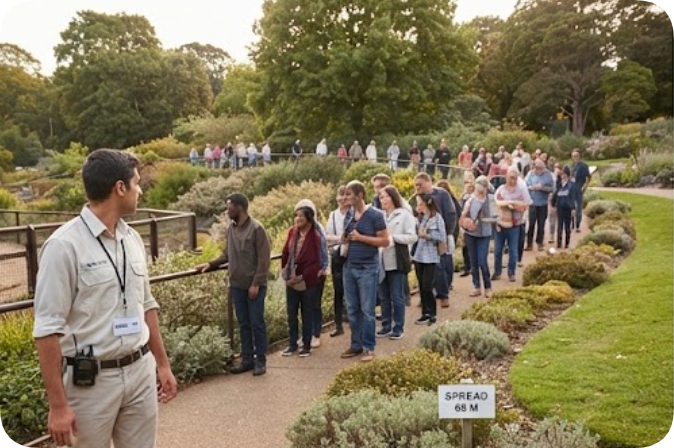
Reading the three curves side by side, the useful column is not the maximum distance reached but the distance at which the group is still moving as a group. That single number changed by more than a factor of two between the first-time school party and the members' walk, with the same equipment and the same route.
Where the Crowd Does What the Wall Was Doing
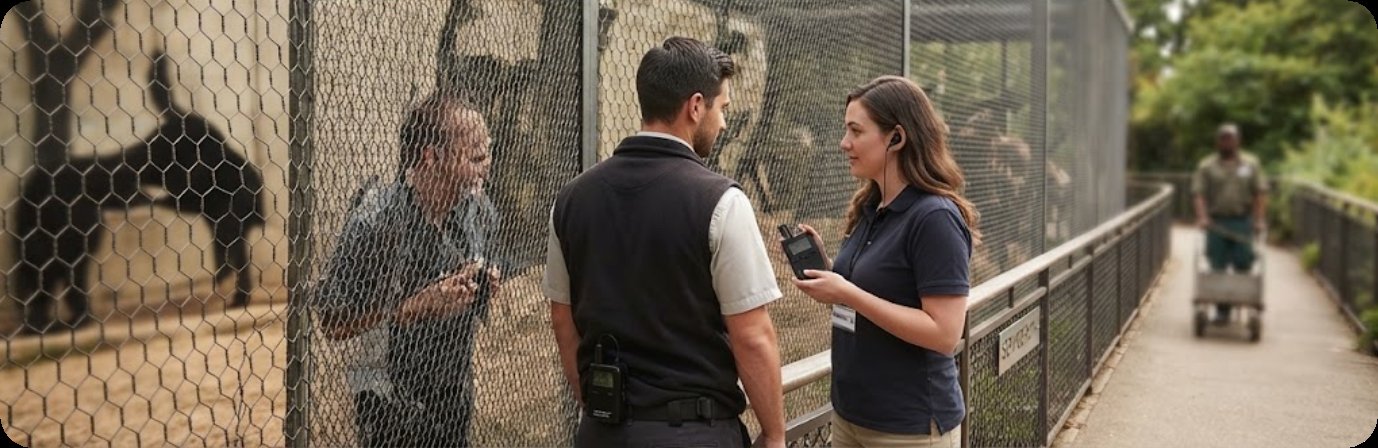
Indoors a building does most of the work for you. The glasshouse and the reptile house both cut the line of sight, which sounds like a problem and is usually not one, because the crowd is compressed at the same time. Thirty people in a tiled room stand far closer together than thirty people on a lawn, and bodies absorb the reflections that a hard floor throws back. Outdoors the reverse holds. The group spreads, the person at the back has a clear line to the transmitter, and the reading improves even though the environment looks worse. The two effects cancel each other often enough that a single test location tells you very little.
A practical consequence follows from that. Run at least two test locations, one enclosed and one on the open route, and compare them before drawing any conclusion. A single location will make a good system look average and an average system look excellent, depending only on which one you happened to pick and what the weather was doing that morning.
One Group Cannot Fill Eighty Channels
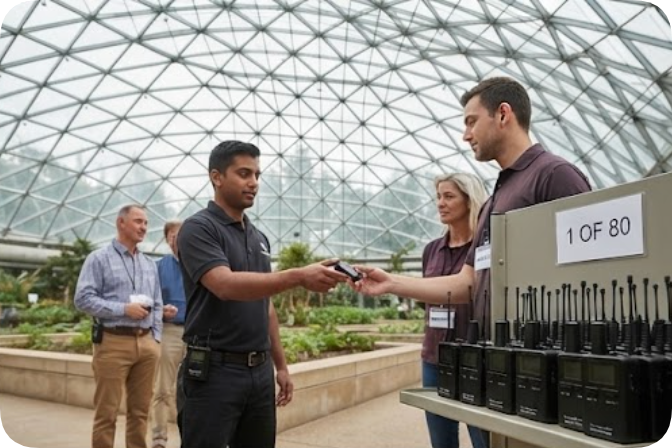
Channel count is usually read as headroom, and in a single-party trial it never gets tested. The RC2406 carries eighty channels on the 2403-2483 MHz band, and one school group of thirty occupied exactly one of them for the whole morning. To learn anything about a unit of that size you have to run several parties at once, which is what an open day actually looks like: three or four guided routes leaving the same gate within twenty minutes of each other. A trial with one party measures a device you will not be buying.
The Unit That Carries Fewer Parties at Once
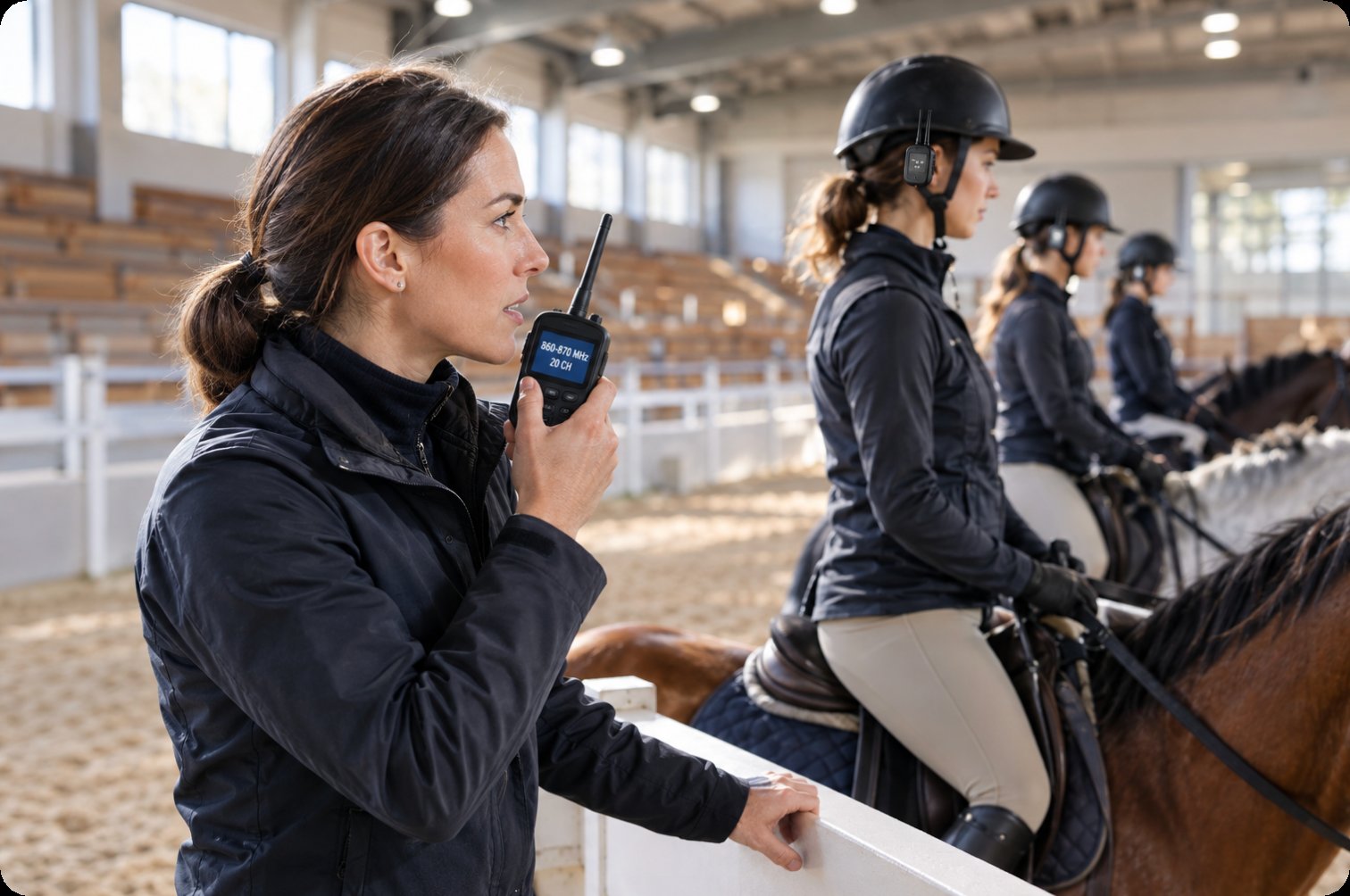
The RC8860 runs on 860-870 MHz rather than 2.4 GHz, and carries twenty channels instead of eighty. That looks like a downgrade until you count the parties a single living collection actually runs in parallel. Most open days here manage two or three, not eight. What the UHF band buys in exchange is behaviour around dense structure: the aviary mesh and the metal frames behind the glasshouses treat it differently from the 2.4 GHz units, and on the service path the two bands stopped being interchangeable at roughly the same distance. The constraint is arithmetic, not performance.
🗺️ The Column That Moves With the Visitor Mix
Put the three units on one sheet and only two fields change.
| Specification | RC2406 | RC2402 | RC8860 |
|---|---|---|---|
| Frequency band | 2403-2483 MHz | 2403-2483 MHz | 860-870 MHz |
| Channels | 80 | 50 | 20 |
| Output power | 10 mW | 10 mW | 10 mW |
| Working range | 1-200 m | 1-200 m | 1-200 m |
| Transmitter battery | 1500 mAh | 1500 mAh | 1500 mAh |
| Receiver battery | 20 h | 20 h | 20 h |
Range, power, transmitter cell and receiver runtime are identical across all three, so the procurement column that actually moves is the one tied to how many parties run at once. Everything else on that sheet was measured on a stand and behaved the same way in every trial we ran here. Write the party count down from your own visitor mix rather than from a specification sheet, and then check it against a day when the weather keeps families away but the booked group arrives anyway. Those are the two figures that decide the order.
🔮 What to Write Down Before the Next Open Day
Record four things on the next busy morning and the arithmetic settles itself. Note the widest spread your longest party reaches, because that sets the distance the system has to carry. Note how many parties leave within the same hour, because that sets the channel count you are paying for. Note which parts of the route put dense structure between the guide and the back rank, since that is where the bands separate. Note how many people in the party have been before. A first-time group is the only honest test load, and a school field trip can be arranged outside opening hours rather than borrowed from a paying day. A general wireless tour guide system will handle the calm runs; the record is what tells you which one handles the other ones.