
.webp)
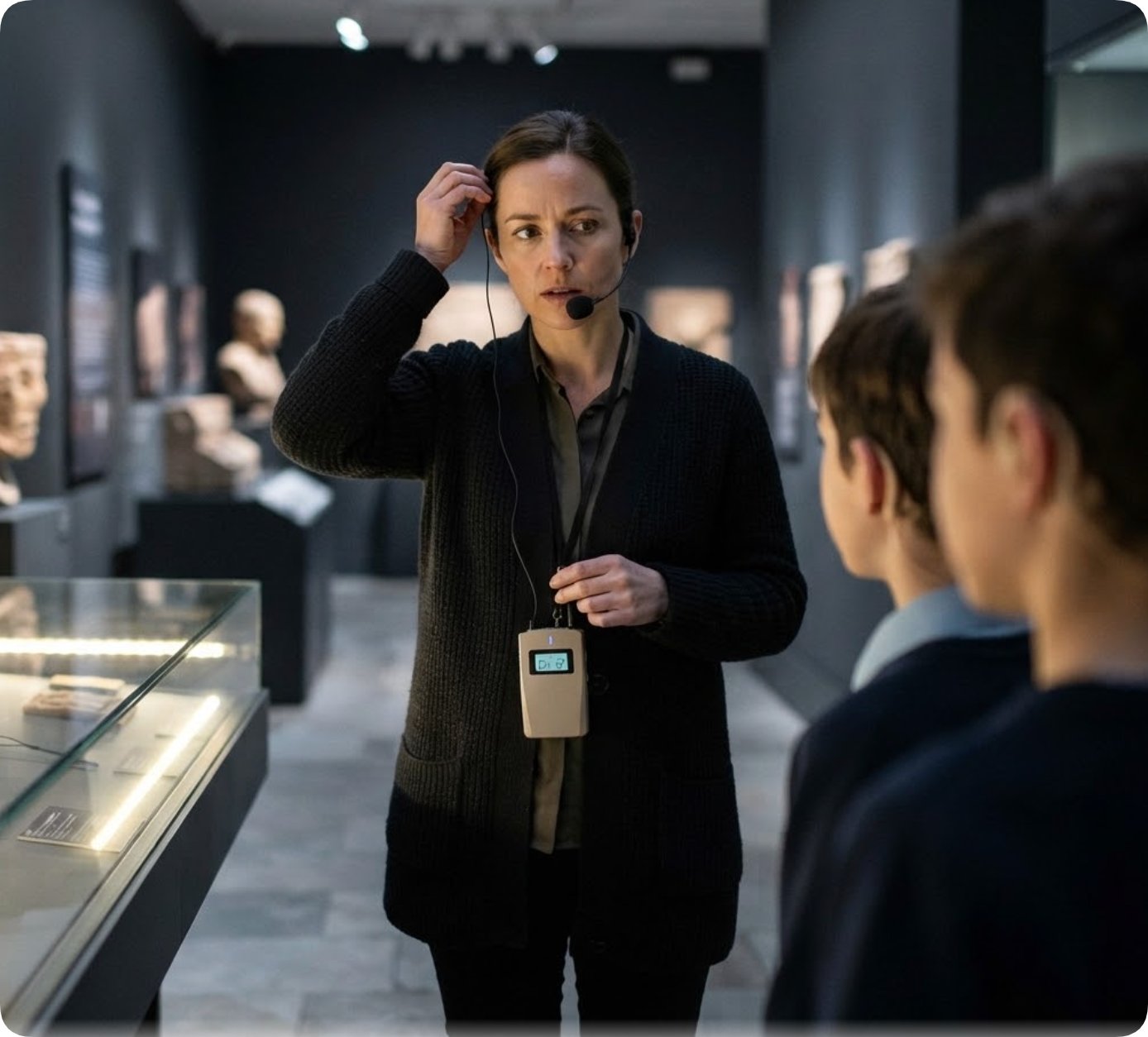
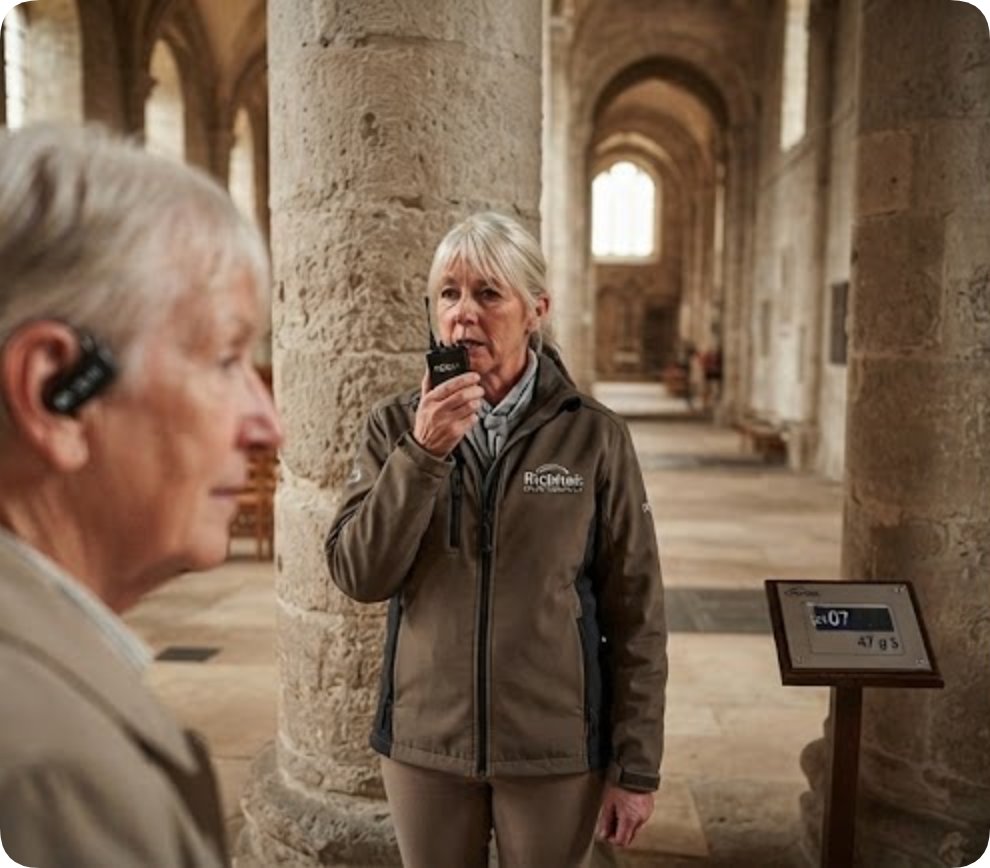
A guide stands near the crossing of an old stone church and speaks at a normal volume. The first row hears every syllable. Twenty metres back, the same voice arrives as a rise and fall of tone with no words attached. Visitors nod politely, because nodding is the only honest thing to do when you can tell that someone is talking but cannot tell what about. Church audio budgets have traditionally been written against a different question. How far will the signal travel, how many channels does the unit carry, how many hours does the battery last. Those numbers are useful, and every one of them is printed on a datasheet. None of them describes what happened in that back row.
That gap is where the category is moving. Across church and cathedral projects, the buying conversation has started to shift from what the transmitter does to what the listener receives. Three things pushed it there. Congregations aged, and the frequencies lost first with age are the ones that carry meaning. Visitor groups stopped arriving in one language. And the buildings themselves never changed, which means every room adds its own distortion on top of the equipment. Read together, those three pressures point at one word that almost never appears on a specification sheet: comprehension. The systems below are worth looking at through wireless audio for churches and cathedrals, not through a range figure.
💡 Why Consonants Become the First Casualty
Reverberation is not a defect in a stone building. It is the building working as designed, returning sound to the room for a second or two after the speaker has stopped. In that returning tail, the quiet parts of speech disappear first. Consonants such as p, t, k, s and f are brief and low in energy. Vowels are longer and louder. So the room keeps the vowels and swallows the consonants, and the listener is left with a melodic shape that carries emotion but not information. This is why a visitor can report that the acoustics are beautiful and, in the same breath, that nothing was understandable. Both statements are accurate. The room is doing exactly what it was built to do, and comprehension is the price.
🔍 Why Volume Cannot Fix a Stone Room
The instinct is to add gain. Turn the transmitter up, add a loudspeaker at the back, and the problem should close. It rarely does. When a room reverberates, raising the level raises the reverberant energy by the same proportion as the direct sound, so the ratio between the two does not improve. What does improve is the amount of the room that the guide is competing with. In a cathedral, that ratio is the whole story. A speaker who is close to the ear wins the ratio without any gain at all, because the reflected sound arrives late and weak relative to a signal delivered at the ear. That is a hardware property, not a mixing decision. Rooms are not fixed with louder equipment. They are bypassed.
The Age Curve in the Seats
The people who struggle most in a reverberant church are the ones who most want to be there. Hearing declines with age, and the high frequencies go first, which is the exact band where consonants live. A congregation that skews older therefore has a built-in reason to lose the words before the equipment has done anything wrong. Add a second language and the load doubles, because a listener working in a non-native language has less spare capacity to fill in what the room removed. It is worth noting that simultaneous interpretation systems exist precisely because churches now serve both groups at once, and both depend on the same thing: consonants that actually arrive.
⚖️ Three Centimetres Between Mouth and Ear
The most reliable way to protect a consonant is to stop asking it to cross the building. A receiver worn at the ear removes the room from the signal path, and everything the room does to speech becomes irrelevant. The RC2501 is built around that idea, at 86 by 50 by 19 mm and 47 g for both the transmitter and the receiver. Two details matter for comprehension rather than coverage. Its noise-cancelling microphone rejects the room instead of amplifying it, capturing the guide and discarding the reflections. And the receiver runs for 35 or more hours against 15 hours on the transmitter, on a Type-C port. One-click pairing means a volunteer can hand a unit to a visitor without a briefing.
Two Tours in One Afternoon, Hearing Different Things
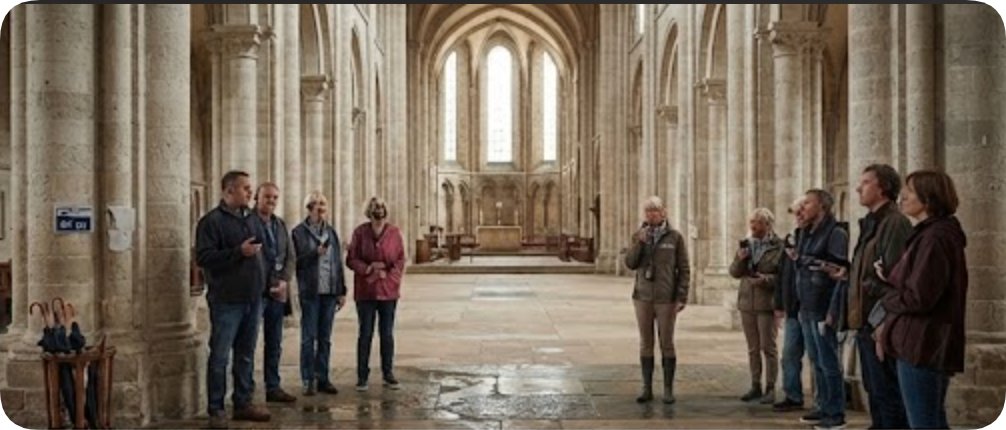
A cathedral is rarely used by one group at a time. A parish tour at two o'clock, a school group at three, a visiting choir in the evening, all inside the same walls. When two guided groups share a space, the failure mode is not silence but bleed, one group catching fragments of the other guide's commentary and losing their own. The RC2406 answers that with 80 channels on the 2.4 GHz band, which needs no regional licence, so a second group is a second channel rather than a second problem. It carries an IPX4 splash rating for the wet end of the building, and the receiver runs 20 hours against 10 on the transmitter.
Talkback for the People Who Lead the Reading
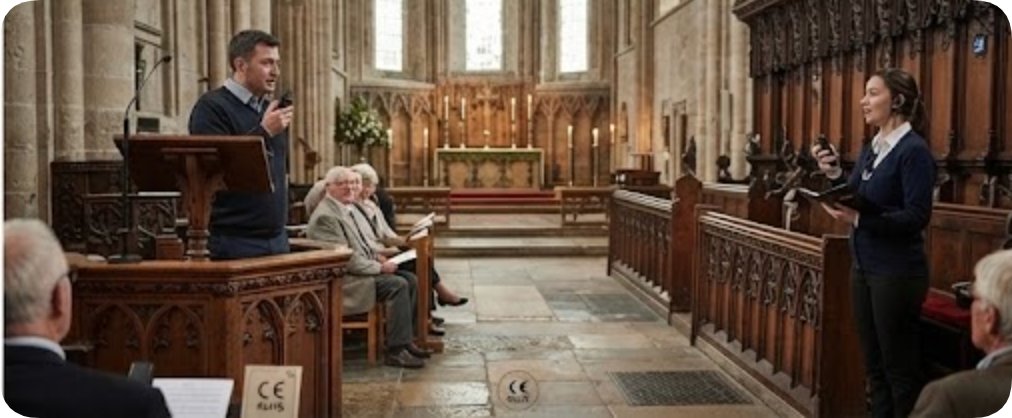
Not every voice in a service comes from the same place. A reader at the lectern, a cantor near the choir, a celebrant at the altar, and a guide at the west door may all need to be heard within the same hour, and they sometimes need to hear each other. The RC2408 supports two-way talkback between two speakers while the rest of the group listens, which turns a one-way commentary channel into something closer to a rehearsal tool. With 59 g on the transmitter and 50 g on the receiver, and 20 hours of receiver time, it covers a morning tour and an evening service on one charge.
Where Measurement Stops
Set the three units side by side and something uncomfortable appears. Two of them publish the same channel count and the same receiver run time. All three reach 200 metres. The figures that get quoted most in procurement are the figures on which the category has converged, which means they no longer separate one choice from another. The differences that remain are the ones that touch a listener: a microphone that refuses the room, a body small enough to forget, a splash rating, a talkback link. Certification splits them as well, with the RC2501 and RC2408 carrying CE and RoHS while the RC2406 carries RoHS alone.
| Unit | What changes at the listener end | Channels | Receiver run time |
|---|---|---|---|
| RC2501 | Noise-cancelling microphone; 86 by 50 by 19 mm body | 50 | 35+ h |
| RC2406 | IPX4 splash resistance; one transmitter to many receivers | 80 | 20 h |
| RC2408 | Two-way talkback between two speakers | 80 | 20 h |
For a building that also runs worship in more than one language, translation headphones for church use follow the same logic, because a translated sentence is only as useful as the consonants that survive the trip to the ear. The measurement that would settle most church purchases is not on any datasheet. It is a listening test in the actual room, at the far end, with the doors open and the congregation seated.
What to Ask Before You Commit
Ask a supplier to stand at the back of your own nave and repeat a sentence at normal speaking volume while you listen at the last row. Then ask what the system does about the reflections that sentence will meet. A vendor who answers with a range figure has answered a different question than the one your congregation is asking. After the listening test, agree on three things in writing: which listener position is the worst one in the building, how many separate groups must hear different content at the same time, and whether any part of the system is expected to sit within a metre of a person's ear. Those three answers decide the choice far more reliably than a coverage radius, a channel count, or a battery claim. Choose the unit that reaches the back rows with words, not with volume.