
.webp)
A shore excursion does not end when the last guest steps off the coach. It ends an hour later, on board, in a corridor that is already busy with dinner. That hour is where the equipment actually gets looked after, and it is the only hour that is reliably free for it. The work done on the quayside is collection. The work done after the gangway closes is maintenance.
The reason is simple arithmetic. A ship cannot hold a departure for a headset, and the next port is not a place where spare parts appear. Everything that has to be ready for tomorrow has to be made ready tonight, in the time between the guests going to their cabins and the crew turning in. Three units handle that window differently, and the difference is not in how they sound on shore.
💡 Why the Work Starts When the Guests Step Off
Guides do a good job of collecting. Receivers go back into the case, transmitters come off the lanyard, and the whole set is handed over at the cabin door. What that handover does not do is separate a unit that worked from a unit that worked once and is about to stop. Those two look identical in a full case. Telling them apart is the first task of the hour, and it has to be done while the memory of the day is still fresh in the guide's mind. A route pattern that runs across several ports is described in our city tour audio solutions, and the maintenance side of it follows the same rhythm.
Sorting the Jobs by How Soon They Bite
Not every job in that hour deserves the same urgency, and treating them all as urgent is how the important one gets skipped. One question sorts them: if this is left alone, does the problem stay the same, or does it get worse by itself? A flat battery gets worse. A scuffed housing does not. A channel that was changed on shore stays changed and will collide with something tomorrow; a smudge on a receiver will still be a smudge next week.
That answer puts every job into one of three bands. Work that degrades on its own and blocks the next departure goes first. Work that degrades quietly and blocks nothing can follow the charging queue. Work that will be identical in the morning should be left alone, because promoting it into the first band is how a short hour turns into a long one.
The Salt That Only Shows Up After Two Ports
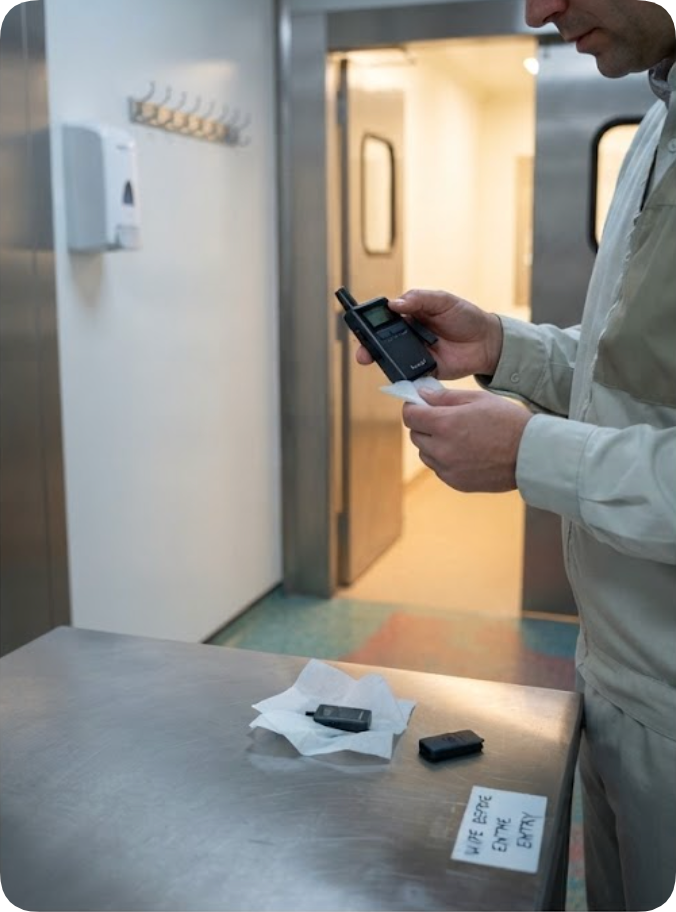
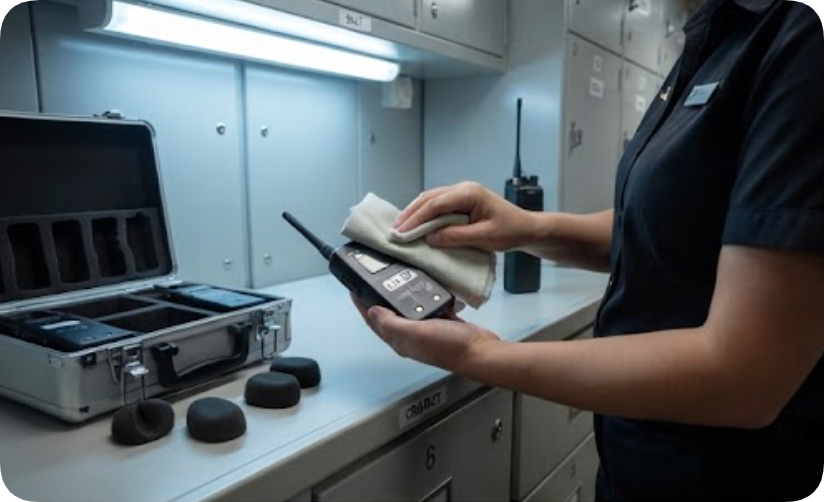
Salt does not arrive with the sea air in a single afternoon. It builds across a sequence of boarding and disembarking, and it settles in the places that are touched and then put away damp. The foam of an earpiece, the clip that grips a collar, the charging contacts on the back of a unit: these are where a routine that only wipes the outside will eventually fail. The RC2408 is the workhorse of the three, and its eighty-channel 2.4G design puts most of the exposed hardware in exactly those three places. Wiping the shell is not cleaning; wiping the contacts is.
🔧 Where the Charging Queue Becomes a Maintenance Item
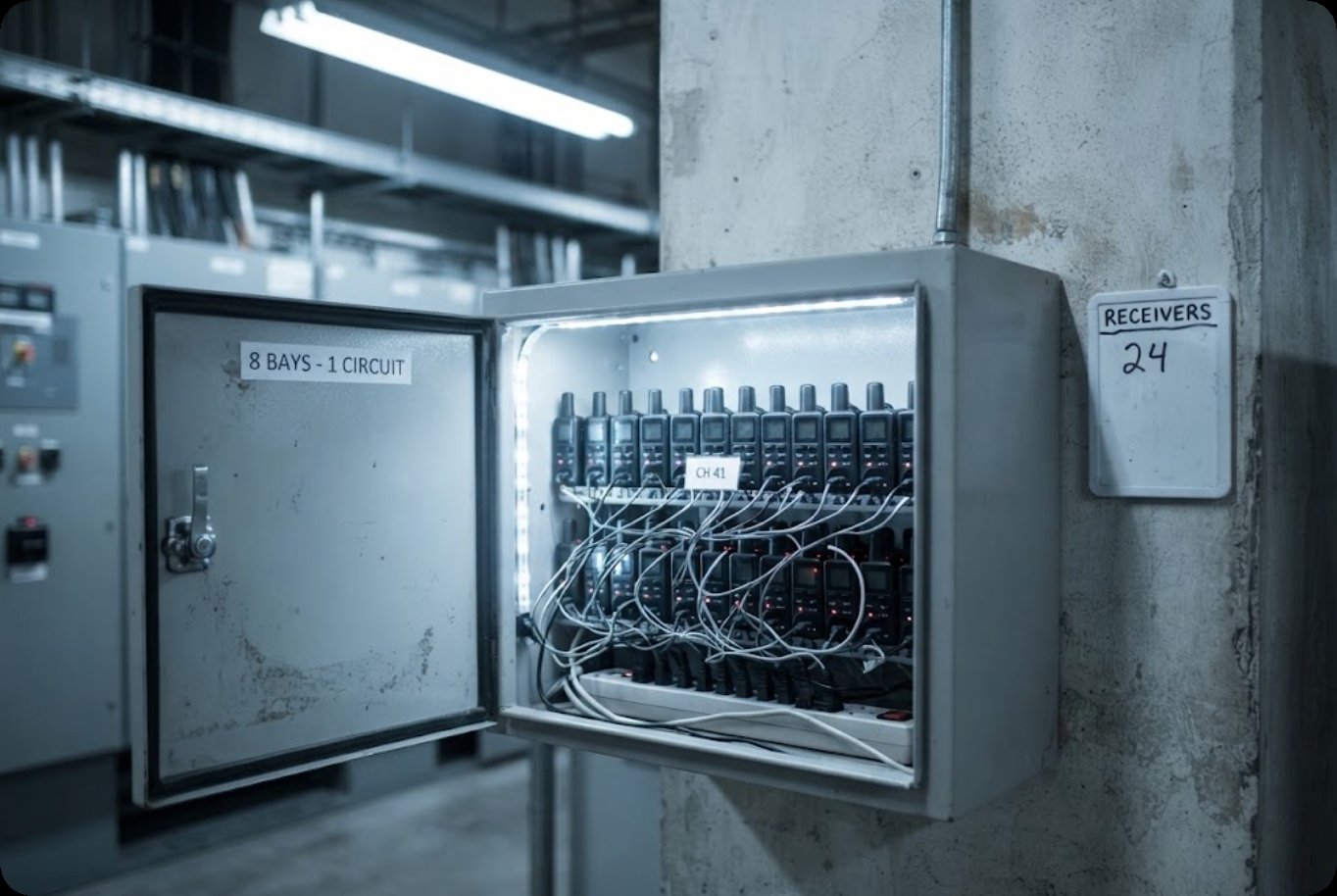
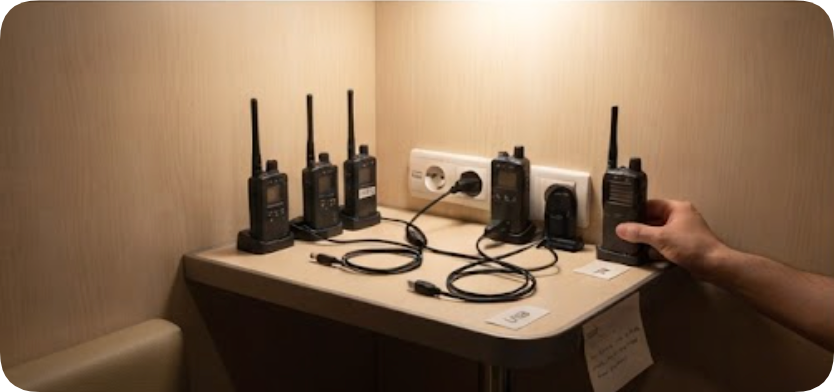
Cabin power is shared and the sockets are few, so charging is a queue rather than a task. That turns two specification lines into operational ones. The first is the connector, because the cable you need determines how many units can be charged at once from the sockets you actually have. The RC085 takes its charge over a hundred-channel system with a USB port, while the other units here use a barrel connector. The second is capacity, because a receiver that holds a full day will survive a missed slot in the queue and one that does not will not.
🔮 What One Missing Receiver Costs the Next Sailing
A count that happens on the quayside is optimistic. Guests are still moving, a receiver can be in a pocket, and the number will look right because it is not complete yet. The count that matters happens after everyone is on board, and it has to be finished before the ship is ready to leave. One missing receiver is not a small loss. It means a group of forty tomorrow is a group of thirty-nine, and the guide finds out at the worst possible moment. The lightest unit in this comparison is the one most likely to be left behind in a seat pocket.
Reading the Cases at the Cabin Door
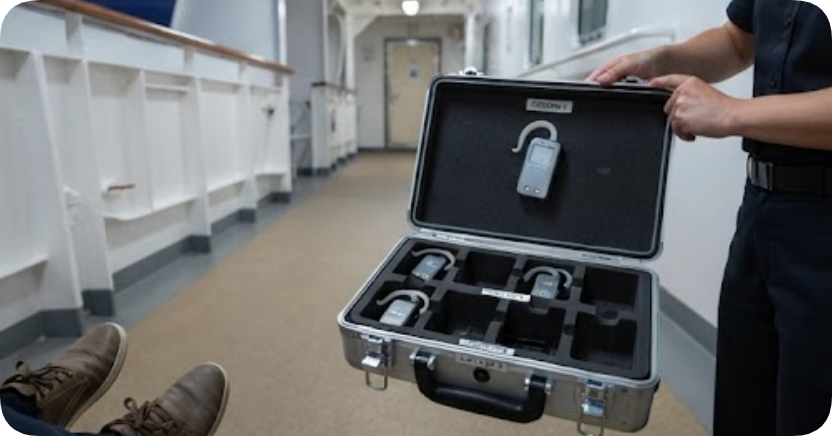
Reading a case takes seconds if it is done in the right unit. Counting items invites a debate. Reading the case as a whole, matched against the number of groups it was issued to, does not: a case that is one slot short announces itself. The ultra-light 2.4G system returns to its case faster than anything else here because the receiver is small and hangs rather than sits, and a case that is laid out to match that shape can be read at a glance instead of emptied.
The Page That Stays in the Case
The record for the next sailing is not a logbook. It is three lines on a page that lives in the case and travels with it. Which channel the day ended on, so tomorrow does not open on the same one in the same port. Which unit behaved oddly, so it can be watched rather than trusted. Which unit is absent, so nobody has to reconstruct the count from memory in a corridor at seven in the morning. It does not need to be long. A page that takes ten minutes to fill in is a page that stops being filled in by the second week.
What You Can Leave Until Breakfast
Some jobs are safe to defer, and being honest about which ones is what keeps the short hour from being wasted. Cosmetic cleaning can wait. A deep clean of foam that is not yet stiff can wait. Restocking of anything that is not needed to make a unit work can wait. The test is the same as before, applied one step further out: if this goes wrong overnight, is there still time to fix it before the guests arrive?
The published figures below are the ones a buyer can check before a season starts. They are worth reading in the order they appear, because the first blocks describe what a unit needs from you and the later ones describe what it gives back.
| Dimension | RC2408 | RC085 | RC2468 |
|---|---|---|---|
| Channels | 80 | 100 | 50 |
| Core band | 2403-2483 MHz | 470-510 MHz | 2403-2483 MHz |
| Battery life (tx / rx) | 10h / 20h | 12h / 20h | 10h / 8h |
| Battery cell (tx / rx) | 1500mAh / 1000mAh | 1200mAh / 1000mAh | 1500mAh / 300mAh |
| Weight (tx / rx) | 59g / 50g | 65g / 60g | 59g / 18g ear-hook |
| Charging port | DC Port | USB | Micro USB |
Two of the six lines carry most of the weight of the hour. Battery life decides whether a unit that misses a slot in the charging queue is usable in the morning, and the receiver figures here span a wide range: a receiver rated at eight hours is a unit that has to be charged every night without exception, while one rated at twenty can survive a night where the queue did not reach it. The charging port decides what has to be in the bag before the ship sails, and a mixed fleet carrying two connector types needs both cables on board.
The other four lines matter, but they matter before the season rather than during it. Weight and cell size tell you how a unit behaves in a queue over ninety days, which is a purchasing question rather than a nightly one. Read them against the wireless tour guide system range as a whole, because a fleet assembled from one family keeps its cables, cases and charging routine interchangeable, and a fleet assembled from three families does not.
Operators running repeated shore programmes have already worked through this. The pattern across a multi-port itinerary is documented in a continental heritage voyage programme, where the count, the charge and the channel note are the three items that carry between stops. Everything else in the hour can be arranged around the departure time, but those three cannot, and the equipment you choose should be chosen on how well it supports them.