
.webp)
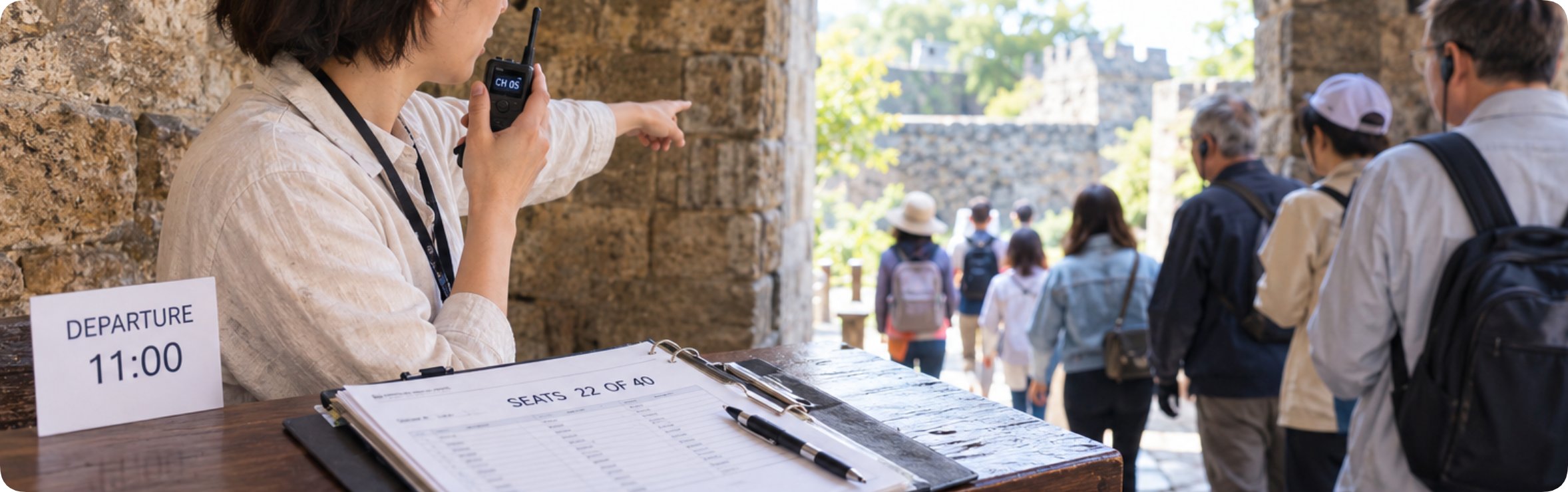
A public service hall rarely has to guess when its busiest stretch will arrive. The dates come as a posting: annual licence renewals, the week a policy change takes effect, the fortnight before a new term, the run-up to a closing year. The building knows the shape of that surge months before it feels it. What the posting never says is how much of the hall's own preparation can still be moved once the first queue has already curled back from the enquiry desk.
This article works backwards from the surge rather than forwards from the calendar. Seasonal planning is treated as a sorting problem: three kinds of decision sit in front of a service hall every year, and each one stops being reversible at a different distance from the busiest morning. RC2500, RC2406 and RC085 serve as the three reference points below, because the practical gap between them maps onto the question of what can still be changed late. The same logic runs through conference and hall audio systems, where several groups are also addressed at once.
💡 Why the Heaviest Stretch Is Published Months in Advance
Service counters do not peak at random. Their peaks follow published cycles such as a renewal deadline, a subsidy window, an enrolment period or a statutory reporting date, which is good news for planning, because an announced date can be counted back from. The difficulty is that the same announcement reaches every applicant in the region, so the load stacks into a handful of weeks rather than spreading. Planning starts with an advantage and inherits a constraint: the timing is known, the compression is not negotiable.
Three Kinds of Choice, Three Points of No Return
Sort a hall's annual decisions by how long they stay open and three groups appear. Staffing and channel allocation can be reworked right up to the moment the duty roster is published. Radio planning closes with the building, because partitions, glazing and service corridors decide what a signal has to cross, and no quantity of spare handsets repairs a band that was chosen badly. Handset-to-counter matching is the only one that stays open into the morning itself. The summary below sets out all three, with the cost of a late change beside each.
| Decision | Latest point it can still change | What a late change costs | Usually settled by |
|---|---|---|---|
| Duty roster and channel allocation | Until the roster is published | Every group re-planned; all handsets re-labelled | Hall operations |
| Radio band and receiver placement | During the building walk-through, before partitions are signed off | Nothing later repairs it; the band is set by the walls | Facilities, together with the supplier |
| Handset matched to a counter | Any morning of the surge | Minutes per unit | Front desk supervisor |
Two of those rows carry more weight than the third. A late roster change is expensive but survivable: it consumes a planning afternoon and a roll of labels. A late radio change is neither. Once the walk-through has passed and the partitions are signed off, the band, the receiver placement and the practical range all sit behind the hall, and the only remaining move is to add repeaters to a layout never surveyed for them.
Channel Count Is Fixed by the Staffing Plan
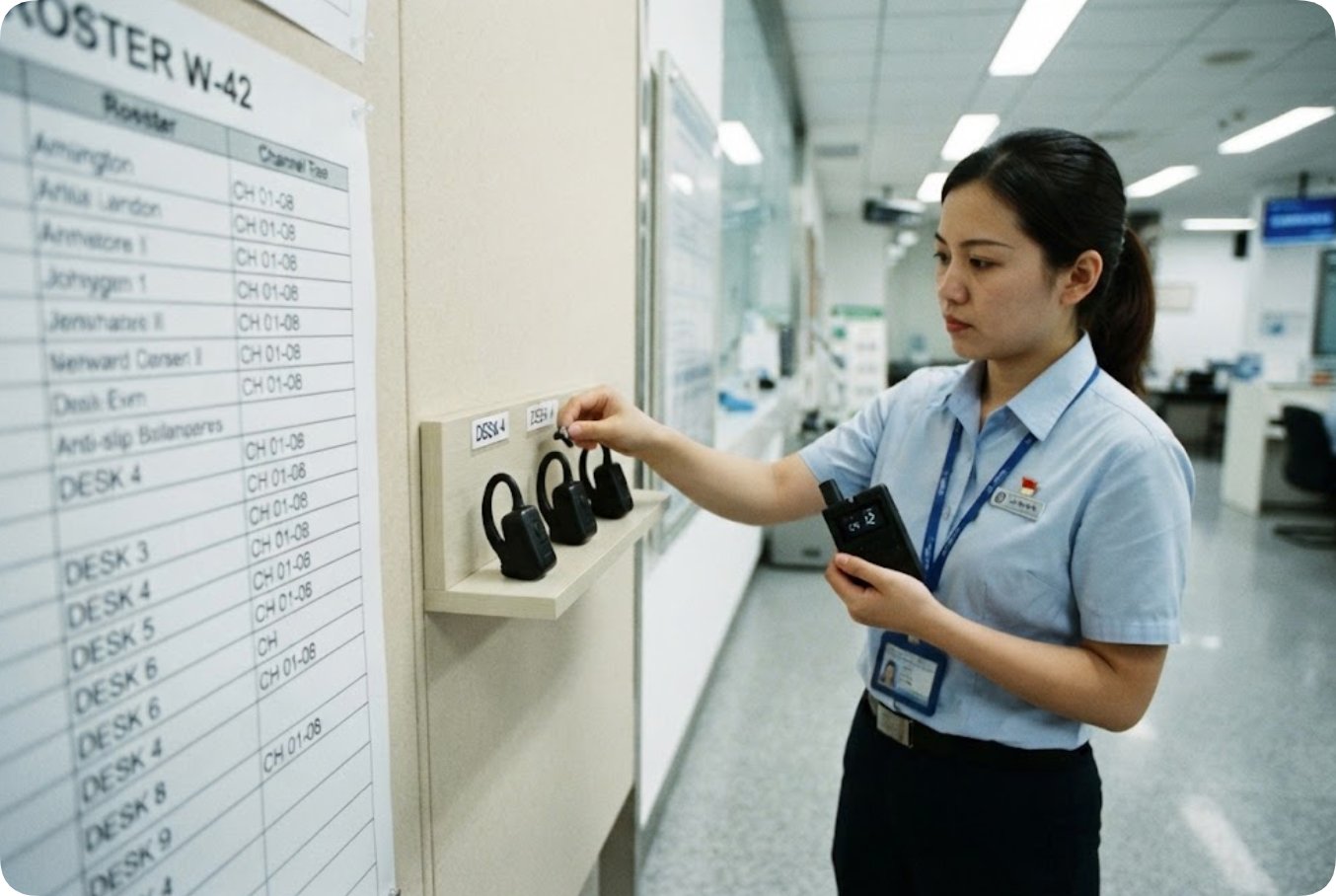
Channel count looks like a technical figure and behaves like a scheduling one. The number of groups a hall can run at once follows from how many counters are open simultaneously, not from how large the crowd is. A hall that runs four desks during a renewal window and eight during an enrolment week needs those groups held apart without cross-talk, and the block assignment has to be written before the roster is printed. RC2406 carries 80 channels on the 2.4G band, headroom for one block per desk plus a spare for the supervisor walking between them. Its receivers run 20h against 10h on the transmitter side, so a single shift passes without a mid-day charge, and the units weigh 59g and 50g, which matters when a handset is carried for six hours rather than left on a desk.
📡 Radio Band Is Decided by the Building, Not the Crowd
Band choice is made by the walls, and service halls are unusually hostile rooms: stone floors, glazed partitions, banks of metal filing cabinets and service corridors running through the middle of the plan. A 2.4G system remains the default answer in an open hall where the queue is one long space. Where the route steps through several enclosed service areas, a UHF band tolerates those crossings better, because it is less sensitive to the geometry a renovation adds. RC085 works on 470-510 MHz with 100 channels, 12h of transmitter life against 20h on the receiver, and 65g and 60g in the hand. Its charging port is USB, so the desk drawer that already holds phone cables holds these too.
The Only Swap That Still Works on the Day Itself
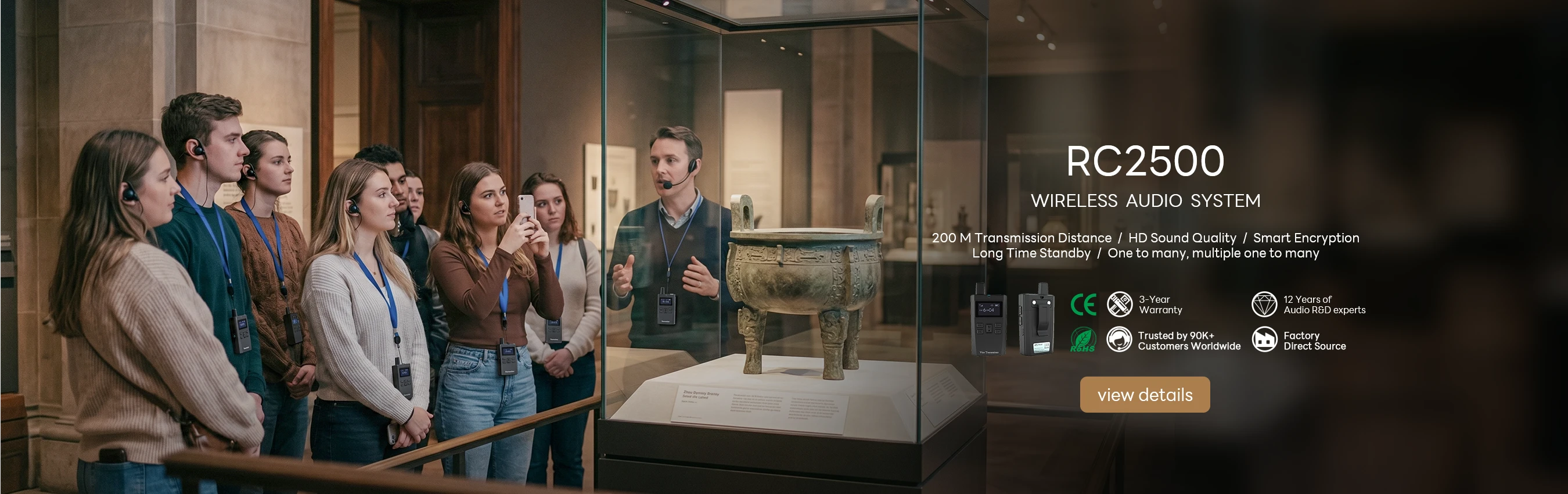
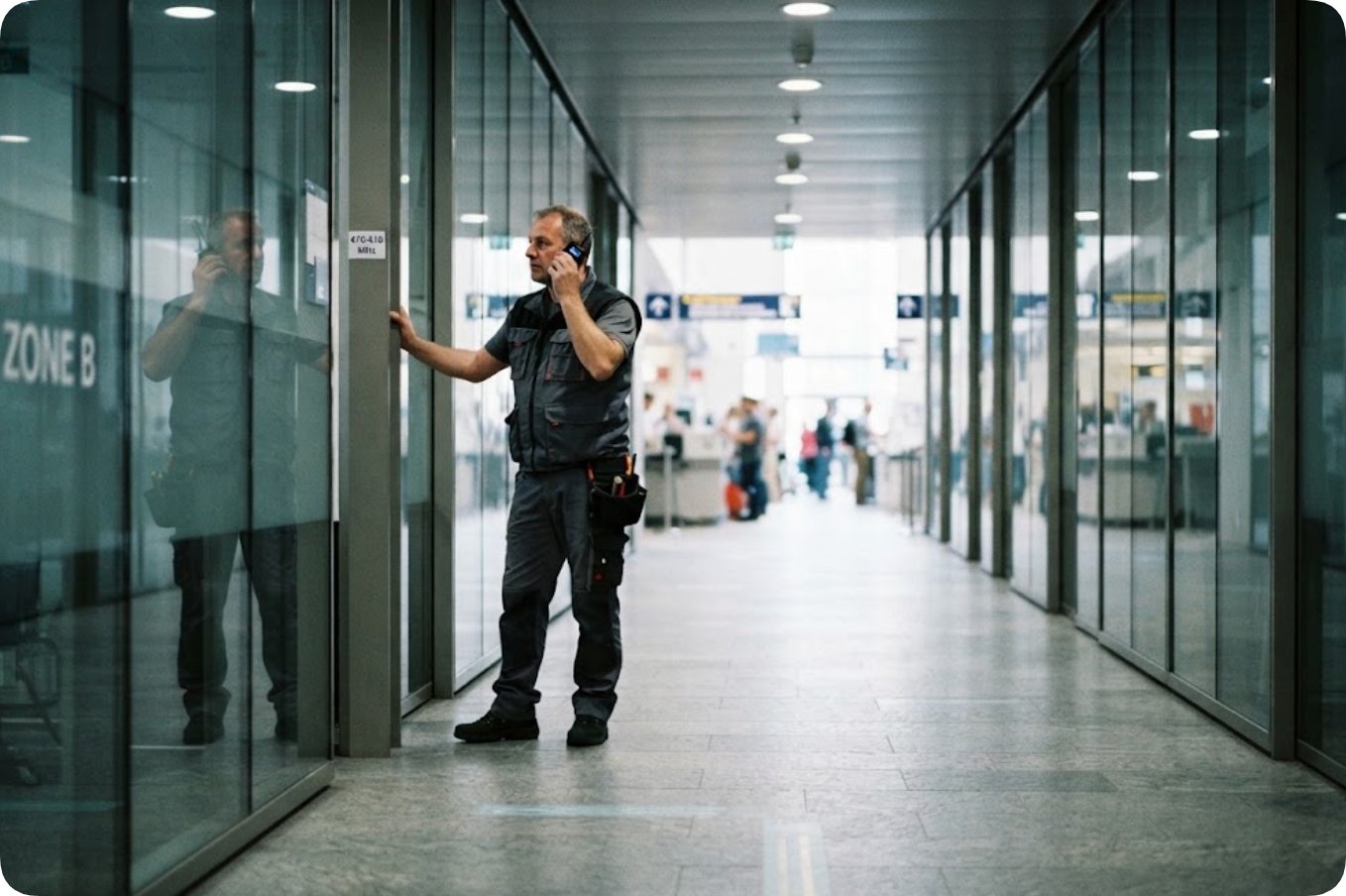
By the morning of the surge most decisions are behind the hall, but the assignment of individual handsets to individual counters is not one of them, and that is the last lever worth keeping loose. A counter that needs a second unit for an interpreter, or a briefing point that has to move because the seating was rearranged, is a five-minute problem if units can be regrouped on the spot. RC2500 keeps that lever usable through one-key sync, one-key power and one-key mute, so a supervisor can fold a handset into an existing group without a menu walk. It runs 15h on the transmitter and 35+h on the receiver, is 104g on both sides, and charges over Type-C, so one cable serves the desk and the unit.
| Model | Core Frequency Band | Channels | Output Power | Transmitter Battery Life | Receiver Battery Life | Weight, per Side | Charging Port |
|---|---|---|---|---|---|---|---|
| RC2500 | 2403-2483 MHz | 50 | 10mW | 15h | 35+h | 104g each | Type-C |
| RC2406 | 2403-2483 MHz | 80 | 10mW | 10h | 20h | 59g / 50g | DC Port |
| RC085 | 470-510 MHz | 100 | 8-10mW | 12h | 20h | 65g / 60g | USB |
Read across that table and the three units answer the three decision layers rather than competing. The channel figure moves with roster complexity, the band moves away from 2.4G exactly where the floor plan has internal doors, and the weight moves with how much hand-carrying a shift involves. All three carry a 3-year mainboard warranty, with the headset, microphone and battery treated as wearing parts across the range.
What the Enquiry Desk Holds Before the Queue Forms
The enquiry desk is where a planning failure becomes visible to the public, so it deserves a fixed list rather than a general instruction to cope. Three items carry most of the weight: a channel map showing which block belongs to which counter that week, a spare handset already paired so that a swap costs no pairing time, and one sentence per counter describing what that queue is actually waiting for. The third item is the one halls skip, and it is why staff improvise explanations on the busiest mornings, when an improvised explanation is the slowest thing a queue can receive.
💡 Ordering Far Enough Ahead That Kitting Is Not the Reason
Most deliveries blamed on manufacturing are late because a specification was confirmed too close to the date. Channel blocks, band choice, the split between single-ear and multi-ear receivers, and the label set are all decided by the hall, and each one is a checkpoint for whoever assembles the kits. Working back from a published peak, the practical sequence runs from a band decision at the walk-through, to a channel block when the roster is drafted, to a quantity confirmation a full ordering cycle before the first morning, which keeps a supplier building rather than waiting.
Writing the Standing Order for Whatever Follows
The most useful document a service hall produces in a busy year is the one written while the surge is still running, because that is when the cost of each late change is visible and nobody has to reconstruct it from memory. Note which decision was moved, how far out it was moved, and what it cost in staff time. Next year's standing order then becomes a short list of dates rather than a fresh debate. To see how the three units sit alongside the rest of the range, review our wireless tour guide system range or explore our solutions.