A leading China factory specializing in Wireless Tour Guide Systems, Church Audio Guides, and Translation Headphones with premium OEM/ODM solutions.

Tel:+86 18922879583

Email:tiger.wang@richitek.com

RC2408, RC2402 and RC9150: Three Numbers on a Test-Centre Handout Sheet and What Each One Is For

RC2408, RC2402 and RC9150: Three Numbers on a Test-Centre Handout Sheet and What Each One Is For

A test centre running wireless receivers does not run on the number of devices it owns. It runs on how many came back, how many were issued, and how many are still on the cabinet. Those figures rarely agree, and the gap is where problems surface weeks later.

The handout sheet exists because a listening test cannot run on trust. Every candidate must hear the same material, so every handset must be on one channel at one volume with a working earpiece. The sheet proves those conditions held. Filled in from memory, it stops being evidence.
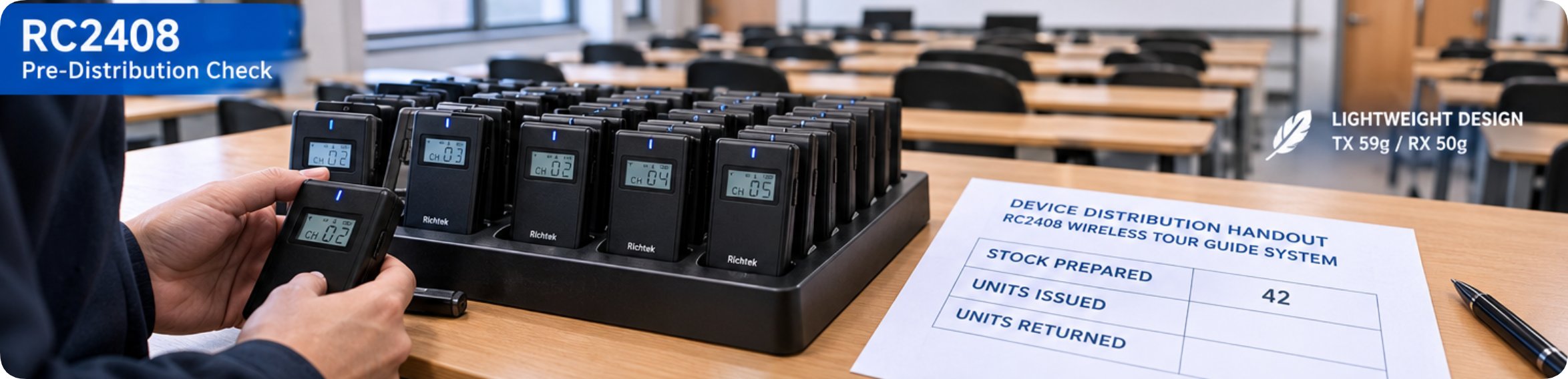
RC2408 wireless receivers counted on a charging tray beside a printed device distribution handout reading STOCK PREPARED 42 in a test centre classroom before the doors open

🏟️ The Count That Has to Match the Seating Plan

The first figure is the easiest to get wrong. Forty candidates need forty handsets plus a margin, because a failed earpiece cannot be repaired mid-sitting. The sheet therefore records seats plus whatever the centre held back. Recording the smaller number is a quiet dishonesty about what was delivered.

Keeping this honest is hard because seats and devices are counted by different people at different times. The seating plan is fixed weeks ahead; the device count belongs to whoever loaded the cabinet. When they disagree the sheet is the only record.

RC2402 one-click frequency synchronisation across two adjacent test centre rooms, screen reading FREQUENCY SYNCHRONISED with 80 CH between ROOM A and ROOM B

The Number That Depends on Someone Remembering

The second figure is what was issued, and it depends on somebody remembering to write it down. It is small next to the first, because most stock stays in the cabinet, but it says whether the margin was right. Issuing thirty-eight of forty works; twenty-eight absorbs the shortfall in unrecorded staff time.

This figure is unreliable because it is derived, not observed. If the column is filled from what was left in the cabinet, an error in the previous return count appears as a sudden drop. Nobody investigating a shortfall looks here first, because it reads like a distribution figure, not a stock figure.

Recording it as an observation removes the problem: one line for what left the cabinet, one for what returned, and the difference is a figure checkable against something physical. That check takes a minute and is the only way a centre learns its margin is correctly sized before it needs to know.

Where a Unit Leaves the Sheet and Does Not Come Back

The third figure damages a centre quietly. A unit leaves the cabinet in the morning and is not back in the afternoon, and the sheet has no column for it. This is not a shortage, which is visible and prompts a call. A unit lost in a bag produces no signal for months.

The consequence is not financial at first. It is that the centre cannot distinguish a failed device from one never returned, and both look identical on the sheet. A centre that quietly loses six handsets in a year buys replacements before investigating, and they vanish at the same rate.

The fix is procedural: the sheet needs a column for units not returned, filled in the same sitting with a name against each. That is five minutes at the end of an afternoon.

One Grid, Three Columns, Three Different Jobs

Figure on the sheetWhat it actually countsWhat it fails to tell you
Stock preparedUnits loaded and counted before the hall opensWhether any of them work
Units issuedWhat a candidate was actually handedWhich of them were returned
Units returnedWhat came back at the end of the sittingWhether it is the same unit that went out
Not returnedNothing, unless the column exists and is filledEverything

Read across a row and the weakness shows. Three rows count objects; one admits a count is short. A sheet carrying only the first three is a stock record, which cannot say whether the margin was right.
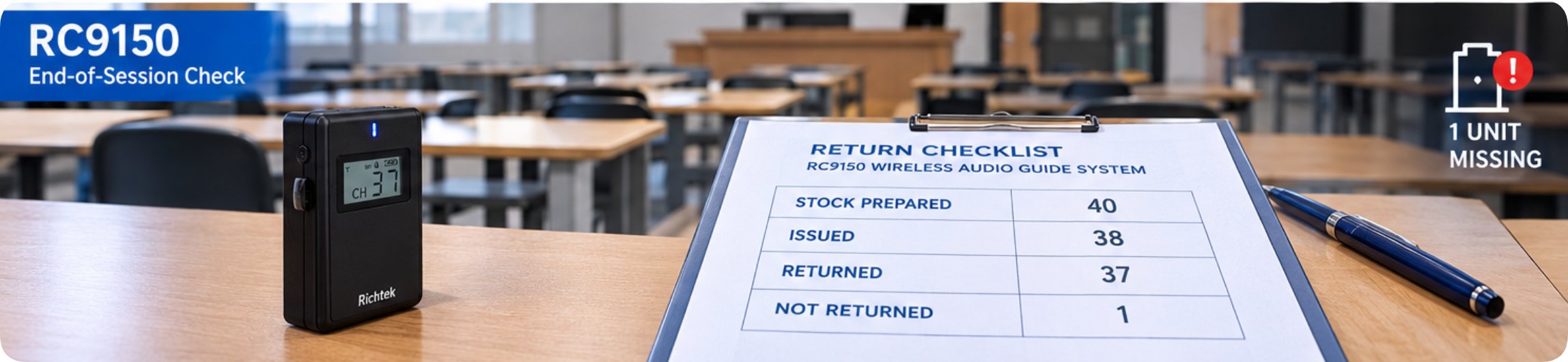
RC9150 end-of-session return checklist on a clipboard reading STOCK PREPARED 40, ISSUED 38, RETURNED 37 and NOT RETURNED 1, with one receiver set aside and marked 1 UNIT MISSING

💡 Why the Middle Figure Is the One That Hurts

Of the three working figures the middle one does most damage when wrong. An overstated stock count causes a shortage discovered on the morning, in a full hall. An understated issue count causes quiet overwork, because staff cover the gap. The third figure is recorded accurately and then ignored.

That middle number also says whether the hardware choice was correct. Forty candidates and thirty-eight issued means correctly sized; forty and fifty means a margin costing storage and charging time.

This is where a long receiver battery earns its place in a way a benchmark never shows. A handset that runs a full day is issued once and returned once. One needing a midday top-up creates a second handling event and another chance to miscount it.

⚖️ The Idle Hour Between Two Sittings

Most centres run more than one sitting a day, and the hour between them is where the system gets tested without anyone designing a test. Devices go back on the charger, counts are done at speed, and the second sitting inherits the first's leftovers.

This gap is also where a centre discovers whether its charging arrangement is adequate, because it is the only part of the day when the whole stock has to be reachable at once.

The measure is literal: how many handsets charge at once, and how long the last takes. A cabinet charging forty units in under two hours turns the stock twice a day. One that takes most of a shift cannot.

This is a specification question, and one product pages rarely answer. What matters is the ratio between receiver battery life and a sitting day, and whether partial recharging needs a supervisor.

🔮 The Figure the Next Centre Can Reconstruct

A handover sheet also has to survive being read by somebody who was not there. Invigilators know what they meant by each column; a new manager or external examiner will not. A figure that only makes sense to its author has no value elsewhere.

Reconstructability comes down to writing what a count is of rather than what it was for. A number followed by what was counted from is understood by anyone; a number followed by an explanation of the difficulty is not.

It also prevents a column quietly changing meaning between sittings. Once each column is defined by a physical object and place, a change in practice shows as a figure behaving unlike previous ones. Without that, three years of data can describe three systems.

Walking the Sheet While the Hall Is Still Empty

The best time to verify a handout sheet is before the hall fills. Forty handsets on a table with no candidates in the room is a few minutes of work that catches dead batteries, failed earpieces and mismatched channels.

It is also the only moment a channel mismatch is cheap to fix. Every handset must be on one channel, and a unit switched off in a drawer may come up on whatever frequency it last used. Checked on the table it takes seconds.

Everything here is cheap: no equipment, no software, no extra staff. The cost is a habit and a printed sheet with the right columns. A centre that adopts both knows its real margin within a term.

For a centre comparing systems, read the wider education audio guide system material before settling on a shortlist, because the recording habit and the hardware must suit each other. Choosing from our wireless tour guide system range on battery figures alone records badly.

The RC2408 wireless tour guide system suits centres where weight matters more than channel count: transmitter 59g, receiver 50g, 80 channels. Its three-year warranty covers the mainboard and excludes headset, mic and battery.

The RC2402 wireless tour guide system runs the same 2.4G band and 200 metre open-area range, with one-click frequency synchronisation, which matters more in a test centre because a synchronised set cannot drift apart. It carries CE, EMC, LVD, RED and RoHS.

The RC9150 2.4G wireless audio guide system suits a centre running several halls: 100 independent channels allow ten parallel sittings, and its transmitter runs fifteen hours against thirty or more on the receiver, so a full day needs no swap. See the solutions overview before fixing a stock count.

What no specification can decide is the margin. That figure belongs to the room, the seating plan and the number of sittings, and it must be measured. The handout sheet is the cheapest instrument for measuring it, and the one thing every centre already owns.

2026年10月13日 09:12
ꄘ click: 123

RC2408, RC2402 and RC9150: Three Numbers on a Test-Centre Handout Sheet and What Each One Is For

time: 2026年10月13日 click:123

RC2408, RC2402 and RC9150: Three Numbers on a Test-Centre Handout Sheet and What Each One Is For

A test centre running wireless receivers does not run on the number of devices it owns. It runs on how many came back, how many were issued, and how many are still on the cabinet. Those figures rarely agree, and the gap is where problems surface weeks later.

The handout sheet exists because a listening test cannot run on trust. Every candidate must hear the same material, so every handset must be on one channel at one volume with a working earpiece. The sheet proves those conditions held. Filled in from memory, it stops being evidence.

RC2408 wireless receivers counted on a charging tray beside a printed device distribution handout reading STOCK PREPARED 42 in a test centre classroom before the doors open

🏟️ The Count That Has to Match the Seating Plan

The first figure is the easiest to get wrong. Forty candidates need forty handsets plus a margin, because a failed earpiece cannot be repaired mid-sitting. The sheet therefore records seats plus whatever the centre held back. Recording the smaller number is a quiet dishonesty about what was delivered.

Keeping this honest is hard because seats and devices are counted by different people at different times. The seating plan is fixed weeks ahead; the device count belongs to whoever loaded the cabinet. When they disagree the sheet is the only record.

RC2402 one-click frequency synchronisation across two adjacent test centre rooms, screen reading FREQUENCY SYNCHRONISED with 80 CH between ROOM A and ROOM B

The Number That Depends on Someone Remembering

The second figure is what was issued, and it depends on somebody remembering to write it down. It is small next to the first, because most stock stays in the cabinet, but it says whether the margin was right. Issuing thirty-eight of forty works; twenty-eight absorbs the shortfall in unrecorded staff time.

This figure is unreliable because it is derived, not observed. If the column is filled from what was left in the cabinet, an error in the previous return count appears as a sudden drop. Nobody investigating a shortfall looks here first, because it reads like a distribution figure, not a stock figure.

Recording it as an observation removes the problem: one line for what left the cabinet, one for what returned, and the difference is a figure checkable against something physical. That check takes a minute and is the only way a centre learns its margin is correctly sized before it needs to know.

Where a Unit Leaves the Sheet and Does Not Come Back

The third figure damages a centre quietly. A unit leaves the cabinet in the morning and is not back in the afternoon, and the sheet has no column for it. This is not a shortage, which is visible and prompts a call. A unit lost in a bag produces no signal for months.

The consequence is not financial at first. It is that the centre cannot distinguish a failed device from one never returned, and both look identical on the sheet. A centre that quietly loses six handsets in a year buys replacements before investigating, and they vanish at the same rate.

The fix is procedural: the sheet needs a column for units not returned, filled in the same sitting with a name against each. That is five minutes at the end of an afternoon.

One Grid, Three Columns, Three Different Jobs

Figure on the sheetWhat it actually countsWhat it fails to tell you
Stock preparedUnits loaded and counted before the hall opensWhether any of them work
Units issuedWhat a candidate was actually handedWhich of them were returned
Units returnedWhat came back at the end of the sittingWhether it is the same unit that went out
Not returnedNothing, unless the column exists and is filledEverything

Read across a row and the weakness shows. Three rows count objects; one admits a count is short. A sheet carrying only the first three is a stock record, which cannot say whether the margin was right.

RC9150 end-of-session return checklist on a clipboard reading STOCK PREPARED 40, ISSUED 38, RETURNED 37 and NOT RETURNED 1, with one receiver set aside and marked 1 UNIT MISSING

💡 Why the Middle Figure Is the One That Hurts

Of the three working figures the middle one does most damage when wrong. An overstated stock count causes a shortage discovered on the morning, in a full hall. An understated issue count causes quiet overwork, because staff cover the gap. The third figure is recorded accurately and then ignored.

That middle number also says whether the hardware choice was correct. Forty candidates and thirty-eight issued means correctly sized; forty and fifty means a margin costing storage and charging time.

This is where a long receiver battery earns its place in a way a benchmark never shows. A handset that runs a full day is issued once and returned once. One needing a midday top-up creates a second handling event and another chance to miscount it.

⚖️ The Idle Hour Between Two Sittings

Most centres run more than one sitting a day, and the hour between them is where the system gets tested without anyone designing a test. Devices go back on the charger, counts are done at speed, and the second sitting inherits the first's leftovers.

This gap is also where a centre discovers whether its charging arrangement is adequate, because it is the only part of the day when the whole stock has to be reachable at once.

The measure is literal: how many handsets charge at once, and how long the last takes. A cabinet charging forty units in under two hours turns the stock twice a day. One that takes most of a shift cannot.

This is a specification question, and one product pages rarely answer. What matters is the ratio between receiver battery life and a sitting day, and whether partial recharging needs a supervisor.

🔮 The Figure the Next Centre Can Reconstruct

A handover sheet also has to survive being read by somebody who was not there. Invigilators know what they meant by each column; a new manager or external examiner will not. A figure that only makes sense to its author has no value elsewhere.

Reconstructability comes down to writing what a count is of rather than what it was for. A number followed by what was counted from is understood by anyone; a number followed by an explanation of the difficulty is not.

It also prevents a column quietly changing meaning between sittings. Once each column is defined by a physical object and place, a change in practice shows as a figure behaving unlike previous ones. Without that, three years of data can describe three systems.

Walking the Sheet While the Hall Is Still Empty

The best time to verify a handout sheet is before the hall fills. Forty handsets on a table with no candidates in the room is a few minutes of work that catches dead batteries, failed earpieces and mismatched channels.

It is also the only moment a channel mismatch is cheap to fix. Every handset must be on one channel, and a unit switched off in a drawer may come up on whatever frequency it last used. Checked on the table it takes seconds.

Everything here is cheap: no equipment, no software, no extra staff. The cost is a habit and a printed sheet with the right columns. A centre that adopts both knows its real margin within a term.

For a centre comparing systems, read the wider education audio guide system material before settling on a shortlist, because the recording habit and the hardware must suit each other. Choosing from our wireless tour guide system range on battery figures alone records badly.

The RC2408 wireless tour guide system suits centres where weight matters more than channel count: transmitter 59g, receiver 50g, 80 channels. Its three-year warranty covers the mainboard and excludes headset, mic and battery.

The RC2402 wireless tour guide system runs the same 2.4G band and 200 metre open-area range, with one-click frequency synchronisation, which matters more in a test centre because a synchronised set cannot drift apart. It carries CE, EMC, LVD, RED and RoHS.

The RC9150 2.4G wireless audio guide system suits a centre running several halls: 100 independent channels allow ten parallel sittings, and its transmitter runs fifteen hours against thirty or more on the receiver, so a full day needs no swap. See the solutions overview before fixing a stock count.

What no specification can decide is the margin. That figure belongs to the room, the seating plan and the number of sittings, and it must be measured. The handout sheet is the cheapest instrument for measuring it, and the one thing every centre already owns.
×

Contact us

email:
name:
subject:
content: