A leading China factory specializing in Wireless Tour Guide Systems, Church Audio Guides, and Translation Headphones with premium OEM/ODM solutions.

Tel:+86 18922879583

Email:tiger.wang@richitek.com

Twenty Minutes on the Floor Decides What a Trade Mission Was Worth: RC2500, RC2501 and a Silent Disco Set

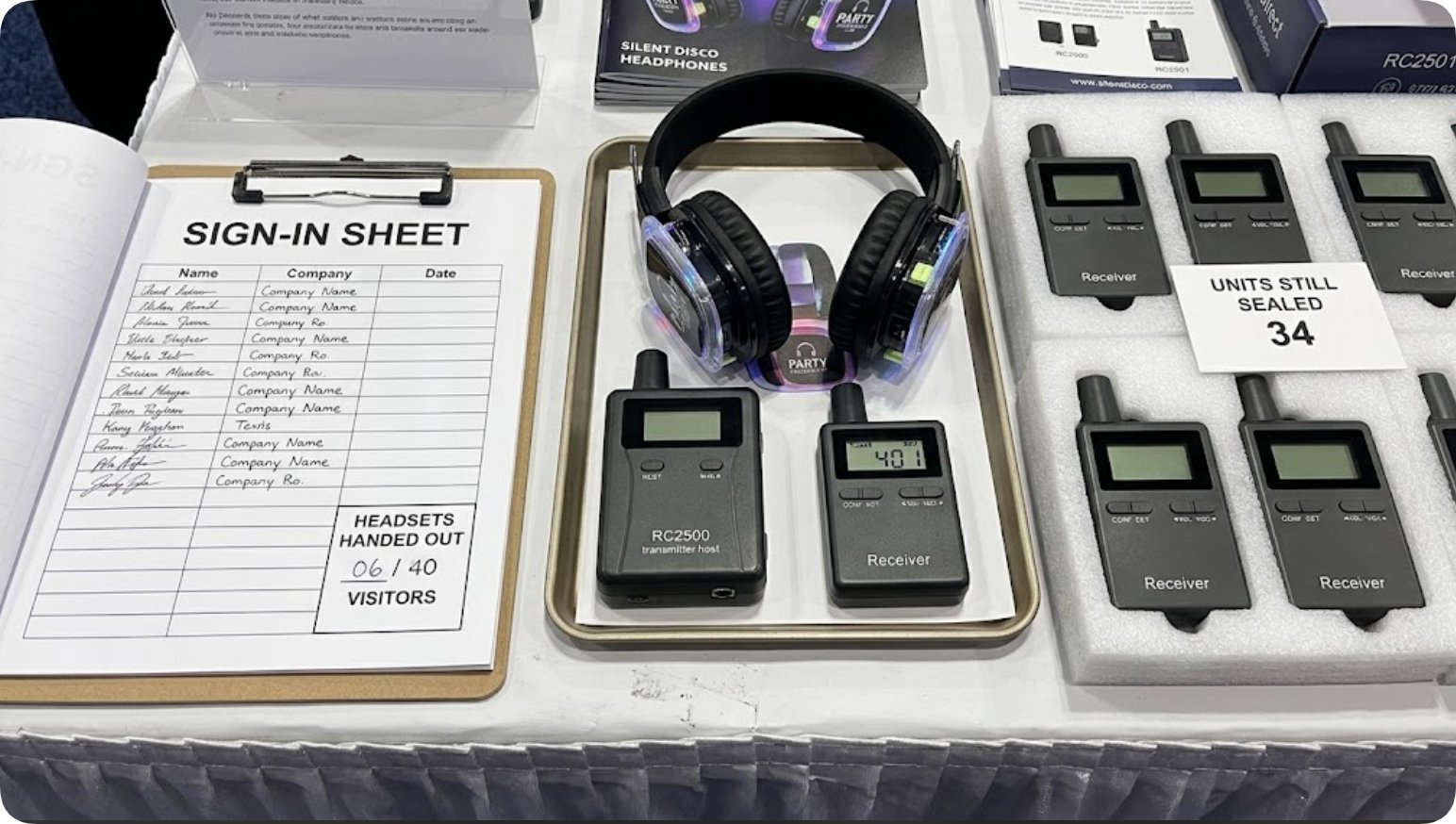
A promotion event is judged on two numbers, and only one is written down. The first is the sign-in sheet: forty names, twenty-two companies, one afternoon. The second is how many of those forty left having actually worn a headset. That number never reaches the report, and it decides whether the next quarter produces a serious enquiry or a polite reply.

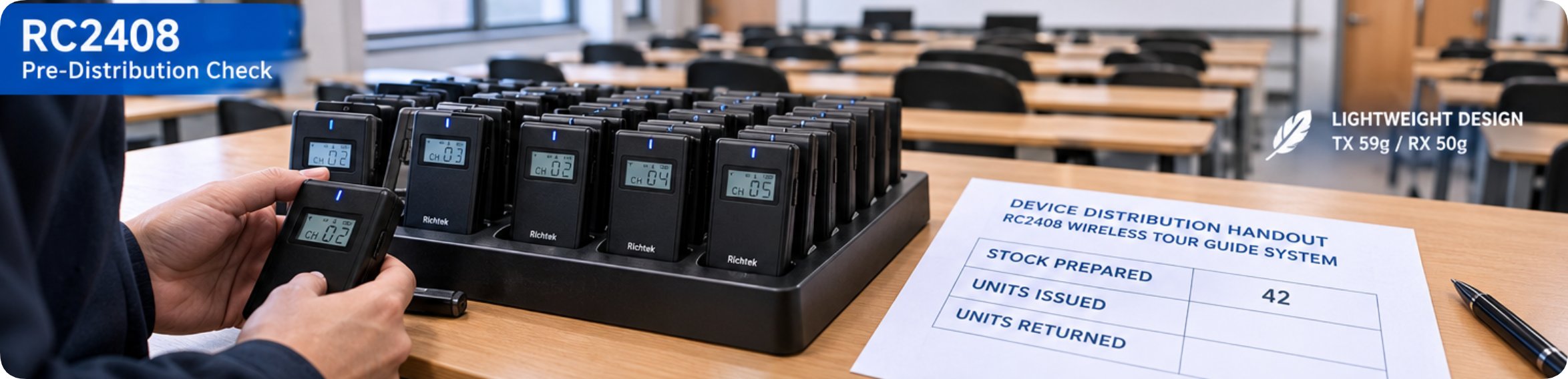
The reason is not a sales failure. A trade mission is the one venue where the visitor has time, and where the demonstration is therefore easiest to do badly: forty minutes of tables, printed sheets, a screen showing a range chart, and receivers wrapped in foam that nobody opens. Nobody is being deceptive. The visit simply passes without ever being tried before it is judged.
RT-investment-promotion-signin-sheet-vs-sealed-units

Nobody Signs for the Part They Actually Used

A visitor book counts arrivals, not what happened after them, which is where the value of a visit is made or lost. A factory receiving a delegation counts the delegation. It does not count the twenty minutes on the floor, the conversation while a headset was being fitted, or the question a technical manager asked once the unit was in his hand.

What changes this is not a better pitch but putting an open unit into a hand inside the first ten minutes, while attention is high and scepticism low. Everything after that is spent recovering a first impression that was never made. The follow-up email is written weeks later by someone who was not present, from three sources: the sign-in sheet, the brochure, and one line of handover notes. Reading the wireless tour guide system range is a brochure, not a trial.

🎪 Three Kits, Three Different Reasons to Be on One Stand

The mistake is treating a stand as one product with three badges. A visitor walking past cannot tell which system addresses the problem they actually have, and the person accompanying them has two minutes per visitor. Reducing three products to one claim wastes the only asset the stand has, which is that a stranger can touch it.

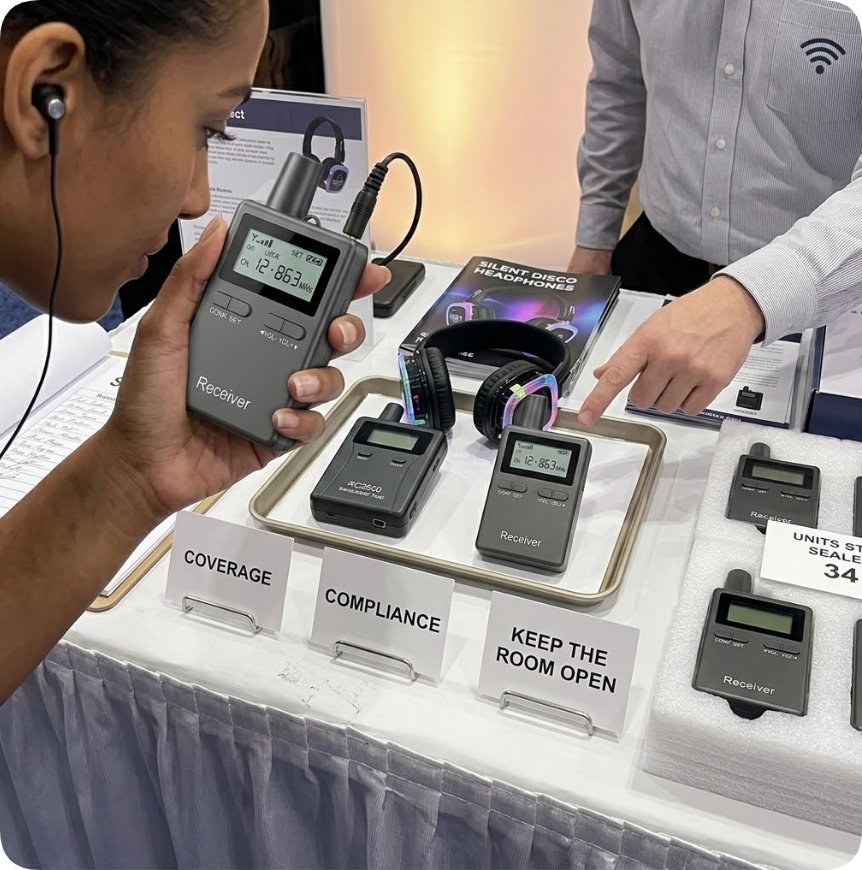
Three products make the argument better because they split by what the visitor came for. A visitor worried about reception in a large hall asks a coverage question. A visitor needing something small enough to issue to people who refuse to wear anything asks a compliance question. A visitor planning an evening event asks whether the room stays open.

Visitor came asking aboutThe question underneathWhere the demonstration has to happen
Reception across a large siteWill it hold where people actually stand?Walk them to the far wall and hand over the unit
Compliance for a mixed-age audienceCan we issue it without a training session?Fitting and pocketing, in front of them
An event that must stay quietDoes the room keep working when we stop talking?Turn the microphone off and let the room answer

The table is not a sales aid but a checklist for whoever staffs the stand, because the failure is almost always answering a scenario question with a specification. Give them the specification afterwards, where it can be read properly.
RT-investment-promotion-three-kits-coverage-compliance-openroom

🔋 The High-Power Set Answers the Question a Walk Cannot

Some questions cannot be answered on a table. Whether a signal holds across an open yard, whether audio survives a partition wall, whether the range figure survives a real building: each needs distance and obstacles, and a stand is the wrong place. This is where a high-power system earns its place.

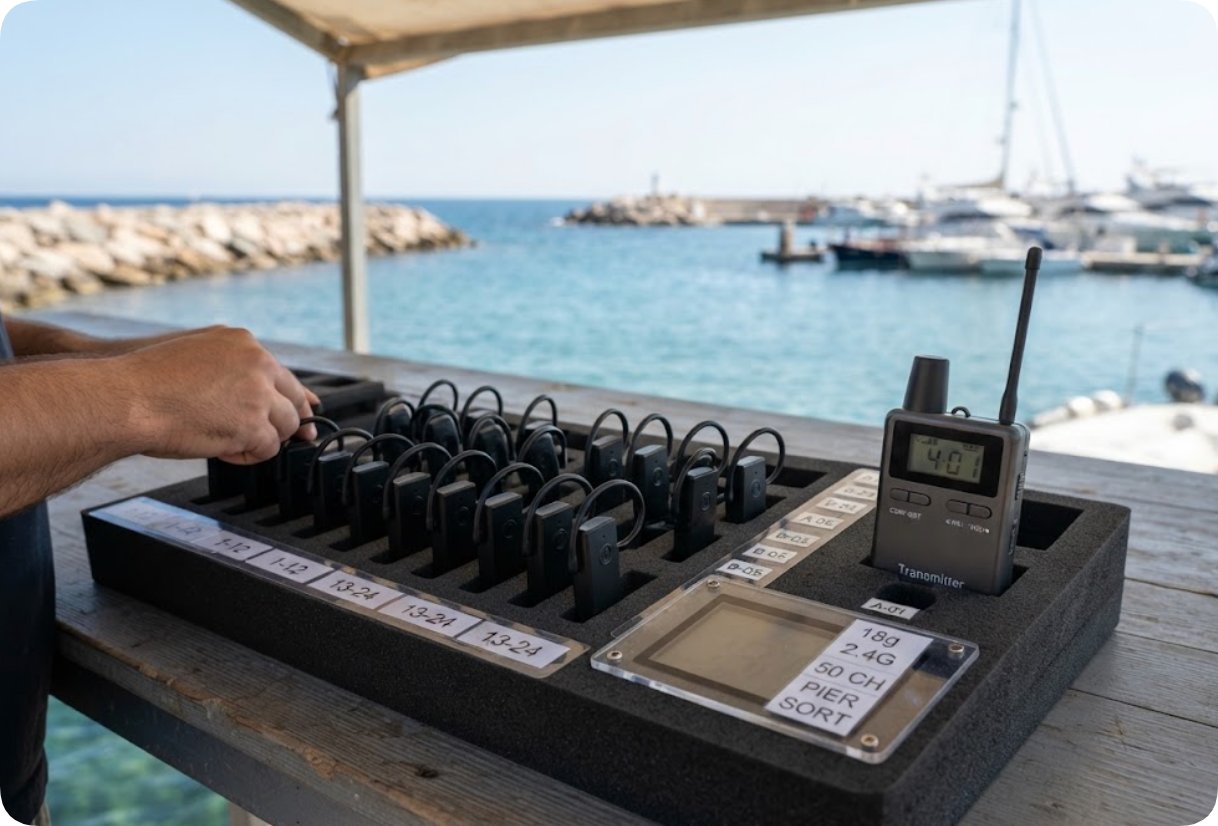
The RC2500 transmits on the 2403 to 2483MHz band at 20mW, with fifty independent channels resolved by PLL synthesis, rated up to 200 metres in open area. Audio runs the full 20Hz to 20kHz response. Transmitter twelve hours, receiver forty, which covers a two-day visit without a charging schedule. Operating temperature is -15 to 50 degrees, so an outdoor floor is not a special case.

Those numbers matter less as features than as testable claims. Fifty channels is what lets six language groups run at once without a technician choosing frequencies that morning. Forty hours of receiver battery removes the charger trolley from a room meant to be free of trolleys. One-click frequency synchronisation makes the second setup of the day as reliable as the first. None of it can be shown on a stand: it takes somebody agreeing to walk to the far wall, which is why the twenty minutes on the floor is the measurement point rather than a courtesy.

The Pocket-Sized Set Answers the Question a Group Cannot

Walk a large group and it becomes a logistics exercise: count bodies at the entrance, assign numbers, check the set returned, with the count only as reliable as the person doing it. For a hard-to-pair audience, or a venue where an usher cannot identify every receiver at closing, that can cost more staff time than the audio.

The RC2501 answers this by being small enough that the count stops being a project. Its receiver measures 86 by 50 by 19 millimetres, and pocketing a set does not change how a person walks. It runs the 2.4GHz ISM band up to 200 metres, uses multi-group independent transmission to avoid crosstalk between adjacent groups, and carries a noise-cancelling microphone. Operating range is -10 to 45 degrees.

The honest limitation is worth stating because it will be tested. This is a 2.4G system, so it competes with the same spectrum as Wi-Fi, and in a building full of access points on adjacent channels that competition is real. It is the reason a high-power band such as the RC2500 exists. The choice is not about quality; it is about what else is running in the room.
RT-investment-promotion-silent-disco-uhf-led-returns

For a promotion event the small set solves a problem unrelated to audio. A visitor handed something they can pocket stops being an observer and becomes someone who has already used the product at your stand, which changes the follow-up call entirely.

The Silent Set Answers the Question Silence Is Supposed to Raise

Some visitors are not evaluating a tour system. They are evaluating whether their event can keep a room running two ways at once, and no table demonstration settles that, because it requires a room already silent. A silent headphone set resolves it in a way hard to argue with, because the silence becomes the visible result.

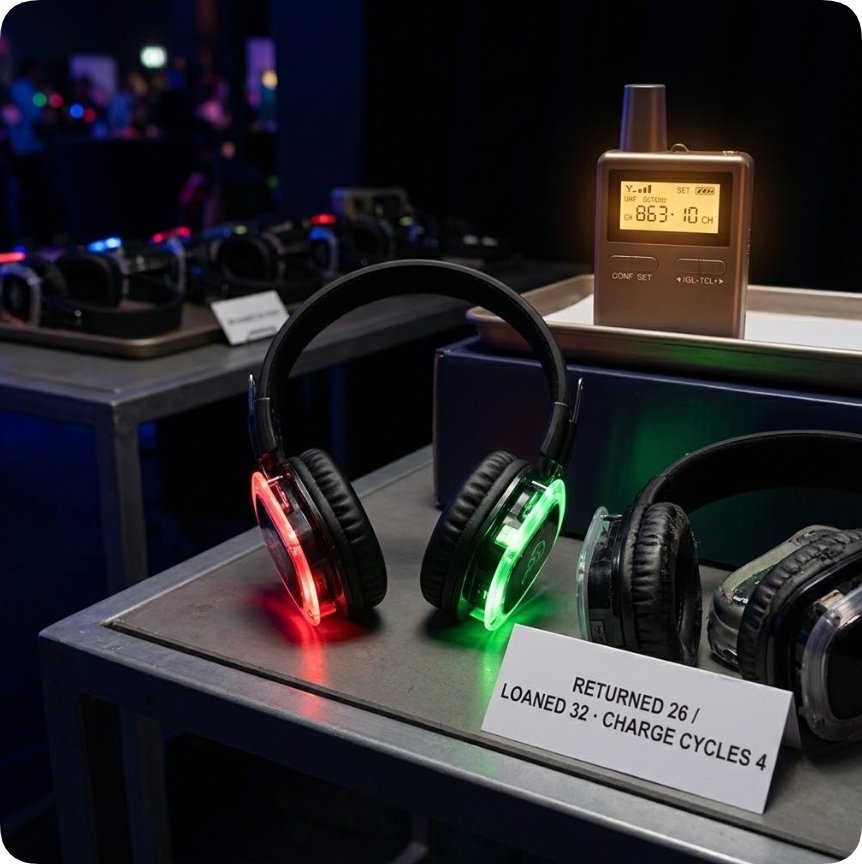
The specification is different in kind. It runs on UHF and RF bands at 863 and 925MHz, away from the Wi-Fi spectrum, with ten channels and FM stereo modulation. Each earcup carries an LED showing the selected channel across five colours, so a user identifies it by looking rather than by being told. Audio uses 40mm Mylar drivers, signal-to-noise above 75dB, distortion under 1%, and a 30 to 20000Hz response.

Battery and range complete the picture. The 500mAh lithium-ion cell gives ten hours of operation and three hours to charge over Micro USB. Transmission runs up to 200 metres in low-power mode and beyond 500 metres in high-power, which lets a set work across a multi-room layout or a festival field. The headphones fold, each side has independent volume, and the transmitter is metal-cased with an LCD.

The five-colour LED deserves more attention than product pages give it. The most common failure on a silent set is a user on the wrong channel who does not know it, and the remedy is a staff member walking between rows checking. Colours on both earcups remove that walk, because the colour is visible from across the room. On a busy evening that is the difference between one staff member and three.

Every stand that hands out hardware accumulates units that left on a battery, came back on a battery, and have been handed out ever since. Nothing is wrong with this and nothing is tracked, because the units are display stock that happens to have left the building. The failure surfaces quietly: a visitor puts a set on, it will not hold a channel, and the conclusion drawn is about the product.

A loan unit is not the same object as a demonstration unit, and the distinction belongs in writing before the event. A demonstration unit stays on the stand and is reset between visitors. A loan unit goes out with somebody, returns at an unknown charge level, and goes into the next pair of hands. Four hours with a ten-minute turnaround is twenty-four hands per set, and battery life is a function of that number.

Two counters fix most of it: charge cycles per unit since the last event, trivial to record and almost never recorded, and hands per unit, which predicts whether a visitor's first impression is of the product or of a flat battery. Both belong on the sheet.

🎪 Where These Same Three Questions Come Up Away From the Stand

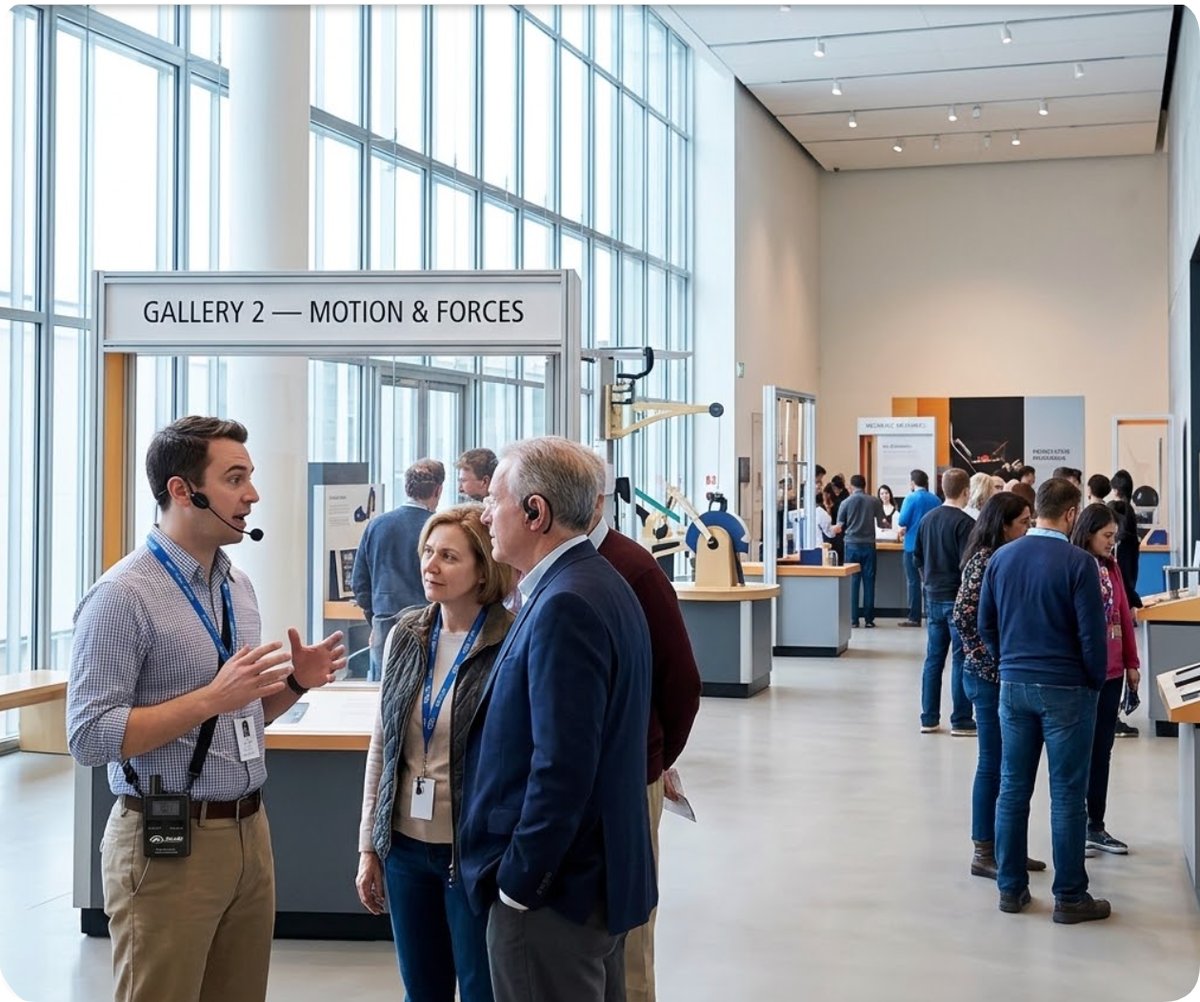
The three problems on a trade stand reappear unchanged in four places, and in each the constraint is different enough that the choice of system is decided by the building rather than by the brochure. A museum that runs four groups across two floors needs the high-power set, because the failure is a lift lobby between the transmitter and the second gallery. A school assembly hall is the opposite case: four hundred students, one transmitter at the front, and a sports hall roof that eats 2.4GHz — the pocket-sized set gets issued faster than any training slot allows. A tour operator moving between a cathedral and a market square on the same day is choosing a band, not a channel count.

The factory visit is the case where the specification argument is weakest. A receiving delegation walks a production line with machinery running, and the audio that matters is the one that keeps working next to a welding bay. That is the argument for a band away from Wi-Fi, stated in a single sentence to a plant manager rather than demonstrated on a table. What fails in practice is not the signal but the count: eighty people issued equipment at the gate, and a staff member walking the line checking which set is still on. The sets that get counted are the ones a visitor can hold and a host can see.

An evening event that must keep the room open is the fourth, and the only one where silence itself is the deliverable. A silent headphone set lets a launch dinner keep a spoken programme in one half of the room and a silent disco in the other, which is why the five-colour LED matters more here than anywhere else: nobody is being handed a leaflet explaining which channel they are on. The practical test is whether a first-time user at a table can put the set on and be in the right channel without a staff member leaning over — and on a stand, that is exactly the twenty minutes worth measuring.

Frequently Asked Questions

1. What is the maximum number of active channels that can be used in a hall with metal structure?

Twenty active channels is the practical ceiling in a hall with metal structure, even though the RC2500 hardware table lists fifty. The limit is rarely the transmitter: it is the forklift controllers and welding equipment on the same 2403 to 2483MHz band in a factory visit, which is why a group that budgets for twenty rarely has interference and a group that budgets for fifty does. Six languages running at once needs eight channels, not fifty.

2. How should devices be managed and handed out at an event?

Hand out as few as possible, and log every one that leaves. A demonstration unit stays on the table and is reset between visitors; a loan unit goes out with somebody, comes back at an unknown charge level, and goes into the next pair of hands. On a four-hour stand with a ten-minute turnaround a single set passes through twenty-four hands, and by the afternoon the flat battery is being read as a verdict on the product rather than on the charging schedule.

3. Why is the RC2501 on a different frequency band?

It is a different band decision, not a smaller version of the same one. The RC2501 sits on 2.4GHz ISM, which is the same spectrum as Wi-Fi, so in a building with access points on adjacent channels the competition is real and cannot be designed out. The high-power set sits away from it for that reason. The correct question is not which set is better but what else is already running in the room where the set will be used.

4. How many transmitters or channels are needed for a venue?

Several, and the count is fixed by room size rather than by the headcount. Ten channels at 863 and 925MHz cover one area comfortably; a venue running two programmes in two halves of the room needs two transmitters on different channel blocks, and the five-colour LED on each earcup is what lets a guest move between them without staff intervention. Ten hours of operation from the 500mAh cell means one set can cover an evening, but not a full day of two sessions.

5. What data should be recorded during an event?

Four columns on a printed sheet: the question asked, the unit handed over, the objection raised, and — for technically literate visitors — which system they were steered toward and which one they asked about afterwards. Nobody raised is a real entry and should be recorded as one. Charge cycles per unit since the last event is the fifth number worth carrying, and it is almost never recorded anywhere.


What the Follow-Up Email Has to Carry

The follow-up is written by someone who was not on the floor, from notes written by someone who was. Between them, every specific observation flattens into general enthusiasm, and the email arrives with a brochure and nothing that could not have been written without attending. This is where a trade mission becomes a wasted afternoon.

What can be carried is not complicated. Three columns: the question asked, the unit handed over, and the objection raised. Nobody raised is a real entry and should be recorded as one, because it separates a visitor who tried and accepted from one who declined politely. The first has told you something actionable.

A fourth column is worthwhile where the visitor is technically literate: which system they were steered toward, and which one they asked about afterwards. Wrong steering is a training issue. Right steering followed by a question about the other is a product-line question worth answering in public, and the RC2500 versus RC2501 comparison answers that case directly.

None of this requires software. A printed sheet with four columns, filled in at the table, produces a follow-up a recipient can act on. It rarely happens because the sheet belongs to sales, the headsets belong to technical, and the gap between them is where the specific detail is lost.

🔮 The Question Worth Asking at the Next Meeting

When the next trade mission is planned, one question settles the design of the stand: what is the visitor going to hold? A stand handing over a printed sheet produces a full sign-in sheet and no technical evaluation. A stand handing over a working unit produces fewer signatures and better follow-up, because those who sign have already decided it is worth another talk.

The three systems should be chosen for what they prove rather than what they sell. A high-power set proves coverage. A pocket-sized set proves compliance. A silent set proves a room can keep working. Each is a claim a visitor can verify in under a minute.

For a site evaluating wireless audio for visitor flow or evening events, the honest test is not which unit has the longest range. It is whether a stranger will put something on your stand, switch it on, and say something you did not expect.

Where the Follow-Up Should Point

A visitor who tried a unit usually wants one of two things next: a quotation, or a sample to test on their own site. The first is a sales conversation. The second is an engineering one, because a buyer testing on site measures the thing that was hardest to demonstrate on a stand.

If the question was coverage, that is the RC2500 high-power 2.4G tour guide system, with fifty PLL channels and a forty-hour receiver battery. If the question was issuing equipment without training, the RC2501 pocket-sized 2.4G audio tour system is the unit at 86 by 50 by 19 millimetres. If the question was keeping a room open to two programmes, the multi-channel silent disco headphone set runs UHF at 863 and 925MHz with ten channels and five-colour LED indication.

For a venue that has not yet decided which of those three problems it has, the conference and event audio guide solutions page is the shorter route, since it sets the systems against the room rather than the specification. A sample kit of one transmitter and two receivers, sent out for testing on site, answers more than an afternoon on a stand.
2026年10月13日 10:27
ꄘ click: 12

Twenty Minutes on the Floor Decides What a Trade Mission Was Worth: RC2500, RC2501 and a Silent Disco Set

time: 2026年10月13日 click:12

A promotion event is judged on two numbers, and only one is written down. The first is the sign-in sheet: forty names, twenty-two companies, one afternoon. The second is how many of those forty left having actually worn a headset. That number never reaches the report, and it decides whether the next quarter produces a serious enquiry or a polite reply.

The reason is not a sales failure. A trade mission is the one venue where the visitor has time, and where the demonstration is therefore easiest to do badly: forty minutes of tables, printed sheets, a screen showing a range chart, and receivers wrapped in foam that nobody opens. Nobody is being deceptive. The visit simply passes without ever being tried before it is judged.

RT-investment-promotion-signin-sheet-vs-sealed-units

Nobody Signs for the Part They Actually Used

A visitor book counts arrivals, not what happened after them, which is where the value of a visit is made or lost. A factory receiving a delegation counts the delegation. It does not count the twenty minutes on the floor, the conversation while a headset was being fitted, or the question a technical manager asked once the unit was in his hand.

What changes this is not a better pitch but putting an open unit into a hand inside the first ten minutes, while attention is high and scepticism low. Everything after that is spent recovering a first impression that was never made. The follow-up email is written weeks later by someone who was not present, from three sources: the sign-in sheet, the brochure, and one line of handover notes. Reading the wireless tour guide system range is a brochure, not a trial.

🎪 Three Kits, Three Different Reasons to Be on One Stand

The mistake is treating a stand as one product with three badges. A visitor walking past cannot tell which system addresses the problem they actually have, and the person accompanying them has two minutes per visitor. Reducing three products to one claim wastes the only asset the stand has, which is that a stranger can touch it.

Three products make the argument better because they split by what the visitor came for. A visitor worried about reception in a large hall asks a coverage question. A visitor needing something small enough to issue to people who refuse to wear anything asks a compliance question. A visitor planning an evening event asks whether the room stays open.

Visitor came asking aboutThe question underneathWhere the demonstration has to happen
Reception across a large siteWill it hold where people actually stand?Walk them to the far wall and hand over the unit
Compliance for a mixed-age audienceCan we issue it without a training session?Fitting and pocketing, in front of them
An event that must stay quietDoes the room keep working when we stop talking?Turn the microphone off and let the room answer

The table is not a sales aid but a checklist for whoever staffs the stand, because the failure is almost always answering a scenario question with a specification. Give them the specification afterwards, where it can be read properly.

RT-investment-promotion-three-kits-coverage-compliance-openroom

🔋 The High-Power Set Answers the Question a Walk Cannot

Some questions cannot be answered on a table. Whether a signal holds across an open yard, whether audio survives a partition wall, whether the range figure survives a real building: each needs distance and obstacles, and a stand is the wrong place. This is where a high-power system earns its place.

The RC2500 transmits on the 2403 to 2483MHz band at 20mW, with fifty independent channels resolved by PLL synthesis, rated up to 200 metres in open area. Audio runs the full 20Hz to 20kHz response. Transmitter twelve hours, receiver forty, which covers a two-day visit without a charging schedule. Operating temperature is -15 to 50 degrees, so an outdoor floor is not a special case.

Those numbers matter less as features than as testable claims. Fifty channels is what lets six language groups run at once without a technician choosing frequencies that morning. Forty hours of receiver battery removes the charger trolley from a room meant to be free of trolleys. One-click frequency synchronisation makes the second setup of the day as reliable as the first. None of it can be shown on a stand: it takes somebody agreeing to walk to the far wall, which is why the twenty minutes on the floor is the measurement point rather than a courtesy.

The Pocket-Sized Set Answers the Question a Group Cannot

Walk a large group and it becomes a logistics exercise: count bodies at the entrance, assign numbers, check the set returned, with the count only as reliable as the person doing it. For a hard-to-pair audience, or a venue where an usher cannot identify every receiver at closing, that can cost more staff time than the audio.

The RC2501 answers this by being small enough that the count stops being a project. Its receiver measures 86 by 50 by 19 millimetres, and pocketing a set does not change how a person walks. It runs the 2.4GHz ISM band up to 200 metres, uses multi-group independent transmission to avoid crosstalk between adjacent groups, and carries a noise-cancelling microphone. Operating range is -10 to 45 degrees.

The honest limitation is worth stating because it will be tested. This is a 2.4G system, so it competes with the same spectrum as Wi-Fi, and in a building full of access points on adjacent channels that competition is real. It is the reason a high-power band such as the RC2500 exists. The choice is not about quality; it is about what else is running in the room.

RT-investment-promotion-silent-disco-uhf-led-returns

For a promotion event the small set solves a problem unrelated to audio. A visitor handed something they can pocket stops being an observer and becomes someone who has already used the product at your stand, which changes the follow-up call entirely.

The Silent Set Answers the Question Silence Is Supposed to Raise

Some visitors are not evaluating a tour system. They are evaluating whether their event can keep a room running two ways at once, and no table demonstration settles that, because it requires a room already silent. A silent headphone set resolves it in a way hard to argue with, because the silence becomes the visible result.

The specification is different in kind. It runs on UHF and RF bands at 863 and 925MHz, away from the Wi-Fi spectrum, with ten channels and FM stereo modulation. Each earcup carries an LED showing the selected channel across five colours, so a user identifies it by looking rather than by being told. Audio uses 40mm Mylar drivers, signal-to-noise above 75dB, distortion under 1%, and a 30 to 20000Hz response.

Battery and range complete the picture. The 500mAh lithium-ion cell gives ten hours of operation and three hours to charge over Micro USB. Transmission runs up to 200 metres in low-power mode and beyond 500 metres in high-power, which lets a set work across a multi-room layout or a festival field. The headphones fold, each side has independent volume, and the transmitter is metal-cased with an LCD.

The five-colour LED deserves more attention than product pages give it. The most common failure on a silent set is a user on the wrong channel who does not know it, and the remedy is a staff member walking between rows checking. Colours on both earcups remove that walk, because the colour is visible from across the room. On a busy evening that is the difference between one staff member and three.

Every stand that hands out hardware accumulates units that left on a battery, came back on a battery, and have been handed out ever since. Nothing is wrong with this and nothing is tracked, because the units are display stock that happens to have left the building. The failure surfaces quietly: a visitor puts a set on, it will not hold a channel, and the conclusion drawn is about the product.

A loan unit is not the same object as a demonstration unit, and the distinction belongs in writing before the event. A demonstration unit stays on the stand and is reset between visitors. A loan unit goes out with somebody, returns at an unknown charge level, and goes into the next pair of hands. Four hours with a ten-minute turnaround is twenty-four hands per set, and battery life is a function of that number.

Two counters fix most of it: charge cycles per unit since the last event, trivial to record and almost never recorded, and hands per unit, which predicts whether a visitor's first impression is of the product or of a flat battery. Both belong on the sheet.

🎪 Where These Same Three Questions Come Up Away From the Stand

The three problems on a trade stand reappear unchanged in four places, and in each the constraint is different enough that the choice of system is decided by the building rather than by the brochure. A museum that runs four groups across two floors needs the high-power set, because the failure is a lift lobby between the transmitter and the second gallery. A school assembly hall is the opposite case: four hundred students, one transmitter at the front, and a sports hall roof that eats 2.4GHz — the pocket-sized set gets issued faster than any training slot allows. A tour operator moving between a cathedral and a market square on the same day is choosing a band, not a channel count.

The factory visit is the case where the specification argument is weakest. A receiving delegation walks a production line with machinery running, and the audio that matters is the one that keeps working next to a welding bay. That is the argument for a band away from Wi-Fi, stated in a single sentence to a plant manager rather than demonstrated on a table. What fails in practice is not the signal but the count: eighty people issued equipment at the gate, and a staff member walking the line checking which set is still on. The sets that get counted are the ones a visitor can hold and a host can see.

An evening event that must keep the room open is the fourth, and the only one where silence itself is the deliverable. A silent headphone set lets a launch dinner keep a spoken programme in one half of the room and a silent disco in the other, which is why the five-colour LED matters more here than anywhere else: nobody is being handed a leaflet explaining which channel they are on. The practical test is whether a first-time user at a table can put the set on and be in the right channel without a staff member leaning over — and on a stand, that is exactly the twenty minutes worth measuring.

Frequently Asked Questions

1. What is the maximum number of active channels that can be used in a hall with metal structure?

Twenty active channels is the practical ceiling in a hall with metal structure, even though the RC2500 hardware table lists fifty. The limit is rarely the transmitter: it is the forklift controllers and welding equipment on the same 2403 to 2483MHz band in a factory visit, which is why a group that budgets for twenty rarely has interference and a group that budgets for fifty does. Six languages running at once needs eight channels, not fifty.

2. How should devices be managed and handed out at an event?

Hand out as few as possible, and log every one that leaves. A demonstration unit stays on the table and is reset between visitors; a loan unit goes out with somebody, comes back at an unknown charge level, and goes into the next pair of hands. On a four-hour stand with a ten-minute turnaround a single set passes through twenty-four hands, and by the afternoon the flat battery is being read as a verdict on the product rather than on the charging schedule.

3. Why is the RC2501 on a different frequency band?

It is a different band decision, not a smaller version of the same one. The RC2501 sits on 2.4GHz ISM, which is the same spectrum as Wi-Fi, so in a building with access points on adjacent channels the competition is real and cannot be designed out. The high-power set sits away from it for that reason. The correct question is not which set is better but what else is already running in the room where the set will be used.

4. How many transmitters or channels are needed for a venue?

Several, and the count is fixed by room size rather than by the headcount. Ten channels at 863 and 925MHz cover one area comfortably; a venue running two programmes in two halves of the room needs two transmitters on different channel blocks, and the five-colour LED on each earcup is what lets a guest move between them without staff intervention. Ten hours of operation from the 500mAh cell means one set can cover an evening, but not a full day of two sessions.

5. What data should be recorded during an event?

Four columns on a printed sheet: the question asked, the unit handed over, the objection raised, and — for technically literate visitors — which system they were steered toward and which one they asked about afterwards. Nobody raised is a real entry and should be recorded as one. Charge cycles per unit since the last event is the fifth number worth carrying, and it is almost never recorded anywhere.


What the Follow-Up Email Has to Carry

The follow-up is written by someone who was not on the floor, from notes written by someone who was. Between them, every specific observation flattens into general enthusiasm, and the email arrives with a brochure and nothing that could not have been written without attending. This is where a trade mission becomes a wasted afternoon.

What can be carried is not complicated. Three columns: the question asked, the unit handed over, and the objection raised. Nobody raised is a real entry and should be recorded as one, because it separates a visitor who tried and accepted from one who declined politely. The first has told you something actionable.

A fourth column is worthwhile where the visitor is technically literate: which system they were steered toward, and which one they asked about afterwards. Wrong steering is a training issue. Right steering followed by a question about the other is a product-line question worth answering in public, and the RC2500 versus RC2501 comparison answers that case directly.

None of this requires software. A printed sheet with four columns, filled in at the table, produces a follow-up a recipient can act on. It rarely happens because the sheet belongs to sales, the headsets belong to technical, and the gap between them is where the specific detail is lost.

🔮 The Question Worth Asking at the Next Meeting

When the next trade mission is planned, one question settles the design of the stand: what is the visitor going to hold? A stand handing over a printed sheet produces a full sign-in sheet and no technical evaluation. A stand handing over a working unit produces fewer signatures and better follow-up, because those who sign have already decided it is worth another talk.

The three systems should be chosen for what they prove rather than what they sell. A high-power set proves coverage. A pocket-sized set proves compliance. A silent set proves a room can keep working. Each is a claim a visitor can verify in under a minute.

For a site evaluating wireless audio for visitor flow or evening events, the honest test is not which unit has the longest range. It is whether a stranger will put something on your stand, switch it on, and say something you did not expect.

Where the Follow-Up Should Point

A visitor who tried a unit usually wants one of two things next: a quotation, or a sample to test on their own site. The first is a sales conversation. The second is an engineering one, because a buyer testing on site measures the thing that was hardest to demonstrate on a stand.

If the question was coverage, that is the RC2500 high-power 2.4G tour guide system, with fifty PLL channels and a forty-hour receiver battery. If the question was issuing equipment without training, the RC2501 pocket-sized 2.4G audio tour system is the unit at 86 by 50 by 19 millimetres. If the question was keeping a room open to two programmes, the multi-channel silent disco headphone set runs UHF at 863 and 925MHz with ten channels and five-colour LED indication.

For a venue that has not yet decided which of those three problems it has, the conference and event audio guide solutions page is the shorter route, since it sets the systems against the room rather than the specification. A sample kit of one transmitter and two receivers, sent out for testing on site, answers more than an afternoon on a stand.
×

Contact us

email:
name:
subject:
content: