.webp)
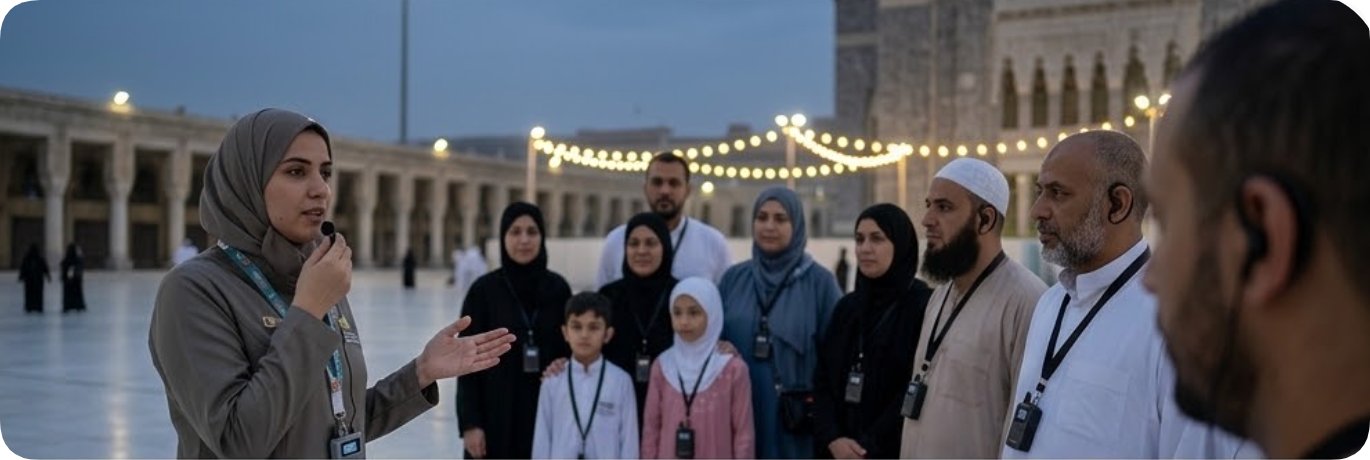
Most visitor attractions run a single audio format from the ticket desk to the last room, and the assumption behind that format is that a guide talks and everybody else listens. A science centre breaks the assumption in a specific way. Its rules usually forbid talking in the galleries, because the exhibits are interactive and a visitor who cannot hear the mechanism should be allowed to lean in and watch it. The same buildings also install machinery that makes noise on its own, from a wave tank to a compressed-air demonstration table. So the format has to change from hall to hall, and the change is decided by the room rather than by the institution.
The brief we were given covered one building, one school group, and three devices that were not meant to be alternates of each other. The centre had already tried issuing a set of receivers to every visitor and giving up when the queue at the hands-on hall became longer than the queue at the entrance. What they wanted was a rule for deciding which hall a visitor walks through alone and which hall a visitor walks through with a voice, and a way to run both formats in the same visit without the group breaking apart in between.
The Enquiry Came With a Floor Plan and One Restriction
The floor plan arrived marked up in three colours. Blue for halls where talking was permitted and the guide would lead. Red for halls where a sign at the door asked visitors to keep their voices down and the visitor would carry their own player. Yellow for the transitional space, the ramp and the small lobby between the two, where nobody had decided anything yet. The centre's education manager described the restriction in one sentence: the building is loud where it is interesting, and quiet where it is fragile.
That sentence decided the shape of the whole project. It meant the choice was never about which device had the longest range or the most channels. Range matters only once a voice is being sent. The first question was whether a voice should be sent at all in a given hall, and the second was what a visitor should hold when the answer was no.
🎯 The Hall Where the Guide Has to Shout Decides Everything Else
Red and blue markings on a plan are tidy; the buildings are not. The hall that forced the decision was a mechanics gallery with a six-metre air table running continuously and a projector fan above it. In that hall a guide talking at a normal museum level was inaudible at the far rail, and a guide raising their voice to be heard would have been doing the thing the centre's own rule was designed to prevent. The measurement the centre had taken during a school session put the ambient level in that room at a level where a guide needs the microphone doing the work rather than the vocal cords.
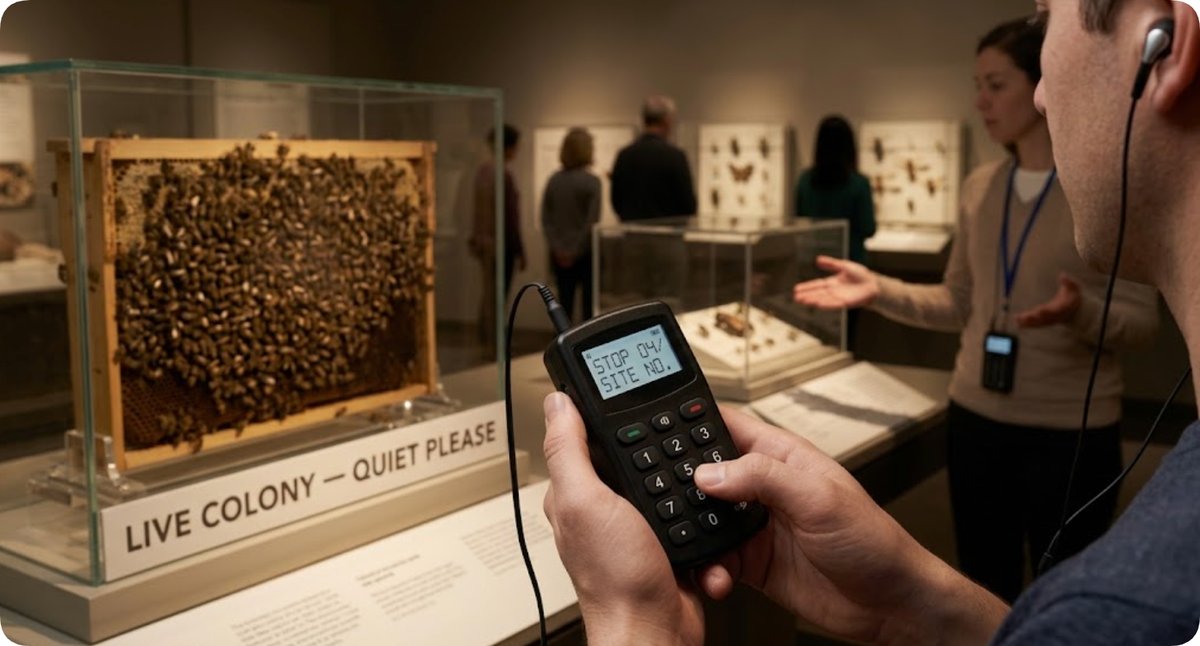
A second hall produced the opposite failure. It held a live bee colony behind glass under a fume extraction hood, and the room genuinely was silent. There, a guide narrating into a headset is not solving a problem; the guide becomes the problem. In a room that quiet, the guide has to stop talking, because any narration stops a visitor from hearing the colony and hearing it is the entire purpose of the room.
This is the point at which a science centre tour stops being a guided tour. Not gradually across the building, but at a doorway. On one side the guide's voice is the channel the group moves through. On the other side the visitor runs the channel themselves with a keypad, and the guide walks behind them and does not talk. A visitor who misses stop four has to wait for the group, and the guide's job becomes keeping the group rather than informing it.
What the Three Units Actually Do at That Boundary
The three units we supplied sit on different sides of that boundary, and the specification table that came with the tender is not what made the choice. Three details did.
| Model | Core Frequency Band | Channels | Transmitter Battery Life | Receiver Battery Life | Transmitter Weight | Receiver Weight | Charging Port |
|---|---|---|---|---|---|---|---|
| RC2402 | 2403-2483 MHz | 50 | 10h | 20h | 59g | 50g | DC Port |
| RC8860 | 860-870 MHz | 20 | 10h | 20h | 59g | 50g | DC Port |
| 2.8-Inch Semi-Auto Digital Audio Guide | Point-and-play, no radio link | Number input 0-9 | Not applicable | 18h | Not published | Not published | Micro USB |
Each row below records what the specification allowed and where the building overrode it. The table is transcribed from the manufacturer comparison sheet, and where a page did not publish a figure the cell says so rather than borrowing a number from the neighbouring model.
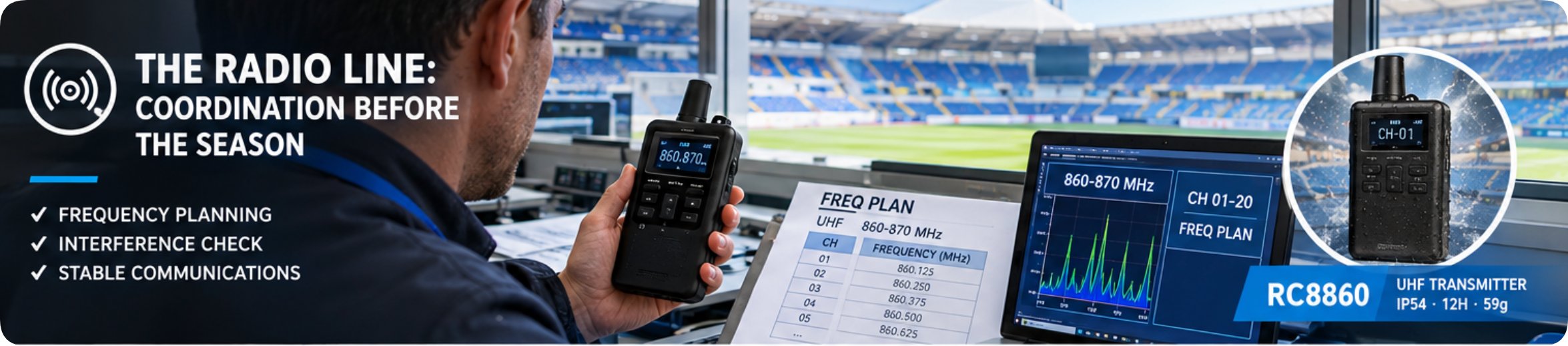
The first detail is the radio band, and it decided the blue halls. The RC2402 2.4 GHz wireless tour guide system works in the open galleries, but the mechanics gallery is bounded on two sides by a steel-frame partition that was added during a refit, and a short flight of stairs separates the upper walkway from the ground floor. Through that steel the 2.4 GHz link is intermittent, while the UHF unit in the same room at the same power output keeps working, because the longer wavelength bends around the obstruction instead of reflecting off it. Twenty UHF channels is a smaller number than fifty and we never used most of them, because the building ran one group at a time and the contention problem the extra channels solve did not exist here.
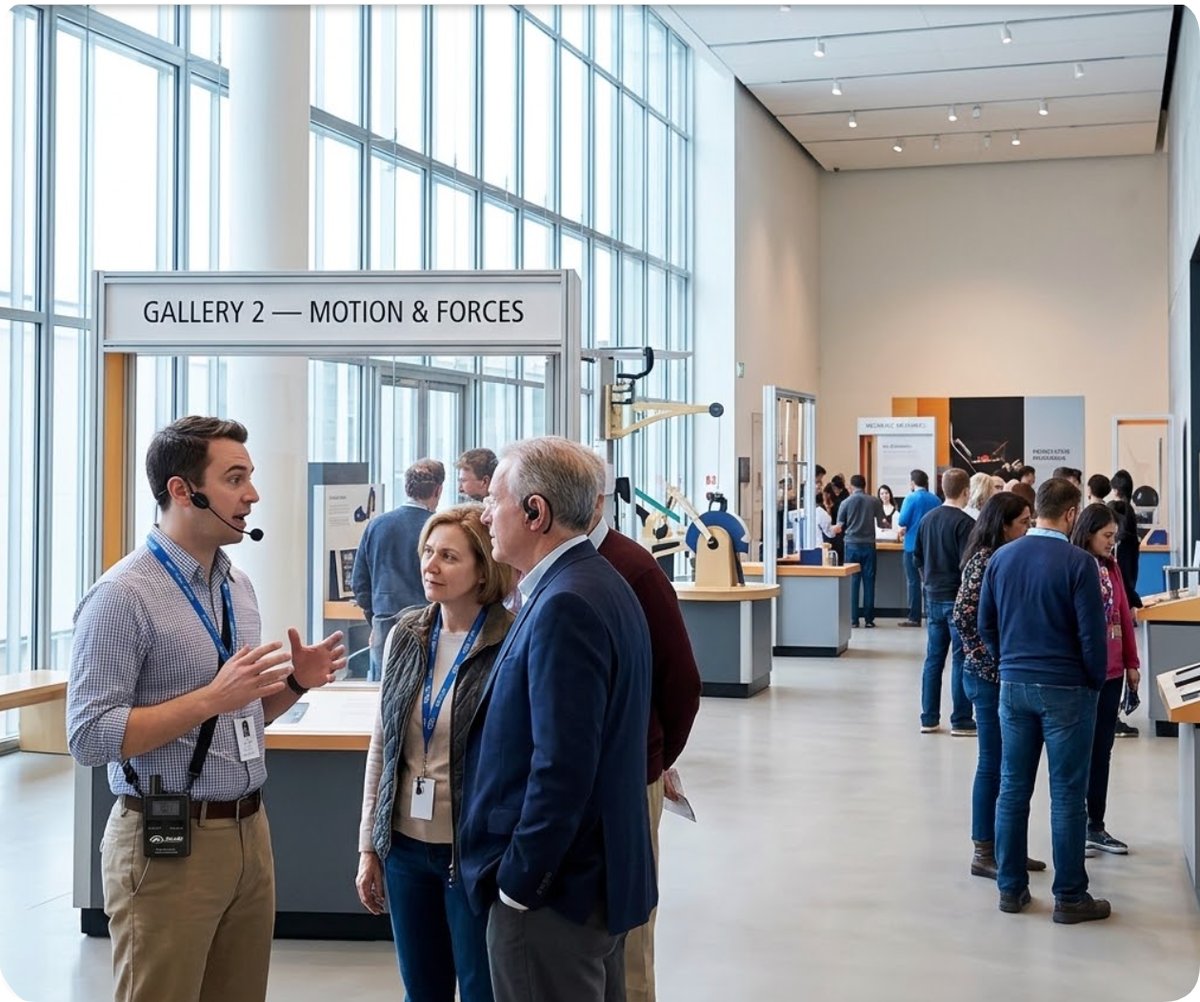
The UHF unit earned its place in the same building for a second reason that no specification states. Its frequency response runs from 50 Hz to 12 kHz, which is where most of the intelligible part of a spoken explanation sits, and its transmitter and receiver both weigh under sixty grams, so a guide can wear one across a four-hour session without thinking about it. The 860 to 870 MHz band is also licence-free in most regions, which matters for a site running programmes in more than one country from the same equipment list. Its frequency response is quoted at 50 Hz to 12 kHz against the 2.4 GHz set's 50 Hz to 12 kHz receive figure, so on voice alone the two are close; the wall is what separates them.
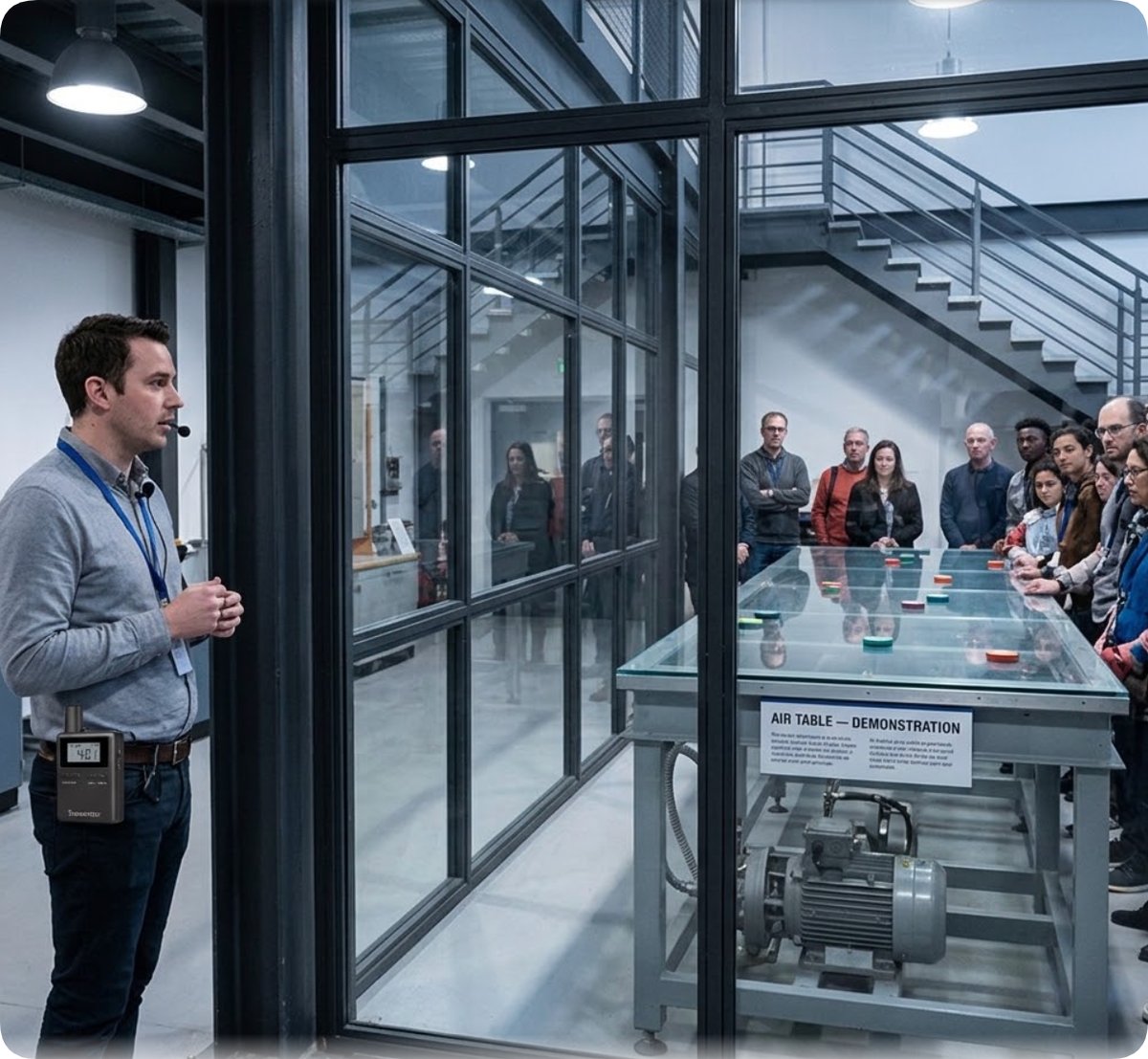
The second detail is how a visitor starts the next stop. The UHF and 2.4 GHz sets both put the guide in control; the visitor presses nothing. In a blue hall that is correct, because the guide is deciding when the group moves. In a red hall there is no guide voice to press, and the visitor has to start their own playback. A button per stop is the wrong shape for a group of forty carrying forty devices into a hall where they will be spread across a hundred metres. A number keypad is the right shape, because a stop can be announced once and then typed by forty people who have never used the device.
The keypad player has no radio specification at all, because it is a standalone playback unit rather than a transmission product, and comparing it on a channel count would be comparing two different things. What it publishes is a numeric keypad for direct stop selection, up to 16 languages and room for 9999 audio files on 2 GB of internal memory, eighteen hours of continuous playback, and a Micro USB charging port. Those four figures matter to this building for one reason: a red hall can hold a different commentary set in a different language on the same physical unit, and the centre switches content by reloading the device rather than by carrying a second set of hardware.
The third detail is what happens at the end of the school day. A school session arrives at nine and leaves at noon, and the receivers from the morning group have to be on charge before the afternoon group walks in. The two radio sets give a guide ten hours of transmitter time and twenty hours on the receiver, and the keypad player gives a visitor eighteen hours of playback. The keypad player wins on that measure and it is still not the device we rely on, because a radio receiver that dies at two in the afternoon costs a visitor their place in the group, while a keypad player that dies at two in the afternoon costs one visitor the rest of their own visit.
Where These Same Three Problems Turn Up in Other Buildings
A museum that insists on silence has the same problem in a different costume. A natural history gallery with a free-flight bird of prey exhibit is quiet in the way the bee colony is quiet: visitors are listening to something they cannot lean past. A guided walking tour of an archaeological site runs into the mechanics gallery problem outdoors, where wind noise and a group spread along a path replace the air table. A private visitor group walking a campus with a guide who must also hold a clipboard and check names has the keypad player's problem without any silence rule at all: they need the guide to be free to do something else.
What travels across all of these is not the equipment list. It is the decision about where the voice goes. A visitor attraction that has answered that question for each hall is holding a system. A visitor attraction that has not answered it is holding three boxes and a set of instructions, and the instructions will be read once by a member of the public who has never been told that the second button starts the next stop.
🎓 What the School Group Actually Did With the Keypads
We ran the format over four sessions with one year group, and the number the centre cared about was not complaints. It was how long it took the group to come back together after a red hall. The education manager counted the time between the guide's signal at the door and the whole group standing at the next stop. The first session took eleven minutes in the hands-on hall, because forty students each found their own stop number at their own speed and the slowest of them set the pace. By the fourth session it was under four, and the change came from numbering rather than from hardware: the stops in each red hall are numbered in the order the group is meant to meet them, and the guide walks the group to the doorway rather than into the hall.
The one thing that did not improve over the four sessions was visitor comprehension in the mechanics hall. Forty students and a guide who is not speaking is a room in which the explanation is being carried by the exhibit itself, and for that room the centre eventually put a printed card on the rail. That card is not part of the audio system and it is not going to be replaced by a system, because in a room that cannot be narrated, the narration has to come from somewhere that is allowed to make noise on paper.
The blue halls behaved differently from the first day. In a hall where talking is permitted, the guide uses the transmitter normally and the visitors do not touch anything. The units that were most useful there were not the highest specification ones but the ones a guide can put on and start without thinking, because the guide is also talking to a class rather than to an audience.
The Build Sheet a Similar Site Can Start From
A building in this position needs three decisions made in order, and the order matters. First, mark every hall as voice or self-play, and accept that the marking will change after the first school group. Second, in every voice hall, check what the walls between the hall and the next one are made of, because that single fact decides whether a 2.4 GHz set is enough or whether the same budget needs a UHF unit. Third, in every self-play hall, publish the numbering to the group before it enters, because a keypad device without an announced stop number is a device that will be returned with the wrong stop still playing.
The three devices we supplied for that building were the RC2402 for the open galleries, the RC8860 UHF unit for the halls with steel and concrete between them and the next room, and the 2.8-inch keypad player for the rooms where talking is not permitted. A site that has not yet worked out which of those three it has can start from the museum audio guide equipment range, which sets the systems against the room rather than against the specification.
Frequently Asked Questions
1. Our gallery has a steel partition and a stair between it and the next room. Is a 2.4 GHz system genuinely not enough?
On the building we measured, the 2.4 GHz link dropped out whenever the group moved past the steel partition, while a UHF unit at the same ten milliwatt output stayed connected through it. That is one building with one partition; treat it as a reason to test the obstruction rather than as a general rule. The test costs one afternoon and answers more than any specification sheet.2. How many stops can a visitor keypad player hold, and what happens when a group does not move in order?
The unit we supplied holds up to 9999 audio files across 16 languages, so the number of stops is not the constraint. Order is the constraint. The four sessions we ran went from eleven minutes to under four minutes to reassemble a group only after the stop numbering was made sequential and announced before entry.3. Do visitors have to be shown how to use a keypad device before they walk into a self-play hall?
One sentence at the door is enough and it should name the first stop number out loud. The keypad takes 0 to 9 and each stop is a typed number, so the failure mode is not confusion with the device; it is a visitor waiting in silence for a stop they were never told to press.4. What happens to the equipment between the morning and the afternoon school group?
The radio sets give a guide ten hours of transmitter time and twenty hours on the receiver, and the keypad player gives about eighteen hours of playback. In our four sessions nothing ran flat during the day; the sets that needed attention were the ones left unreturned overnight, not the ones that ran out of charge.Where the Centre Started Instead of Where It Finished
The centre did not buy all three devices for every hall. It bought the radio set for the galleries where a guide already speaks, the UHF unit for the two halls that a material survey flagged as difficult, and the keypad players for the quiet rooms, and it kept a spare set of receivers charged for the afternoon group. A science centre that decides where the voice goes, hall by hall, gets more out of three devices than one that issues a receiver to everybody and hopes the building stays quiet.