.webp)
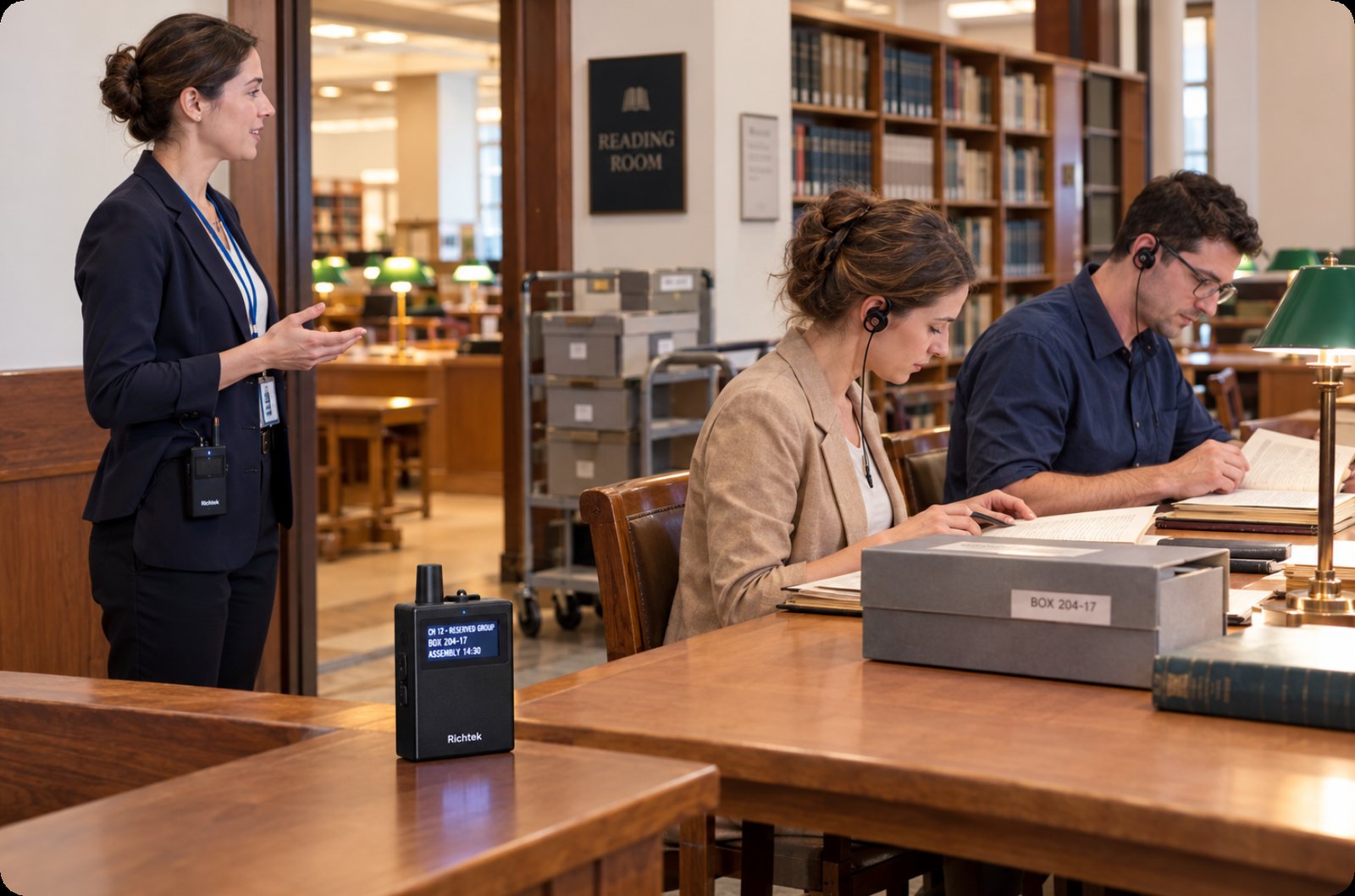
An archive does not run its tour equipment the way a museum does. The visiting pattern is two half-days a week, sometimes one afternoon reserved for a single research appointment, and long quiet stretches in between when the receivers sit in the charging case with nobody looking at them. That rhythm changes what maintenance means. Most published guidance assumes daily turnover: wipe, charge, count, repeat. In a reading room fed by a stack corridor, the failure modes are seasonal and slow, and they show up as condensation on a walk between two rooms, as paper dust working into a grille, and as a battery that has been sitting at a half charge since the last group left. This guide follows one month of checks on three units that an archive actually keeps in service.
The three models cover the three shapes an archive job takes. The RC9150 carries the large reserved group, the RC2406 handles the parallel sessions that happen when two reading rooms are open at once, and the RC2401 covers walk-in researchers and small teaching visits where one-button pairing matters more than channel count. Everything below is built on the numbers each product page publishes, and where a page does not publish a figure, this guide says so rather than guessing.
💡 Why the Archive Calendar Is Not the Tour Calendar
A museum audio system sees the same eight hours every day. An archive system sees a calendar with holes in it, and the holes are where maintenance debt accumulates. Between the last visiting Saturday and the next, the receivers can sit for six days. Nothing dramatic happens in six days, but the state they sit in decides how the next visiting day starts. A unit shelved at forty percent is ready; a unit shelved empty after a busy Saturday is a unit that will be half dead by Thursday's research appointment.
So the archive maintenance round is not a daily round. It is a layered one: a short pass after every visiting half-day, a weekly pass on a fixed weekday, a monthly pass on the first working day, and a seasonal pass timed to the climate calendar rather than to the visitor calendar. The layers exist because the equipment experiences the archive in slow motion. Problems that a daily-turnover site would catch on day one, a low-turnover site meets on week three, already grown.
This is also why the maintenance log matters more here than the maintenance kit. A note that says "RC2406 grille cleaned, 14 March" is worth more than a cleaning that nobody recorded, because the next person to open the case can see the interval instead of guessing it. The log lives in the same drawer as the sign-out book, which is the subject of a later section.
⚖️ Condensation on the Walk Between the Stack and the Reading Room
Archive buildings are climate-controlled in zones, not in whole. The reading room sits at a comfortable twenty-two degrees; the stack corridor a floor below runs cooler and drier; the loading dock in winter is a third climate again. Every guided group walks that gradient, and every piece of equipment walks it with them. When warm humid air meets a cooler lens or a cooler display bezel, water appears. It is not a defect; it is physics, and the only question is whether the crew has a procedure for it.
The procedure that works is boring and reliable. When a group comes back in from a humid afternoon, the units go on the bench near the reading room door, cases still closed, for twenty minutes before anyone opens a case and powers anything on. Twenty minutes is enough for the housings to come up to room temperature. Powering a receiver on while condensation is still on the board is the one version of this problem that can actually kill a unit, and it is entirely avoidable with a timer and a shelf.
In the wet months, the archive's own humidity readings become part of the round. When the corridor hygrometer reads above seventy-five percent, the bench-wait goes up to thirty minutes and the drying cloth comes out: a dry microfiber cloth for housings and lenses only, never for the grille meshes, which push dust inward rather than lifting it off. The three models take this differently in the documentation. The RC2406 80-channel 2.4G tour guide system page lists IPX4 splash resistance, and the RICH AGE RC2401 wireless audio guide system page lists the same IPX4 splash-resistant design; the RC9150 page does not publish a protection rating, so the archive treats all three the same way and simply keeps water away from all of them.
Paper Dust Goes for the Grille Before the Contacts
An archive's dust is not the same as a museum's dust. Museum dust is skin flakes and floor grit; archive dust is paper fibre, and there is a lot of it. A forty-person research group working through box files for one afternoon lifts a visible fuzz off every fold they open, and that fuzz settles on whatever is warm and whatever has an opening. The receiver grille is both. Over weeks, the mesh loads up, and a loaded grille is a muffled receiver: the researcher hears the guide as if the guide were speaking through a wall.
Paper fibre is not corrosive the way salt is, and that is exactly why archives underestimate it. Nothing visibly rusts. What happens instead is quieter: fibre mats across the grille and drops the output by a few decibels, fibre works into the seam around a button and makes the button stiff, and a few strands bridge a charging contact often enough to matter. The cleaning answer is mechanical, not chemical. A soft dry brush, a lens blower for the mesh, and a wooden toothpick for the seam. No solvent, no compressed air from a shop line, which is wet and oily and will make things worse.
The RC9150 2.4G wireless audio guide system takes the lead in this section because it is the unit the archive assigns to the reserved group, and reserved groups are the heavy paper handlers: they spend the whole session in boxes rather than walking. Its product page publishes one hundred independent channels, which matters here for an unexpected reason. A hundred channels means the archive can run the reserved group, a teaching group, and a walk-in on non-overlapping channels without re-planning, so the units stay assigned to fixed slots in the charging case instead of being grabbed at random, and fixed slots mean each unit's dust history is traceable.

🔋 A Half-Charge Shelf Is the Right Answer Here
Outdoor guidance writing is full of advice about leaving on a full charge, and that advice is correct for a site that turns over daily. The archive is the opposite problem. Units here spend six days idle between visiting afternoons, and a lithium cell left at full charge for six days is a cell that spends those days under storage stress. The archive rule is a half-charge shelf: after every visiting half-day, units go back to the case at roughly forty to sixty percent, not topped to one hundred.
The published battery figures support this rather than contradict it. The RC9150 page lists over thirty hours of continuous standby on the receiver and fifteen hours on the transmitter, so a half-charged RC9150 receiver comfortably covers a two-hour research appointment a week later without a mid-week top-up. The RC2401 page lists ten-plus hours on the transmitter and twenty-plus hours of standby and playback on the receiver, which sets a different rhythm: RC2401s get the weekly pass rather than the monthly one, because their transmitter endurance is the tighter of the two. The RC2406 page does not publish an hourly figure; it publishes full-day continuous use, and the archive reads that as an all-day working unit and charges it to half after each half-day like the others.
The one thing the archive does not do is trust standby numbers as a substitute for a monthly pass. A receiver can hold a charge for weeks and still have a charging contact that has gone high-resistance, and the symptom only appears when someone tries to fill it. So the monthly round includes a deliberate full charge and discharge cycle on one unit per model, rotated, purely to prove the charging path is still honest.
Reading the Sign-Out Book Against the Charging Case
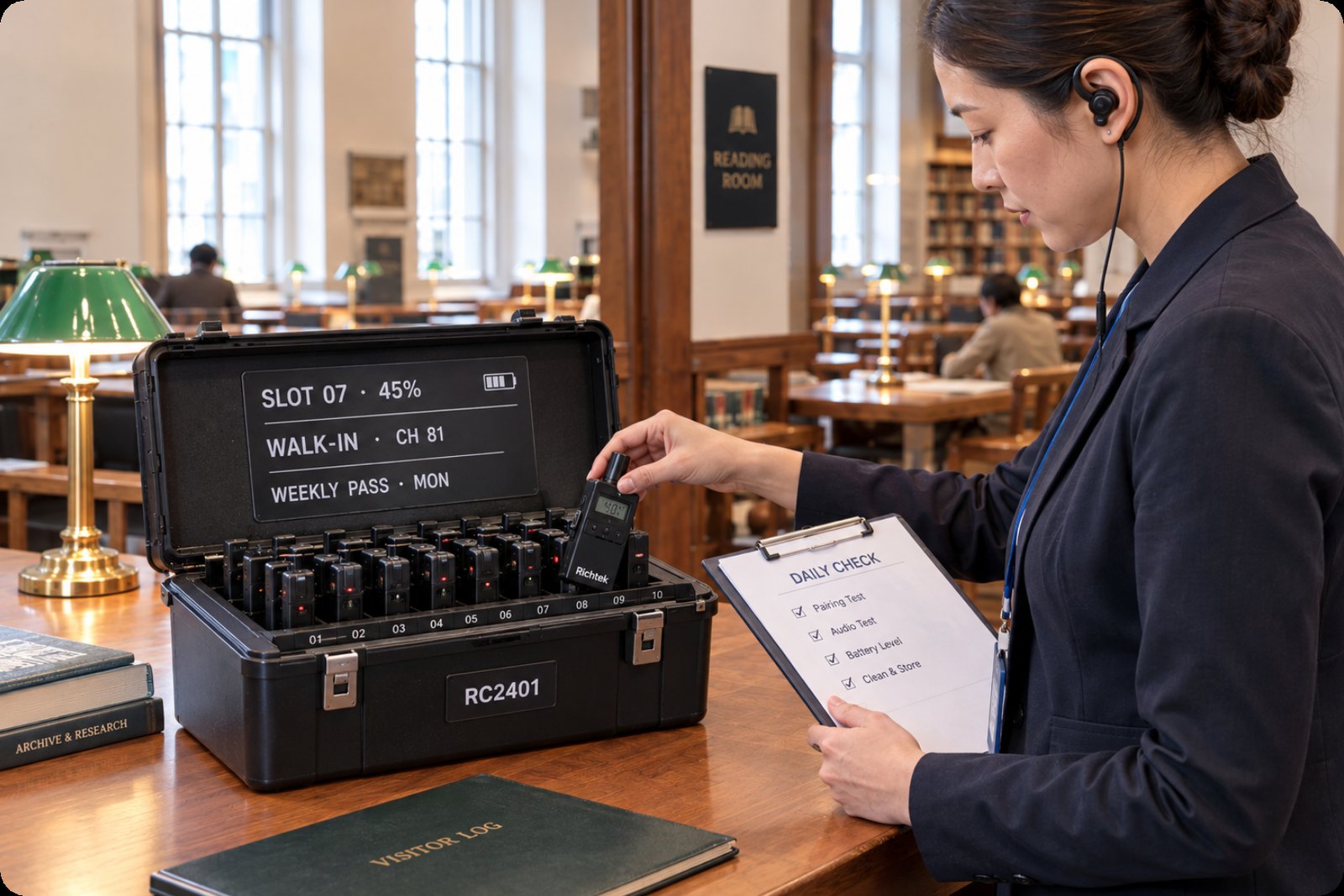
Every archive keeps a sign-out book for the reading room: readers sign in, sign out, and note which box numbers they consulted. The audio equipment should live in the same bookkeeping habit, and the counting point is the charging case. Sixteen RC2401 receivers in a sixteen-slot case is a fact you can check in ten seconds; sixteen receivers signed out to eleven readers is a problem you can only catch by reading the book against the case at the end of the half-day.
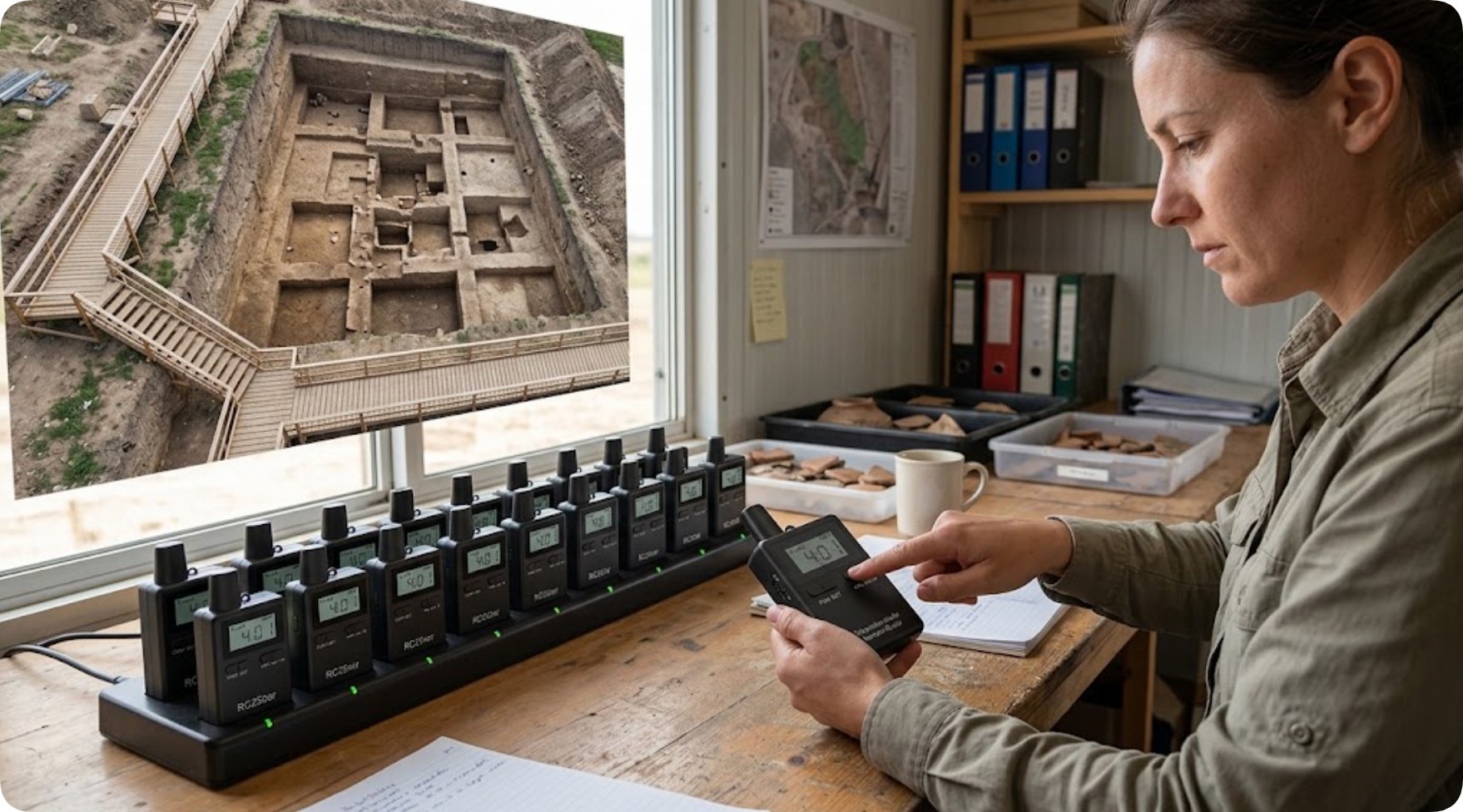
The archive does this count at two levels. The slot count answers "is anything missing," and the book answers "who has it," which is the more useful question at half past four when a researcher has already left the building. The RC2401 makes this easier than it sounds: its product page describes a DC charging system with multi-device charging supported, so the case is a fixed grid rather than a pile of cables, and a fixed grid makes a missing unit visually obvious. One-button synchronization on the same page means the morning pairing pass is quick enough that the crew actually does it instead of skipping it when the group is already at the door.
The RC2406 earns its place in the two-room archive for the reason its product page leads with: eighty channels with PLL anti-interference technology. When the north reading room and the south reading room both have a group, the two sessions need channel plans that cannot drift into each other. Eighty channels is more separation than a fifty-channel unit can offer when both rooms also want spare channels for late additions. The maintenance consequence is simple: the channel assignment sheet is part of the round, and a wipe of the whiteboard is not a substitute for rewriting it.
Prompt Tones and the Quiet the Room Is Owed
A reading room runs quieter than a tour route. Page turns sit around forty decibels; a conversation above a murmur carries across the room and earns a look from the reference desk. That is the background the equipment has to fit into, and it is the one maintenance item most sites forget entirely: the prompt tones. The power-on chime, the pairing confirmation, the low-battery beep, the power-off tone. Outdoors nobody hears them. In a reading room they are the loudest thing in the building.
The archive's rule is that prompt tone management is a setup step, not a cleaning step, and it belongs in the round. Before every visiting half-day, whoever opens the case checks that each unit's tones are set to the reading-room profile: confirmation tones off where the model allows, low-battery warning set to the earliest setting so it never fires mid-session, and volume floors set so a researcher can raise the level without the guide's voice carrying to the next table. On the RC2401, one-button pairing means the morning setup is short enough that the tone check does not get skipped when the group arrives early.
This is also where the one hundred channels on the RC9150 pay off in a way that has nothing to do with range. With that many channels, the archive can leave a quiet margin between the reserved group and the walk-in, so a researcher who leans in to ask the guide a question does not pull the walk-in's audio down with them. Channel discipline is a noise-control measure in a quiet room, and it is maintained the same way any other setting is maintained: on a schedule, with a note in the log.
The Monthly Round That Fits One Coffee Break
The monthly pass is where the four layers land, and at this site it takes about twenty-five minutes once the habit is set. It runs on the first working day of the month, before the visiting calendar resumes, and it follows the same order every time so that nothing depends on memory. The table below is the version the archive actually uses, trimmed to what three models share and marked where they differ.
| Monthly round item | RC9150 (100 channels) | RC2406 (80 channels) | RC2401 (50 channels) |
|---|---|---|---|
| Grille and mic mesh | Dry brush, then blower; log the date | Dry brush, then blower; IPX4 housing still gets dusted | Dry brush, then blower; check the seam around the button |
| Charging contacts | Toothpick pass on every contact, then a test charge | Toothpick pass on every contact, then a test charge | Toothpick pass on every contact, then a test charge |
| Battery state on the shelf | Half charge; receiver standby is long enough to skip mid-week | Half charge; no hourly figure published, so treat as full-day unit | Half charge; weekly pass because transmitter endurance is tighter |
| Channel record | Rewrite the assignment sheet; 100 channels allows three-way split | Rewrite the assignment sheet; 80 channels keeps two rooms separated | Rewrite the assignment sheet; 50 channels covers walk-ins and teaching |
| Prompt tone profile | Reset to reading-room profile before first group | Reset to reading-room profile before first group | Reset to reading-room profile; one-button pairing makes it quick |
| Condensation check | Lens and bezel wipe; twenty-minute bench wait after humid afternoons | Same wait; splash rating does not cover condensation | Same wait; splash rating does not cover condensation |
Two rows deserve a note. The battery row is written the way it is because the three product pages publish three different things: hourly figures for the RC9150 and the RC2401, an all-day statement for the RC2406, and nothing at all on protection ratings for the RC9150. The archive's answer is to schedule from the weakest published figure rather than the strongest, which is why the RC2401 sits on the weekly pass instead of the monthly one. The condensation row exists because no splash rating on any of the three pages covers condensation, and treating one as if it did is the most expensive mistake on this list.
The seasonal layer sits on top. Twice a year, timed to the climate calendar rather than the visitor one, the round adds a full charge-and-discharge cycle on one unit per model, a deeper contact cleaning, and a firmware check where the manufacturer publishes one. That is also the moment to re-read the sign-out book for the season: units that were borrowed for a project that has ended go back to the shelf, and the case map is redrawn to match.
Sites that run the same layered round with a different mix of models will find the structure holds. If you are comparing models for a new archive installation, the museum audio guide equipment range covers the same channel and battery questions in one place, and the wider wireless tour guide system solutions pages map the scenario end of the decision.
Frequently Asked Questions
1. The archive is indoors and dry. Do we really need a condensation procedure?
A: Yes, because the gradient is indoors too. Reading rooms run warmer than stack corridors, and humid afternoons raise the moisture in everything a group carries in. Twenty minutes on the bench with cases closed costs nothing and removes the only failure mode on this list that can kill a unit outright.2. Should units be left fully charged for the six idle days?
A: No. A half charge, roughly forty to sixty percent, is the safer shelf state for multi-day storage. The monthly full-cycle pass exists to prove the charging path still works, not to keep the shelf topped up.3. Paper dust keeps coming back within days. Is the cleaning wrong?
A: The cleaning is right but the interval may be wrong. If grilles load up faster than the weekly pass, move the grille check into the after-every-half-day layer. Paper fibre is an ongoing input in an archive, not a one-time problem, and the fix is frequency rather than stronger chemicals.4. How should we split one hundred channels across a reserved group, a teaching group and walk-ins?
A: Assign in blocks and write the blocks down: for example, one to forty for the reserved group, forty-one to eighty for teaching, and the remainder for walk-ins. The block sizes matter less than the fact that the sheet is rewritten at each monthly round, so nobody has to reconstruct the plan from memory.Whatever mix of models your reading room settles on, the RICH AGE wireless tour guide system range publishes the channel counts and battery figures this round is built on, and the numbers are the right place to start before the first visiting afternoon.