A leading China factory specializing in Wireless Tour Guide Systems, Church Audio Guides, and Translation Headphones with premium OEM/ODM solutions.

Tel:+86 18922879583

Email:tiger.wang@richitek.com

RC2408, RC8860 and RC2402: A Fault-Finding Sheet for Hajj Season Audio Kits

RC2408, RC8860 and RC2402: A Fault-Finding Sheet for Hajj Season Audio Kits

During Hajj season, an audio guide kit does not fail in a laboratory. It fails at the edge of the Mataf crowd when a receiver picks up a stranger's guide, or in a Mina tent corridor where the signal that worked at the hotel gate thins out to nothing, or at four in the afternoon when a transmitter that started the day at full volume now asks every pilgrim to lean in. None of these are defects. All of them are diagnosable, and the diagnosis is faster when the kit carries a fault-finding sheet written before the season starts, not improvised at the gate.

This sheet is organized by symptom, not by model, because the person holding the radio at 3pm does not care which box it came out of. Three models anchor the recommendations: the RC2408, an 80-channel 2.4G workhorse built for crowded frequency space; the RC8860, the only UHF unit in the lineup at 860-870 MHz, which escapes 2.4G congestion entirely; and the RC2402, the standard 50-channel 2.4G set that most groups run. Every figure below is published on the product pages, and where a model does not publish a figure, the sheet says so instead of guessing.

Before Departure: Baseline Every Unit Against Itself

Most seasonal failures are inherited from the storage room, not the plaza. Before the first group departs, every transmitter and receiver gets a ten-minute bench pass: power on, link to its own transmitter, confirm audio on a headphone, and note the battery indicator at start. The pass exists to separate two populations. A unit that fails on the bench stays home; a unit that passes on the bench and fails in the field has an environmental cause, and the fault-finding sheet treats those two cases completely differently.

The baseline also records pairing state. All three models use PLL frequency synthesis, which holds a channel without drift, so a receiver that comes home still locked to channel 12 from last season will wake up on channel 12 this season. That is normally a virtue. It becomes a fault when two kits in the same storage crate were left on adjacent channels, and the first group to power up in the plaza discovers they are neighbors on the dial. One line on the sheet covers it: after every trip, channels get reset to the kit's assigned defaults before the units go back in the case.

The third baseline item is the count against the manifest. Hajj operations lose receivers the way all moving-crowd operations do, quietly and in ones. A manifest check at departure and return turns a slow attrition problem into a number the office sees monthly, while an unchecked case turns it into a mid-season surprise when the group size changes.

Symptom One: A Second Voice on the Channel

The complaint sounds like this: pilgrims hear another guide overlapping the intended one, usually faintly, usually for a minute at a time. The cause is almost never interference in the physics sense. The 2.4G band is license-free, which means every tour operator, every wireless headset vendor and every hotel AV rig at the site shares it. With hundreds of groups operating inside the same compound, someone else is on your frequency. This is a channel-planning problem, and the three models answer it with different mathematics.

The RC2408 has the deepest bench in the band: 80 channels across 2403-2483 MHz, and it is built exactly for this symptom, which is why its product positioning leads with anti-interference in crowds. When a second voice appears, the move is a coordinated hop: the guide switches the transmitter to a channel several slots away from the crowded one, and receivers re-sync in seconds. Because the whole group re-syncs from the transmitter, the fix costs one announcement, not a lap around the plaza collecting earpieces.

The RC2402 runs the same band with 50 channels, and the same hop works. What the smaller channel count changes is the odds of finding a quiet slot on a peak day, so a fleet that mixes RC2402 sets with RC2408 sets should assign the RC2402 kits to earlier time windows, when the plaza's channel occupancy is thinner, and keep the 80-channel units for the peak hours around the obligatory prayers.

The RC8860 plays a different game. Its 20 channels live at 860-870 MHz in the UHF band, which consumer audio gear barely touches. If the 2.4G environment collapses into unusability, the UHF set does not hunt for a quiet slot, because its band is quiet by construction. The fault sheet treats it as the escape hatch: when hopping fails twice on 2.4G, the group that owns an RC8860 kit switches to it for the rest of the day and the problem class disappears rather than shrinks. The trade is capacity, since 20 channels support fewer parallel groups than 80, but for a single guide with one group, that trade never matters.
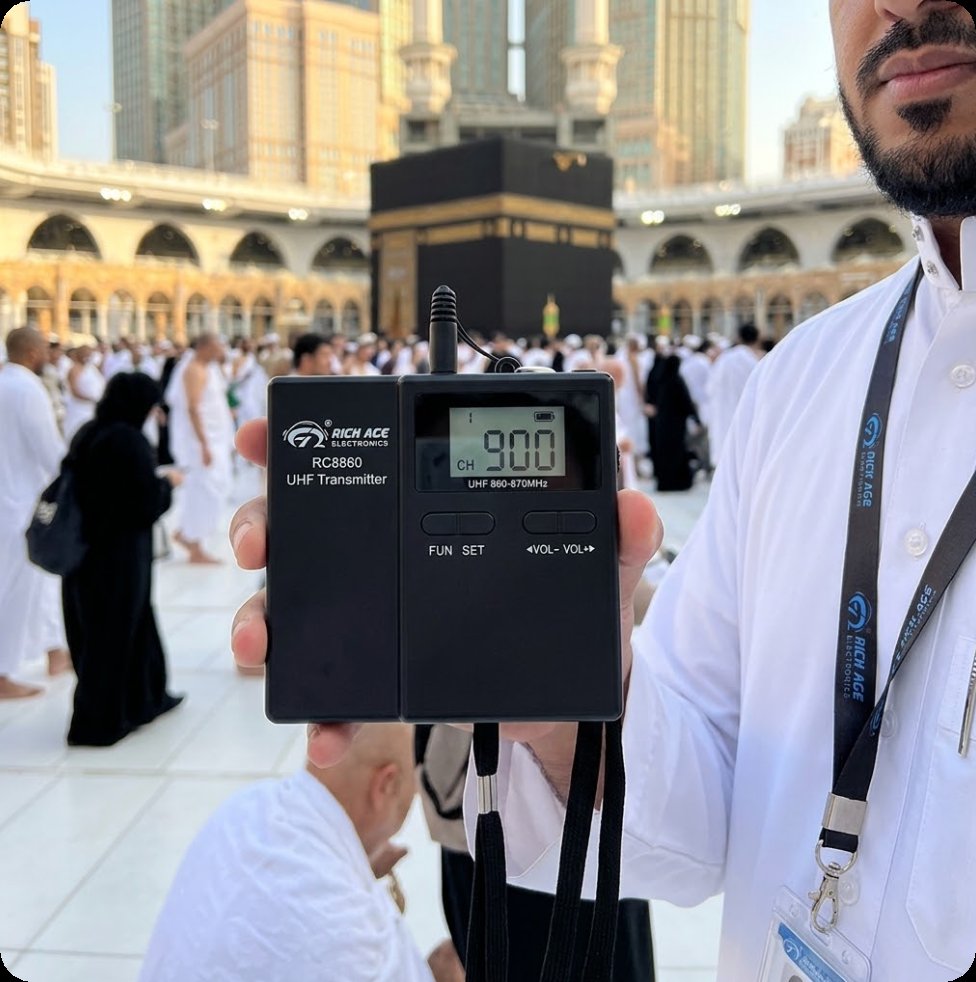
RC8860 UHF transmitter held up at the Grand Mosque with channel display visible

📡 Symptom Two: The Signal That Dies in a Corridor

The second complaint arrives from the tent city rather than the mosque: audio that is clean in the open courtyard becomes choppy the moment the group funnels through a corridor of canvas, concrete pillars or stacked luggage. Every model in the sheet publishes the same headline figure here, a transmission distance of 1-200m, and the number causes misdiagnosis because pilgrims assume 200m is the failing parameter. It almost never is. A guide and a pilgrim walking the same route are rarely more than thirty metres apart even in the largest processions. What kills the link is not distance but obstruction plus angle: the human body absorbs 2.4G aggressively, and a receiver worn under three layers of ihram cloth at the bottom of a backpack is a different radio from one clipped to a belt.

The first fix costs nothing and solves most corridor reports: move the receiver. Upper chest, outside the outermost cloth layer, antenna side clear. The guides who brief this at the hotel gate on day one stop receiving corridor complaints by day two, and the sheet records it as a briefing item rather than a repair item.

When positioning does not fix it, the fault sheet separates the two bands. UHF at 860-870 MHz behaves differently around massed bodies and canvas than 2.4G does; the RC8860's band is less absorbed by water-rich obstacles like crowds, which is one reason it holds audio in dense plaza conditions that push a 2.4G set into breakup. The RC2408 and RC2402 answer with the tools their band gives them: output power is fixed at 10mW by regulation on all three models, so the only remaining 2.4G lever is placement of the transmitter itself. A transmitter in a guide's hip pocket broadcasts to the crowd's knees. Moved to a lanyard or a chest pouch at shoulder height, the same transmitter on the same channel covers the same group with margin, because the 200m limit is an open-field figure and shoulder-height transmission is the closest condition to it that a crowd allows.

Hajj guide using the RC2408 transmitter with its 80-channel badge among a walking crowd

🎯 Symptom Three: A Receiver Stops Following the Guide

Once or twice a season, a receiver goes silent on a working system, or plays audio that belongs to no channel the guide is using. The bench pass already cleared stale pairing, so a field failure has three usual sources: the receiver was power-cycled and woke before the transmitter, the receiver picked up a foreign transmitter during a sync scan, or the unit has a hardware fault that the bench pass missed.

The recovery sequence is the same on all three models because all three use PLL selection, and it takes under a minute. Power the receiver off and on once while the guide's transmitter is already transmitting, so the receiver finds its own group first. If the unit re-links, note the channel it woke on, because a receiver that repeatedly wakes on the wrong channel is flagging a selector-switch fault, and the fault sheet sends it to the back of the distribution line for the bench to look at that evening. If the unit does not re-link, it comes out of rotation entirely; a receiver that cannot hold a lock mid-route is not worth one more announcement to a group that is already moving.

The RC2501 and RC085 earn their keep on fleets that push this symptom hardest, with selectable head-worn and lavalier microphones and in the RC085's case a sensitivity figure around -102dBm, but that is a fleet-design answer rather than a field fix. For the three models on this sheet, the honest summary is that pairing faults are rare, one minute to resolve when they occur, and almost always traceable to a power-cycle order rather than a radio problem.

Symptom Four: The Mid-Afternoon Volume Drop

The complaint sounds subjective and is not: by mid-afternoon, receivers sound quieter than they did at dawn. Volume settings have not changed; the battery curve has. All three models publish the same asymmetry here, and it is the most important number on the sheet: transmitters run 10 hours, receivers 20. The RC8860 and RC2402 publish that pair explicitly, and the RC2408's receiver figure is 20 hours against a 10-hour transmitter as well. A day that starts after the Fajr prayer and ends after Isha runs fourteen to sixteen hours, which means the transmitters, not the receivers, define when the kit needs power.

The fix is a transmitter rotation, planned at dawn rather than improvised. A kit carrying three transmitters runs two in service and one on the charger, swapping at midday; the 20-hour receivers never see a charger during the day at all. The published battery capacities explain the asymmetry worth knowing when someone asks why: transmitters carry 3.7V 1500mAh cells on all three models while receivers run 3.7V 1000mAh, and a transmitter broadcasting continuously drains its cell faster than a receiver that spends much of the day idle between the guide's sentences.

The sheet also records the quiet failure hiding inside this symptom: a receiver that sounds quiet at hour ten while its neighbors sound normal is not showing a battery curve, it is showing a failing earphone or a partially blocked acoustic port, and swapping the earpiece before swapping the unit saves a diagnosis. That one-line triage, earpiece first, unit second, battery last, belongs on the laminated card because it is the check pilgrims themselves can do without radio knowledge.
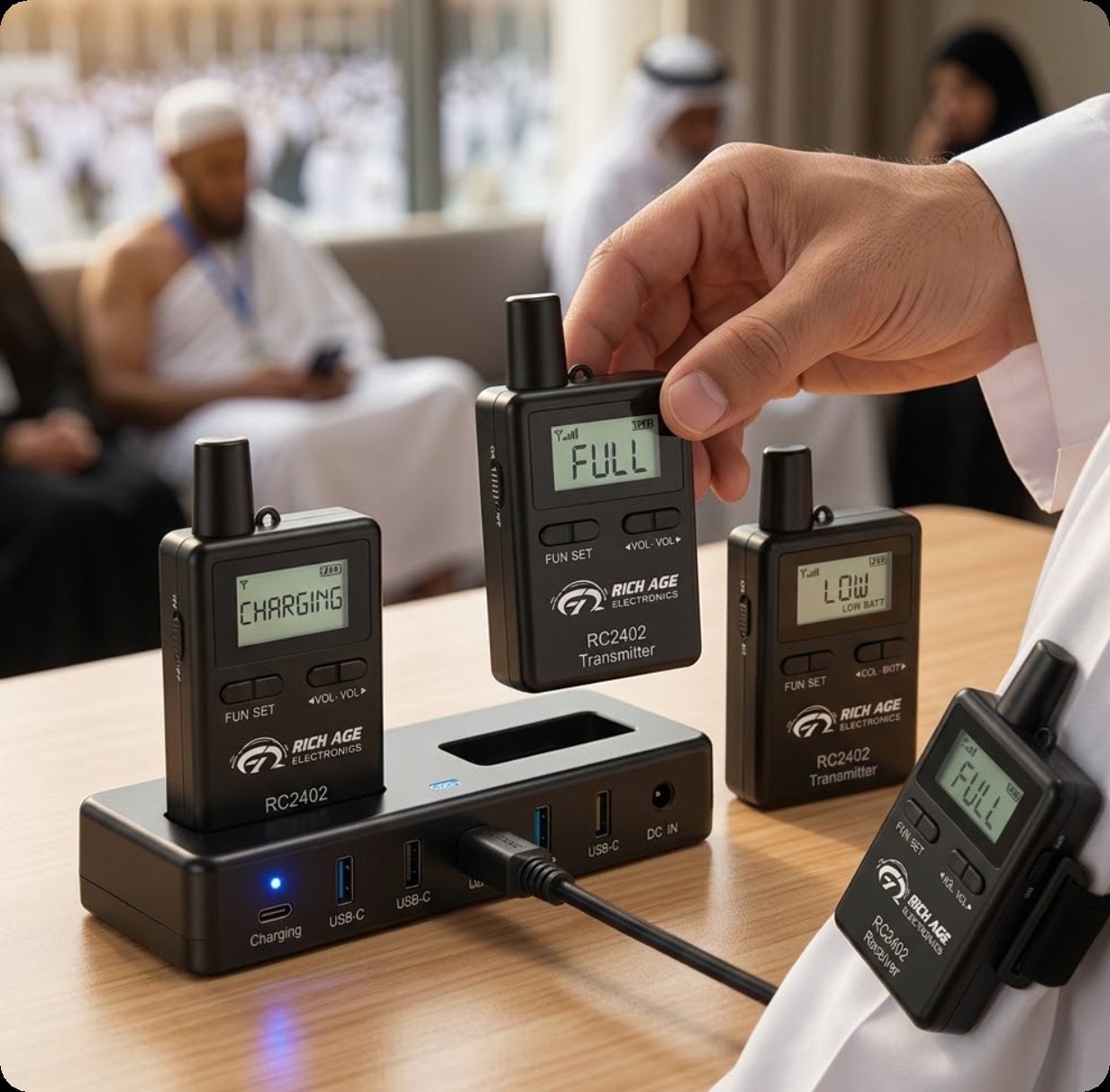
RC2402 transmitters on a charging station showing charging, full and low battery states

One Charger for the Whole Case

Some faults are logistics wearing a technical costume, and charging is the main one. Here the three models agree on the detail that matters most at season scale: all three charge over a DC port. A mixed fleet that carries RC2408 transmitters, RC8860 escape-hatch kits and RC2402 standard sets therefore needs one charger type and one cable run, not three. The difference shows up at the hotel at eleven at night: two charging stations instead of four is the difference between a full case and a 6am scramble.

The sheet gives charging its own line because charging faults disguise themselves as battery faults. A unit that returns from the field at twenty percent and leaves the next morning at sixty has either a failing cell or a charging station that someone else's adapter half-fits. Marking the charging stations with the date they were last tested, and rotating the oldest stations out first, is the same manifest discipline applied to accessories, and it catches more field failures than any radio setting.

Where a fleet needs faster turnaround than DC charging allows, the RC9150 and RC2500 sit at the top of the lineup with Type-C charging and 35-hour-plus receiver endurance, and they are the models to specify when the operation runs multiple group rotations per day. This sheet keeps them off the fault table deliberately: their failure modes duplicate the ones above, and the fixes are identical, which is the point of a sheet organized by symptom.

The Fault Table to Tape Inside the Case Lid

Condensed to one surface, the season's troubleshooting fits a single table. It records the symptom, the first action that resolves most cases, the escalation when the first action fails, and which published figure the case actually tested. The table is deliberately model-agnostic except where a model owns a unique answer.

Symptom in the fieldFirst actionEscalationFigure being tested
A second guide's voice on the channelCoordinated channel hop from the transmitter; group re-syncsSecond hop fails: switch that group's route to the RC8860 UHF kit for the dayChannels: 80 (RC2408) / 50 (RC2402) on 2.4G; 20 on UHF 860-870 MHz (RC8860)
Choppy audio in corridors or dense crowdMove receiver to upper chest, outside outer cloth layerRaise transmitter to shoulder height on lanyard or chest pouch1-200m transmission distance, open-field; 10mW output on all three
Receiver silent or on wrong channelPower-cycle receiver while guide's transmitter is activeNo re-link: pull unit from rotation for evening bench checkPLL frequency synthesis, all three models
Quieter audio by mid-afternoonSwap earpiece before swapping the unitRotate transmitter from the dawn-charged spareTx 10h / Rx 20h; Tx 3.7V 1500mAh, Rx 3.7V 1000mAh
Unit dead at morning issueCheck it was on a tested charging station, not a mixed oneSwap in the bench-passed spare from the case lid pocketDC port charging, all three models
Receiver count short at returnManifest check against the departure countLog monthly attrition; reorder before next season's bookingsKit manifest, not a radio figure

Read down the last column and the pattern is plain: most field faults test a published figure only incidentally, because the real variables are channel occupancy, clothing, placement and charge discipline. The published numbers still matter. They are what lets an office compare the RC2408's 80-channel depth against the RC2402's 50, and the RC8860's separate UHF band against both, before the season assigns kits to groups.

Operators who want the full specification behind each line will find it on the RC2408 Wireless Tour Guide System, RC8860 Tour Guide Transmitter and RC2402 Wireless Tour Guide System product pages, and the Hajj and Umrah tour guide system page collects the season-specific kit guidance in one place.

Frequently Asked Questions

1. Can we run RC2408, RC8860 and RC2402 kits at the same time in one group of operators?

A: Yes, and mixed fleets are the normal case at season scale. The RC8860's UHF band at 860-870 MHz does not collide with the 2.4G band the other two share, and within 2.4G the channel hop procedure is identical on the RC2408 and RC2402, so guides only learn one recovery routine. Assign the 80-channel RC2408 kits to the peak hours and the 50-channel RC2402 kits to earlier windows, and keep the RC8860 as the standing escape hatch.

2. The receivers sound quiet in the afternoon. Do we need new units?

A: Almost never. Transmitters run 10 hours against 20 on receivers, so by mid-afternoon the transmitter's battery curve, not a fault, explains the change. Rotate the dawn-charged spare transmitter first. If one receiver is quieter than its neighbors on the same transmitter, swap its earpiece before touching anything else.

3. Is 200m enough range for the Mataf and the tent city?

A: Published range is 1-200m open-field on all three models, and real Hajj use never approaches that distance between guide and pilgrim. What fails in crowds and corridors is obstruction, not distance: body absorption and layering matter more than metres. Receiver placement outside the outer cloth layer and transmitter placement at shoulder height recover nearly all of it.

4. Why does the UHF unit have fewer channels if it is the flagship fix?

A: Because it solves a different problem. The RC8860's 20 channels live in the 860-870 MHz UHF band, which the license-free consumer gear that crowds 2.4G does not use. It needs fewer channels for the same result, the way a quiet street needs fewer lanes. Its value is that its band is empty by construction, not that it can host more parallel groups.

5. What should we check before the season that prevents most of this?

A: Three passes: a bench pass that links every unit and benches out the failures, a channel reset to kit defaults after every trip so stale pairings do not board the bus, and a charging-station test with dated labels. Operators running these three checks report that field troubleshooting shrinks to channel hops and transmitter rotations, which is what the sheet is sized for.

Building the kit for the season itself is a separate exercise from keeping it running: the full range of Richitek wireless tour guide systems covers every tier from the 100-channel flagship down to the lightest ear-hook receiver, and to see how the same equipment behaves in other demanding environments, explore our solutions across museums, factories and city tours.


2026年10月17日 10:17
ꄘ click: 32

RC2408, RC8860 and RC2402: A Fault-Finding Sheet for Hajj Season Audio Kits

time: 2026年10月17日 click:32

RC2408, RC8860 and RC2402: A Fault-Finding Sheet for Hajj Season Audio Kits

During Hajj season, an audio guide kit does not fail in a laboratory. It fails at the edge of the Mataf crowd when a receiver picks up a stranger's guide, or in a Mina tent corridor where the signal that worked at the hotel gate thins out to nothing, or at four in the afternoon when a transmitter that started the day at full volume now asks every pilgrim to lean in. None of these are defects. All of them are diagnosable, and the diagnosis is faster when the kit carries a fault-finding sheet written before the season starts, not improvised at the gate.

This sheet is organized by symptom, not by model, because the person holding the radio at 3pm does not care which box it came out of. Three models anchor the recommendations: the RC2408, an 80-channel 2.4G workhorse built for crowded frequency space; the RC8860, the only UHF unit in the lineup at 860-870 MHz, which escapes 2.4G congestion entirely; and the RC2402, the standard 50-channel 2.4G set that most groups run. Every figure below is published on the product pages, and where a model does not publish a figure, the sheet says so instead of guessing.

Before Departure: Baseline Every Unit Against Itself

Most seasonal failures are inherited from the storage room, not the plaza. Before the first group departs, every transmitter and receiver gets a ten-minute bench pass: power on, link to its own transmitter, confirm audio on a headphone, and note the battery indicator at start. The pass exists to separate two populations. A unit that fails on the bench stays home; a unit that passes on the bench and fails in the field has an environmental cause, and the fault-finding sheet treats those two cases completely differently.

The baseline also records pairing state. All three models use PLL frequency synthesis, which holds a channel without drift, so a receiver that comes home still locked to channel 12 from last season will wake up on channel 12 this season. That is normally a virtue. It becomes a fault when two kits in the same storage crate were left on adjacent channels, and the first group to power up in the plaza discovers they are neighbors on the dial. One line on the sheet covers it: after every trip, channels get reset to the kit's assigned defaults before the units go back in the case.

The third baseline item is the count against the manifest. Hajj operations lose receivers the way all moving-crowd operations do, quietly and in ones. A manifest check at departure and return turns a slow attrition problem into a number the office sees monthly, while an unchecked case turns it into a mid-season surprise when the group size changes.

Symptom One: A Second Voice on the Channel

The complaint sounds like this: pilgrims hear another guide overlapping the intended one, usually faintly, usually for a minute at a time. The cause is almost never interference in the physics sense. The 2.4G band is license-free, which means every tour operator, every wireless headset vendor and every hotel AV rig at the site shares it. With hundreds of groups operating inside the same compound, someone else is on your frequency. This is a channel-planning problem, and the three models answer it with different mathematics.

The RC2408 has the deepest bench in the band: 80 channels across 2403-2483 MHz, and it is built exactly for this symptom, which is why its product positioning leads with anti-interference in crowds. When a second voice appears, the move is a coordinated hop: the guide switches the transmitter to a channel several slots away from the crowded one, and receivers re-sync in seconds. Because the whole group re-syncs from the transmitter, the fix costs one announcement, not a lap around the plaza collecting earpieces.

The RC2402 runs the same band with 50 channels, and the same hop works. What the smaller channel count changes is the odds of finding a quiet slot on a peak day, so a fleet that mixes RC2402 sets with RC2408 sets should assign the RC2402 kits to earlier time windows, when the plaza's channel occupancy is thinner, and keep the 80-channel units for the peak hours around the obligatory prayers.

The RC8860 plays a different game. Its 20 channels live at 860-870 MHz in the UHF band, which consumer audio gear barely touches. If the 2.4G environment collapses into unusability, the UHF set does not hunt for a quiet slot, because its band is quiet by construction. The fault sheet treats it as the escape hatch: when hopping fails twice on 2.4G, the group that owns an RC8860 kit switches to it for the rest of the day and the problem class disappears rather than shrinks. The trade is capacity, since 20 channels support fewer parallel groups than 80, but for a single guide with one group, that trade never matters.

RC8860 UHF transmitter held up at the Grand Mosque with channel display visible

📡 Symptom Two: The Signal That Dies in a Corridor

The second complaint arrives from the tent city rather than the mosque: audio that is clean in the open courtyard becomes choppy the moment the group funnels through a corridor of canvas, concrete pillars or stacked luggage. Every model in the sheet publishes the same headline figure here, a transmission distance of 1-200m, and the number causes misdiagnosis because pilgrims assume 200m is the failing parameter. It almost never is. A guide and a pilgrim walking the same route are rarely more than thirty metres apart even in the largest processions. What kills the link is not distance but obstruction plus angle: the human body absorbs 2.4G aggressively, and a receiver worn under three layers of ihram cloth at the bottom of a backpack is a different radio from one clipped to a belt.

The first fix costs nothing and solves most corridor reports: move the receiver. Upper chest, outside the outermost cloth layer, antenna side clear. The guides who brief this at the hotel gate on day one stop receiving corridor complaints by day two, and the sheet records it as a briefing item rather than a repair item.

When positioning does not fix it, the fault sheet separates the two bands. UHF at 860-870 MHz behaves differently around massed bodies and canvas than 2.4G does; the RC8860's band is less absorbed by water-rich obstacles like crowds, which is one reason it holds audio in dense plaza conditions that push a 2.4G set into breakup. The RC2408 and RC2402 answer with the tools their band gives them: output power is fixed at 10mW by regulation on all three models, so the only remaining 2.4G lever is placement of the transmitter itself. A transmitter in a guide's hip pocket broadcasts to the crowd's knees. Moved to a lanyard or a chest pouch at shoulder height, the same transmitter on the same channel covers the same group with margin, because the 200m limit is an open-field figure and shoulder-height transmission is the closest condition to it that a crowd allows.

Hajj guide using the RC2408 transmitter with its 80-channel badge among a walking crowd

🎯 Symptom Three: A Receiver Stops Following the Guide

Once or twice a season, a receiver goes silent on a working system, or plays audio that belongs to no channel the guide is using. The bench pass already cleared stale pairing, so a field failure has three usual sources: the receiver was power-cycled and woke before the transmitter, the receiver picked up a foreign transmitter during a sync scan, or the unit has a hardware fault that the bench pass missed.

The recovery sequence is the same on all three models because all three use PLL selection, and it takes under a minute. Power the receiver off and on once while the guide's transmitter is already transmitting, so the receiver finds its own group first. If the unit re-links, note the channel it woke on, because a receiver that repeatedly wakes on the wrong channel is flagging a selector-switch fault, and the fault sheet sends it to the back of the distribution line for the bench to look at that evening. If the unit does not re-link, it comes out of rotation entirely; a receiver that cannot hold a lock mid-route is not worth one more announcement to a group that is already moving.

The RC2501 and RC085 earn their keep on fleets that push this symptom hardest, with selectable head-worn and lavalier microphones and in the RC085's case a sensitivity figure around -102dBm, but that is a fleet-design answer rather than a field fix. For the three models on this sheet, the honest summary is that pairing faults are rare, one minute to resolve when they occur, and almost always traceable to a power-cycle order rather than a radio problem.

Symptom Four: The Mid-Afternoon Volume Drop

The complaint sounds subjective and is not: by mid-afternoon, receivers sound quieter than they did at dawn. Volume settings have not changed; the battery curve has. All three models publish the same asymmetry here, and it is the most important number on the sheet: transmitters run 10 hours, receivers 20. The RC8860 and RC2402 publish that pair explicitly, and the RC2408's receiver figure is 20 hours against a 10-hour transmitter as well. A day that starts after the Fajr prayer and ends after Isha runs fourteen to sixteen hours, which means the transmitters, not the receivers, define when the kit needs power.

The fix is a transmitter rotation, planned at dawn rather than improvised. A kit carrying three transmitters runs two in service and one on the charger, swapping at midday; the 20-hour receivers never see a charger during the day at all. The published battery capacities explain the asymmetry worth knowing when someone asks why: transmitters carry 3.7V 1500mAh cells on all three models while receivers run 3.7V 1000mAh, and a transmitter broadcasting continuously drains its cell faster than a receiver that spends much of the day idle between the guide's sentences.

The sheet also records the quiet failure hiding inside this symptom: a receiver that sounds quiet at hour ten while its neighbors sound normal is not showing a battery curve, it is showing a failing earphone or a partially blocked acoustic port, and swapping the earpiece before swapping the unit saves a diagnosis. That one-line triage, earpiece first, unit second, battery last, belongs on the laminated card because it is the check pilgrims themselves can do without radio knowledge.

RC2402 transmitters on a charging station showing charging, full and low battery states

One Charger for the Whole Case

Some faults are logistics wearing a technical costume, and charging is the main one. Here the three models agree on the detail that matters most at season scale: all three charge over a DC port. A mixed fleet that carries RC2408 transmitters, RC8860 escape-hatch kits and RC2402 standard sets therefore needs one charger type and one cable run, not three. The difference shows up at the hotel at eleven at night: two charging stations instead of four is the difference between a full case and a 6am scramble.

The sheet gives charging its own line because charging faults disguise themselves as battery faults. A unit that returns from the field at twenty percent and leaves the next morning at sixty has either a failing cell or a charging station that someone else's adapter half-fits. Marking the charging stations with the date they were last tested, and rotating the oldest stations out first, is the same manifest discipline applied to accessories, and it catches more field failures than any radio setting.

Where a fleet needs faster turnaround than DC charging allows, the RC9150 and RC2500 sit at the top of the lineup with Type-C charging and 35-hour-plus receiver endurance, and they are the models to specify when the operation runs multiple group rotations per day. This sheet keeps them off the fault table deliberately: their failure modes duplicate the ones above, and the fixes are identical, which is the point of a sheet organized by symptom.

The Fault Table to Tape Inside the Case Lid

Condensed to one surface, the season's troubleshooting fits a single table. It records the symptom, the first action that resolves most cases, the escalation when the first action fails, and which published figure the case actually tested. The table is deliberately model-agnostic except where a model owns a unique answer.

Symptom in the fieldFirst actionEscalationFigure being tested
A second guide's voice on the channelCoordinated channel hop from the transmitter; group re-syncsSecond hop fails: switch that group's route to the RC8860 UHF kit for the dayChannels: 80 (RC2408) / 50 (RC2402) on 2.4G; 20 on UHF 860-870 MHz (RC8860)
Choppy audio in corridors or dense crowdMove receiver to upper chest, outside outer cloth layerRaise transmitter to shoulder height on lanyard or chest pouch1-200m transmission distance, open-field; 10mW output on all three
Receiver silent or on wrong channelPower-cycle receiver while guide's transmitter is activeNo re-link: pull unit from rotation for evening bench checkPLL frequency synthesis, all three models
Quieter audio by mid-afternoonSwap earpiece before swapping the unitRotate transmitter from the dawn-charged spareTx 10h / Rx 20h; Tx 3.7V 1500mAh, Rx 3.7V 1000mAh
Unit dead at morning issueCheck it was on a tested charging station, not a mixed oneSwap in the bench-passed spare from the case lid pocketDC port charging, all three models
Receiver count short at returnManifest check against the departure countLog monthly attrition; reorder before next season's bookingsKit manifest, not a radio figure

Read down the last column and the pattern is plain: most field faults test a published figure only incidentally, because the real variables are channel occupancy, clothing, placement and charge discipline. The published numbers still matter. They are what lets an office compare the RC2408's 80-channel depth against the RC2402's 50, and the RC8860's separate UHF band against both, before the season assigns kits to groups.

Operators who want the full specification behind each line will find it on the RC2408 Wireless Tour Guide System, RC8860 Tour Guide Transmitter and RC2402 Wireless Tour Guide System product pages, and the Hajj and Umrah tour guide system page collects the season-specific kit guidance in one place.

Frequently Asked Questions

1. Can we run RC2408, RC8860 and RC2402 kits at the same time in one group of operators?

A: Yes, and mixed fleets are the normal case at season scale. The RC8860's UHF band at 860-870 MHz does not collide with the 2.4G band the other two share, and within 2.4G the channel hop procedure is identical on the RC2408 and RC2402, so guides only learn one recovery routine. Assign the 80-channel RC2408 kits to the peak hours and the 50-channel RC2402 kits to earlier windows, and keep the RC8860 as the standing escape hatch.

2. The receivers sound quiet in the afternoon. Do we need new units?

A: Almost never. Transmitters run 10 hours against 20 on receivers, so by mid-afternoon the transmitter's battery curve, not a fault, explains the change. Rotate the dawn-charged spare transmitter first. If one receiver is quieter than its neighbors on the same transmitter, swap its earpiece before touching anything else.

3. Is 200m enough range for the Mataf and the tent city?

A: Published range is 1-200m open-field on all three models, and real Hajj use never approaches that distance between guide and pilgrim. What fails in crowds and corridors is obstruction, not distance: body absorption and layering matter more than metres. Receiver placement outside the outer cloth layer and transmitter placement at shoulder height recover nearly all of it.

4. Why does the UHF unit have fewer channels if it is the flagship fix?

A: Because it solves a different problem. The RC8860's 20 channels live in the 860-870 MHz UHF band, which the license-free consumer gear that crowds 2.4G does not use. It needs fewer channels for the same result, the way a quiet street needs fewer lanes. Its value is that its band is empty by construction, not that it can host more parallel groups.

5. What should we check before the season that prevents most of this?

A: Three passes: a bench pass that links every unit and benches out the failures, a channel reset to kit defaults after every trip so stale pairings do not board the bus, and a charging-station test with dated labels. Operators running these three checks report that field troubleshooting shrinks to channel hops and transmitter rotations, which is what the sheet is sized for.

Building the kit for the season itself is a separate exercise from keeping it running: the full range of Richitek wireless tour guide systems covers every tier from the 100-channel flagship down to the lightest ear-hook receiver, and to see how the same equipment behaves in other demanding environments, explore our solutions across museums, factories and city tours.


×

Contact us

email:
name:
subject:
content: