.webp)
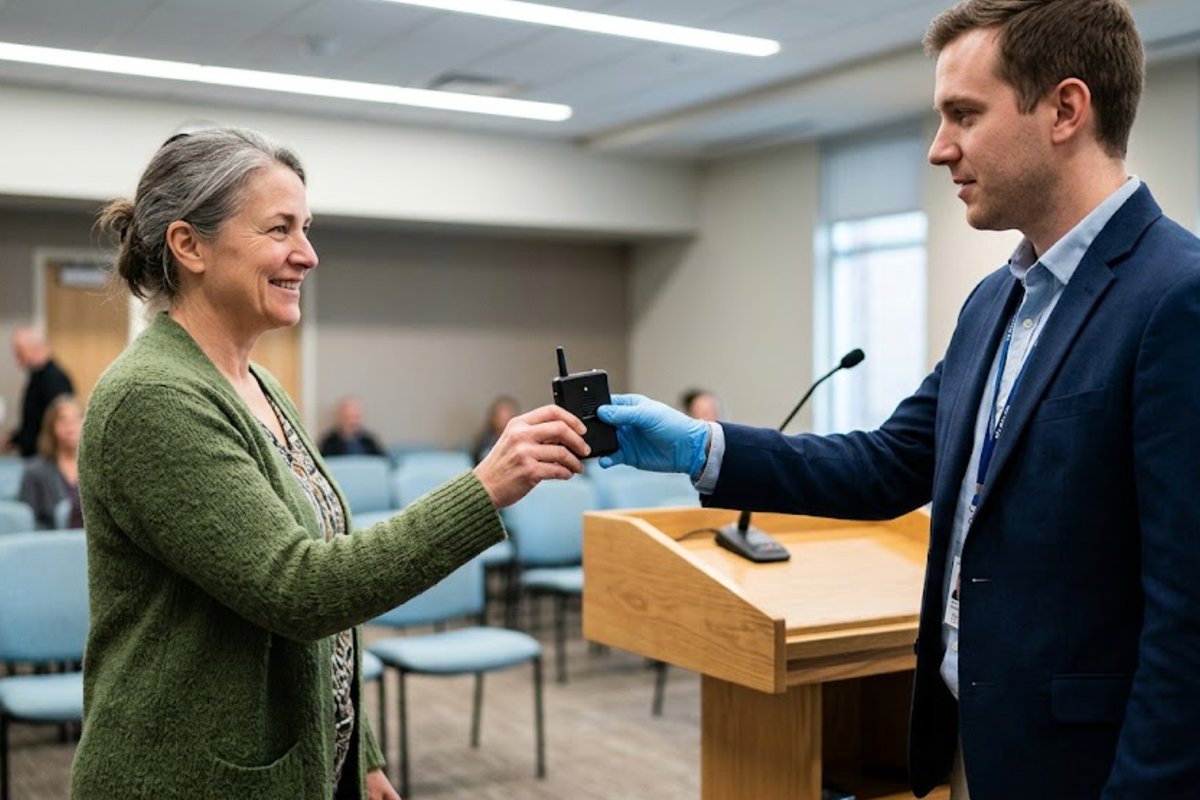
Ports, container terminals and large distribution centres have become regular stops on the industrial visit circuit, and they are the most demanding ordinary venue a tour guide system will ever face. The walls are steel, the aisles are forty metres wide, a gantry crane starts up mid-sentence, and the group wears ear protection that was chosen for safety, not for listening. A system that performs well in a museum conference room can lose half its audience here on the first afternoon.
This checklist exists so the purchase decision happens once, against the site's real conditions, instead of three times as returns. It scores three models against the questions a port walkthrough actually asks: the RC2402, the standard 50-channel 2.4G set; the RC2406, its 80-channel stablemate built for congested frequency space; and the RC085, the UHF unit at 470-510 MHz with 100 channels and professional microphone options. Every figure below is published on the product pages, and where a page is silent, the checklist says so rather than assuming.
📡 What a Port Walkthrough Asks of the Radio Link
The environment writes the first four lines of the checklist. Distance: a quay wall to a gangway can stretch past the point where guides feel comfortable, so published range matters as a ceiling. Obstruction: shipping containers are steel boxes, and a group strung out between two of them is a different radio problem from a group in an open hall. Congestion: a working terminal shares its air with handheld radios, vehicle telematics and visitors' phones, most of it on the unlicensed 2.4G band. Noise: the system's job is not volume alone but clarity at moderate volume, because hearing protection narrows what the ear can use.
All three models answer the distance line identically: a transmission range of 1-200m in open-field conditions. The differences live in how each one behaves when the route bends between steel boxes, and that is where the frequency bands and channel counts stop being spec-sheet numbers and start being purchase criteria.
Count Channels Before You Count Units
Channel count is the checklist's capacity line. Multiple groups run in the same terminal at once: a customer delegation, a contractor induction, a training class from the local institute. If two groups land on the same channel, both guides lose their audiences simultaneously. The RC2402 carries 50 channels across the 2.4G band, which covers a single operator running two or three groups comfortably. The RC2406 carries 80 channels on the same band, and its product page positions it explicitly for interference resistance in crowded spaces — the model to specify when the site hosts several visitor groups per day, because more channels means the coordinated channel assignment each group gets at the gate stays valid all day.
The RC085 triples the standard count: 100 channels, but on a different band entirely, which is why it appears on the same line rather than below it. Channel arithmetic is only meaningful within a band, and the RC085's arithmetic is decided by the frequency line of the checklist below.
📡 The Frequency Question the Steel Answers
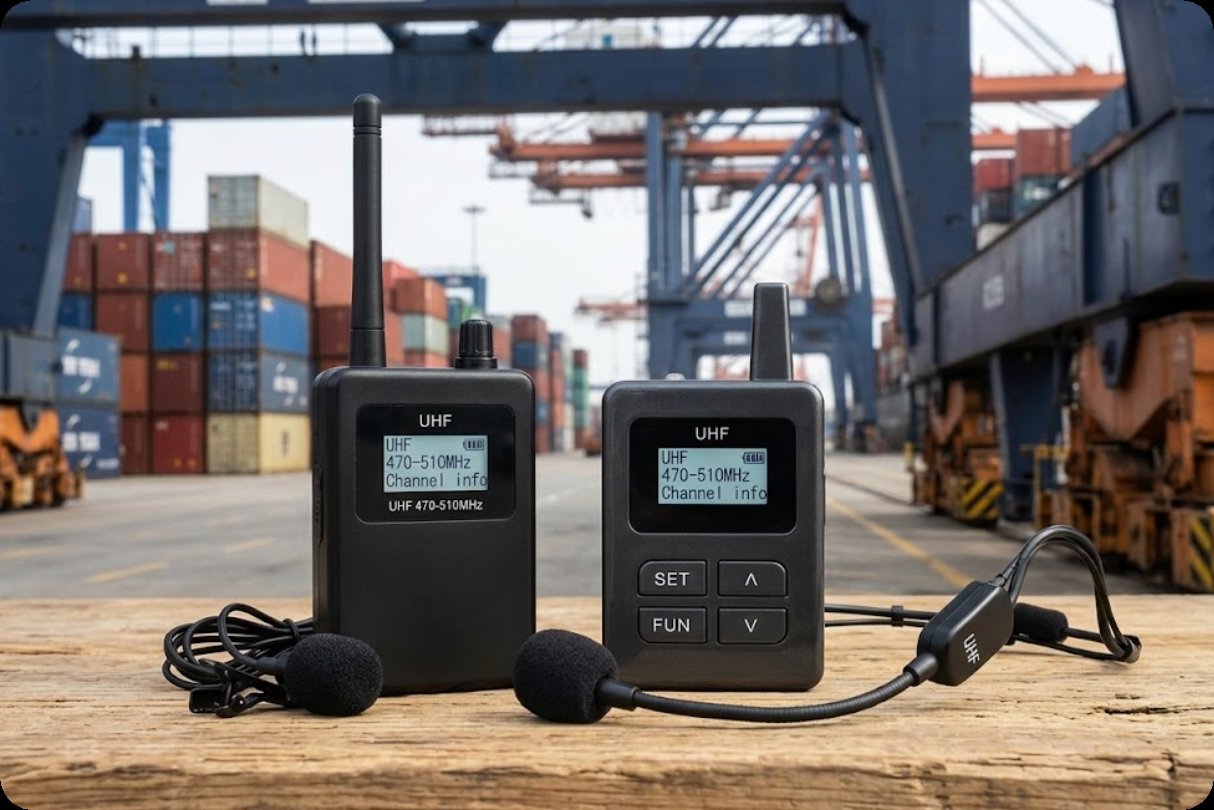
The RC2402 and RC2406 operate at 2403-2483 MHz, the license-free 2.4G ISM band, using PLL frequency synthesis to hold their channels. The RC085 operates at 470-510 MHz in the UHF band using GFSK modulation. For a port walkthrough the practical distinction is congestion: 2.4G is where consumer and industrial wireless gear crowds together, while 470-510 MHz is a band that phones and visitor devices do not touch. Inside a terminal where every crane cab and vehicle carries a radio, the UHF set's band is quieter by construction, and that quiet survives the steel canyons between container stacks better than a crowded band does.
The RC085 backs the band choice with a published sensitivity figure of approximately -102dBm, the specification that describes how weak a signal it can still render intelligibly, and weak signals are exactly what remains after a signal crosses two steel walls. Neither 2.4G page publishes a comparable sensitivity figure, and the checklist scores that gap as a gap: the buyer who needs a defensible answer for the worst corner of the terminal has one from the RC085 page and silence from the others.
🔋 Battery Figures That Match a Two-Shift Site
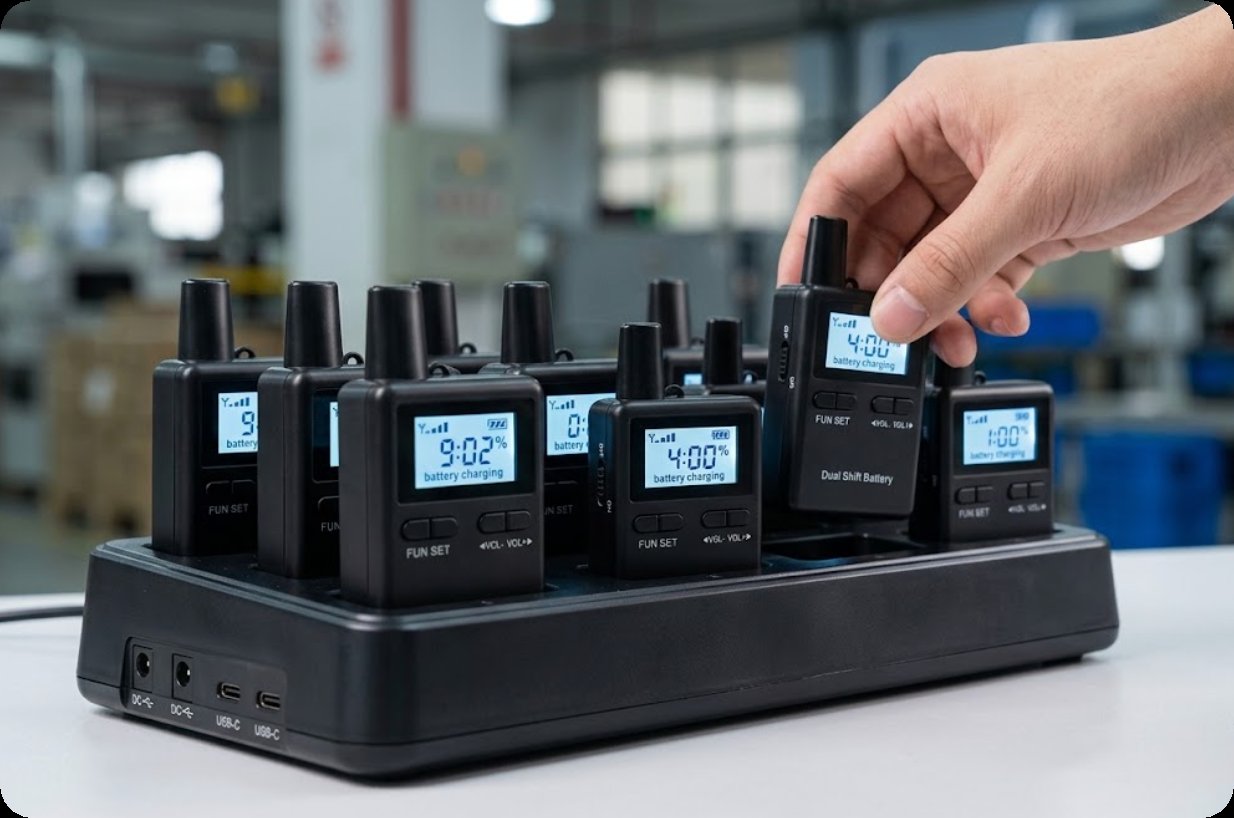
Industrial sites do not run museum hours. A terminal visit starts when the ship berth frees up, which can mean a morning group and an afternoon group back to back, with the equipment charging over lunch or not at all. The checklist asks each page for transmitter and receiver endurance separately, because the two batteries drain on different schedules. The RC2402 and RC2406 both publish 10 hours for transmitters and 20 for receivers. The RC085 publishes 12 hours for its transmitter and 20 for receivers, the longest talk time of the three, which matters when the same guide covers both groups and cannot reach a charger in between.
Receiver endurance is the quieter half of the line, and the more important one for a two-shift site: at 20 hours published on all three models, receivers charged at dawn survive a full double-header without a mid-day swap, which removes the entire battery question from the visitor-facing part of the day. The remaining decisions concern transmitters only, and spares are cheap compared to the alternative of a guide switching units mid-route.
🎯 Mic Options Decide Who Speaks
Port walkthroughs often have two speakers: the guide from the tour company, and an engineer or safety officer who joins for part of the route. The RC085 is the only one of the three models that publishes optional head-worn and lavalier microphone support, which turns the second speaker into a plug-in rather than a handover of the main transmitter. The 65g transmitter body stays with the tour guide while the second microphone goes to whoever is presenting that leg.
The RC2402 and RC2406 run their built-in microphones, and for a single-guide operation that is the simpler inventory: fewer accessories to charge, issue and recover. The checklist treats this line as a hiring question more than a hardware one — sites whose visits always include a plant engineer should score the RC085's mic options; sites that run one guide per group lose nothing with either 2.4G model.

The Checklist to Score Vendors Against
Condensed to one page, this is the scorecard a procurement team can put in front of any vendor, with the three models filled in from published figures. Where a cell says not published, that is the vendor's homework, not the buyer's guess.
| Checklist line | RC2402 | RC2406 | RC085 |
|---|---|---|---|
| Frequency band | 2.4G, 2403-2483 MHz | 2.4G, 2403-2483 MHz | UHF, 470-510 MHz (GFSK) |
| Channels | 50 | 80 | 100 |
| Transmission range | 1-200m | 1-200m | 1-200m |
| Transmitter battery | 10 hours | 10 hours | 12 hours |
| Receiver battery | 20 hours | 20 hours | 20 hours |
| Receiver weight | 50g | 50g | 60g |
| Receiver sensitivity | Not published | Not published | ≈ -102dBm |
| Microphone options | Built-in | Built-in | Optional head-worn / lavalier |
| Charging port | DC Port | DC Port | USB |
| Best fit on this checklist | Single-guide, low traffic | Multiple daily groups | Steel-heavy routes, second speaker |
Read as a decision, the table says what every port procurement round eventually discovers: the band is the biggest choice, the channel count is the second, and everything else is arithmetic. A site that knows its daily group count and its worst steel corner already knows which row to read first.
The full published specifications behind each line sit on the RC2402 Wireless Tour Guide System, RC2406 80-Channel 2.4G Tour Guide System and RC085 Digital Tour Guide System product pages, and the plant and logistics site solutions page collects the environment-specific guidance for industrial visits.
Frequently Asked Questions
1. Is the RC085's UHF band harder to licence than 2.4G?
A: The product page does not publish licensing terms, so ask the vendor for the destination country before ordering; what the page does publish is that 470-510 MHz is the operating band with GFSK modulation and 100 channels. The practical point stands regardless of paperwork: visitor phones and consumer gear crowd 2.4G, not UHF.2. We run one group a month. Is the 80-channel RC2406 wasted money?
A: For low-frequency visits the RC2402's 50 channels are the honest fit, and the checklist's best-fit row says as much. The RC2406 earns its extra channels where several groups move through the same terminal per day and channel assignments have to hold from morning to afternoon.3. Why does receiver battery life matter more than transmitter life on a two-shift site?
A: Because receivers outnumber transmitters and visitors cannot change them. All three models publish 20 hours on receivers, so a dawn charge covers both shifts; the swap conversation only ever involves the transmitter, at 10 hours on the RC2402 and RC2406 and 12 on the RC085.4. What does the -102dBm sensitivity figure buy in a container yard?
A: It is the published answer to the worst-corner question: how weak a signal the receiver still turns into intelligible audio after steel walls have absorbed most of it. Where a buyer needs a defensible number for coverage planning, the RC085 supplies one, and the 2.4G pages currently leave that cell open.Whichever model the scorecard selects, the Richitek wireless tour guide systems range covers every tier from the 50-channel standard set to the 100-channel UHF unit, and to see how the same equipment behaves in other demanding environments, explore our solutions across museums, factories, city tours and conference floors.